• العربية
  • فارسی
Brand
  • Iran Insight
  • Politics
  • Economy
  • Analysis
  • Special Report
  • Opinion
  • Podcast
  • Iran Insight
  • Politics
  • Economy
  • Analysis
  • Special Report
  • Opinion
  • Podcast
  • Theme
  • Language
    • العربية
    • فارسی
  • Iran Insight
  • Politics
  • Economy
  • Analysis
  • Special Report
  • Opinion
  • Podcast
All rights reserved for Volant Media UK Limited
volant media logo

Iranians Renew Rumpus Over Raisi Kremlin Reception

Maryam Sinaiee
Maryam Sinaiee

Iran International

Feb 5, 2022, 22:25 GMT+0Updated: 17:43 GMT+1
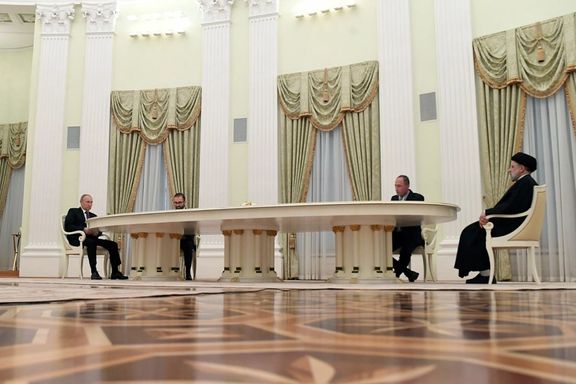
Ebrahim Raisi in his meeting with Vladimir Putin in Moscow. January 19, 2022

Vladimir Putin’s warm reception of the Argentinian president recently was in stark contrast to the way Kremlin treated Iran's president, many Iranians say.

Photos and videos emerged Thursday of Alberto Fernandez being warmly embraced by Putin, who sat very close to the Argentinian president in contrast to his greeting Raisi, a cleric, from a distance before the two men sat at opposite ends of a long table. This led to social-media comments claiming confirmation that Putin had not shown the respect due to the Iranian president.

Critics widely shared photos and videos of the two meetings alongside each other on various social media platforms on Friday and commented that they proved earlier claims that Putin had not shown due respect to the Iranian President.

Morteza Kazemian, journalist, told Iran International TV Friday that Putin’s reception of Fernandez proved that Raisi's treatment had been “out of the ordinary.” Clearly this showed the Russian president considered Raisi "a second-rate official” and "an executive officer" of Iran's Supreme Leader Ali Khamenei, Kazemian opined.

The Putin-Raisi January 21 meeting fed speculation over the table’s placement – for some as an intentional act to imply "distance" – over Putin apparently chewing gum, and over the absence of the two countries’ flags in the hall. A video released by Russian media after the visit apparently showed Raisi leaving the Kremlin without being seen off by Russian officials.

A conservative journalist, Mohammad Mohahjeri, called for Foreign Minister Hossein Amir-Abdollahian's resignation for failing to ensure that diplomatic protocols had been observed. The arrangements were "disgraceful," he said.

Various officials, government media, politicians, and Friday imams disagreed, insisting that Raisi had been respectfully received. They praised Raisi for praying in the Kremlin, a building seen for decades under Communism as the bastion of world atheism, and rejected criticism of Raisi’s government's efforts to expand relations with Russia and China in the face of continuing US ‘maximum pressure’ sanctions.

Some argued that Putin had kept a ‘social distance’ because Raisi had refused to abide by Covid protocols required by the Kremlin, including vaccination with the Russian Sputnik V vaccine and being tested before the meeting. They also said this was a "working visit" which did not require the ceremonial display of flags.

Fars news agency said the whole show, including the placement of the table, conformed with diplomatic protocols and suggested that Putin had been so impressed with the Iranian president that he fidgeted with his tie.


Most Viewed

Ideology may be fading in Iran, but not in Kashmir's ‘Mini Iran'
1
INSIGHT

Ideology may be fading in Iran, but not in Kashmir's ‘Mini Iran'

2
INSIGHT

Hardliners push Hormuz ‘red line’ as US blockade tests Iran’s leverage

3
VOICES FROM IRAN

Hope and anger in Iran as fragile ceasefire persists

4

Iran International says it won’t be silenced after London arson attack

5

US sanctions oil network tied to Iranian tycoon Shamkhani

Banner
Banner

Spotlight

  • Hardliners push Hormuz ‘red line’ as US blockade tests Iran’s leverage
    INSIGHT

    Hardliners push Hormuz ‘red line’ as US blockade tests Iran’s leverage

  • Ideology may be fading in Iran, but not in Kashmir's ‘Mini Iran'
    INSIGHT

    Ideology may be fading in Iran, but not in Kashmir's ‘Mini Iran'

  • War damage amounts to $3,000 per Iranian, with blockade set to add to losses
    INSIGHT

    War damage amounts to $3,000 per Iranian, with blockade set to add to losses

  • Why the $100 billion Hormuz toll revenue is a myth
    ANALYSIS

    Why the $100 billion Hormuz toll revenue is a myth

  • US blockade targets Iran oil boom amid regional disruption
    ANALYSIS

    US blockade targets Iran oil boom amid regional disruption

  • Iran's digital economy battered by prolonged blackout
    INSIGHT

    Iran's digital economy battered by prolonged blackout

•
•
•

More Stories

Iraqis, Afghans Helped Crush 2019 Iran Protests, London Tribunal Told

Feb 5, 2022, 17:59 GMT+0
•
Iran International Newsroom

Afghans and Iraqis were involved in curbing Iranian protests in November 2019, the 'Iran Atrocities Tribunal' was told Saturday.

‘Witness 458’ told the unofficial tribunal in London, which is meeting behind closed doors and not open to most media, that as a member of Iran’s ‘Imam Ali’ anti-riot brigades he had seen the deployment of “violent criminals” as well as members of the Iraqi Popular Mobilization Forces, and the Afghan Fatimiyoun militia.

Speaking online with a covered face, witness 458 said Imam Ali brigades had set gas stations ablaze to blame the fires on the protesters and so justify suppression, and had been authorized to shoot protesters in the torso and head to end the unrest.

Witness 458 told the tribunal he had witnessed the killing of five protesters and that members of the Basij, the state-run paramilitary group, as young as 15 had helped deal with the protests, which followed a rise in rationed fuel prices from 7 cents to 10 cents a liter.

Iraq’s Popular Mobilization Forces (Hashd al-Shaabi) consist mainly of Shia Muslims and played a leading role fighting the Islamic State group (Isis) in Iraq after 2014 in coordination with Iraqi Kurdish forces and Iran’s Revolutionary Guards (IRGC). The Fatemiyoun brigades (Liwa al-Fatimiyun) are an Afghan Shia militia funded and trained by the IRGC who have been fighting in Syria to keep Iran’s ally, Bashar al-Assad in power.

In another presentation to the tribunal, Ali Rezaei played a recording of a phone call, made he said on November 17 in Karaj, from a third party taking his brother Naser Rezaei to hospital. "He has been shot in the eye,” the speaker said. “He is unconscious.” The Rezaei family have said they do not believe they can get justice for Naser, who died, through the Iranian legal system.

Assembly and collusion

Amnesty International reported the killing of at least 304 protesters including at least 23 minors during the November 2019 protests – but its report made no reference to evidence of the involvement of Iraqi or Afghan militias. Reuters in December 2019 reported that around 1,500 civilians were killed by orders of Supreme Leader Ali Khamenei to suppress the protests.

Iran has not announced figures for deaths or arrests, nor tried anyone over killing protesters, but has prosecuted and passed heavy sentences including the death penalty on protesters on charges including “assembly and collusion.” Over 700 banks as well as gas stations and police stations were targets of violence.

Saturday was the resumption of the ‘Iran atrocities tribunal’ set up in November 2020 on the first anniversary of the protests by the London-based Justice for Iran, the Oslo-based Iran Human Rights (IHR), and the international anti-capital punishment organization Ensemble Contre la Peine de Mort (Together Against the Death Penalty).

The tribunal stated its aim as investigating “atrocities” and “human rights violations by Iran” during the protests. The tribunal has so far ‘indicted’ 160 Iranian officials, but its ‘verdicts’ will be symbolic. Iran has dismissed the tribunal, with media calling it a stunt and “puppet show” with findings decided in advance.

Iran's President Rejects Nationwide Lockdown Despite Soaring Omicron

Feb 5, 2022, 13:51 GMT+0

Despite the highly contagious Covid-19 Omicron variant spreading fast across Iran, President Ebrahim Raisi has rejected proposals for a nationwide shutdown.

Raisi made the decision during a session of the Covid-19 taskforce on Saturday while 120 cities are now considered "red zones”.

Instead, he proposed that the definition of the red zones should be changed in a way that the number of 'red' cities decreases.

Raisi said the country should not go into lockdown as was the case during the previous waves and restrictions should be regional and local.

Etekaf (from the Arabic for ‘adhering to’) ceremonies, scheduled this year for February 15-18, during which large numbers pray in mosques throughout day and night, were cancelled in the cities deemed red zones.

The government hasn’t announced restrictions on the Fajr film and theater festivals, and its plans remain in force to re-open schools and to hold gatherings during the ten-day Fajr period that ends on the anniversary of the 1979 Revolution on February 11.

This would not the first time the Islamic Republic seems to prioritize official events over the health and safety of people. There were media allegations that authorities played down the threat from Covid in early 2020 so as not to deter voting in the February 2020 parliamentary elections.

Health authorities, who have said the country is in a sixth wave of the pandemic, expect infections to rise to “up to”

US Lawmakers Urge Biden To Focus On Iran’s Ballistic Missiles

Feb 5, 2022, 13:10 GMT+0

Members of the US House of Representatives has asked President Joe Biden to focus on Iran’s ballistic-missile capabilities.

In a letter released by National Review on Friday, a group of lawmakers called for a clear strategy to counter the evolving capabilities of Iran’s long-range strikes and urged the administration to take measures against the threat.

The group, led by Representative Joe Wilson who is the chairman of the Republican Study Committee’s national-security taskforce, said the recent tests of a satellite-launch vehicle contributes to attempts to develop an intercontinental ballistic missile whose range could “potentially put US allies in Europe as well as the US homeland in range.”

They expressed concerns over the recent missile launches by Iran-backed Houthis in Yemen against the United Arab Emirates and the Iranian military launches of 16 ballistic missiles during military exercises in December and said these all overlapped with the talks to revive the nuclear deal in Vienna.

They said the Biden administration only condemns such launches “but concern and condemnations are insufficient. Action is needed”.

“The Trump administration routinely sanctioned these networks which supported Iran’s missile and military programs as well as those of its proxies, whereas your administration has been lagging in this area,” read the letter.

They demanded written answers in 30 days to questions about the capability of CENTCOM defense systems against the missile threat and the administration’s measures to enforce sanctions on sectors of Iran’s economy that support the ballistic missile program.

Groups Urge Canada Not To Issue Visas To Iranian Rights Violators

Feb 5, 2022, 10:30 GMT+0

Several human rights groups have called on Canada to stop former officers of Iran’s military (IRGC) and other human rights violators from entering the country.

In an open letter signed the human rights groups on Friday asked the prime minister not to allow Canada to become a haven for Iranian officials who are known rights violators.

The move was in reaction to a short video of a retired commander of the Tehran's Police forces and the IRGC, Morteza Talaie, working out in a gym during a visit to Canada.

The video was shared on social media last week with a caption saying the former police chief has emigrated to Canada. It drew criticism from dozens of social media users, especially after Talaie released a video from Tehran, denying the report and saying it is nobody’s business where he travels.

Expressing serious concerns, the rights groups urged the Canadian government “to take immediate action to uphold its stated commitment to human rightsand ensure that impunity at home, does not mean impunity abroad”.

“Allowing Talaei to freely enter Canada sends a dangerous message; a message that is an affront to Iranians who have themselves sought refuge in Canada”.

Talaei orchestrated widespread crackdownson protestors, mass arrests, beatings, and torture of many dissidents, and is the founder of the so-called hijab police.

EXCLUSIVE: Israel Mulling Large-Scale War Against Iranian Forces In Syria

Feb 5, 2022, 09:13 GMT+0
•
Iran International Newsroom

Israel is considering the possibility of a direct conflict with Iran’s Revolutionary Guard in Syria and its proxies in Lebanon, Iran International has learned.

Our reporters in Israel have learned from reliable sources that the Israeli military is preparing a month-long exercise to gauge its readiness to fight Iranian forces and proxies on its borders with Syria and Lebanon.

Iran maintains its Revolutionary Guard Qods (Quds) forces in Syria as well as large contingents of Afghan and other militias who have fought for a decade under Iranian command to defend Bashar al-Assad’s rule. But since at least 2017, these forces have tried to position themselves at the border with Israel to open a front, similar to Hezbollah on the Israeli-Lebanese border.

Israel has repeatedly warned in the past five years that it will not tolerate the entrenchment of Iranian forces in Syria, specially near its borders. It has launched hundreds of air raids against suspected Iranian targets, weapons depots, and arms shipments in Syria and from there to Lebanon.

Iran International has also learned that Israel is planning to hold the military drills in May to prepare for large-scale conflict and to confront possible attacks by Iranian forces in case of an Israeli strike against Tehran’s nuclear installations.

Israel has repeatedly said that the Vienna nuclear talks between Iran and the West do not provide the assurance it needs for preventing Tehran from pursuing a nuclear weapons option. It has said that it reserves the right to deal with the Iranian nuclear program through its own means, which would be a military strike to derail Iran’s uranium enrichment and other aspects of the nuclear program.

In case of such a strike, forces commanded by Iran would most probably retaliate against Israel from Syria and Lebanon. This would be a convenient option for Iran, instead of direct missile attacks against Israel that could expand the conflict into a full-fledged regional war, possible involving the United States.

Israeli officials and media have been discussing the real possibility of attacks from Syria and Lebanon in case of a strike against Iran. In such a scenario, Israelis have hinted at large-scale retaliation not only against aggressor forces but also at targets throughout Syria, including Syrian government assets.

Israel holds Assad’s government responsible for whatever takes place in territories under its control.

Although relations between Israel and the Biden Administration are as close as ties former Prime Minister Benjamin Netanyahu enjoyed with Donald Trump, but in recent weeks there have been signs of more military coordination and contacts.