• العربية
  • فارسی
Brand
  • Iran Insight
  • Politics
  • Economy
  • Analysis
  • Special Report
  • Opinion
  • Podcast
  • Iran Insight
  • Politics
  • Economy
  • Analysis
  • Special Report
  • Opinion
  • Podcast
  • Theme
  • Language
    • العربية
    • فارسی
  • Iran Insight
  • Politics
  • Economy
  • Analysis
  • Special Report
  • Opinion
  • Podcast
All rights reserved for Volant Media UK Limited
volant media logo

Russia Says Ukraine Crisis Not Linked With Iran Nuclear Talks
Iran International Newsroom
Jan 24, 2022, 09:07 GMT+0Updated: 17:41 GMT+1
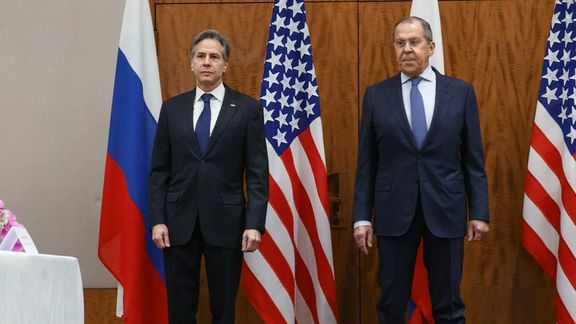
Us Secretary of State Antony Blinken meeting Russian Foreign Minister Sergei Lavrov. January 21, 2022

Russia’s envoy in Iran nuclear talks, Mikhail Ulyanov, said Monday that the Ukraine crisis had nothing to do with talks to revive the 2015 Iran nuclear deal.

Speculations about a possible US attempt to have Russia convince Iran to accept an interim agreement began three days ago when NBC News reported that Moscow, with the knowledge of the United States has proposed to Tehran a partial deal to accept curbs on its nuclear activities for limited sanctions relief.

The Vienna nuclear talks to revive the Joint Comprehensive Plan of Action, JCPOA, that started almost ten months ago have not succeeded and critics see an interim deal as a way for the Biden Administration to salvage its policy of negotiating with Iran to revive the Obama-era agreement. Former president Donald Trump withdrew from the JCPOA in 2018, arguing that it will not prevent Iran from becoming a nuclear power once its provisions expire in the coming years.

Speculations increased when on January 21 US Secretary of State Antony Blinken told the media that American-Russian cooperation in the nuclear talks was an example of how Moscow and Washington can work together on security issues. He said that in a meeting with the Russian foreign minister Sergei Lavrov he urged Moscow to use its influence with Iran to impress upon Tehran a sense of urgency to reach an agreement in Vienna.

This was seen by some observers commenting on Twitter and others in the Iranian media as a linkage with the Ukraine crisis and a sign that Russia was becoming the real mover and coordinator in the Iran nuclear talks.

“Some people in the West and Iran claim that there is a link between Iran and Ukraine in the Russian foreign policy. It has nothing in common with real life,” Ulyanov tweeted on Monday.

A day earlier, Blinken told CBS's Face the Nation that the Iran talks have no bearing on US positions regarding Russian threats to Ukraine.

However, some Republicans in Congress saw the reports about Russia proposing an interim deal and Blinken’s statement as a sign that a secret deal is being shaped with Russia on Iran and the Biden Administration is keeping lawmakers in the dark.

"Russia sent a secret agreement to Iran," Rep. Michael McCaul (R., Texas), lead Republican on the House Foreign Affairs Committee, told the Washington Free Beacon on Friday. "Russia is trying to take the lead now in the negotiations with Iran. This is a secret agreement. We haven’t seen it."

Congressional Republicans have been complaining that the Biden Administration is ignoring their requests for information on the Iran talks. More than 100 Republican wrote President Joe Biden earlier this month to end the negotiations, which have not succeeded but have provided time to Iran to advance its nuclear program.

"Reports that the Biden administration is working with the Russians on a secret nuclear agreement with Iran are doubly concerning," Rep. Mike Gallagher (R., Wis.), a member of the House Armed Services Committee told the Free Beacon.

"First, they create a conflict of interest with Russia as we are trying to prevent an invasion of Ukraine. Second, preemptive sanctions relief, and failure to transmit an interim agreement to Congress, would violate the Iran Nuclear Agreement Review Act. The administration needs to end their simultaneous surrender to Russia and Iran before it's too late," Rep. Elise Stefanik (R., N.Y.), chair of the House Republican Conference was quoted as saying.


Most Viewed

Ideology may be fading in Iran, but not in Kashmir's ‘Mini Iran'
1
INSIGHT

Ideology may be fading in Iran, but not in Kashmir's ‘Mini Iran'

2
INSIGHT

Hardliners push Hormuz ‘red line’ as US blockade tests Iran’s leverage

3
VOICES FROM IRAN

Hope and anger in Iran as fragile ceasefire persists

4

US sanctions oil network tied to Iranian tycoon Shamkhani

5

Iran International says it won’t be silenced after London arson attack

Banner
Banner

Spotlight

  • Hardliners push Hormuz ‘red line’ as US blockade tests Iran’s leverage
    INSIGHT

    Hardliners push Hormuz ‘red line’ as US blockade tests Iran’s leverage

  • Ideology may be fading in Iran, but not in Kashmir's ‘Mini Iran'
    INSIGHT

    Ideology may be fading in Iran, but not in Kashmir's ‘Mini Iran'

  • War damage amounts to $3,000 per Iranian, with blockade set to add to losses
    INSIGHT

    War damage amounts to $3,000 per Iranian, with blockade set to add to losses

  • Why the $100 billion Hormuz toll revenue is a myth
    ANALYSIS

    Why the $100 billion Hormuz toll revenue is a myth

  • US blockade targets Iran oil boom amid regional disruption
    ANALYSIS

    US blockade targets Iran oil boom amid regional disruption

  • Iran's digital economy battered by prolonged blackout
    INSIGHT

    Iran's digital economy battered by prolonged blackout

•
•
•

More Stories

Officials Say Iran In Strong Position In Nuclear Talks, No Interim Deal

Jan 23, 2022, 21:53 GMT+0
•
Iran International Newsroom

Iran's ambassador To Moscow, Kazem Jalali has refuted reports that Russia has suggested Iran should accept an interim nuclear agreement with the United States.

Jalali said that Russia has not put forward the idea of accepting an interim agreement during President Ebrahim Raisi's visit to Moscow last week. He added that reports about such a suggestion were lies, and therefore wrong.

He accused the media of knowing nothing about the content of the talks between the two presidents.

Reports have suggested that Russia has suggested to Iran to accept an interim agreement that would freeze its nuclear activities in return for partial sanctions relief by the United States.

According to the semi-official news agency ISNA, Jalali added that both Russia and Iran disagree with American unilateralism, and this is what has brought Iran closer to Russia. He said Iran has resisted the West's unilateralism during the past 43 years and has paid a high price for that.

At the same time, the spokesman for the Iranian parliament's national Security and Foreign Policy Committee, Mahmoud Abbaszadeh Meshkini said in an interview with Khabar Online website in Tehran on Sunday, that a nuclear agreement in Vienna is within reach and Iran and the United States will reach a deal before the Iranian New Year which starts on March 20.

Meshkini said "Iran has some golden cards to put on the table in Vienna," insisting that Iran has defeated the US sanctions and has solid ties with Russia and China. He added: "Although the United States wishes to impose a bad agreement on us, we believe a win-win nuclear agreement is within reach in Vienna."

Meshkini added that Iran's situation in the negotiations is "very good," adding that "Iran is in control of the negotiations and has the upper hand in the talks and its negotiators enjoy strong backing."

"The United States should accept the Islamic Republic as a reality and should know that Iran will not accept a bad agreement, "Meshkini said, adding that "an agreement will be made before March 20 although it is not important when we are going to reach that agreement. What is significant is that we reach a good agreement. " Meanwhile he reassured Khabar Online that "We have good initiatives and will manage the negotiations."

He argued that following the December 2020 legislation that called for boosting uranium enrichment and reducing Iran's commitments under the 2015 nuclear agreement, Iran regained freedom of action over stockpiling enriched uranium and the type and number of centrifuges. In the meantime, the coming to power of a new hardliner "revolutionary" government in Tehran as well as Tehran's alliance with the East, offered some golden cards to Iran to put on the negotiating table.

Meshkini continued with a certain optimism that: "The sanctions were the West's most powerful and dangerous tool. But we circumvented them by forging an alliance with the East. Iran, Russia and China are the three pillars of the Eastern bloc which is becoming more and more powerful on a daily basis." He added that Iran's agreement with China includes more than $500 billion in Chinese investments in Iran's strategic industries.

Iran's ambassador in Moscow had also said in his interview that the West is annoyed by the alliance between Iran, Russia and China, calling Iran "an influential regional power."

South Korea Again Pays Iran's UN Dues From Frozen Funds

Jan 23, 2022, 08:35 GMT+0
•
Iran International Newsroom

South Korea has paid part of Iran’s delinquent dues to the United Nations from funds frozen at its banks because of American sanctions, Seoul announced Sunday.

Seoul "on Friday completed the payment of Iran's UN dues of about $18 million through the Iranian frozen funds in South Korea, in active cooperation with related agencies such as US Treasury's Office of Foreign Assets Control and the United Nations Secretariat," the finance ministry said in a statement.

This was the second time South Korea, with approval of the United States has paid Iran’s debts to the UN. A similar payment was made last June but Tehran lost its right to vote once again according to membership rules demanding a minimum amount of arrears to be paid.

Questions were raised in the first week of January when South Korean Vice Foreign Minister Choi Jong-Kun visited Vienna where Iran and world powers are negotiating over the revival of the 2015 nuclear deal. The Korean diplomat met all sides and observers expected that Seoul was negotiating to find an acceptable process to begin releasing around $7 billion it holds as frozen Iranian funds.

The case might still prove to be a much wider deal with Seoul than to just pay the UN dues, but at this stage there appears to be very limited progress in the talks for the US to agree to the release of a larger amount.

Tehran is demanding that South Korea must release all the money regardless of the outcome of the Vienna negotiations. Iran’s chief negotiator Ali Bagheri-Kani met the Korean diplomat in Vienna on January 5 and demanded the unconditional release of the funds, but Washington said it would waive third-party banking sanctions for South Korea only with “everything” agreed. Meaning a final deal on the nuclear issue.

Nevertheless, many critics say that the Biden Administration is too eager to accommodate Iran’s demands as it has already reduced sanctions’ pressure on Tehran. Richard Nephew, a key member of the US negotiating team and an expert on sanctions reportedly was in disagreement with US chief negotiator Robert Malley and left the negotiations for another job at the state department.

The news about the payment of the UN dues by US agreement came just two days after Iran was the only country to reject a General Assembly vote approving a definition of the Holocaust. Critics were quick to highlight the point, saying Tehran deserves no good-faith gestures.

The funds held by two Seoul banks are Iran’s proceeds from oil exports before the Trump administration imposed sanctions on Iran after it withdrew from the 2015 Joint Comprehensive Plan of Action (JCPOA) in May 2018.

Negotiations in Vienna are progressing far too slowly according to the Biden Administration and US allies, the United Kingdom, France and Germany who are participants in the JCPOA talks as signatories of the agreement in 2015. They have told Iran it has weeks, not months, to close a deal. The reason is Iran’s high-level enrichment of uranium in violation of the JCPOA that bring it ever closer to amount of fissile material it would need to make a nuclear bomb.

Key US Sanctions Expert Leaves Negotiating Team In Vienna

Jan 22, 2022, 10:52 GMT+0

Richard Nephew, who is known as the architect of Washington’s sanctions on Iran, has left the US negotiating team in Vienna over differences with chief US negotiator Robert Malley.

According to NBC News on Saturday, Nephew and Malley had a disagreement over the direction of the negotiations to revive the 2015 nuclear deal between Iran and world powers.

The report cited two people familiar with the matter as the source of the news but did not elaborate on the disagreement.

“Richard Nephew made important contributions to the team, where he served for nearly a year. He remains with the Department of State”, a State Department official said in a statement.

Back in March 2021, when Nephew was appointed as Malley’s deputy, some Iranian officials described it as proof of the Biden administration's “maliciousness.”

Iranian lawmaker Ahmad Naderi had said appointing the “architect of the oppressive sanctions” show that “Americans' hatred of Iran is not limited to Republicans or Democrats".

Iranian newspaper Vatan-e Emrooz had covered the news on its front page, depicting Nephew as Keanu Reeves from the movie The Devil's Advocate, with Biden replacing Al Pacino, who played the Devil.

Nephew, who is a non-resident Senior Fellow at the Brookings Institution, published a book about the sanctions in 2017, titled The Art of Sanctions: A View from the Field.

Russia Discussed An Interim Nuclear Deal With Iran, US Officials Say

Jan 22, 2022, 10:42 GMT+0
•
Maryam Sinaiee

Iran has rejected a Russia-proposed ‘interim’ deal that would have given limited sanctions relief in return for some nuclear curbs, US officials have told NBC News.

According to NBC, several United States officials including a Congressional official, a former official and four other people familiar with the Iran nuclear case said Washington was aware of Moscow’s suggestion to Tehran.

An interim deal would been a partial step towards restoring the 2015 agreement, the JCPOA (Joint Comprehensive Plan of Action), which imposed strict curbs on the Iranian nuclear program and which the US left in 2018.

One person familiar with the Russian proposal described it as “an interim step towards a full return to compliance” with the JCPOA: “It’s not a substitute…it’s not a new agreement. It’s an understanding to go part of the way there.”

A statement from Iran's Permanent Mission to the United Nations Friday appeared to rule out such a step. “Iran seeks a reliable but also durable agreement that is consistent with the promises [over lifting sanctions] made in the JCPOA, and any agreement that does not meet these two criteria is not on the agenda for us,” it read. The statement reiterated Tehran’s refusal talk directly with Washington until the US returned to the JCPOA.

NBC's sources said Russia had discussed a draft with Tehran in recent weeks under which Iran would stop uranium enrichment to 60 percent, which it began last year, and dispose of its stockpile of highly enriched uranium. In return, the US would ‘allow’ Iran access to assets frozen in South Korea, Japan, and Iraq by third parties wary of US punitive action under Washington’s ‘maximum pressure’ sanctions targeting Iran’s oil sales and financial sector.

Russia has played an active role in the Vienna talks since they resumed November, with its representative Mikhail Ulyanov regularly reporting meetings with the US special representative for Iran, Robert Malley. Russian president Vladimir Putin told reporters Wednesday, before a three-hour meeting with Iranian president Ebrahim Raisi (Raeesi) in Moscow, that he was eager to hear Raisi’s take on the Vienna talks.

Extracting leverage

But a senior official in the administration of US President Joe Biden told NBC that an interim “arrangement” was not under serious discussion. Some US lawmakers have expressed concern at the possibility that this would not return the Iran nuclear program to JCPOA limits.

More than 100 Republican members of Congress wrote recently to Biden urging him to withdraw from any negotiations over the JCPOA. Opponents of the JCPOA have also suggested that any settlement other than the 2015 agreement should be reviewed by Congress.

Some principlists in Tehran, who generally opposed the JCPOA, also reject any notion of interim arrangements and argue that Iran can extract leverage from its uranium stockpiles and use of more advanced centrifuges barred by the JCPOA.

The idea of an interim agreement came first from a European state, a source told Axios in November, with the idea focused on releasing Iranian money frozen in Asia. The Iranian Students News Agency (ISNA) in a report November 13 said Iran's assets frozen abroad totaled $50 billion, including $8 billion in South Korea, $3 billion in Japan, and $6 billion in Iraq.

Blinken Tells Lavrov He Sees Only Brief Window To Reach Deal With Iran

Jan 21, 2022, 15:12 GMT+0

US Secretary of State Antony Blinken said Friday he discussed Iran with his Russian counterpart, warning there was only a brief window to succeed in Vienna talks.

Blinken told reporters the 2015 nuclear deal (JCPOA) was an example of how Moscow and Washington can work together on security issues, urging Russia to use the influence it has and its relationship with Iran to impress upon Tehran the sense of urgency.

Blinken said there was still a window to return to the deal - which has unraveled since 2018 when then-US President Donald Trump abandoned it - but warned that Tehran's continuing nuclear advances would foil any return to the accord if a fresh pact was not reached in coming weeks.

"The talks with Iran about a mutual return to compliance with the JCPOA (2015 deal) have reached a decisive moment," Blinken said.

"If a deal is not reached in the next few weeks, Iran's ongoing nuclear advances will make it impossible to return to the JCPOA. But right now, there's still a window, a brief one, to bring those talks to a successful conclusion and address the remaining concerns of all sides."

The US and its European allies said on Thursday it was now just a matter of weeks to salvage the deal after the latest round of talks in which a French diplomatic source said there had been no progress on the core issues.

Report by Reuters