• العربية
  • فارسی
Brand
  • Iran Insight
  • Politics
  • Economy
  • Analysis
  • Special Report
  • Opinion
  • Podcast
  • Iran Insight
  • Politics
  • Economy
  • Analysis
  • Special Report
  • Opinion
  • Podcast
  • Theme
  • Language
    • العربية
    • فارسی
  • Iran Insight
  • Politics
  • Economy
  • Analysis
  • Special Report
  • Opinion
  • Podcast
All rights reserved for Volant Media UK Limited
volant media logo

South Korea Again Pays Iran's UN Dues From Frozen Funds
Iran International Newsroom
Jan 23, 2022, 08:35 GMT+0Updated: 17:36 GMT+1
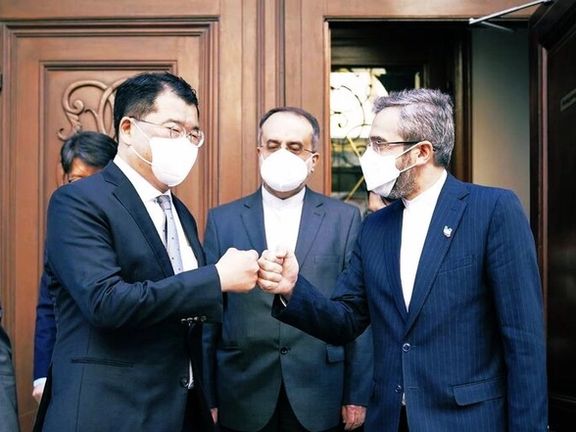
Iran's envoy in nuclear talks Ali Bagheri-Kani met with Korean Vice Foreign Minister Choi Jong-Kun on January 5, 2022

South Korea has paid part of Iran’s delinquent dues to the United Nations from funds frozen at its banks because of American sanctions, Seoul announced Sunday.

Seoul "on Friday completed the payment of Iran's UN dues of about $18 million through the Iranian frozen funds in South Korea, in active cooperation with related agencies such as US Treasury's Office of Foreign Assets Control and the United Nations Secretariat," the finance ministry said in a statement.

This was the second time South Korea, with approval of the United States has paid Iran’s debts to the UN. A similar payment was made last June but Tehran lost its right to vote once again according to membership rules demanding a minimum amount of arrears to be paid.

Questions were raised in the first week of January when South Korean Vice Foreign Minister Choi Jong-Kun visited Vienna where Iran and world powers are negotiating over the revival of the 2015 nuclear deal. The Korean diplomat met all sides and observers expected that Seoul was negotiating to find an acceptable process to begin releasing around $7 billion it holds as frozen Iranian funds.

The case might still prove to be a much wider deal with Seoul than to just pay the UN dues, but at this stage there appears to be very limited progress in the talks for the US to agree to the release of a larger amount.

Tehran is demanding that South Korea must release all the money regardless of the outcome of the Vienna negotiations. Iran’s chief negotiator Ali Bagheri-Kani met the Korean diplomat in Vienna on January 5 and demanded the unconditional release of the funds, but Washington said it would waive third-party banking sanctions for South Korea only with “everything” agreed. Meaning a final deal on the nuclear issue.

Nevertheless, many critics say that the Biden Administration is too eager to accommodate Iran’s demands as it has already reduced sanctions’ pressure on Tehran. Richard Nephew, a key member of the US negotiating team and an expert on sanctions reportedly was in disagreement with US chief negotiator Robert Malley and left the negotiations for another job at the state department.

The news about the payment of the UN dues by US agreement came just two days after Iran was the only country to reject a General Assembly vote approving a definition of the Holocaust. Critics were quick to highlight the point, saying Tehran deserves no good-faith gestures.

The funds held by two Seoul banks are Iran’s proceeds from oil exports before the Trump administration imposed sanctions on Iran after it withdrew from the 2015 Joint Comprehensive Plan of Action (JCPOA) in May 2018.

Negotiations in Vienna are progressing far too slowly according to the Biden Administration and US allies, the United Kingdom, France and Germany who are participants in the JCPOA talks as signatories of the agreement in 2015. They have told Iran it has weeks, not months, to close a deal. The reason is Iran’s high-level enrichment of uranium in violation of the JCPOA that bring it ever closer to amount of fissile material it would need to make a nuclear bomb.


Most Viewed

Ghalibaf defends Iran-US talks amid hardline backlash
1
INSIGHT

Ghalibaf defends Iran-US talks amid hardline backlash

2
VOICES FROM IRAN

Bread shortages, soaring prices strain households in Iran, residents say

3
ANALYSIS

From instability to influence: Pakistan’s pivotal role in US-Iran diplomacy

4
ANALYSIS

100 days on: why Iran’s January protests spread across social classes

5

War-hit homeowners feel abandoned as Iran’s reconstruction aid fades

Banner
Banner

Spotlight

  • Is Iran entering its Gorbachev moment?
    INSIGHT

    Is Iran entering its Gorbachev moment?

  • Iran crackdown reaches cemeteries as graves of slain protesters defaced
    EXCLUSIVE

    Iran crackdown reaches cemeteries as graves of slain protesters defaced

  • Iran diplomacy wobbles as factions compete to avoid looking soft on US
    INSIGHT

    Iran diplomacy wobbles as factions compete to avoid looking soft on US

  • The politics of pink: how Iran uses cuteness to rebrand violence
    ANALYSIS

    The politics of pink: how Iran uses cuteness to rebrand violence

  • Bread shortages, soaring prices strain households in Iran, residents say
    VOICES FROM IRAN

    Bread shortages, soaring prices strain households in Iran, residents say

  • Ghalibaf defends Iran-US talks amid hardline backlash
    INSIGHT

    Ghalibaf defends Iran-US talks amid hardline backlash

•
•
•

More Stories

US Firm Withdraws Safety Cover Of 2 Tankers For Shipping Iran’s Oil

Jan 22, 2022, 17:07 GMT+0

A US safety firm has cancelled environmental and safety classification of two tankers following accusations that they had shipped cargoes of Iranian oil.

Reuters reported that the American Bureau of Shipping (ABS), the classification company that provides certifications services such as checking that ships are seaworthy, withdrew cover for the two tankers in the past month.

Without the certification -- the so-called class cover that includes vessel safety inspections -- vessels are unable to secure insurance cover or call at most international ports.

Advocacy group United Against Nuclear Iran (UANI) that tracks Iran-related tanker traffic through ship and satellite data, informed the American Bureau of Shipping about the breach of US sanctions in December.

According to correspondence between the UANI and ABS seen by Reuters, several vessels were involved in the transfers of Iranian oil, including the Panama-flagged Karo owned by Hong Kong-based Delta Lines and the Belize-flagged Elsa owned by India-based Karo Shipping Services.

The ABS, the only US firm among the top 12 ship classification societies that are mainly based in Europe and Asia, withdrew the cover for Elsa on December 17 and the Karo on January 13 because of their illicit transshipment operations with Iranian tankers.

"Classification societies are faced with the challenge of keeping up with Iran's tactics in order to avoid facing sanctions themselves," said UANI Claire Jungm

Key US Sanctions Expert Leaves Negotiating Team In Vienna

Jan 22, 2022, 10:52 GMT+0

Richard Nephew, who is known as the architect of Washington’s sanctions on Iran, has left the US negotiating team in Vienna over differences with chief US negotiator Robert Malley.

According to NBC News on Saturday, Nephew and Malley had a disagreement over the direction of the negotiations to revive the 2015 nuclear deal between Iran and world powers.

The report cited two people familiar with the matter as the source of the news but did not elaborate on the disagreement.

“Richard Nephew made important contributions to the team, where he served for nearly a year. He remains with the Department of State”, a State Department official said in a statement.

Back in March 2021, when Nephew was appointed as Malley’s deputy, some Iranian officials described it as proof of the Biden administration's “maliciousness.”

Iranian lawmaker Ahmad Naderi had said appointing the “architect of the oppressive sanctions” show that “Americans' hatred of Iran is not limited to Republicans or Democrats".

Iranian newspaper Vatan-e Emrooz had covered the news on its front page, depicting Nephew as Keanu Reeves from the movie The Devil's Advocate, with Biden replacing Al Pacino, who played the Devil.

Nephew, who is a non-resident Senior Fellow at the Brookings Institution, published a book about the sanctions in 2017, titled The Art of Sanctions: A View from the Field.

Russia Discussed An Interim Nuclear Deal With Iran, US Officials Say

Jan 22, 2022, 10:42 GMT+0
•
Maryam Sinaiee

Iran has rejected a Russia-proposed ‘interim’ deal that would have given limited sanctions relief in return for some nuclear curbs, US officials have told NBC News.

According to NBC, several United States officials including a Congressional official, a former official and four other people familiar with the Iran nuclear case said Washington was aware of Moscow’s suggestion to Tehran.

An interim deal would been a partial step towards restoring the 2015 agreement, the JCPOA (Joint Comprehensive Plan of Action), which imposed strict curbs on the Iranian nuclear program and which the US left in 2018.

One person familiar with the Russian proposal described it as “an interim step towards a full return to compliance” with the JCPOA: “It’s not a substitute…it’s not a new agreement. It’s an understanding to go part of the way there.”

A statement from Iran's Permanent Mission to the United Nations Friday appeared to rule out such a step. “Iran seeks a reliable but also durable agreement that is consistent with the promises [over lifting sanctions] made in the JCPOA, and any agreement that does not meet these two criteria is not on the agenda for us,” it read. The statement reiterated Tehran’s refusal talk directly with Washington until the US returned to the JCPOA.

NBC's sources said Russia had discussed a draft with Tehran in recent weeks under which Iran would stop uranium enrichment to 60 percent, which it began last year, and dispose of its stockpile of highly enriched uranium. In return, the US would ‘allow’ Iran access to assets frozen in South Korea, Japan, and Iraq by third parties wary of US punitive action under Washington’s ‘maximum pressure’ sanctions targeting Iran’s oil sales and financial sector.

Russia has played an active role in the Vienna talks since they resumed November, with its representative Mikhail Ulyanov regularly reporting meetings with the US special representative for Iran, Robert Malley. Russian president Vladimir Putin told reporters Wednesday, before a three-hour meeting with Iranian president Ebrahim Raisi (Raeesi) in Moscow, that he was eager to hear Raisi’s take on the Vienna talks.

Extracting leverage

But a senior official in the administration of US President Joe Biden told NBC that an interim “arrangement” was not under serious discussion. Some US lawmakers have expressed concern at the possibility that this would not return the Iran nuclear program to JCPOA limits.

More than 100 Republican members of Congress wrote recently to Biden urging him to withdraw from any negotiations over the JCPOA. Opponents of the JCPOA have also suggested that any settlement other than the 2015 agreement should be reviewed by Congress.

Some principlists in Tehran, who generally opposed the JCPOA, also reject any notion of interim arrangements and argue that Iran can extract leverage from its uranium stockpiles and use of more advanced centrifuges barred by the JCPOA.

The idea of an interim agreement came first from a European state, a source told Axios in November, with the idea focused on releasing Iranian money frozen in Asia. The Iranian Students News Agency (ISNA) in a report November 13 said Iran's assets frozen abroad totaled $50 billion, including $8 billion in South Korea, $3 billion in Japan, and $6 billion in Iraq.

Blinken Tells Lavrov He Sees Only Brief Window To Reach Deal With Iran

Jan 21, 2022, 15:12 GMT+0

US Secretary of State Antony Blinken said Friday he discussed Iran with his Russian counterpart, warning there was only a brief window to succeed in Vienna talks.

Blinken told reporters the 2015 nuclear deal (JCPOA) was an example of how Moscow and Washington can work together on security issues, urging Russia to use the influence it has and its relationship with Iran to impress upon Tehran the sense of urgency.

Blinken said there was still a window to return to the deal - which has unraveled since 2018 when then-US President Donald Trump abandoned it - but warned that Tehran's continuing nuclear advances would foil any return to the accord if a fresh pact was not reached in coming weeks.

"The talks with Iran about a mutual return to compliance with the JCPOA (2015 deal) have reached a decisive moment," Blinken said.

"If a deal is not reached in the next few weeks, Iran's ongoing nuclear advances will make it impossible to return to the JCPOA. But right now, there's still a window, a brief one, to bring those talks to a successful conclusion and address the remaining concerns of all sides."

The US and its European allies said on Thursday it was now just a matter of weeks to salvage the deal after the latest round of talks in which a French diplomatic source said there had been no progress on the core issues.

Report by Reuters

US, European Allies Say Progress In Iran Talks Too Slow

Jan 20, 2022, 18:38 GMT+0

US Secretary of State Antony Blinken says nuclear talks with Iran are at a decisive moment but there is not much time left until Washington and its allies change tactics.

Blinken made the remarks in Berlin on Thursday after meeting senior diplomats from Germany, France, and Britain, stating that modest progress has been made during the ongoing round of talks in Vienna to revive the 2015 nuclear accord.

Blinken said, “We are indeed at a decisive moment, but we are not where we need to be. And if we don’t get there very soon, we will have to take a different course”.

"My own assessment, talking to all of our colleagues, is that returning to mutual compliance remains possible," he added, warning that "There is real urgency and it's really now a matter of weeks, where we determine whether or not we can return to mutual compliance with the agreement."

The United States has been warning since early December that time is running out and only weeks remain to reach a point where the JCPOA agreement would lose its utility as a non-proliferation instrument.

German Foreign Minister Annalena Baerbock echoed Blinken’s comments, saying, “Our objective is to maintain and to preserve the agreement and above all, to make Iran see sense and to ensure that Iran can no further increase its enrichment capacity”.

She underlined that “the window for finding a solution is closing. The negotiations are in a decisive phase. We need urgent, urgent progress, otherwise we will not be successful in reaching a joint accord."

Referring to Iran’s enrichment of uranium at 60-percent purity, Baerbock said that "there is no plausible explanation for this and Iran is not providing a plausible explanation for this".

French Foreign Minister Jean-Yves Le Drian reiterated complaints about the "partial, timid and slow" progress in talks, saying that "the negotiations cannot go on so slowly".

President Joe Biden on Wednesday dismissed abandoning the talks and insisted there is some progress. “It’s not time to give up. There is some progress being made. The P5+1 is on the same page. But it remains to be seen,” he said.

Iran continues to enrich uranium at 60-percent purity and most analysts agree that it is shortening the time to having enough fissile material for a nuclear bomb. The US and its European allies have warned that with the kind of progress Iran is making, the Vienna talks can become meaningless if they drag on.