• العربية
  • فارسی
Brand
  • Iran Insight
  • Politics
  • Economy
  • Analysis
  • Special Report
  • Opinion
  • Podcast
  • Iran Insight
  • Politics
  • Economy
  • Analysis
  • Special Report
  • Opinion
  • Podcast
  • Theme
  • Language
    • العربية
    • فارسی
  • Iran Insight
  • Politics
  • Economy
  • Analysis
  • Special Report
  • Opinion
  • Podcast
All rights reserved for Volant Media UK Limited
volant media logo

‘US At Its Weakest Point’, Iran’s President Tells Russian Duma

Maryam Sinaiee
Maryam Sinaiee

Iran International

Jan 20, 2022, 15:01 GMT+0Updated: 17:22 GMT+1
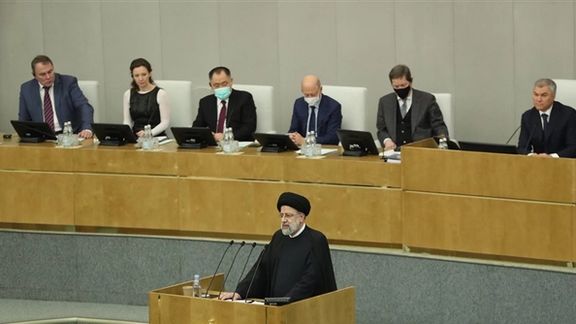
Ebrahim Raisi speaking at the Russian Duma on Thursday.

Iran’s president told the Russian Duma that the “resistance” of nations such as Iran and Russia has weakened the US and put its “strategy of domination” in disarray.

“The strategy of domination has now failed, and the America is in its weakest position,”President Ebrahim Raisi who is on an official visit to Moscow told the representatives of the Russian state Duma while emphasizing that "the desires for domination" persists and new forms of domination are on the agenda.

"The most important goal of this agenda is to weaken independent governments from within, which is pursued through economic sanctions, destabilization, the promotion of insecurity, and false narratives of events; in such a way that they try to change the place of the oppressor and the oppressed in public opinion," Raisi said.

The Iranian President also said the single "concept of resistance" brought about "failure of the policy of military occupation" and forced the US to flee Iraq and Afghanistan.

US forces are still in Iraq with a new mission of training Iraqi forces, instead of combat against the Islamic State group.

Raisi, who held a three-hour meeting with the Russian President Vladimir Putin on Wednesday, in his address to the Duma accused Western powers of forging complex plans "to send Takfiri terrorists on new missions" from the Caucasus to Central Asia.

Iranian officials use 'takfiri' to refer to Sunni fundamentalism and as a vague umbrella term to refer to Sunni dissident groups and individuals inside Iran. "Experience has shown that it is pure Islamic thought that can prevent the formation of extremism and Takfiri terrorism," Raisi said.

In a clear show of support to Russia, he also alleged that the North Atlantic Treaty Organization (NATO) is also trying to infiltrate various geographical areas under new guises. "Promoting pro-Western governments and confronting independent democracies based on national identities and traditions is part of NATO's cultural projects that reflect the hypocrisy of this diminishing pattern of behavior."

Calling sanctions "a common form of new domination", he said countering them requires a collective response from “independent nations”.

The US has threatened Russia with more sanctions if it attacks Ukraine amid a serious crisis triggered by large Russian troop concentrations on the Ukrainian border.

On the nuclear issue and the ongoing Vienna talks to restore the 2015 nuclear deal, Raisi said the Islamic Republic will never relinquish its rights but reiterated that Tehran is serious about reaching an agreement, "if the other parties are serious about lifting the sanctions effectively and operationally."

Russia is a signatory to the deal, the Joint Comprehensive Plan of Action (JCPOA) and in recent weeks has played a proactive role in the Vienna talks as a mediator between Iran and the United States which is only indirectly involved in the talks.

Calling the model of cooperation between Tehran and Moscow in Syria successful, Raisi said resistance of the Syrian people and government this has ensured the consolidation of regional security. The Iranian and Russian military interventions in Syria has killed tens of thousands of civilians.

Referring to economic relations between Tehran and Moscow, Raisi said boosting ties will strengthen the economies of both nations and regional and international security. The signing of a 20-year agreement during his Moscow trip has not materialized.

The annual volume of trade between the countries currently stands at around $3 billion. Tehran says it intends to increase it to $25 billion.

Most Viewed

US blockade enters murky phase as tankers spoof signals and buyers hesitate
1
ANALYSIS

US blockade enters murky phase as tankers spoof signals and buyers hesitate

2

US tightens financial squeeze on Iran, warns banks over oil money flows

3
INSIGHT

Ideology may be fading in Iran, but not in Kashmir's ‘Mini Iran'

4
INSIGHT

Hardliners push Hormuz ‘red line’ as US blockade tests Iran’s leverage

5
VOICES FROM IRAN

Hope and anger in Iran as fragile ceasefire persists

Banner
Banner

Spotlight

  • Hardliners push Hormuz ‘red line’ as US blockade tests Iran’s leverage
    INSIGHT

    Hardliners push Hormuz ‘red line’ as US blockade tests Iran’s leverage

  • Ideology may be fading in Iran, but not in Kashmir's ‘Mini Iran'
    INSIGHT

    Ideology may be fading in Iran, but not in Kashmir's ‘Mini Iran'

  • War damage amounts to $3,000 per Iranian, with blockade set to add to losses
    INSIGHT

    War damage amounts to $3,000 per Iranian, with blockade set to add to losses

  • Why the $100 billion Hormuz toll revenue is a myth
    ANALYSIS

    Why the $100 billion Hormuz toll revenue is a myth

  • US blockade targets Iran oil boom amid regional disruption
    ANALYSIS

    US blockade targets Iran oil boom amid regional disruption

  • Iran's digital economy battered by prolonged blackout
    INSIGHT

    Iran's digital economy battered by prolonged blackout

•
•
•

More Stories

Iran Says ‘Important’ Deals Signed During Raisi’s Visit To Russia

Jan 20, 2022, 14:31 GMT+0

Iran's finance minister says Tehran and Moscow have signed several “important” economic agreements during President Ebrahim Raisi’s visit to Russia.

Ehsan Khanduzi said on Thursday that the two countries have agreed to expedite the implementation of a $5-billion credit line, which was announced a few years ago.

He added that among the projects to be financed through the credit line is completing the construction of railroads, including the International North–South Transport Corridor, parts of which pass through Iran. He also said some 200 locomotives will also be bought from Russia.

Iran's Oil Minister Javad Owji said on Thursday that the two countries agreed on several projects in the energy sector, without providing any details.

Behrouz Kamalvandi, the spokesman of the Atomic Energy Organization of Iran, said that Tehran and Moscow are in talks over the construction of new units at the Bushehr nuclear power plant as part of their efforts to boost cooperation in nuclear technology.

Earlier on Wednesday, Raisi presented the draft of a proposed 20-year cooperation agreement to President Vladimir Putin, to update a 2001 version. Iranian officials had for months said preparations for the agreement were finalized and it would be signed soon when the two presidents met, but last week they said more preparations were required.

Foreign Minister Hossein Amir-Abdollahian said on Wednesday that the two presidents have tasked their respective foreign ministries with preparing the 20-year roadmap.

UAE Says Missiles, Drones Used In Houthi Attack, Some Intercepted

Jan 20, 2022, 11:35 GMT+0

Cruise and ballistic missiles were used alongside drones in Monday's attack on the United Arab Emirates, and several weapons were intercepted, the UAE ambassador to the United States said.

It was the first time the UAE, which rarely discusses its security in public, had said missiles were used in the attack which killed three civilians in Abu Dhabi, and the first time it has claimed to have intercepted some of the weapons.

Yemen's Iran-backed Houthi group siad it carried out the attack with five ballistic missiles and several drones.

"Several attacks - a combination of cruise missiles, ballistic missiles and drones - targeted civilian sites in the UAE. Several were intercepted," UAE Ambassador Yousef Al Otaiba told an online panel hosted by the Jewish Institute for National Security of America (JINSA).

Many analysts and UN experts belive Iran is supplying the Houthis with the sophisticated weapons. Yemen is not known for having the technological capabilities needed to develop and manufacture missiles and drones.

In response to the attacks, US President Joe Biden said on Wednesday his administration was considering re-designating the Houthis a terrorist organization. The Biden administration lifted that designation last February; the UAE has called for it to be restored.

The UAE had "long left the Yemen war," Otaiba said. "Attacking a country that is not in combat makes a very clear case" to reinstate the Houthi terrorist designation.

With reporting by Reuters

Iran Seeks To Use Money Frozen In South Korea To Pay UN Dues

Jan 20, 2022, 11:01 GMT+0

Iran and South Korea are discussing ways to use funds blocked in Seoul due to the US sanctions to settle Tehran’s overdue membership fees to the United Nations.

According to South Korean government sources on Thursday, Tehran and Seoul seek to capitalize on the assets to handle the issue of the UN dues, which have deprived Iran of its voting rights.

"Our government is in consultations with the Iranian government in that regard and is in related consultations with the US and the UN as well," sources told Yonhap News Agency on condition of anonymity.

After the Islamic Republic lost the right to vote at the UN, Foreign Ministry Spokesman Saeed Khatibzadeh said Tehran is trying to find a secure channelto pay its membership fee and end its suspension.

According to the UN charter, a member loses the right to vote when its debts equal or exceed the amount of dues it should have paid over the previous two years.

Last year, Iran managed to pay $16 million of its $65 million arrears to recover its vote after Tehran was granted an exemption from the sanctions and was allowed to access money blocked by the US Treasury. This time the minimum amount Iran must pay is over $18 million.

Two South Korea banks hold $7-9 billion of Iranian money, owed for oil imports.

British Parliament Weighs Proscription Of Iran’s Revolutionary Guards

Jan 20, 2022, 10:17 GMT+0
•
Iran International Newsroom

A debate in the British House of Lords Wednesday highlighted pressure for the United Kingdom proscribing Iran’s Revolutionary Guards (IRGC) as a terrorist group.

In response to a question from Lord Polak, chairman of the Conservative Friends of Israel, government whip and spokesman Lord Sharpe said the matter was “under review.”

Lord Polak argued that the UK should “fully proscribe” the Guards, citing an article in the London Times. He argued the UK had “failed to hold the IRGC to account” for its activities, including the shooting down of a Ukrainian airliner over Tehran in January 2020 and an attack on the tanker MV Mercer Street in July 2021, in which a British citizen died, and which London and Washington attributed to Iran.

Several other member of the Lords joined the discussion demanding action against IRGC or asking questions about the progress in nuclear talks with Iran.

The discussion in the Lords followed Monday’s attack, attributed to Yemen’s Ansar Allah, or Houthis, on an oil facility and airport in Abu Dhabi, in which three died. Allied to Saudi Arabia, the United Arab Emirates has been involved in the Yemen war since 2015, while Iran has lent support and training to the Houthis. Proof of Iranian involvement in the attack could undermine the current thaw in Iran-UAE relations.

Lord Sharpe told the Lords, the UK’s upper parliamentary chamber, that the UK had already imposed 200 sanctions against Iran, including on the IRGC. Those calling for proscription argue it would tighten measures against the Guards, with designation under UK law makingeven the expression of support for such a group a criminal offense.

Lord Sharpe criticized the IRGC’s role in supporting Iran’s allies and proxies around the region, including the Houthis, Hezbollah in Lebanon, and Iraqi Shiite militia groups. “The UK strongly condemns the Houthi-based claimed attacks on the UAE,” Lord Sharpe said. “We are in contact with our Emirati partners and have offered UK solidarity and support.”

Best way forward

In 2019 US president Donald Trump proscribed the IRGC as a ‘foreign terrorist organization,’ prompting Iranian President Hassan Rouhani to describe the US as the “leader of world terrorism” and the Iranian government to list the US as a ‘state sponsor of terrorism.’

Trump’s designation came a year after he withdrew the US from the 2015 Iranian nuclear deal, the JCPOA (Joint Comprehensive Plan of Action), which world powers are currently working with Iran to revive in negotiations in Vienna.

Tehran has demanded that all sanctions incompatible with the JCPOA, including those restricting its ability to trade internationally, must be withdrawn before President Joe Biden can bring the US back into the nuclear agreement with Iran restoring the JCPOA’s nuclear limits.

In response to a question from Labour peer Lord West, Lord Sharpe told the House of Lords that the British government was convinced that restoring the JCPOA was “the best way forward” for curbing Iran’s atomic program and that United Nations Security Council Resolution 2231 of 2015, which endorsed the JCPOA, precluded Iran from activities, including launches, related to ballistic missiles “designed to be capable of delivering a nuclear weapon.”

Lord West said that “one month ago the Iranians exercised a practice dummy rum attacking the Dimona nuclear facility in Israel using 16 ballistic missiles and lots of drones,” and that “a number of agencies are now assessing that Iran will have a nuclear weapon capability within months.”

Biden Says Iran Talks Making Progress As China Reports Oil Imports

Jan 20, 2022, 08:22 GMT+0
•
Iran International Newsroom

As President Joe Biden said Wednesday that there is some progress in Iran nuclear talks, China officially reported buying oil from Tehran, despite US sanctions.

In a press conference, Biden spoke two sentences about the Iran negotiations, but what he said was that it is not time to stop the nuclear talks, which are making “some progress.”

US officials have been saying for weeks that the multilateral negotiations in Vienna to revive the 2015 nuclear agreement, JCPOA, cannot go on forever and should reach a resolution in a matter of “weeks, not months.” But the Biden Administration has not put a clear deadline on when it would decide if the talks were productive.

Iran continues to enrich uranium at 60-percent purity and most analysts agree that it is shortening the time to having enough fissile material for a nuclear bomb. The US and its European allies have warned that with the kind of progress Iran is making the Vienna talks can become meaningless if they drag on.

“It’s not time to give up. There is some progress being made. The P5+1 is on the same page. But it remains to be seen,” was all Biden said during the press conference.

While the US President was saying that the P5, meaning permanent members of the United Nations Security Council, “is on the same page”, data released by China showed for the first time in a year that Beijing is officially importing Iranian oil in violation of US sanctions.

Reuters reported that China imported 260,312 tons of Iranian crude oil in December, according to data from the General Administration of Chinese Customs, which last recorded Iranian oil inflows in December 2020 at 520,000 tons.

Energy monitoring firms were reporting throughout 2021 that China was importing large quantities of Iranian oil indirectly, through third countries without registering the cargos as having originated in Iran. But now Beijing is officially disclosing its imports. The question is if the Biden Administration will respond in some way or prefer to have China’s support in the nuclear talks.

On the other hand, Iran has been boasting lately that it is defeating the sanctions, selling much more oil than in 2019-2020, implying that it does need to make concession at the Vienna talks. So China’s increased volume imports of Iranian oil and its official admission in customs data provides diplomatic leverage to Tehran.

Estimates are that oil exports have topped 600,000 barrels per day in 2021 compared with around 200,000 in 2019 and the first nine months of 2020. Imports from Iran have accounted for about 6% of China's crude oil imports, according to shipping data and trader estimates.

Secretary of State Antony Blinken on Wednesday argued that the Administration cannot provide guarantees to Tehran that the United States will never pull out of the nuclear deal, like former president Donald trump did in 2018.

“In our system you can’t give that kind of quick and serious guarantee. President Biden can certainly say what he will or won’t do as president as long as Iran remains committed to the deal, but we can’t bind future presidents. And that’s one of the things we’re talking about,” he said referring to the Vienna negotiations.