• العربية
  • فارسی
Brand
  • Iran Insight
  • Politics
  • Economy
  • Analysis
  • Special Report
  • Opinion
  • Podcast
  • Iran Insight
  • Politics
  • Economy
  • Analysis
  • Special Report
  • Opinion
  • Podcast
  • Theme
  • Language
    • العربية
    • فارسی
  • Iran Insight
  • Politics
  • Economy
  • Analysis
  • Special Report
  • Opinion
  • Podcast
All rights reserved for Volant Media UK Limited
volant media logo

Iranians Debate Raisi’s Upcoming Visit To Moscow
Iran International Newsroom
Jan 8, 2022, 08:54 GMT+0Updated: 17:26 GMT+1
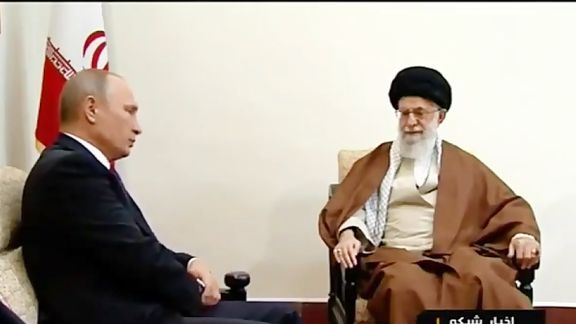
Vladimir Putin meeting with Ali Khamenei in Tehran on November 1, 2017

Iranian President Ebrahim Raisi’s upcoming January visit to Russia is perceived both as an opportunity and as a moment of sober calculations in Tehran.

A January 4 report the Iranian Labor News Agency ILNA said that the two countries will discuss an agreement in defense, which includes purchasing tens of military aircraft for Iran. Iranian pilots have been undergoing training to fly Sukhoi jets, ILNA reported. According to ILNA, Iran might also try to purchase the Russian S-400 air defense systems.

Russia, a participant in the Joint Comprehensive Plan of Action (JCPAO), and a key player in the current Vienna negotiations to restore the agreement is seen as the Islamic Republic’s diplomatic backer. However, some Iranian media and social media users have harshly criticized Russian envoy Mikhail Ulyanov's accentuated role in the talks saying that he has sometimes behaved in a way as if he was speaking for Iran. Others have accused him of dictating his ideas to the Iranian team.

Meanwhile, a video of Iran's chief negotiator Ali Bagheri-Kani speaking after a meeting with Russian Deputy Foreign Minister Sergei Ryabkov in Moscow has gone viral on social media. In the video, Bagheri tells Ulyanov: "We are seriously counting on you.” Also, going viral on social media is a photo showing Ulyanov in a meeting with US Special Representative for Iran Robert Malley, as if the two world powers are deciding the fate of the talks.

The Iranian opposition sees Raisi's trip as part of the Islamic Republic's determined policy to rely on Russia and China to avoid better relations with the West, to the detriment of Iran's national interests.

In a commentary on the moderate news website Rouydad24, Seyyed Mahmoud Sadri, a former Iranian ambassador to Cuba, wrote, "Raisi's visit to Moscow is a significant event, however, he should be aware that this is a complicated political move. Both sides at this meeting should try to win the other side's confidence and provide a baseline for solid relations in the future."

"What makes this visit important is Russia's geopolitical situation and its industrial and military potentials as well as its membership at the UN Security Council," Sadri said, mindless of the fact that in early 2010s Russia at times voted against Iran at the Security Council.

However, Sadri noted that Iran should also remember some bitter episodes between Tehran and Moscow including broken promises and quite a few wars in the past two centuries. However, he did not elaborate on Moscow's broken promises. But he pointed out that both under Communism and in the post-Communist period, Russia has benefitted from Iran much in the relationship. As an example, he mentioned the way Russia has benefitted from Iran's military support in Syria while it has given more concessions to Turkey and Israel.

Sadri warned that Iran's "Looking East" policy cannot serve the country's national interests without trying to reduce tensions with the West at the same time. Also, Iran should be aware that ties with the West are always important for Moscow.

Last Autumn, the Chief of Staff of the Iranian armed forces Mohammad Bagheri claimed that Iran has received advanced military equipment from Russia, but although Iran is keen to display its military capabilities, nothing in this regard has been showcased so far.

Bagheri has said, "Ties between Tehran and Moscow are strong enough, but the two sides are still far from building a military bloc."

Iran expects to get 59 Sukhoi and other military aircraft from Russia as well as overhauling its old MIG and Sukhoi jets. However, these might be more feasible than Iran's demand for the S-400 system which Russia has agreed with Israel not to sell to "untrustworthy" countries.

On the other hand, even if Iran prioritizes its military needs over improving its citizens' livelihood, it might not be able to pay for what it wishes to purchase from Russia as a result of US sanctions on its international banking.


Most Viewed

State media slam Araghchi's Hormuz tweet, say it let Trump claim victory
1

State media slam Araghchi's Hormuz tweet, say it let Trump claim victory

2
OPINION

The Hormuz get out of jail card turned to a grave

3
INSIGHT

How Tehran bends its own red lines to boost state rallies

4

Iran International says it won’t be silenced after London arson attack

5
VOICES FROM IRAN

Iran blackout cripples freelancer, small business incomes

Banner
Banner

Spotlight

  • Too early to tell who is winning Iran war, experts say
    PODCAST

    Too early to tell who is winning Iran war, experts say

  • How Tehran bends its own red lines to boost state rallies
    INSIGHT

    How Tehran bends its own red lines to boost state rallies

  • Iran blackout cripples freelancer, small business incomes
    VOICES FROM IRAN

    Iran blackout cripples freelancer, small business incomes

  • Ideology may be fading in Iran, but not in Kashmir's ‘Mini Iran'
    INSIGHT

    Ideology may be fading in Iran, but not in Kashmir's ‘Mini Iran'

  • US blockade enters murky phase as tankers spoof signals and buyers hesitate
    ANALYSIS

    US blockade enters murky phase as tankers spoof signals and buyers hesitate

  • Why the $100 billion Hormuz toll revenue is a myth
    ANALYSIS

    Why the $100 billion Hormuz toll revenue is a myth

•
•
•

More Stories

Iranians Consume 30% Less Milk Products Due To Rising Prices

Jan 7, 2022, 23:19 GMT+0

Iran’s health ministry has announced that the average consumption of milk and dairy products has decreased about 30 percent in the last two years.

The director of the ministry’s nutrition department, Zahra Abdollahi, said on Friday that the rise in food prices and inflationare the main reasons that have made people consume less milk products.

She noted that the country’s average consumption has always been under the recommended amount but the economic consequences of the Covid-19 pandemic and inflation have contributed to the sharp decline.

Abdollahi added that such low consumption of dairy products -- and consequently less calcium and phosphorus -- can cause serious health issues among people, particularly in children.

She stressed that currently osteoporosis is one of the leading diseases in Iran, warning that such a low consumption of dairy products can further increase such problems in the coming years.

Mentioning some reports that predict a 60-percent rise in the price of milk products in the coming months, she urged the authorities to consider subsidies and plans for free-of-charge milk for students.

The Iranian government has cut the subsidy on milk, which resulted in higher prices for dairy products, while free-of-charge milk is no longer distributed in elementary schools.

Despite having the biggest dairy products factory in the Middle East, Iran has a per capita consumption of about 60 to 80 kilograms a year, that is about half of the global average.

Iran Aims To Set Up Basij Paramilitary Bases In 11,000 Neighborhood

Jan 7, 2022, 17:02 GMT+0

Iran's Revolutionary Guard (IRGC) has announced plans to set up Basij paramilitary bases in about 11,000 neighborhoods across the country by March 2023.

The head of the Basij Organization, under the command of the IRGC, said that there are 50,000 neighborhoods in the country, therefore when the plan – dubbed Islamic neighborhoods – is implemented, Basij will have active presence in about one-fifth of the neighborhoods all over Iran.

The move is a measure to strengthen internal security in the country, by establishing control over residents in these neighborhoods.

Brig. Gen. Gholamreza Soleimani commander of the Basij made the remarks during a Thursday meeting in Shahrekord, where a memorial statue of Qasem Soleimani, the commander of Iran’s Qods Force, was set on fire on Wednesday.

Soleimani added that the neighborhood patrols scheme has been carried out in about 800 locations so far, and Basij is ready to provide support for all the mosques that would join the project.

The Basij commander was sanctioned by the US and the Council of Euopre in 2021 for his role in the violent crackdown during the bloody November 2019 protests.

The Basij is a paramilitary force of mostly young volunteers, who receive benefits. Its members usually go through limited training to serve as an auxiliary force in local security and enforcing state control over society through suppressing demonstrations and gathering intelligence.

Iran Rejects International Demands Over Downing Of Airliner

Jan 7, 2022, 16:12 GMT+0
•
Iran International Newsroom

Iran has condemned four countries who announced Thursday they would take action against Tehran over compensation for the downing of a Ukrainian plane in 2020.

Iran’s foreign ministry issued a statement Friday accusing Canada, Sweden, the United Kingdom and Ukraine of “mis-using this incident,” saying it will only negotiate with each country separately.

The four countries with the greatest number of victims on the Ukrainian International Airlines flight shot down over Tehran have formed the International Coordination and Response Group to support families of victims of flight PS752.

On Thursday, the four countries in a joint statement said they had abandoned efforts to talk to Iran about reparations and would try to settle the matter according to international law.

"Despite our best efforts over the past two years and multiple attempts to resolve this matter through negotiations, the Coordination Group has determined that further attempts to negotiate with Iran ... are futile," the statement said.

Flight PS752 was shot down by two air-defense missiles fired by Iran’s Revolutionary Guard (IRGC) in the morning of January 8, 2020, as it took off from Tehran’s Imam Khomeini International Airport. All 176 people on board were killed.

Just hours earlier Iran had fired ballistic missiles at bases in Iraq hosting US troops and was expecting a retaliation, but it failed to close the civilian airspace. After the tragic incident, the government tried to hide the true cause for three days, but after amateur video footage emerged showing the plane exploding it admitted that the military was responsible but said that a “human error” had taken place,

Tehran never allowed an independent investigation or provide full answers to questions by other countries, such as Ukraine. Eventually it put ten lower-ranking military personnel on trial, while victims’ families demanded investigation of senior government officials in charge.

In the Friday statement Iran’s foreign ministry emphasized on sovereignty of states over air disaster incidents on their territory, more of an argument Tehran has used not to provide answers, such as who in the command chain issued orders that day. It has also argued that a “radar misalignment” caused the incident but that begs the question of why two missiles were fired 30 seconds apart.

The statement also said that Iran is ready to pay reparations to the families of thirty foreign nationals. The amount Iran has decided to pay is $150,000 per victim. Mentioning 30 victims means that Iran does not want to recognize those who were dual national residents of Canada or Sweden as automatically eligible for the $150,000 compensation.

Iran’s government announced in December 2020 that all victims would receive the $150,000 compensation, but a year later, it said that it has paid just a few families.

In countries with independent courts families of victims can pursue legal avenues to receive compensation or demand accountability in such an incident, but in Iran courts and prosecutors are all part of the Judiciary controlled by the Supreme Leader Ali Khamenei.

A Canadian court just recently awarded C$107 million ($84 million) to the families of six people who had sued Iran. More court cases are pending in Canada.

In May 2021, an association representing the families of victims announced on social media that some families have received an electronic message from the military prosecutor handling the case informing them that high-ranking officials cannot be prosecuted.

Iran’s Friday Prayer Imams Vow Revenge, Urge US To Leave Region

Jan 7, 2022, 13:50 GMT+0

Many Friday Prayer Imams in Iran have talked about revenge for the targeted killing of Qasem Soleimani in their weekly sermons and urged American forces to leave the region.

Tehran’s interim leader of the weekly Friday congregation, Kazem Seddiqi, said the United States had thought that killing Soleimani would weaken the ‘resistance front’ but it proved to be the opposite.

He said that Soleimani created a united front for the resistance forces in Iran, Iraq, Yemen, Lebanon, Pakistan, and Afghanistan that provided new ways for the resistance forces.

Seddiqi praised recent attacks on Iraq’s Ain al-Asad base as revenge for the killing of Soleimani and Abu Mahdi al-Muhandis, the Iraqi commander of the Popular Mobilization Forces in January 2020.

Such remarks against the presence of American troops in the region were echoed by many other Friday Imams, which usually serve as a platform to promulgate the official policies and views of supreme leader Ali Khamenei.

The ongoing Vienna nuclear talks and restriction on the Internet were apparently among the other directives on agenda for today’s Friday prayers.

During numerous ceremonies and publications to mark the second anniversary of Soleimani’s killing in a US drone strike, the Islamic Republic tried to claim ultimate victory by saying that the US is leaving the region, by emphasizing the American departure from Afghanistan.

Tehran Police Warn Long-Haired Male Football Coach Over His Hijab

Jan 7, 2022, 13:32 GMT+0
•
Maryam Sinaiee

An Albanian male soccer coach has received a police text message over violating Iran’s hijab laws after being caught by a traffic camera while in a car.

Shpejtim Arifi, a Kosovar Albanian with German citizenship, manages the Persepolis junior team. He was a prolific goal-scorer transferred to Persepolis for $850,000 in 2009 after joining Payam the previous year.

Fluent in Persian, Arifi is well known, partly for football, and partly through fashion modelling and appearances in television and cinema films. He was riding in a friend's car in Tehran when the friend’s phone bleeped.

"The text message shocked us at first because I had been mistaken for a woman flouting her hijab,” Arifi told Sports News . “I think it was the traffic camera that took my image. My friend was taken aback at first but then we laughed a lot…Later, many other friends called or sent text message to joke about this incident.”

Arifi explained he had grown his hair long since he was 18 and had no intention of cutting it.

“I've lived in Iran for many years looking the same and never had a problem,” he said. “I think it was a misunderstanding and nothing can be done about it.”

Iranian morality police who dress code and other “un-Islamic” behavior have an easier job in the streets, where they stop violators and order them to fix their hijab or even arrest them, but it is harder to control people riding in cars.

A method to deal with this started a few years ago when police monitoring cameras became prevalent. The morality police who notice a hijab violation send text messages – citing the vehicle's plate number, time, date, and location – to female drivers or passengers who drop their headscarf when driving, and drivers are responsible for their passengers. On the second offense, drivers must report to a police station within ten days, and may have their vehicle confiscated by court order if they fail to do so.

Women who break hijab laws while in a car can face a cash fine, penalty points on their license, and a maximum two months’ jail.

While the long black veil (the chador) is promoted as the best hijab in many government offices and educational establishments, a headscarf covering hair and shoulders and a long coat (manteau) coming below knees are generally acceptable. Many women, however, twist the rules. Headscarves that show hair in the front and back often slip down on the shoulders, while manteaus can be very tight.

A report by the parliament's research center in 2018 said the number of Iranians who believed in compulsory hijab had waned. According to the report those who considered the hijab a value that could be defined by law had fallen from 85 percent in the early 1980s to around 35 percent.





