As criticism over Iran’s proposed budget echoes in local media, a former lawmaker says the top leadership has decided to reach an agreement with the West.
Mehrdad Lahouti told Aftab News, a Tehran political website that this year’s budget is not much different from previous ones in facing a serious deficit and the country's top leadership has apparently decided to solve its issues with the West.
He was was quoted on Sunday as having said that as long as Tehran does not improve ties with the world, “we cannot be hopeful about an improvement in people’s lives.”
Meanwhile, the head of the Budget and Planning Organization, Massoud Mirkazemi has written to President Ebrahim Raisi that a 10-percent extra pay in the current budget plan cannot be met because there is no money for it.
Mirkazemi has proposed to sell assets of medical universities and the government to raise money. He has admitted that targets this year for selling government property have not been met, reducing budget revenues.
Iran has faced serious budget deficits since the United States withdrew from the Obama-era nuclear agreement known as JCPOA in 2018 and imposed sanctions that have denied tens of billions of dollars in oil revenues to the Islamic Republic.
Lahouti argued that the main sources of revenue for the proposed budget to start in March 2022 are oil exports and more taxes. The budget draft is based on the projection that Iran can export 1.2 million dollars of crude oil per day next year, but the proposition depends on lifting of US sanctions.
Tehran is currently negotiating with world powers over reviving the JCPOA, which would lift the oil sanctions, but if these talks fail or are delayed it cannot sell the expected amount of oil.
Lahouti said that in such a scenario the government has to resort to borrowing from domestic markets, but he did not mention that cash has dried out and internal capital markets cannot lend billions of dollars to the government. That means the Central Bank will resort to printing money as in past years, driving up inflation that now stands close to a 50-percent annual rate.
But the former lawmaker did highlight that the government is planning to also borrow around $5.5 billion from its foreign currency reserve fund. Information about the fund is a state secret but observers agree it has declined substantially from more than $100 billion a decade ago to perhaps less than $30 billion.
Despite the unsurmountable budgetary problems, the Raisi administration has promised 8 percent economic growth, a figure Iran has never achieved before. Lahouti said that to get to that level of growth, the country would need $65 billion in foreign investment – again a figure the Islamic Republic has not seen in its 42-year existence.
But Lahouti said he believes that the top leadership has concluded it needs to solve its problems with the West, and “that is why Iran’s negotiators are in Vienna trying to reach an agreement with the West.”
Potato farmers in Iran will suffer from a ban by neighboring countires.
Turkmenistan and Uzbekistan have rejected large shipments of Iranian potatoes, citing dangerous contamination with agricultural pesticides and chemicals..
Heydar Sakenborji, the head of the Fruit and Vegetables Association of the city of Mashhad, in Khorasan Razavi province, told Tejarat newsthat the low quality of the pesticides used is the main culprit.
He elaborated that after harvest, most agricultural produce should be quarantined for a specific period for pesticides to naturally become less harmful, but pesticides used in Iran stay longer on fruits and vegetables making them toxic for humans.
"According to the investigations, pesticides used in these agricultural products are imported from China," Sakenborji said, speculating that these pesticides don’t have the required standards and quality.
He also said that in about ten days Pakistan took over these Central Asian markets from Iranian fruits and vegetables.
The Uzbek government has reportedly returned around 3,500 tons of the potatoes to Iran and destroyed other 775 tons.
Recently, a trade representative in Tehran said various countries have banned imports of Iranian fruits and vegetables due to mold or high pesticide residues, adding that India, Russia, Uzbekistan, the United Arab Emirates, Oman, Qatar and some others no longer accept certificates issued by Iran.
Iran exported $6.5 billion in agricultural products last year.
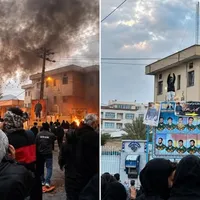
Protests In Iran's third largest city Esfahan on November 26.
A conservative newspaper in Tehran warned on Sunday that if the government’s proposed new budget is adopted it might lead to a “major social explosion.”
"If the government's budget bill for the next Iranian year, [starting late March] is implemented, it will create a lot of problems for the people and might lead to a major social explosion that cannot be controlled," Jomhuri Eslami (Islamic Republic) daily wrote in an editorial. The paper called on parliament to amend the bill.
In November 2019, a government decision to increase fuel prices led to immediate street unrest, put down by security forces who killed hundreds of people. As a result, the regime’s legitimacy took a big blow.
The daily said that the government should not increase taxes and should continue to subsidize essential commodities by allocating cheap foreign currency for their import to prevent further inflation.
The leading conservative paper charged that those who wrote the budget bill failed to understand the importance of these points because they do not come from the low-income classes and do not know about the impact of a devalued national currency on people's livelihood.
Jomhouiri Eslami further added that the new taxation regulations stipulated in the budget bill will lead to a revolt.The daily suggested that the government should avoid allocating budget to municipalities and to tens of useless organizations.
Iranian economists and media have often criticized the governments for allocating hefty budgets to the seminaries and propaganda organizations whose only function is to convince the people that the government's ideology can lead to their salvation.
Meanwhile, reformist newspaper Sharq in a report on Saturday reminded that President Ebrahim Raisi in his latest televised interview on December 5 said, "We are not going to surprise the people by sudden hikes in prices." The paper wrote despite the president’s statement price continued to increase since he took office in August.
Sharq said that given the government's inability to control prices, it is likely that the people will surprise Raisi. This was a clear allusion to the possibility of protests in Iran because of rising inflation as many Iranian analysts have warned.
Iran’s inflation began to rise dangerously after the United States pulled out of the 2015 nuclear deal and imposed sanctions in 2018. Without oil export revenues, the government is facing a serious budget shortfall. The currency rial has fallen eightfold since early 2018.
Last week, once again Raisi called on his economic team to make sure that the prices do not go up as people prepared to celebrate a pre-Islamic feast on the longest night of the year, Yalda, on December 21. But press and social media reports indicated that food shopping was reduced to a quarter of what it was last year.
Sharq reminded Raisi that ordering his managers to lower the prices is not likely to work. "He still cannot believe that he is the president and in charge of managing the economy. That is why he keeps issuing orders to others instead of taking action to correct the situation," the paper quoted social media users as saying.
Sharq also pointed out that only three days after Raisi promised on live TV that he would not surprise the people, the price of Iranian-made cars went up by 100 to 500 million rials each. This further discredited Raisi because the cars are being produced by or in partnership with the government. Sharq quoted social media users as saying that "The economic Mafia made the president look like a fool.”
Iran’s intelligence minister Esmail Khatib says despite pressure by the United States and its allies Tehran currently has fewer problems in selling oil.
Iran’s oil exports have increased in the past one year compared with 2019-2020, according to business intelligence groups, but are still well below 2 million bpd exported before US sanctions were imposed in 2018.
Khatib also said that Iran’s access to its foreign currency reserves have also increased.
Iran does not officially announce the foreign currency reserves as a matter of policy and all figures are estimates calculated by international or foreign institutes. However, Iran’s currency has fallen by more than 20 percent since August, which is not an indication of access to foreign currencies.
In its regional report for the Middle East and Central Asia, the International Monetary Fund (IMF) has said Iran’s accessible international reserves was $4 billion in 2020, that is a tiny fraction of the $122.5 billion of reserves the country held in 2018.
In its latest Regional Economic Outlook, the IMF said Iran’s “oil activity will remain subdued in the short term, reflecting the OPEC+ production curbs and continued US sanctions.”
Islamic Republic has dipped into its foreign reserves to make up for the loss of oil revenues.
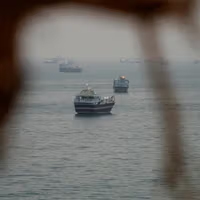
An Iranian oil tanker starting its journey near a loading dock in August.
Iran has been able to boost oil exports to the extent that it has helped the economy grow by 3.3 percent this year, the government's news website said Friday.
The Islamic Republic News Agency, IRNA said that in the first six monthsof last Iranian year economic growth was 1.8 percent and because of more oil sales it reached 3.3 percent since March 21, when the new calendar year started.
The fact that Iran is selling more oil in 2021 has been reported by international oil trade and shipping monitoring firms, such as Kpler, that has said Iran this year is selling twice as much oil as in 2020.
Iran’s oil exports dropped from more than 2 million barrels per day in 2016-2017 to less than 200,000 in 2019, but started to grow in September 2020, before the US presidential election. No one can say with any certainty how much Tehran is exporting but estimates say volumes reach over 600,000 barrels per day.
Some have argued that this is because of less enforcement by the Biden Administration that has been indirectly negotiating with Iran since April trying to restore the 2015 nuclear agreement. The Administration denies it has been looking the other way, but somehow Tehran is shipping more oil primarily to China via middlemen and using illicit tactics.
China officially does not report any oil imports from Iran, because it is usually diverted through third countries and imported into China as originating from countries such as Malaysia, Iraq or the United Arab Emirates.
Over decades of various sanctions Iran has developed complex ways of circumvention and only diligent and determined pursuit can slow its illicit exports.
But the illicit methods also mean Iran sells the oil with a deep discount and middlemen also make hefty profits. Moreover, because of US banking sanctions Tehran often imports vital goods instead of receiving dollars for the oil.
The claim of 3.3 percent economic growth by IRNA cannot be independently verified and no details are mentioned in the report. In fact, other media in Iran, still under government censorship, sound dire warnings about the state of the economy, often through interviews with local experts and politicians who are currently out of power.
The national currency, rial, has fallen by more than 20 percentjust since August when President Ebrahim Raisi took office. This is indicative of a foreign currency shortage and the government’s reluctance to support the rial with limited reserves it controls.
The IRNA report is one of many other government claims, coming on daily basis, that that the Raisi Administration is hard at work and producing results, while except his hardliner supporters everyone else criticizes lack of progress in solving the economic crisis.
Iran and Sri Lanka sign tea barter agreement. December 22, 2021
To settle its $251 million debt to Iran, Sri Lanka will barter tea in monthly instalments of $5 million, because of United States sanctions on Iranian banking.
Head of Iran’s Trade Promotion Organization, Alireza Peyman-Pak and Sri Lanka Minister of Plantation, Ramesh Pathirana signed the barter agreement in Colombo on Tuesday.
Pathirana said that the deal makes it possible for the Ceylon Petroleum Corporation to settle its debts with the National Iranian Oil Company without violating US sanctions.
“This scheme will not violate any UN or US sanctions since tea has been categorized as a food item on humanitarian grounds while none of the black-listed Iranian banks will be involved in the equation,” read a statement by Sri Lanka’s plantation ministry.
According to the agreement, Sri Lanka’s Treasury will release equivalent of $5 million in rupees every month to the Sri Lanka Tea Board - a state-run industry regulator– that will then pay individual exporters in rupees at the central bank’s exchange rate.
Iran is among the top 10 importers of Ceylon Tea for the past several decades although purchases have declined following US sanctions.
Iran is trying to increase barter deals amid sanctions. “We have the lower hand and we have to make concessions, which means we have to accept any goods at any price”, Hamidreza Salehi, a member of Tehran’s Chamber of Commerce, has said.