• العربية
  • فارسی
Brand
  • Iran Insight
  • Politics
  • Economy
  • Analysis
  • Special Report
  • Opinion
  • Podcast
  • Iran Insight
  • Politics
  • Economy
  • Analysis
  • Special Report
  • Opinion
  • Podcast
  • Theme
  • Language
    • العربية
    • فارسی
  • Iran Insight
  • Politics
  • Economy
  • Analysis
  • Special Report
  • Opinion
  • Podcast
All rights reserved for Volant Media UK Limited
volant media logo

India, Russia, Others Reject Iran’s Fruit And Vegetables

Maryam Sinaiee
Maryam Sinaiee

Iran International

Dec 12, 2021, 12:51 GMT+0Updated: 17:28 GMT+1
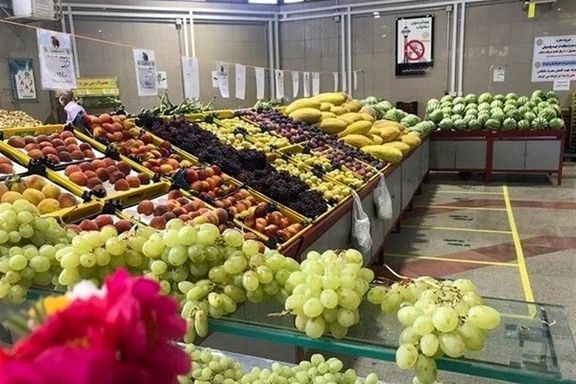
A fruit and vegetable market in Tehran.

A trade representative in Tehran has said various countries have banned imports of Iranian fruits and vegetables due to mold or high pesticide residues.

Mostafa Daraeinejad the head of Iran’s fruit and vegetables association told the Iranian Labour News Agency (ILNA) Friday that India, Russia, Uzbekistan, the United Arab Emirates, Oman, Qatar and others no longer accepted some certificates issued by Iran's agricultural organizations and demanded their own standards be met.

Iran exported $6.5 billion in agricultural products last year. It is among the top ten producers of more than two dozen fruits and vegetables, including saffron, apples, citrus fruit, watermelons and other melons, pomegranates, dates, pistachios, and walnuts.

Daraeinejad said India was refusing import permits for Iranian kiwi after finding it did not meet safety standards. Iran is seventh in world kiwi production, and the main producing region exported nearly 60,000 metric tons, worth $95 million in 2018.

Daraeinejad warned that Iran faced the threat of losing agricultural markets if the ministry of agriculture did not take immediate action to raise standards. He said the matter should also concern domestic consumers as "Iranians don't deserve to ingest nitrates and other pesticide residues…”

In November Uzbekistan turned down several thousand tons of Iranian and Pakistani potatoes due to high levels of pesticide. Qatari importers in November returned to Iran nearly 588 date palms, worth $136,000, imported for lining streets in preparation for the 2022 soccer World Cup.

A few weeks ago, Russia banned imports of some Iranian agricultural products. According to Reza Nourani, chairman of the National Association of Agricultural Producers, a large shipment of peppers was rejected because certificates on pesticide-residue levels were lacking. The Mashregh News website claimed December 1, that “the Israeli lobby” in Russia was behind the move in order to eliminate market competition for Israeli peppers.

According to Iranian Customs Organization, Iran last year exported $22 million of peppers to Russia, which after the imposition of US ‘maximum pressure’ sanctions in 2018 became one of the major destinations for Iran's fruit and vegetable exports. Agricultural products make up more than 80 percent of Iran's exports to Russia.

Although Iran produces a wide variety of agricultural products, the sector has been battling with serious drought and inadequate water supplies for years. At the same time, environmentalists argued that cultivation of watermelonsand cucumbers, two of Iran's major fruit and vegetable exports, should be banned in most areas as producing one kilo of watermelon requires on average 300 liters of water. Producing chicken, rice and bread all require even more water.


Most Viewed

US blockade enters murky phase as tankers spoof signals and buyers hesitate
1
ANALYSIS

US blockade enters murky phase as tankers spoof signals and buyers hesitate

2

US tightens financial squeeze on Iran, warns banks over oil money flows

3
INSIGHT

Ideology may be fading in Iran, but not in Kashmir's ‘Mini Iran'

4
INSIGHT

Hardliners push Hormuz ‘red line’ as US blockade tests Iran’s leverage

5
VOICES FROM IRAN

Hope and anger in Iran as fragile ceasefire persists

Banner
Banner

Spotlight

  • Hardliners push Hormuz ‘red line’ as US blockade tests Iran’s leverage
    INSIGHT

    Hardliners push Hormuz ‘red line’ as US blockade tests Iran’s leverage

  • Ideology may be fading in Iran, but not in Kashmir's ‘Mini Iran'
    INSIGHT

    Ideology may be fading in Iran, but not in Kashmir's ‘Mini Iran'

  • War damage amounts to $3,000 per Iranian, with blockade set to add to losses
    INSIGHT

    War damage amounts to $3,000 per Iranian, with blockade set to add to losses

  • Why the $100 billion Hormuz toll revenue is a myth
    ANALYSIS

    Why the $100 billion Hormuz toll revenue is a myth

  • US blockade targets Iran oil boom amid regional disruption
    ANALYSIS

    US blockade targets Iran oil boom amid regional disruption

  • Iran's digital economy battered by prolonged blackout
    INSIGHT

    Iran's digital economy battered by prolonged blackout

•
•
•

More Stories

Khamenei Avoids Mentioning Nuclear Talks And The US In Speech

Dec 12, 2021, 11:26 GMT+0

Iran’s Supreme Leader Ali Khamenei delivered a speech Sunday where he refrained from mentioning the ongoing nuclear talks and from attacking the United States.

Khamenei has delivered several speeches since the beginning of October and has not mentioned the nuclear talks and has refrained from his usual attacks on the United States. The last time he mentioned the United States was in a speech on October 3, when he spoke of the US role in Afghanistan.

Khamenei’s tactic of avoiding subjects related to the core of his foreign policy might be intended to show that he does not interfere in the business of the government, after foreign media and officials increasingly acknowledge his role as the final decision maker in important matters.

The only noteworthy part of his speech was his insistence to “tell the truth” about the history of the Islamic Republic and how much enmity has existed against the regime. He said that if supporters do not spread the truth, “the enemy will play the role of a victim.”

He also claimed in an implicit reference to the US that “arrogant powers” enjoy “the suffering of the Iranian nation.”

Iran Eliminating Low Dollar Exchange Rate Meant To Control Prices

Dec 12, 2021, 09:37 GMT+0
•
Mardo Soghom

Iran will stop offering cheap dollars to importers next year that was meant to keep prices of essential goods low amid the inflationary impact of US sanctions.

President Ebrahim Raisi (Raeesi) went to parliament on Sunday to present his budget for the coming Iranian calendar year that will begin on March 21, 2022. Except some general budgetary numbers, details are scarce and it is not clear how the government is planning to deal with a growing deficit that this year is estimated to be more than 50 percent.

But one deficit-fighting measure is to stop providing cheap dollars to importers of essential goods, saving around $8 billion annually. The problem is that many in parliament, economists and politicians say this would add fuel to inflation, which has already reached 45 percent this year.

Just before the United States pulled out of the 2015 nuclear agreement (JCPOA) in May 2018, the former Iranian president Hassan Rouhani decided to offer dollars at 42,000 rials for essential imports to keep food and medicine cheap. Iran’s currency was already falling in anticipation of the US withdrawal from the nuclear agreement and new sanctions.

The subsidized dollars however did little to keep prices low, as imported grain, rice, sugar and animal feed reached consumers with ever higher prices. Simply, those importing the essential commodities and businesses in the supply chain pocketed huge profits. There were also proven cases of companies applying to receive the cheap dollars and then importing luxury goods, such as thousands of foreign cars.

US sanctions have dramatically reduced revenues for the Islamic Republic, which heavily depends on oil exports. Not only Tehran is getting a fraction of its usual oil income but trade in general has suffered because of US banking sanctions, forcing Iran to offer low prices and still struggling to bring back dollars earned.

Raisi claimed that past administration tied the fate of the country's economy to foreign sanctions, but his budget has ignored those restriction and will deliver health economic growth.

How the Raisi government has put together a budget that at least on paper is supposed to be balanced is shrouded in accounting gimmicks and over-optimistic assessments. It projects selling more than a million barrels of oil per day at around $60 per barrel, an over-estimation unless the United States lifts its sanctions. It also projects selling billions of dollars in government assets to raise money, but there is little no capital or confidence left among the people and investors for buying these assets.

Mostly politically well-connected people and officials who have either become rich or know others with money will scoop up some valuable real estate and other assets, at a fraction of their value. Quasi-governmental companies, such as those belonging to the Revolutionary Guard and foundations under Khamenei’s control will be well positioned to buy the cheap assets the government offers.

In practice, officials running these companies are like private owners, making money for themselves, their relatives and friends without any transparency and accountability. In the past 15 years most “privatization” deals have ended in stories of corruption, some exposed by dissatisfied workers or rival factions within the regime.

Other than unsubstantiated revenue numbers from oil and asset sales, the Raisi government has little else to balance its budget on paper.

The Chairman of Iran-China chamber of commerce Majid-Reza Hariri warned in November that Iran’s economy is “at its most dangerous period in its 40-year cycle of inflation” and can expect to reach “hyperinflation” in the coming months.

Iran's Student Movement Is No Longer Anti-American, Says Website

Dec 11, 2021, 18:17 GMT+0
•
Iran International Newsroom

A note published in the conservative website Alef in Tehran has speculated about why Iran’s traditionally leftist student movement is no longer anti-American.

The note entitled "The movement which is no longer a movement," published on the Student Day, December 7, argued that like all student movements in the world Iran's students have also been idealist and anti-imperialist. They were always anti-American, particularly during the events of 1953 when three Tehran University students were killed by the police when they demonstrated against the visit of then-US Vice President Richard Nixon. They also revealed their opposition to the United States in November 1979 when Islamic students seized the US embassy in Tehran and took American hostages for 444 days.

However, the short article went on to argue that the student protests in June 1999, against the Islamic Republic’s suppressive measures, marked a change in the narrative of the student movement. Instead of being anti-West, the protests were aimed at the fundamentalist and totalitarian nature of the Islamic regime and supported ideas such as liberalism, feminism and pluralism as a reform movement was dawning in the country.

The violent crackdown on that protest and ten years later in 2009 against a rigged presidential election, totally changed the face of Iran's student movement as its leaders came under pressure in prison and others fled the country and gradually forgot about the student movement and what it stood for.

Readers commented under the article that Islamic Republic’s anti-Americanism and the anti-Western ideologies have prevented Iran’s progress in recent decades.

The editors of the website felt obliged to publish a new article, trying to defend why they had printed a report saying that students were no longer anti-West.

The new article quoted Iranian scholars such as Sadeq Zibakalam and Abdolhossein Khosrowpanah to prove that anti-Americanism has its roots in Communism but did not elaborate why anti-Americanism is the focal point in the ideas and speeches of Supreme Leader Ali Khamenei.

A vivid example of how students and the youth have changed their political perspectives emerged this week, when President Ebrahim Raisi visited the Sharif University of Technology in Tehran.

One leading student, Mohammad Hossein Bayat addressed him by saying, “You got elected in the least competitive election in the history of the Islamic Republic, with the lowest rate of voter participation,” and warned, “We are speaking to you not as a president elected with the free vote of the people in a free election. We are speaking to you as a representative of the ruling system.” No mention of America or the West, as if the young man knew where exactly the country's problems were.

This squarely contradicted Khamenei’s constant anti-Western remarks that signal to his followers to chant “Death to America” and vow not to directly negotiate with “the great satan”.

Bayat also told Raisi that he represents a ruling system which “in the past 40 years has not opened a path for the progress of the people, despite the revolutionary ideals of freedom and justice.”

US General Concerned Over Iran's Missiles And Drones

Dec 10, 2021, 16:11 GMT+0
•
Iran International Newsroom

Gen. Kenneth McKenzie, US CENTCOM commander has expressed concern in an Associated Press interview over the growing capabilities of Iran’s missiles and drones.

The US general in charge of protecting the Persian Gulf and the wider Middle East said that the range, lethality, capability as well as the quantity of Iranian missiles are increasing and “that concerns me, coupled with their land attack, cruise missiles over the last couple of years,” and with their growing drone program he said.

“You know, they starve their people so they can build these missiles,” the CENTCOM commander said.

Iran’s Islamic government touts its missile and other military programs as sign of its success in self-reliance, but the civilian economy has not grown in the past decade. High inflation, a battered currency and lack of investments have increased poverty.

An underground Iranian missile base pictured in March 2021
100%
An underground Iranian missile base pictured in March 2021

Regarding Iran’s role in Iraq and the presence of around 2,500 US troops, McKenzie said that Tehran and Iraqi militias it backs are upset that they lost in the parliamentary elections in October, and he is anticipating more attacks during December.

"They're really frustrated over their inability to affect government formation in the way they want to do it,” he said and their attacks, including a drone strike at the prime minister’s residence is “a signpost of the desperation that they're under right now.”

Many Iraqis detest Iran’s indirect presence in their country and the political influence Tehran has projected, ensuring that loyal politicians maintain control in Iraq. But at the same time, inefficiencies and the mismanagement of successive governments are also blamed on Iran’s meddling. Large anti-government and anti-Iran protests erupted in October 2019 and continued for months, openly demanding Iran to remove itself from Iraqi politics.

The US general added that Iran’s ultimate aim is to evict American forces from Iraq, but those forces will stay, he reiterated, with a new, non-combat role.

Top Iranian officials have been often claiming that US forces are about to leave Iraq and that would be a second victory after their “escape” from Afghanistan.

Senior Ayatollah Insists Iran Cannot Avoid Dealing With Others

Dec 10, 2021, 13:43 GMT+0
•
Maryam Sinaiee

A prominent cleric has told Foreign Minister Hossein Amir-Abdollahian that Iran must negotiate with the rest of the world because it cannot live in isolation.

"No one can be trusted [fully] in the international community, but at the same time, no one is needless of negotiations and relations with other countries," Ayatollah Abdollah Javadi-Amoli told Amir-Abdollahian Friday during his visit to Qom, the main concentration of Iranian Shiite seminaries and senior clerics.

"We have to negotiate with them and shake hands with them whether we want or not, but we have to count our fingers afterwards," Javadi-Amoli advised, according to remarks published on the ayatollah's personal portal.

Javadi Amoli is recognized by many Shiites as a grand ayatollah, which means he is accepted as a top religious authority.

The quotes came from a readout of the meeting published on the grand ayatollah's personal portal, while state media largely did not reflect his message about the importance of good relations with other countries.

Amir-Abdollahian visited several leading clerics, including grand ayatollahs Naser Makarem-Shirazi, Hossein Safi-Golpaygani, Jafar Sobhani, and Hossein Nouri-Hamedani, as well as Mohammad Saeedi, who holds the lesser title of hojjat ol-eslam.

The foreign ministry reported that Amir-Abdollahian had discussed regional developments including Afghanistan and the government commitment to prioritize relations with immediate neighbors. Saeedi, custodian of the Shiite shrine of Masoumeh, told the foreign minister that proving one is not on the enemy's side did not mean “cutting off economic and human relations with them.”

Amir-Abdollahian's visits to influential Shiite leaders in Qom came ahead of a round of nuclear talks between the administration of hardline President Ebrahim Raisi and world powers to revive the 2015 nuclear deal.

Iran refuses to directly negotiate with the United States, even during multilateral nuclear talks currently underway in Vienna.

A few months after Iran's 2015 nuclear deal with world powers, Javadi-Amoli welcomed the agreement while advising then foreign minister Mohammad Javad Zarif to remain on guard. "We kept all that we needed" for work in medicine and agriculture, he told Zarif, but had conceded nothing, given Iran had never sought nuclear weapons.

Javadi-Amoli, who is 88, led a mission on behalf of Ruhollah Khomeini, the founder of the Islamic Republic, to Mikhail Gorbachev, the leader of the Soviet Union in 1988. In January 2009, he resigned as Friday imam of Qom, possibly due to dissatisfaction with President Mahmoud Ahmadinejad's disputed re-election and handling of subsequent protests, and had generally good relations with the government of President Hassan Rouhani (2013-17).

As recipients of massive religious duties from their devout followers and as providers of funding for seminaries as well as their charitable foundations, grand ayatollahs wield great influence in the Shiite establishment, particularly Qom where most of them are based.

Visits to prominent ayatollahs by the president, parliament speaker, judiciary chief, and ministers are common before or after important occasions. The general content of such talks is published in readouts on personal portals.

Details usually remain private but occasionally reach the media. In November 2005 Baztab website, linked to former Revolutionary Guard commander Mohsen Rezaei (Rezaee), published a video and transcript of a meeting with a cleric in which President Mahmoud Ahmadinjejad had claimed to have been surrounded by a “bright light” when addressing the United Nations two months earlier.

The story, whose leaking was taken to reflect the clerical establishment’s unease at Ahmadinejad, dogged the president for many years.