• العربية
  • فارسی
Brand
  • Iran Insight
  • Politics
  • Economy
  • Analysis
  • Special Report
  • Opinion
  • Podcast
  • Iran Insight
  • Politics
  • Economy
  • Analysis
  • Special Report
  • Opinion
  • Podcast
  • Theme
  • Language
    • العربية
    • فارسی
  • Iran Insight
  • Politics
  • Economy
  • Analysis
  • Special Report
  • Opinion
  • Podcast
All rights reserved for Volant Media UK Limited
volant media logo

Saudi Coalition Says It Helped Evacuate Iran's Envoy From Yemen
Dec 22, 2021, 08:09 GMT+0
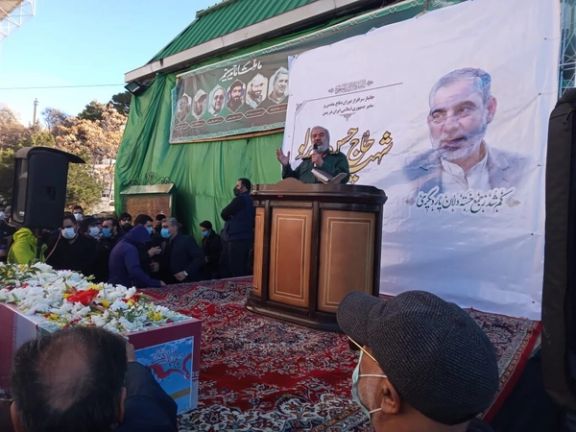
Funeral of Iran's envoy in Yemen, said to have died of Covid-19. December 22, 2021

The Saudi-led coalition fighting in Yemen has rejected Iranian accusations that it delayed arrangements for the evacuation of Tehran’s envoy from Sanaa.

The coalition said on Wednesday it had helped get the sick ambassador out of the country before he died.

Iran said on Tuesday that Hasan Irloo (Irlu), its ambassador to Houthi-run north Yemen, had died of Covid-19 after his evacuation from Yemen, and accused Saudi Arabia of delaying his departure from the capital, Sanaa.

The coalition, which has been fighting the Iran-aligned Houthi movement since early 2015, said in a statement it had facilitated Irloo's repatriation and had arranged for an Iraqi medical plane to fly him from Sanaa to Basra in Iraq.

It said it began facilitating Irloo's transfer from Sanaa on humanitarian grounds, considering mediation from Oman and Iraq, within 48 hours of being informed of his health condition.

It had provided permits and logistical support for the Iraqi air force C-130 medical evacuation plane that took Irloo out, coalition spokesperson Turki al-Malki said.

Hassan Irloo (L) with a Houthi official in Sanaa on January 2, 2021
100%
Hassan Irloo (L) with a Houthi official in Sanaa on January 2, 2021

The coalition did not say in the statement what medical condition Irloo had been suffering from. He was buried in Iran on Wednesday.

Fars news agency affiliated with Iran’s Revolutionary Guard repeated Wednesday that Saudi Arabia’s “delay caused the martyrdom” of Irloo, quoting the Houthi foreign minister Hisham Sharaf.

In his funeral ceremony on Wednesday, deputy commander of the IRGC, Ali Fadavi, portrayed Irloo as a longtime “fighter in the resistance front”, a term the Islamic Republic uses to describe its allies and proxies in the region. He accused the United States and “its allies” of delaying Irloo’s evacuation, saying that when he was finally brought to Iran he had been suffering from Covid “for a long time”.

Last week controversy ensued after a Wall Street Journal report said that the Houthis had asked Iran to withdraw Irloo. Both Iran and the Houthi leadership denied the report, insisting that the ambassador suffered from Covid and needed to receive medical attention in Iran.

But speculations on Iranian social media continued that Irloo had been perhaps killed or injured in Yemen and both Tehran and Riyadh preferred to say he was evacuated for medical reasons. Saudi Arabia has been conducting a fierce air campaign on suspected military and Iran-related targets in and around Sanaa.

Saudi Arabia and Iran, the region's Sunni Muslim and Shi'ite powerhouses, are bitter rivals but they launched direct talks this year as global powers try to salvage a nuclear pact with Iran and as UN-led efforts to end the Yemen war have stalled.

The bilateral talks have not resulted in any breakthrough, Iran said on Sunday. The two countries severed diplomatic ties in January 2016, after mobs in Iran attacked and ransacked Saudi diplomatic missions.

Last December, the US Treasury blacklisted Irloo and described him as an official of Iran's elite Quds Force, the overseas arm of Iran's Revolutionary Guards and a pillar of Iranian efforts to project power in Yemen, Syria and elsewhere.

Two Yemeni political sources and a foreign source have said Irloo had recently kept a low profile due to illness and political tension.

With reporting by Reuters

Most Viewed

Iran negotiators ordered to return after internal rift over Islamabad talks
1
EXCLUSIVE

Iran negotiators ordered to return after internal rift over Islamabad talks

2
ANALYSIS

US blockade enters murky phase as tankers spoof signals and buyers hesitate

3
ANALYSIS

Why the $100 billion Hormuz toll revenue is a myth

4

US tightens financial squeeze on Iran, warns banks over oil money flows

5
ANALYSIS

US blockade targets Iran oil boom amid regional disruption

Banner
Banner

Spotlight

  • Hardliners push Hormuz ‘red line’ as US blockade tests Iran’s leverage
    INSIGHT

    Hardliners push Hormuz ‘red line’ as US blockade tests Iran’s leverage

  • Ideology may be fading in Iran, but not in Kashmir's ‘Mini Iran'
    INSIGHT

    Ideology may be fading in Iran, but not in Kashmir's ‘Mini Iran'

  • War damage amounts to $3,000 per Iranian, with blockade set to add to losses
    INSIGHT

    War damage amounts to $3,000 per Iranian, with blockade set to add to losses

  • Why the $100 billion Hormuz toll revenue is a myth
    ANALYSIS

    Why the $100 billion Hormuz toll revenue is a myth

  • US blockade targets Iran oil boom amid regional disruption
    ANALYSIS

    US blockade targets Iran oil boom amid regional disruption

  • Iran's digital economy battered by prolonged blackout
    INSIGHT

    Iran's digital economy battered by prolonged blackout

•
•
•

More Stories

Prominent Cleric In Iran Says Government Money Bad For Seminaries

Dec 21, 2021, 19:48 GMT+0
•
Maryam Sinaiee

Referring to large budget increases next year for Shiite seminaries in Iran, a prominent cleric has criticized dependence of religious centers on state money.

"Seminaries must use the money coming from people who pay willingly. Seminaries must be independent [from the government]," Ayatollah Mostafa Mohaghegh-Damad, a professor of Islamic law at Shahid Beheshti University of Tehran, said in a speech on a book dedicated to the Centenary of the Qom Seminary. "Today one of the problems of the seminary is its dependence on the government."

The Qom Seminary, established by Sheikh Abdul-Karim Haeri-Yazdi in 1922, is the largest Shiite seminary (hawza) in Iran with over 75,000 students. Seminaries were self-funded before the Islamic Revolution but like many other religious institutions, they now receive huge sums annually from the government.

In his speech, Mohaghegh-Damad, a moderate religious figure and a member of Iran's Science Academy, cited examples of prominent Shiite religious leaders who have emphasized the importance of separating religion from politics.

The budget allocated to religious institutions in the first budget bill presented to Parliament by President Ebrahim Raisi recently is noticeably higher in comparison with the previous year's budget – at least on those instances where clear figures have been noted.

For instance, the budget proposed for the Seminaries Services Center has doubled. The Seminaries Services Center is to receive 2.8 trillion rials which is higher than the 2,157 trillion rials allocated to the Department of Environment and many other government bodies including the Crisis Management Headquarters. The Center also receives funding from the Supreme Leader's office.

Supreme Leader Ali Khamenei ordered the Seminaries Services Center to be established in 1991 to provide housing assistance, health insurance, and similar services to seminary students, who are the future clerics and whose loyalty is important for the regime.

Critics say that in some cases the budgets proposed for government bodies and state entities is difficult to calculate from what is discernible in the budget bill, which does not provide sufficient details.

The government says its budget bill is based on restrictive monetary policies.

Based on the details provided in the bill, the budget of the Islamic Propaganda Organization itself has increased by 43% in comparison with the previous year and reached 11.7 trillion rials. Many other large and small institutions have also been allocated huge increases of up to 124%.

The budget allocated to Al-Mustafa International University of Qom, the Islamic Propaganda Bureau of the Qom Seminary, and the Artistic School of the Islamic Propaganda Organization have not been announced this year.

The Al-Mustafa International University, a state-funded university-style Shiite seminary with branches in many countries, received a budget nearly 5 trillion rials last year, or around $100 million based on the official exchange rate that was applicable at the time. This is higher than the budget of any university in Iran.

The Al-Mustafa University pays for hundreds of foreign students from China to Africa and Latin America who come to study and then return to spread Iranian Shiite teachings in their countries.

Khamenei Rejected Rouhani’s Offer Of Resignation In 2018, Insider Says

Dec 21, 2021, 16:06 GMT+0
•
Iran International Newsroom

A leading regime insider says former President Hassan Rouhani wanted to resign after the US pull-out from the 2015 nuclear deal, but the Supreme Leader refused.

Hassan Marashi, the secretary general of the centrist Executives of Construction Party told the economic website Eghtesad News on Tuesday that Rouhani should have resigned as his government was formed based on the idea of holding a dialogue with the United States, but Iran's foreign policy needed to change track in 2018 after Donald Trump left the JCPOA.

"When diplomacy failed, there was no reason for Iran continuing diplomacy," Marashi said. Meanwhile,Marashi acknowledged that the pull-out by Trump was a hard blow to the Rouhani administration. It also emboldened Rouhani's political rivals to start attacking him.

"I told the Supreme Leader that we needed to change course after Trump's pull-out, and then I heard that Rouhani had suggested that he should resign, but the leader did not deem the decision fit for the situation," Marashi added.

Supreme Leader Ali Khamenei with Hassan Rouhani during his presidency.
100%
Supreme Leader Ali Khamenei with Hassan Rouhani during his presidency.

In another development, while Rouhani's hardliners have been demanding to put him on trial for his failure to sort out the country's economic and foreign relations problems during his presidency, another reformist figure has suggested that he should welcome a trial.

"I would have welcomed the trial if I were him, " said Mohammad Ali Abtahi the chief of staff of former President Mohammad Khatami in an interview with the Iranian Labour News Agency ILNA on Tuesday, adding that the call for Rouhani's trial is a blame game to divert attention from the new government's failure in solving the country's economic problems.

Abtahi added that the lawmakers who found their way to the parliament with revolutionary slogans have not been able to bring about any positive change and the economic crisis has been deepening on daily basis during the past six months.

"They have also not managed to solve the problem the issue of nuclear negotiations and the markets are still waiting for a positive sign from Vienna, and this is against the Majles and the administration's claims about separating the fate of the country's economy from what happens in the course of the negotiations,” Abtahi argued.

Speaking of responsibility about the current situation addressed both to President Rouhani and former Parliament Speaker Ali Larijani, former government spokesman Ali Rabiei, who is a swell informed veteran intelligence ministry official, summarized what Iran's hardliners call "the current situation"in his Telegram Channel and on the proreform Fararu news website.

Rabiei highlighted Iran's current situation as "the undesirable situation of economic hardships that make life difficult for decent Iranians, an unprecedented inflation worsened by the instability of Iran’s currency and other markets since 2018, widespread poverty that defies all the revolutionary slogans, the social fatigue and insecurity felt by various walks of life in Iran, a rise in emigration by elite Iranians, as well as a decline in respect for revolutionary values."

Rabiei also pointed out that decline in political participation is so bad “that in a city such as Tehran only around 7 percent of eligible voters went to the polls in the 2020 parliamentary election and in some cities the number of votes cast for the winner was barely higher than the number of those who worked at the polling station."

"Add to that the loss of Iran's geopolitical advantage, having no place in the international economy and depriving the nation of the opportunities international economy and modern technology can offer," Rabiei stressed.

No Urban Development Project Possible With Iran's Next Year Budget

Dec 21, 2021, 14:39 GMT+0

Iran's transport and urban development minister says no construction project will be possible due to the low budget earmarked for the ministry for next year.

During a meeting with businesspeople and contractors active in road and infrastructure construction in the country, Rostam Ghassemi added that the allocated budget can hardly provide the salaries of employees.

“Today, living conditions are such that if a worker does not receive salary for one month, he will not be able to eat even an egg,” the minister said.

Attracting private sector investments for the transportation sector is one way to address the budget shortfall the minister said but added that parliamentary authorization would be needed.

The ministry’s total budget for the next year is already 66 percent more than that of the current year, at roughly $4.8 billion at today’s market exchange rate, but high inflation in the past three years have eroded the value of the national currency.

Earlier in the month, President Ebrahim Raeesi submitted the fiscal 2022-23 budget bill to the parliament, projected to stand at about $50 billion.

This year's large budget deficit is expected to persist into next year.

Iran Fires Cruise Missiles During Persian Gulf Drills

Dec 21, 2021, 12:11 GMT+0

Iran’s Revolutionary Guard (IRGC) has fired cruise missiles and other weapons during its ongoing military drills in the Persian Gulf and the Strait of Hormuz.

On the second day of the military maneuvers on Tuesday, five anti-ship cruise missiles were fired from the shore and Zolfaghar fast patrol naval vessels at designated targets on the sea, the IRGC said.

IRGC also put to test the latest version of its single-engine tactical unmanned aerial vehicle, named Mohajer, capable of carrying a multispectral surveillance payload and up to two precision-guided munitions.

The operations also included Bavar missile air defense system and Sukhoi Su-22, old Russian fighter-bombers, as well as surface-to-surface ballistic missiles.

The five-day drills involve various IRGC units, such as the aerospace force and the cyber-electronic division and covers the coastlines of the southern provinces of Hormozgan, Bushehr, and Khuzestan.

About a fifth of oil consumed globally passes through the strategic Hormuz Strait in the Persian Gulf, where periodic confrontations have taken place between Iran’s military and the US Navy.

US Says Iran Dragging Its Feet At Talks And Speeding Up Nuclear Program

Dec 21, 2021, 10:27 GMT+0
•
Iran International Newsroom

The United States says insufficient progress in Iran nuclear talks has left Washington in an uncertain position as to whether the 2015 deal can be revived.

US Department of State spokesman Ned Price said during a press briefing Monday that there might be some modest progress in talks between Iran and the world powers but if the pace of diplomacy continues to lag, the the 2015 nuclear deal, JCPOA will be a corpse that cannot be revived.

A reporter asked that the Biden Administration has been complaining about Iran's slow pace in the talks but so far the US remains committed to the process.Price responded that progress in the talks “was better than it might have been, but it was worse than it should have been”, putting the US in an uncertain position as to whether the JCPOA is worth saving.

Price pointed out that the talks are going on in an atmosphere of provocation from the Iranians, saying that Iran is accelerating the pace of its nuclear program and leveling up its destabilizing activities in the region. “We can’t accept a situation in which Iran is dragging its feet at the negotiating table but accelerating the pace of its nuclear program back home”, he said.

He acknowledged the arrangement between Iran and the United Nations nuclear watchdog, the IAEA, to restore elements of transparency to international monitoring through reinstalling cameras at Karaj nuclear facility, calling it “a welcome step” but also “a step that never should have been necessary in the first place”.

He noted that there is still “a window of opportunity in which a mutual return to compliance with the JCPOA would be the best option for us, it would be the best option for the other members of the P5+1, it would be the best option for the international community”, because it would still be able to prevent Iran from obtaining a nuclear weapon.

Price, however, added that the US does not waste time and that it is discussing alternatives with partners in the region and beyond, saying, “We continue to watch what Iran does and what Iran says publicly, privately in the context of these indirect negotiations in Vienna… We’re prepared to lift sanctions inconsistent with the JCPOA, as long as Iran places itself back within the strict confines… in terms of the stringent verification and monitoring”.

Answering a question about Iranian-backed militias or proxies across the region, the spokesman said that the decision to walk away from the deal by the Trump administration in 2018 was supposed to “result in a so-called better deal, that would cow Iran and its proxies, that would leave the United States in a stronger position...And across every one of those promises, we’ve actually seen the opposite take place”.

“Across all of our concerns with Iran whether it’s its nuclear program, whether it’s support for terrorism, whether it’s support for proxies, whether it is destabilizing influence in the region, I think it is fair to say that every single one of our concerns has become more pronounced since 2018”, price said.

Defenders of a tough policy on Iran maintain that Iran will never make a deal that would permanently stop it from obtaining nuclear weapons or reduce its destabilizing activities in the region. Negotiations with and concessions to Tehran would provide time and resources for it to pursue its policies.

Price also spoke about the possibility that a nuclear deal might not address the concerns about the broader array of Iran’s destabilizing activities and behaviors throughout the region, noting that Washington is not sitting on its hands when it comes to Iran’s other “malign activities”.

“Iran’s support for armed groups threatens international and regional security. It threatens our forces, our diplomatic personnel, and our partners in the region and elsewhere. We as an administration are committed to countering the destabilizing influence and role that Iran is playing throughout the region, including with its support to proxies”, he said.

In another briefing on the same day, White House Press Secretary Jen Psaki said that due to the way that the Iranians have participated in the last round of talks in Vienna, President Joe Biden has asked the national security team “to be prepared in the event that diplomacy fails and to take a look at other options. And that has been work that has been ongoing, including in consultation with a range of partners around the world”.