• العربية
  • فارسی
Brand
  • Iran Insight
  • Politics
  • Economy
  • Analysis
  • Special Report
  • Opinion
  • Podcast
  • Iran Insight
  • Politics
  • Economy
  • Analysis
  • Special Report
  • Opinion
  • Podcast
  • Theme
  • Language
    • العربية
    • فارسی
  • Iran Insight
  • Politics
  • Economy
  • Analysis
  • Special Report
  • Opinion
  • Podcast
All rights reserved for Volant Media UK Limited
volant media logo

Iran Calls For Freeing Afghanistan's Frozen Assets, Provide Aid
Dec 20, 2021, 08:41 GMT+0
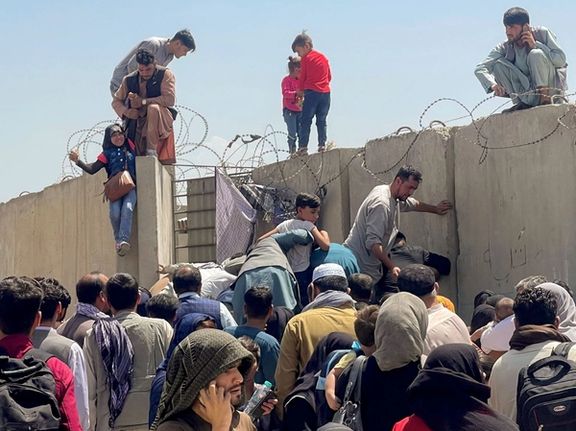
Afghans trying to flee after the Taliban takeover, in Kabul airport. August 16, 2021

Iran has proposed that Muslim states establish a joint fund to help stabilize Afghanistan and prevent a serious crisis from impacting other regional countries.

Addressing the 17th Extraordinary Session of the OIC Council of Foreign Ministers in Islamabad, Pakistan, on Sunday, Iranian Foreign Minister Hossein Amir-Abdollahian said that the collective interests of the entire region depends on security and stability in Afghanistan.

Contributions by neighboring countries along with their humanitarian assistance are among the most urgent requirements for supporting the Afghan people, he added.

Tehran’s chief diplomat criticized the international community's “indifference” toward the situation of Afghan refugees in Iran, saying that Iran has tried to keep its borders open. Amir-Abdollahian noted, "During the past 40 years, the Islamic Republic of Iran has been hosting millions of Afghan refugees and immigrants" while it “has not received any international aid for this particular purpose so far.”

Despite Amir-Abdollahian’s claim, UNHCR, the UN refugee agency has been aiding Afghan refugees in Iran, including health insurance for 120,000 people. Many governments, such as South Korea, Germany and Italy have also made contributions. Seoul so far has donated $30 million dollars through the United Nations.

Elsewhere during his speech, Amir-Abdollahian also called on foreign banks to release billions of dollars of Afghanistan’s assets that were frozen after Taliban took over the country.

In October the US Treasury announced that it is holding firm on its freeze of Afghan central bank reserves to deny access to the Taliban. Since August, the Taliban have been trying hard to get hold of almost $10 billion worth of assets, which are largely kept in the US.

Iran’s top diplomat stated that sustainable calm in Afghanistan is only possible through an inclusive and effective government in which all ethnic and religious groups would be present. Pointing to Afghanistan’s empty seat in the conference, he also expressed hope that the country will be able to send its representatives to the next OIC summit.

On the sidelines of the conference, Amir-Abdollahian held a meeting with Pakistan’s Prime Minister Imran Khan, in which he stressed the necessity of sending humanitarian aid to Afghanistan as soon as possible.

“The Islamic Republic of Iran supports dispatch of humanitarian aid to Afghanistan regardless of political issues… To this end, while keeping its borders open, the Islamic Republic of Iran is ready to cooperate with all countries to get aid to people of Afghanistan,” he said during the meeting.

Envoys from 57 Muslim nations as well as representatives from the United Nations and international financial institutions, plus the United States, the European Union and Japan attended the two-day summit aimed at relieving the humanitarian crisis in Afghanistan.

Tehran insists that despite an economic crisis due to US sanctions, it has accepted more than 300,000 Afghan refugees following the collapse of the government in Kabul.

However, the International Organization for Migration said in November that Iranian and Pakistani authorities have sent back more than one million Afghan refugees this year, including more than 28,000 people only in the last week of October. “The majority were deported, returning to Afghanistan often broke and broken, in need of health support, food and rest,” said an IOM statement.

The United Nations refugee agency’s appeal to support Afghans fleeing to neighboring countries has called for nearly $300 million to help up to 515,000 people that may flee before the end of the year. About $136 million of the total appeal funding is needed to support Afghans in Iran.

According to the Norwegian Refugee Council, 4,000 to 5,000 Afghans flee across the border to Iran every day. It says some 3.6 million Afghans reside in Iran, although only 780,000 are recognized as refugees. Most other Afghans are considered economic migrants who have been an important workforce in Iran.


Most Viewed

Iran negotiators ordered to return after internal rift over Islamabad talks
1
EXCLUSIVE

Iran negotiators ordered to return after internal rift over Islamabad talks

2
ANALYSIS

US blockade enters murky phase as tankers spoof signals and buyers hesitate

3
ANALYSIS

Why the $100 billion Hormuz toll revenue is a myth

4

US tightens financial squeeze on Iran, warns banks over oil money flows

5
INSIGHT

Ideology may be fading in Iran, but not in Kashmir's ‘Mini Iran'

Banner
Banner

Spotlight

  • Hardliners push Hormuz ‘red line’ as US blockade tests Iran’s leverage
    INSIGHT

    Hardliners push Hormuz ‘red line’ as US blockade tests Iran’s leverage

  • Ideology may be fading in Iran, but not in Kashmir's ‘Mini Iran'
    INSIGHT

    Ideology may be fading in Iran, but not in Kashmir's ‘Mini Iran'

  • War damage amounts to $3,000 per Iranian, with blockade set to add to losses
    INSIGHT

    War damage amounts to $3,000 per Iranian, with blockade set to add to losses

  • Why the $100 billion Hormuz toll revenue is a myth
    ANALYSIS

    Why the $100 billion Hormuz toll revenue is a myth

  • US blockade targets Iran oil boom amid regional disruption
    ANALYSIS

    US blockade targets Iran oil boom amid regional disruption

  • Iran's digital economy battered by prolonged blackout
    INSIGHT

    Iran's digital economy battered by prolonged blackout

•
•
•

More Stories

Iran Plans To Take More Money From National Reserves

Dec 19, 2021, 20:35 GMT+0
•
Maryam Sinaiee

Iran’s government is again planning to take money from the National Development Fund (NDF) to finance its budget next year, as sanctions have cut its revenues.

The government’s plan is to slash in half the amount of money from oil sales which is supposed to be saved in the NDF and spend it on its operations.

According to the charter of the National Development Fund, 40 percent of oil revenues next year should be saved by the government in the fund for investment on productive economic activities that would guarantee the welfare of future generations. NFD is a sovereign wealth fund.

Now, the budget bill presented to parliament on December 12, proposes to save only 20 percent of oil revenues and transfer the other 20 percent to the government.

At the time of its establishment, the fund's share from oil revenues was 20 percent to be increased by 3 percent annually until the end of the Fifth [five-year] Socio-Economic Plan in 2016. The fund's share from oil revenues increased to 30 percent with a 2 percent annual increase during of the Sixth [Five-year] Socio-Economic Plan.

"What has happened in reality, however, is [various] administrations' request to pay less into the fund and to take hold of the rest [of the money destined for the fund] as [US] sanctions grew stronger and oil revenues fell," the Iranian Students News Agency (ISNA) wrote Sunday.

Another problem with this scheme is that Iran might not be able to repatriate all the oil revenues because of US banking sanctions, which means the NDF money the government wants to spend will not enter the country as hard currency. Economists say that in such a case, borrowing from the fund would mean printing Iranian rials and spending it in the country, further fuelling inflation, which now stands at the annual rate of 45 percent.

Since its establishment in 2000 as a currency reserve fund, all administrations have borrowed from the fund for various purposes, including 2 billion euros in 2019 to increase the military's budget. The administration of President Mahmoud Ahmadinejad borrowed heavily from the fundwhich had been handed over to him with over $24b, including $2.7b to pay New Year cash handouts to all Iranians in 2013.

In 2008 the government of President Ahmadinejad classified information about the fund. In 2013, the newly elected President Hassan Rouhani said the fund had completely been drained by his predecessor's government. There is currently no concrete information on the fund's assets, but it is clear billion were withdrawn since 2018 when the United States abandoned the 2015 nuclear agreement and imposed sanctions.

The amount that the Raisi administration intends to borrow, half of the fund's share, will be the largest percentage ever drawn from the fund.

Withdrawing, or borrowing, from the fund requires the approval of Supreme Leader Ali Khamenei.

In 2020, Khamenei did not approve the Rouhani administration's request to slash NDF’s share from oil revenues and add it to its budget revenues.

Paper In Iran Warns Of 'Revolution By The Barefoot Against Aristocracy'

Dec 19, 2021, 16:38 GMT+0
•
Iran International Newsroom

Data published in Iran recently, showing a vast differences between minimum and maximum salaries in the government seems to have taken the nation by surprise.

The data is based on payment information across the government between March and November 2021.

Meanwhile, a conservative daily in Tehran, the Jomhouri Eslami newspaper, wrote on Sunday, December 19that the gap between minimum wage and hefty salaries for certain managers can lead to a catastrophe.

The leaked data, published by the conservative news website Alefindicates that minimum wages across the Executive, Judiciary and Legislative bodies, as well as Supreme Leader Ali Khamenei's office, and other government institutions is fixed at a flat 32,550,000 rial rate, or a little over $100 a month. The purchasing power of $100 is a little bit more in Iran than in Western countries, but still a family of 3 cannot afford the bare necessities with that amount of money.

However, the highest earning personnel at those entities receive salaries at different levels. The monthly salary of the highest paid government employee in Iran at the executive branch is 2.84 billion rials, or around $10,000. This is followed by 1.84 billion rials at the judiciary branch and 830 million rials in the legislative branch, and 485 million rials at Khamenei's office.

A luxurious mansion in Tehran rented out only in US dollars. Undated
100%
A luxurious mansion in Tehran rented out only in US dollars.

These salaries include workers and managers at state-owned industries, which are mostly money-losing enterprises.

Alef quoted Vice President Meysam Latifi as saying that high earners receive up to 62 times more salary than the low earning government personnel, although the difference is closer to 100 times.

Jomhouri Eslami wrote that the highest salaries at the executive and judiciary branches should no longer be called "astronomical salaries," as these are "super astronomical figures."

The official poverty line in Iran is drawn just under 100 million rials per month. However, most low-paid workers earn around or less than 40 million rials per month and manage to survive in a mysterious way.

Iranian media have been reporting that meet, fruits and dairy products are now consumed regularly only by a minority and consumption of these food staples have decreased up to 50 percent.

According to Jomhouri Eslami, a maximum of 10 percent of the employees receive the highest payments in the range while the other 90 percent fall below the official poverty line. Meanwhile, the high earners are those who receive separate allowances for housing and transportation while low earners have to have another job after their first work to make ends meet and most of them are tenants.

The high paid employees are usually well-connected individuals who have access to extra legitimate or illicit incomes if they are part of the financial corruption network in the country.

Jomhouri Eslami wrote that the existence of shanty towns next to luxurious buildings in most parts of Iran is indicative of a vast class difference which is getting wider by the day, while the government seems to have no plan to bridge the gap in any way.

The daily wrote, "Although the society looks calm on the surface, there are alarming signs hiding under the skin. There is a limit to the people's patience and if it ends, the gathering storm will eventually arrive to trigger explosive changes that will sweep aside everything and everyone. This means if there is going to be a revolution, it is likely to be one by the barefoot people against an aristocracy that earns astronomical salaries and has access to the cash coming out of corruption."

The daily warned: "This is something that is most certainly likely to happen if the current situation continues."

Iranian Greco-Roman Wrestler Defects To Serbia

Dec 19, 2021, 12:15 GMT+0

Iran’s Greco-Roman national team wrestler Ali Arsalan has defected and will represent Serbia in future competitions, including the upcoming European championship.

In addition to his many national titles, Arsalan has earned four gold medals and two bronzes in Asian tournaments during his career. He has not commented on reasons for his defection.

Arsalan, who left U23 World Wrestling Championships in Romania emptyhanded in 2018, is set to be competing as a member of the Serbian national team in the 72-kilogram category.

The news of Arsalan’s defection comes only days after a member of the Iranian women’s handball team, Shaqayeq Bapiri, confirmed after a tournament in Spain that she broke away from the team and would not return due to forced hijab rules in Iran and other restrictions. Last year, Iran's only female Olympic medalist Kimia Alizadeh changed her nationality.

Around 30 Iranian athletes have defected in recent years, seeking asylum in other countries. Some took part in this year’s Olympics in Tokyo as non-state athletes.

In addition to dress code restrictions, another issue forcing Iranian athletes to defect is Tehran’s policy of not allowing them to compete against Israelis, as was the case for Iranian judoka Olympian, and 2018 world champion Saeid Mollaei.

First Omicron COVID Case Confirmed In Iran

Dec 19, 2021, 11:32 GMT+0

An Iranian health official said Sunday it has detected its first case of infection by the Omicron variant of the coronavirus in the country.

Director of Iran’s Center for Disease Control Mohammad Mehdi Gouya told state TV that the first case was verified and there might be two other possible cases whose tests are yet to be confirmed. He added that the first case was a traveler who had returned from the United Arab Emirates.

The new variant has been spreading fast around the globe less than a month after scientists warned the World Health Organization of the new threat.

Iran has reportedly vaccinated about 60 percent of its 84-million population with two doses of Covid vaccines, mainly the Chinese-made Sinopharm while the Russian Sputnik-V and the British-Swedish AstraZeneca have also been used.

Although fatal cases have been decreasing during the past few weeks due to vaccination, the Omicron may push the death rate to a new peak in the upcoming cold winter months. A new study has indicated that Sinopharm and Sputnik vaccines are weaker against Omicron.

With over 130,000 officially announced deaths, Iran has the worst fatality rate among the countries of the Middle East, mostly because the attempts in lockdowns were haphazardly managed and vaccination was delayed due to a ban by Supreme Leader Ali Khamenei in January against purchasing British and American vaccines.

Iran's Ambassador With Houthis Leaves Yemen Amid Conflicting Reports

Dec 19, 2021, 11:15 GMT+0

Iran's ambassador with Houthi rebels has left Yemen amid controversy whether he was sent back by his hosts or he contracted coronavirus and needed treatment.

Iranian and Houthi official have denied a Wall Street Journal report about Houthis sending the ambassador back due to disputes with Tehran.

Foreign Ministry Spokesman Saeed Khatibzadeh said in a tweet Saturday that the Iranian envoy to Sanaa, Hassan Irloo (Irlu), was brought back home for Covid treatment "with the assistance of some regional countries" and thanked "the countries that contributed to this humanitarian measure."

Muhammad Abdul Salam, the Houthi group's chief negotiator and spokesman, said in tweet Saturday also said that the Iranian ambassador was repatriated due to his health circumstances. "The accounts and speculations reported in the media are untrue," he wrote. Abdul Salam said an "Iranian-Saudi understanding mediated by Baghdad" resulted in Irloo's repatriation on an Iraqi plane.

Abdul Malik al-Ajri, another Houthi official, also said in a tweet that the Iranian ambassador's repatriation was "purely for health reasons" and had nothing to do with "disputes with our Iranian friends as foreign media claimed."

A high-ranking Saudi official told AFP Saturday that the Iranian ambassador had left on an Iraqi plane and was probably in Baghdad. He said following mediation by Iraq and Oman, the Saudi authorities permitted the flight at the request of the Houthis.

Iraq had to get involved in the repatriation of the Iranian ambassador as Saudi Arabia would not allow Iran to fly a plane to the Yemeni capital Sanaa which is controlled by the Houthis.

"The Houthi forces have asked Saudi Arabia, which maintains a sweeping air blockade of Yemen’s capital, to let the top Iranian diplomat in the country immediately fly back to Iran, a request seen by Saudi officials as a sign of strains between Tehran and the militant group," the Wall Street Journal said in a report Saturday.

The Wall Street Journal quoted an unnamed regional official as saying that Irloo had become "a burden" and a "political problem" for the Houthis.Irloo has been deeply involved in helping the Houthis with battlefield planning, but his influence in Yemen has bolstered a negative perception in the country that the militant force answers to Tehran, according to regional officials, the newspaper wrote.

Iran said in October that its new ambassador, Hassan Irloo, had arrived in Sanaa and would present his credentials to the Houthi government. Iran's previous ambassador left Sanaa in 2015.

The manner of Irloo's arrival in Sanaa despite the Saudi blockade was not disclosed. Irloo is a member of Iran's Revolutionary Guards (IRGC) with close ties to Lebanese Hezbollah. He was sanctioned by the US Treasury Department in December 2020 due to his connections with the IRGC's Qods Force.

Houthis had dispatched Ibrahim al-Dulaimi, a former director general of the Houthi Al Masirah TV, To Tehran in 2019. The internationally recognized Yemeni government condemned the appointment as a breach of “international laws and said it contravened UN Security Council resolutions related to the Yemen crisis.

Iran is the only country that has diplomatic relations with the rebel Houthi government which controls Sanaa and much of the north of Yemen.

The Saudi-led coalition which supports Yemen's internationally recognized government and has fought alongside it since 2015 has repeatedly accused Iran of arming the Houthi rebels. Tehran has always denied Iran's involvement in Yemen or providing weapons including missiles to the Houthis.