• العربية
  • فارسی
Brand
  • Iran Insight
  • Politics
  • Economy
  • Analysis
  • Special Report
  • Opinion
  • Podcast
  • Iran Insight
  • Politics
  • Economy
  • Analysis
  • Special Report
  • Opinion
  • Podcast
  • Theme
  • Language
    • العربية
    • فارسی
  • Iran Insight
  • Politics
  • Economy
  • Analysis
  • Special Report
  • Opinion
  • Podcast
All rights reserved for Volant Media UK Limited
volant media logo

Iran's Ambassador With Houthis Leaves Yemen Amid Conflicting Reports
Dec 19, 2021, 11:15 GMT+0
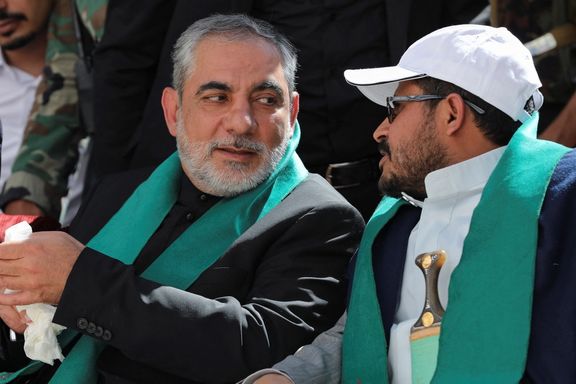
Hassan Irloo at a ceremony in Yemen with Houthi officials. Janyary2, 2021

Iran's ambassador with Houthi rebels has left Yemen amid controversy whether he was sent back by his hosts or he contracted coronavirus and needed treatment.

Iranian and Houthi official have denied a Wall Street Journal report about Houthis sending the ambassador back due to disputes with Tehran.

Foreign Ministry Spokesman Saeed Khatibzadeh said in a tweet Saturday that the Iranian envoy to Sanaa, Hassan Irloo (Irlu), was brought back home for Covid treatment "with the assistance of some regional countries" and thanked "the countries that contributed to this humanitarian measure."

Muhammad Abdul Salam, the Houthi group's chief negotiator and spokesman, said in tweet Saturday also said that the Iranian ambassador was repatriated due to his health circumstances. "The accounts and speculations reported in the media are untrue," he wrote. Abdul Salam said an "Iranian-Saudi understanding mediated by Baghdad" resulted in Irloo's repatriation on an Iraqi plane.

Abdul Malik al-Ajri, another Houthi official, also said in a tweet that the Iranian ambassador's repatriation was "purely for health reasons" and had nothing to do with "disputes with our Iranian friends as foreign media claimed."

A high-ranking Saudi official told AFP Saturday that the Iranian ambassador had left on an Iraqi plane and was probably in Baghdad. He said following mediation by Iraq and Oman, the Saudi authorities permitted the flight at the request of the Houthis.

Iraq had to get involved in the repatriation of the Iranian ambassador as Saudi Arabia would not allow Iran to fly a plane to the Yemeni capital Sanaa which is controlled by the Houthis.

"The Houthi forces have asked Saudi Arabia, which maintains a sweeping air blockade of Yemen’s capital, to let the top Iranian diplomat in the country immediately fly back to Iran, a request seen by Saudi officials as a sign of strains between Tehran and the militant group," the Wall Street Journal said in a report Saturday.

The Wall Street Journal quoted an unnamed regional official as saying that Irloo had become "a burden" and a "political problem" for the Houthis.Irloo has been deeply involved in helping the Houthis with battlefield planning, but his influence in Yemen has bolstered a negative perception in the country that the militant force answers to Tehran, according to regional officials, the newspaper wrote.

Iran said in October that its new ambassador, Hassan Irloo, had arrived in Sanaa and would present his credentials to the Houthi government. Iran's previous ambassador left Sanaa in 2015.

The manner of Irloo's arrival in Sanaa despite the Saudi blockade was not disclosed. Irloo is a member of Iran's Revolutionary Guards (IRGC) with close ties to Lebanese Hezbollah. He was sanctioned by the US Treasury Department in December 2020 due to his connections with the IRGC's Qods Force.

Houthis had dispatched Ibrahim al-Dulaimi, a former director general of the Houthi Al Masirah TV, To Tehran in 2019. The internationally recognized Yemeni government condemned the appointment as a breach of “international laws and said it contravened UN Security Council resolutions related to the Yemen crisis.

Iran is the only country that has diplomatic relations with the rebel Houthi government which controls Sanaa and much of the north of Yemen.

The Saudi-led coalition which supports Yemen's internationally recognized government and has fought alongside it since 2015 has repeatedly accused Iran of arming the Houthi rebels. Tehran has always denied Iran's involvement in Yemen or providing weapons including missiles to the Houthis.


Most Viewed

US blockade enters murky phase as tankers spoof signals and buyers hesitate
1
ANALYSIS

US blockade enters murky phase as tankers spoof signals and buyers hesitate

2

US tightens financial squeeze on Iran, warns banks over oil money flows

3
INSIGHT

Ideology may be fading in Iran, but not in Kashmir's ‘Mini Iran'

4
INSIGHT

Hardliners push Hormuz ‘red line’ as US blockade tests Iran’s leverage

5
VOICES FROM IRAN

Hope and anger in Iran as fragile ceasefire persists

Banner
Banner

Spotlight

  • Hardliners push Hormuz ‘red line’ as US blockade tests Iran’s leverage
    INSIGHT

    Hardliners push Hormuz ‘red line’ as US blockade tests Iran’s leverage

  • Ideology may be fading in Iran, but not in Kashmir's ‘Mini Iran'
    INSIGHT

    Ideology may be fading in Iran, but not in Kashmir's ‘Mini Iran'

  • War damage amounts to $3,000 per Iranian, with blockade set to add to losses
    INSIGHT

    War damage amounts to $3,000 per Iranian, with blockade set to add to losses

  • Why the $100 billion Hormuz toll revenue is a myth
    ANALYSIS

    Why the $100 billion Hormuz toll revenue is a myth

  • US blockade targets Iran oil boom amid regional disruption
    ANALYSIS

    US blockade targets Iran oil boom amid regional disruption

  • Iran's digital economy battered by prolonged blackout
    INSIGHT

    Iran's digital economy battered by prolonged blackout

•
•
•

More Stories

Rocket And Drone Attacks Launched In Baghdad And Against Saudi Arabia

Dec 19, 2021, 09:14 GMT+0

Two Katyusha rockets hit Baghdad's fortified Green Zone early on Sunday as Saudi Arabia said it destroed two drones launched by Iran-backed Yemeni Houthis.

One rocket was destroyed in the air by the C-RAM defense system and the other landed near the zone's festivals arena damaging two cars, the report added.

Security forces started an investigation to detect the launch site, the agency reported.

Saudi Arabia also reported that its air defences on Sunday destroyed two drones launched by Yemen's Houthis toward the Abha international airport in the southwest of the kingdom.

A US military official told Reuters that the C-RAM system brought down one of the rounds and none of them landed on the US embassy. The official said there were no American casualties.

The Green Zone hosts foreign embassies, including the US embassy, and government buildings and is regularly the target of rockets fired by groups that US and Iraqi officials say are backed by Iran.

US officials have said Iranian-backed militia could increase attacks on US troops in Iraq and Syria in coming weeks, in part to mark the anniversary of the killing of top Iranian general Qasem Soleimani and Iraqi militia commander Abu Mahdi al-Muhandis.

The two were killed by a US drone strike in Baghdad on January 3, 2020.

Reporting by Reuters

Dismissal Of Prominent Sunni Cleric Draws Outrage In Northern Iran

Dec 19, 2021, 07:53 GMT+0

Supreme Leader Ali Khamenei has warned Sunni religious leaders in Iran against any protests to the dismissal of a popular Imam who had made controversial remarks.

Khamenei’s representative in Golestan province, with a large Sunni population, earlier this week dismissed Mowlavi Hossein Gorgij, an outspoken and popular religious leader revered by his followers.

The dismissal led to public outrage and protests in the northeastern region in the city of Azadshahr, where Gorgij was the Friday Prayer Imam.

The decision to fire the Sunni cleric was announced as a reaction to some of his remarks that were deemed insulting to Shia sanctities. Gorgij, however, issued a statement afterwards to apologize, clarifying that his speech was misinterpreted, and he meant no disrespect towards the Shias.

Gorgij was sacked by Ali Khamenei’s representative in the province, Kazem Nour-Mofidi, a member of the Assembly of Experts and the oldest Friday Prayer leader in the country.

Nour-Mofidi then appointed a new Imam for Sunni Muslims in Azadshahr. Such interventions by a Shiite official in the Sunni community are rare.

The move against the Sunni Imam, who had earlier condemned the Islamic Republic's police brutality against citizens, has prompted several protests Khamenei's decision across the province.

Israel Cannot Destroy Iran's Nuclear Program, Former Officials Say - NYT

Dec 18, 2021, 19:00 GMT+0

Current and former Israeli military officials have said that Israel does not have the ability to inflict significant damage on Iran’s nuclear infrastructure.

In recent months Israeli officials, nervous about a new agreement between the United States and Iran, have repeatedly said they will take action to defend their nation if Iran is believed to be close to producing a nuclear bomb.

But The New York Times reported Saturday that current and former Israeli military figures and experts doubt Israel has the capability to destroy or significantly delay Iran’s nuclear program, which is dispersed throughout the large country and some hidden underground.

Experts and officials said that a small-scale attack damaging parts of Iran’s infrastructure might be possible in months while a large attack would take two years to prepare and are currently beyond Israel’s capabilities. One former Israeli general said the only air force capable of a sustained attack is the US Air Force.

Since July 2020, many mysterious sabotage attacks have hit Iran’s sensitive installations, including two devastating explosions at Natanz uranium enrichment site, widely attributed to Israel. These have caused some slowdown, but Iran continues to enrich uranium at higher levels, getting closer to having enough fissile material for a bomb.

Former Iran Speaker Barred From Presidential Race Challenges Decision

Dec 18, 2021, 18:16 GMT+0

Six months after Iran's hardliner Guardian Council barred a former parliament speaker from running for president it has finally tried to defend its decision.

The Guardian Council, a constitutional watchdog vetting candidates and supervised by Supreme Leader Ali Khamenei, offered 7 explanations about Ali Larijani’s disqualification, some simply political in nature and others less than substantiated or not representing any legal prohibition.

One reason given by the Council is a vague reference to Larijani past remarks regarding the disputed 2009 election, when millions protested the decision to announce Mahmoud Ahmadinejad the winner of the presidential race. Conservatives suppressed the protests and called the demonstrators provocateurs. But there is no record of Larijani defending the protesters.

The Council also cited accusations including his son's involvement in dubious contracts with the parliament, some of his relatives' residence in the United Kingdom and the United States which the council described as "belligerent states," frequent visits to foreign countries by Larijani's family members, following a luxurious lifestyle, and sharing responsibility for the undesirable situation of the country.

The letters were exchanged by Larijani and the Guardian Council in September, but they were released by the press on Saturday.

The Council also disqualified other strong candidates in what the many saw was a blatant attempt to ensure a win for Ebrahim Raisi, the current president.

Earlier, Larijani had repeatedly called on the Council to let the public know why he was barred from running, but the council replied that it would not be in Larijani's interest.

Following the disqualification, his brother Sadeq Larijani who was a member of the Guardian Council, protested the decision and charged that it was based on wrong information given to the council by IRGC's intelligence organization.

Later Supreme Leader Ali Khamenei called on the Guardian Council "to make up for its unfair treatment" without actually mentioning Ali Larijani.

Meanwhile, Ali Larijani wrote a strongly worded reply to the Council's Secretary, hardline cleric and politician Ahmad Jannati explaining that one of his children lives in the United States where he or she is studying, and this is different from frequent visits.

He also asked the Council whether the family members of "qualified" candidates have not been visiting foreign countries frequently.

Larijani also said he has asked the Judiciary Chief to launch an investigation into his son's involvement in construction contracts with the parliament. He further explained that he has always been living in his grandfather's luxurious home in north Tehran since 1977.

Responding to the charges of "sharing responsibility for the undesirable situation of the country" Larijani asked if the Guardian Council believed Khamenei was also responsible for that when he was Iran's President in the late 1980s and early 1990s. However, he did not mention Khamenei's responsibility as the Islamic Republic's leader during the past 30 years.

Larijani concluded: "Just say that you wanted to get rid of me," and questioned the Council's competency to make such judgements.

Iranian analysts Mehdi Mahdavi Azad and Jamshid Barzegar told Iranian International Television on Saturday that both Jannati and Larijani know the real reason why he was disqualified. The true reason for the whole episode is that Ali Khamenei decided to purge some of the individuals in his inner circle. He got rid of Larijani in the same way he got rid of former Presidents Akbar Rafsanjani and Mahmoud Ahmadinejad, said Mahdavi Azad.

Iran Minister Speaks Of 'Good News' About a Satellite Launch Till March

Dec 18, 2021, 09:51 GMT+0

Iran’s communication minister said Saturday "there will be good news” about launching a satellite until March, after recent reports about preparations at a launch site.

The Associated Press reported earlier this week that evidence points to Iran preparing a space launch and Iranian media offered a list of upcoming planned satellite launched.

In his first press conference, communication minister Issa Zarepour said that Iran’s space program was put on the backburner during former president Hassan Rouhani’s eight-year administration (2013-2021), but now its budget has increased. He added that the country needs a ten-year plan to expand its satellite program to put vehicles at a higher orbit.

Currently, Iran can reach 500 kilometers into space, which is considered a lower orbit. President Hassan Rouhani ordered officials to aim for the 36,000-kilometer orbit and increased the space program budget up to 12 times.

Foreign observers and governments have charged that Iran's space program is a cover to justify its testing of ballistic missiles. Israel and the United States have said that Iran's space program is against a UN resolution banning Iranian missiles with nuclear weapons capability.





