• العربية
  • فارسی
Brand
  • Iran Insight
  • Politics
  • Economy
  • Analysis
  • Special Report
  • Opinion
  • Podcast
  • Iran Insight
  • Politics
  • Economy
  • Analysis
  • Special Report
  • Opinion
  • Podcast
  • Theme
  • Language
    • العربية
    • فارسی
  • Iran Insight
  • Politics
  • Economy
  • Analysis
  • Special Report
  • Opinion
  • Podcast
All rights reserved for Volant Media UK Limited
volant media logo

Riyadh Warns Gulf Summit About Iran's Nuclear, Missile Programs
Dec 14, 2021, 20:14 GMT+0
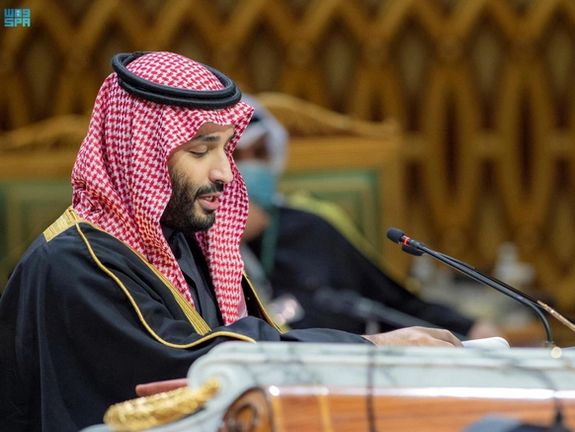
Saudi Crown Prince Mohammed bin Salman speaks during the Gulf Summit in Riyadh, Saudi Arabia, December 14, 2021.

Saudi Arabia has told a Gulf Arab summit on Tuesday Iran’s nuclear and missile programs should be handled "seriously and effectively" amid nuclear talks with Tehran.

Saudi Crown Prince Mohammed bin Salman, speaking before a closed session of the Gulf Cooperation Council (GCC) summit, also said Riyadh, which has launched its own direct talks with Iran, supported resolving conflict through dialogue.

After a few rounds of talks earlier this year, there have been no new meetings between Riyadh and Tehran. Saudi officials have said that talks so far have been exploratory. Riyadh's UN envoy Abdallah Al-Mouallimi told Saudi newspaper Arab News in a video interview published on Monday that no major results had been achieved. He said Tehran was so far biding its time and playing "games" in the discussions.

Closing remarks read by GCC Secretary General Nayef al-Hajraf stressed the importance of joint efforts by Gulf states to face threats and to avoid regional and international conflicts.

"Member states of the (GCC) consider that any attack on any of them is an attack on them all, and any danger that threatens one of them is threatening them all," he said.

Leaders attend the Gulf Summit in Riyadh, Saudi Arabia, December 14, 2021.
100%
Leaders attend the Gulf Summit in Riyadh, Saudi Arabia, December 14, 2021.

Saudi Arabia and non-Gulf Egypt have restored diplomatic ties with Qatar but the United Arab Emirates and Bahrain have yet to do so, though Abu Dhabi has moved to mend fences.

"There are areas that will need some time, but... practical, functional (Gulf) cooperation is back on track," senior UAE official Anwar Gargash said last week.

Prince Mohammed had visited Gulf states ahead of the summit in a tour aimed at highlighting solidarity as global powers seek to revive a nuclear pact with Iran, amid deepening Gulf uncertainty about the US role in the region.

Riyadh and Abu Dhabi, concerned about Iran's nuclear ambitions, missile program and regional proxies, are engaging with Tehran to contain tension.

Iran's new, hardline president has said his foreign policy priority would be improving ties with Gulf neighbors.

But nuclear talks in Vienna aimed at restoring the 2015 nuclear agreement between Iran and world powers face uncertainty, while Iran is enriching more uranium and getting closer to a nuclear breakout point.

Hajraf told Saudi TV ahead of the summit that Iran should "offer indications of good intent".

Saudi Arabia and the UAE have moved away from hawkish foreign policies that saw them wade into Yemen and lead the boycott of Qatar, to a more conciliatory approach as they vie to lure foreign investment and win over US President Joe Biden.

Abu Dhabi has moved faster to improve ties with Iran and Turkey while also re-engaging with Syria after forging relations with Israel last year.

Reporting by Reuters

Most Viewed

US blockade enters murky phase as tankers spoof signals and buyers hesitate
1
ANALYSIS

US blockade enters murky phase as tankers spoof signals and buyers hesitate

2
INSIGHT

Ideology may be fading in Iran, but not in Kashmir's ‘Mini Iran'

3
INSIGHT

Hardliners push Hormuz ‘red line’ as US blockade tests Iran’s leverage

4
VOICES FROM IRAN

Hope and anger in Iran as fragile ceasefire persists

5

US sanctions oil network tied to Iranian tycoon Shamkhani

Banner
Banner

Spotlight

  • Hardliners push Hormuz ‘red line’ as US blockade tests Iran’s leverage
    INSIGHT

    Hardliners push Hormuz ‘red line’ as US blockade tests Iran’s leverage

  • Ideology may be fading in Iran, but not in Kashmir's ‘Mini Iran'
    INSIGHT

    Ideology may be fading in Iran, but not in Kashmir's ‘Mini Iran'

  • War damage amounts to $3,000 per Iranian, with blockade set to add to losses
    INSIGHT

    War damage amounts to $3,000 per Iranian, with blockade set to add to losses

  • Why the $100 billion Hormuz toll revenue is a myth
    ANALYSIS

    Why the $100 billion Hormuz toll revenue is a myth

  • US blockade targets Iran oil boom amid regional disruption
    ANALYSIS

    US blockade targets Iran oil boom amid regional disruption

  • Iran's digital economy battered by prolonged blackout
    INSIGHT

    Iran's digital economy battered by prolonged blackout

•
•
•

More Stories

Government Proposes To Boost IRGC Budget More Than Twofold

Dec 14, 2021, 15:54 GMT+0
•
Iran International Newsroom

The public, formal part of Iran’s Revolutionary Guard budget will increase 2.4 times next year and Iran’s armed forces will receive crude oil to sell abroad.

In the budget draft bill presented to parliament on Sunday President Ebrahim Raisi’s government proposed a 930 trillion rial budget for Islamic Revolution Guard Corps, IRGC. Last year that number was 380 trillion rials and the year before that was 240 trillion.

The trajectory of ever higher budgets for the IRGC and other entities that directly support and defend the Islamic Republic against domestic opponents is vivid in the new draft. The fiscal year will start on March 21, 2022.

The state broadcaster, the main propaganda arm of the regime and a host of clerical entities will also receive double-digit boosts to the current budgets, while an $8-billion subsidy for imports of food and medicine will be discontinued.

In addition, the government announced that 4.5 billion euros worth of crude oil will be put at the disposal of the armed forces to sell. This means the lion’s share will go to the IRGC, which has to find middlemen and illicit ways to export the oil, giving rise to corruption.

The same scenario happened during former president Mahmoud Ahmadinejad’s presidency in early 2010s, when for example the police was given oil to sell to provide for its needs. In the end it came to light that nearly $200 million of oil revenue in 2012 was never returned to the country.

A businessman, Babak Zanjani, who is now in jail with the death penalty hanging over his head, was a middleman selling oil during international sanctions also in the early 2010s, who failed to pay back at least $2.7 billion. His accomplices in the government were never identified. It would have not been easy for him to embezzle such a large amount of money without insider support.

IRGC has a major role in illicit oil trade. In September 2020, Iran’s oil minister Bijan Zanganeh asked help from IRGC’s business conglomerate, Khatam al-Anbia Headquarters to help circumvent US sanctions and sell crude on international markets.

The increase in IRGC’s formal budget is only the visible part of the all-powerful military’s sources of income. Government organizations all contribute a percentage of their budget to the Revolutionary Guard, in addition to its vast economic and business empire that generates income and pays salaries of many loyalists.

Analysts often try to estimate IRGC’s budget in US dollars, a difficult task given various exchange rates applicable in Iran and determining what part of its expenses and to what extent are in dollars. For example, the current formal budget would be around $3.5 billion calculated in free-market rate, but using a government exchange rate, it comes closer to $5 billion.

Perhaps a better gauge is to look at Iran’s annual inflation rate. This year inflation hovers around 45-50 percent, but IRGC’s proposed budget jumped 2.4 times. Moreover, the government is proposing to increase salaries of its administrative and industrial workers by 10 percent, which is way below the inflation rate.

Tens of thousands of teachers protested nationwide on Monday for higher pay to keep up with a nearly 50-percent annual inflation. The state has delayed the implementation of a law that would have boosted teacher’s pay, arguing that it has no money amid US sanctions.

Iran Condemns Bennett's Visit To UAE, Seen As Historic

Dec 14, 2021, 14:08 GMT+0
•
Iran International Newsroom

Iran reacting to the visit of Israeli Prime Minister Naftali Bennett to the United Arab Emirates on Monday warned against any Israeli presence in the region.

Foreign ministry spokesman Saeed Khatibzadeh Monday evening said any step which leads to Israel’s presence in West Asia “is against the interests of Muslim countries and peoples in the region.”

Israeli Prime Minister Naftali Bennett made a two-day historic trip to the United Arab Emirates, the first visit by an Israeli premier as part of a blitz of regional diplomacy against the backdrop of struggling nuclear talks with Iran.

Bennett's office said the premier met Abu Dhabi's powerful Crown Prince Sheikh Mohammed bin Zayed Al Nahyan for some four hours, with more than half of the time spent in one-on-one talks.

Iran has started overtures to improve relations with the UAE and Saudi Arabia in recent months. Abu Dhabi’s top national security adviser Sheikh Tahnoon bin Zayed Al Nahyan visited Tehran last week after years of distance between the two countries. But Khatibzadeh condemned UAE’s decision to host Bennett. “To host the prime minister of an illegal regime…will remain in the historic memory of the Palestinians, the peoples of the region and all the freedom-lovers in the world,” he said.

Iran was discussed during the meeting although details have remained secret so far. Israel has made offers of military cooperation to the UAE and it was reported that small Arab country dangerously close to Iran across the Persian Gulf, wants to acquire the Iron Dome air defense system from Israel.

An Israeli expert on gulf affairs told AP Tuesday that the recent meeting between the Israeli prime minister and Abu Dhabi's crown prince was "very important".

Yoel Guzansky, a senior fellow at the Tel Aviv-based Institute for National Security Studies, said the meeting "sends a strong message to the region, to the global arena as well, in the background of the talks in Vienna".

Israel has watched with concern as Iran has pushed a hard line against negotiators meeting in Vienna, at once demanding sanctions relief while accelerating its nuclear program.

Guzansky said the talks send the message "that both countries see the threat from Iran and (are) working together on this issue," even if their strategies are different.

Israel and the UAE have long shared concerns about Iran's nuclear program.

Iran says its nuclear program is meant for peaceful purposes, while Israel, which considers Iran its greatest enemy, says it will not allow Iran to develop nuclear weapons.

Bennett on Monday said he was returning home "very optimistic" from the two-day trip to the UAE.

Israel and the UAE last year signed a deal to normalize relations that was brokered by the Trump administration under the "Abraham Accords," a series of diplomatic agreements with Arab countries that also included Bahrain, Sudan and Morocco.

"A new wind is blowing in the region, and I think new understanding between Israel and some of the countries in the region can be reached because of that," Guzansky said.

With reporting by AP

Gulf Arab Summit Aims To Signal Solidarity Amid Iran Tensions

Dec 14, 2021, 09:59 GMT+0

Persian Gulf Arab leaders gather on Tuesday for an annual summit expected to stress cohesion after a deep rift, at a time of regional concerns over Iran.

The Saudi crown prince toured Gulf states ahead of the summit, which comes nearly a year after Riyadh put an end to a 3-1/2-year Arab boycott of Qatar that had shattered the US-allied Gulf Cooperation Council.

"I have to admit there are areas that will need some time, but I mean practical, functional (Gulf) cooperation is back on track," senior UAE official Anwar Gargash said last week.

Saudi media said Crown Prince Mohammed bin Salman's tour aimed to highlight solidarity as global powers seek to revive a nuclear pact with Iran, amid deepening Gulf uncertainty about the US role in the region.

Riyadh and Abu Dhabi, concerned about Iran's nuclear ambitions, missile program and regional proxies, are engaging with Tehran to contain tension.

Saudi Arabia and the UAE have moved away from hawkish foreign policies that saw them wade into Yemen and lead the boycott of Qatar, to a more conciliatory approach as they vie to lure foreign investment and win over US President Joe Biden.

Abu Dhabi has moved faster to mend fences with Iran and Turkey while also re-engaging with Syria after forging ties with Israel last year.

Reporting by Reuters

New Budget Bill Means Even More Inflation For Iranians

Dec 14, 2021, 08:30 GMT+0

A leading economic daily in Tehran says the main implication of Iran's new budget bill for ordinary people would be higher inflation in the months to come.

Donyaye Eghtesad (World of Economy) has highlighted the elimination of cheap dollars government has been providing to importers of food and medicine as the main factor, which will boost prices.

The government's annual budget bill for the new Iranian year that starts on March 21,2022 was handed over to the parliament for ratification on Sunday. Usually, the bill will undergo dramatic changes before it takes its final shape probably in February or March.

During the past two years, the parliament and the government had so many problems over the annual budget that their debates remained inconclusive after several weeks and Supreme Leader Khamenei handed over the ratification of the bill to the heads of the executive, judiciary and legislative powers.

This year, political analysts have said that debates over the budget are likely to widen the gap between the parliament and the presidential administration more than ever before. The Majles Speaker, and the parliament's biggest fraction, the Paydari Party members are preparing to fight over the lion's share of the budget.

Last year a deputy Majles Speaker charged that Speaker Mohammad Bagher Ghalibaf made changes in the budget numbers after its final ratification. But the matter was pushed under the carpet to avoid further controversy.

According to Donyaye Eqtesad the delaying of retirement age will be raised to take some pressure off from the Social Security Organization. The organization has been facing problems in recent years as cash from the pension fund was diverted into some failed business activities, reducing available cash.

Olia Alibeigi, a member of the trustees of the organization has charged in an interview with the Iranian Labor News Agency (ILNA)on Monday that successive government and the parliament in Iran think they can withdraw money from the pension fund whenever they need to solve other economic problems.

Meanwhile, observers say an average 10 percent salary increase for government employees amid 50-percent inflation, will add to dissatisfaction among the workers. On Monday, thousands of Iranian teachers clashed with the police near the parliament after security agents attacked protesters who wanted a pay adjustment to make up for the impact of the country's back-breaking inflation. Not only government office workers are affected but millions of workers in state-owned industries.

Social media users in Iran have pointed out that the 10 percent raise for government employees is ridiculous while Raisi has proposed a 300-percent increase for the expenses of the Presidential Office.

Meanewhile, many economists argue that not providing cheap dollars to importers of essential goods, may save around $8 billion annually. But the problem is that many in parliament, economists and politicians say this would add fuel to inflation, which has already reached 45 percent this year.

Rising inflation, small salary increases and the amount of tax the government is planning to collect from citizens are likely to exert immense pressure on the nation. Experts talking to Iran International Television during Sunday and Monday predicted that one of the implications of the new budget bill is the increased likelihood of protests in Iran.

Israeli Leader Discusses Iran In First Visit To UAE

Dec 13, 2021, 16:30 GMT+0

Leaders of Israel and the United Arab Emirates discussed Iran in their first ever meeting on Monday but both sides gave little detail about their discussion.

The United Arab Emirates' de facto ruler Abu Dhabi Crown Prince Sheikh Mohammed bin Zayed al-Nahyan hosted Israel's Prime Minister Naftali Bennett in their first ever public meeting.

Israel's ambassador to Abu Dhabi said the issue of Iran was on the agenda for their talks, which follow the formalization of Israel-UAE relations last year under a US-led regional initiative.

While shared concern about Iranian activity was among reasons for establishing full relations, the UAE has also been trying to improve ties with Tehran, amid Iran’s expanding nuclear program.

Iran has condemned moves by Arab countries to normalize relations with Israel, although it has begun advocating close ties with neighbors since the election of President Ebrahim Raisi. Talks have also taken place between Iran and Saudi Arabia although no breakthrough has been achieved.

Releasing photographs of Bennett and Sheikh Mohammed smiling and shaking hands, the Israeli leader's office described the meeting as "historic".

Before he flew home later in the day, Bennett's office said in a statement that Sheikh Mohammed had accepted an invitation to visit Israel. There was no immediate confirmation from UAE officials.

A statement on state news agency WAM said Sheikh Mohammed voiced hope for "stability in the Middle East" and that Bennet's visit would "advance the relationship of cooperation towards more positive steps in the interests of the people of the two nations and of the region".

Israeli Ambassador Amir Hayek declined to elaborate on any discussion of Iran, but he told Israel's Army Radio: "The prime minister did not only come here solely to address the Iranian issue."

With world powers now trying to renew the Iran nuclear deal, Abu Dhabi last week sent an envoy to Tehran. A US delegation is due in the UAE this week to warn Emirati banks against non-compliance with sanctions on Iran.

Iran is Israel's arch-foe, but it has not been mentioned publicly by Bennett since he set off on Sunday to the UAE with pledges to promote bilateral commerce and other forms of civilian cooperation.

The Israel Hayom newspaper, quoting unnamed officials, said Bennett was expected to brief Sheikh Mohammed on intelligence regarding Iranian-supplied militias and drones in the region.

Israel last month broached setting up joint defenses against Iran with Gulf Arab states. Hayek said military sales to UAE are in the works, though Israeli industry sources say advanced Israeli air defense systems have yet to be offered.

"Israel is in cooperation with a new friend, with a partner for the long-term, and the considerations will be both considerations of defense and also considerations of how you work with a country which is very, very, very friendly to Israel," Hayek said.

Bennett said he told his government to step up efforts to reach a free trade agreement with the United Arab Emirates by the first quarter of 2022.

Israel-UAE bilateral trade in goods alone reached nearly $500 million so far in 2021 - up from $125 million in 2020 - and is expected to continue growing rapidly.

Reporting by Reuters