• العربية
  • فارسی
Brand
  • Iran Insight
  • Politics
  • Economy
  • Analysis
  • Special Report
  • Opinion
  • Podcast
  • Iran Insight
  • Politics
  • Economy
  • Analysis
  • Special Report
  • Opinion
  • Podcast
  • Theme
  • Language
    • العربية
    • فارسی
  • Iran Insight
  • Politics
  • Economy
  • Analysis
  • Special Report
  • Opinion
  • Podcast
All rights reserved for Volant Media UK Limited
volant media logo

Israeli Leader Discusses Iran In First Visit To UAE
Dec 13, 2021, 16:30 GMT+0
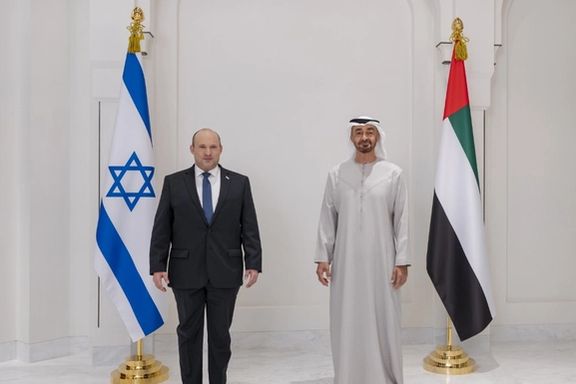
Israeli Prime Minister Naftali Bennet and Abu Dhabi Crown Prince Sheikh Mohammed bin Zayed al-Nahyan meeting on Monday.

Leaders of Israel and the United Arab Emirates discussed Iran in their first ever meeting on Monday but both sides gave little detail about their discussion.

The United Arab Emirates' de facto ruler Abu Dhabi Crown Prince Sheikh Mohammed bin Zayed al-Nahyan hosted Israel's Prime Minister Naftali Bennett in their first ever public meeting.

Israel's ambassador to Abu Dhabi said the issue of Iran was on the agenda for their talks, which follow the formalization of Israel-UAE relations last year under a US-led regional initiative.

While shared concern about Iranian activity was among reasons for establishing full relations, the UAE has also been trying to improve ties with Tehran, amid Iran’s expanding nuclear program.

Iran has condemned moves by Arab countries to normalize relations with Israel, although it has begun advocating close ties with neighbors since the election of President Ebrahim Raisi. Talks have also taken place between Iran and Saudi Arabia although no breakthrough has been achieved.

Releasing photographs of Bennett and Sheikh Mohammed smiling and shaking hands, the Israeli leader's office described the meeting as "historic".

Before he flew home later in the day, Bennett's office said in a statement that Sheikh Mohammed had accepted an invitation to visit Israel. There was no immediate confirmation from UAE officials.

A statement on state news agency WAM said Sheikh Mohammed voiced hope for "stability in the Middle East" and that Bennet's visit would "advance the relationship of cooperation towards more positive steps in the interests of the people of the two nations and of the region".

Israeli Ambassador Amir Hayek declined to elaborate on any discussion of Iran, but he told Israel's Army Radio: "The prime minister did not only come here solely to address the Iranian issue."

With world powers now trying to renew the Iran nuclear deal, Abu Dhabi last week sent an envoy to Tehran. A US delegation is due in the UAE this week to warn Emirati banks against non-compliance with sanctions on Iran.

Iran is Israel's arch-foe, but it has not been mentioned publicly by Bennett since he set off on Sunday to the UAE with pledges to promote bilateral commerce and other forms of civilian cooperation.

The Israel Hayom newspaper, quoting unnamed officials, said Bennett was expected to brief Sheikh Mohammed on intelligence regarding Iranian-supplied militias and drones in the region.

Israel last month broached setting up joint defenses against Iran with Gulf Arab states. Hayek said military sales to UAE are in the works, though Israeli industry sources say advanced Israeli air defense systems have yet to be offered.

"Israel is in cooperation with a new friend, with a partner for the long-term, and the considerations will be both considerations of defense and also considerations of how you work with a country which is very, very, very friendly to Israel," Hayek said.

Bennett said he told his government to step up efforts to reach a free trade agreement with the United Arab Emirates by the first quarter of 2022.

Israel-UAE bilateral trade in goods alone reached nearly $500 million so far in 2021 - up from $125 million in 2020 - and is expected to continue growing rapidly.

Reporting by Reuters

Most Viewed

US blockade enters murky phase as tankers spoof signals and buyers hesitate
1
ANALYSIS

US blockade enters murky phase as tankers spoof signals and buyers hesitate

2
INSIGHT

Ideology may be fading in Iran, but not in Kashmir's ‘Mini Iran'

3
INSIGHT

Hardliners push Hormuz ‘red line’ as US blockade tests Iran’s leverage

4
VOICES FROM IRAN

Hope and anger in Iran as fragile ceasefire persists

5

US sanctions oil network tied to Iranian tycoon Shamkhani

Banner
Banner

Spotlight

  • Hardliners push Hormuz ‘red line’ as US blockade tests Iran’s leverage
    INSIGHT

    Hardliners push Hormuz ‘red line’ as US blockade tests Iran’s leverage

  • Ideology may be fading in Iran, but not in Kashmir's ‘Mini Iran'
    INSIGHT

    Ideology may be fading in Iran, but not in Kashmir's ‘Mini Iran'

  • War damage amounts to $3,000 per Iranian, with blockade set to add to losses
    INSIGHT

    War damage amounts to $3,000 per Iranian, with blockade set to add to losses

  • Why the $100 billion Hormuz toll revenue is a myth
    ANALYSIS

    Why the $100 billion Hormuz toll revenue is a myth

  • US blockade targets Iran oil boom amid regional disruption
    ANALYSIS

    US blockade targets Iran oil boom amid regional disruption

  • Iran's digital economy battered by prolonged blackout
    INSIGHT

    Iran's digital economy battered by prolonged blackout

•
•
•

More Stories

Teachers Rally Across Iran On Third Day Of Strike

Dec 13, 2021, 16:05 GMT+0

On the third day of their strike, tens of thousands of teachers across Iran staged rallies Monday demanding higher pay and freedom for colleagues in prisons.

Teachers demanded implementation of legislation, which would bring salaries and pensions in line with of other civil servants, would benefit around 750,000 teachers.

The budget bill that President Ebrahim Raisi presented to parliament December 12 proposes increasing the education ministry's budget by 14 percent but does not identify specific resources to increase teachers' salaries matching the reform plan.

Videos posted on social media showed rallies in Tehran, tens of smaller cities, and most province capitals including, Ahvaz, Tabriz, Zanjan, Kerman, Rasht,Yasuj, and Bushehr.

In Sari, capital of the northern province of Mazandaran, protesters were reportedly arrested. Social media posts showed protestors outside parliament in Tehran shouting "scoundrels, scoundrels" at security forces. A video from Shirazshowed protesters chanting "Detained Teacher Must Be Freed,” "Rise Teachers to Eradicate Discrimination.”

Monday's protests were held without interior ministry permits. Unlicensed protests are illegal, and authorities recently dispersed recent unlicensed water protests in Khuzestan and Esfahan.

Some teachers also shouted slogans in support of Rasoul Bodaghi, a leading figure in a teachers' trade association, who was arrested Saturday.

Bodaghi has been briefly detained several times since release from prison in 2016 following a six-year prison sentence from a revolutionary court in 2010 for “assembly with the intent to disrupt national security” and propaganda against the state. In 2015 Bodaghi was sentenced to a further three years’ jail but the sentence was not enforced.

Protesting teachers demanded the freedom of detained colleagues and the recognition of their constitutional right to protest and form independent unions, both of which they say are curbed by the need for permission for protests.

Referring to water protesters in Esfahan, one protestor in Tehran carried a poster: "My pupil was blinded; shotgun pellet is not the response to demanding water." The poster referred to the crackdown on water protesters in Esfahan 26 November where several protesters were blinded by shotgun pellets.

This was widely circulated on social media. A medical official told Iranian state television on November 27 that 40 people in Esfahan had been treated for eye injuries sustained the previous day.

Iran Commander Says 'Misunderstandings' With Gulf States Partly Resolved

Dec 13, 2021, 15:05 GMT+0

The chief of staff of Iran’s armed forces said Monday that Tehran had meetings with Saudi And Emirati sides and to an extent “misunderstandings” were resolved.

General Mohammad Bagheri was speaking in a meeting with the visiting deputy commander of Oman’s armed forces. He added that no contacts have been established with Bahrain, but Oman can perhaps help in that matter.

Iranian and Saudi officials held meetings earlier this year, that according to Riyadh were exploratory and did not lead to any breakthrough. Saudi Arabia severed ties with Iran in 2016.

Saudi and Iranian experts took part in a security dialogue in the Jordanian capital Amman which discussed confidence-building measures between the regional rivals, Jordan's state news agency Petra reported on Monday.

A senior Iranian diplomat told Reuters that no Iranian official attended the session, which Petra said was hosted by the Arab Institute for Security Studies.

"What was held in Amman was not an official meeting. But of course, such meetings between academics are useful to give better understanding about realities between the two neighbors," the diplomat said.

Israeli Prime Minister Naftali Bennett visited Abu Dhabi and met Abu Dhabi Crown Prince Sheikh Mohammed bin Zayed al-Nahyan on Monday, where they discussed Iran among other issues.

US Forces, Allies Raid A Town In Syria Pursuing Gun Dealers, ISIS - Reports

Dec 13, 2021, 13:44 GMT+0

Syrian government and opposition media report a US airdrop in eastern Syria designed as a raid against arms dealers and people suspected of working with the Islamic State group.

The official Syrian news agency SANA reported of a US raid where civilians “were abducted”, while the Syrian Observatory for Human Rights (SOHR), an opposition monitoring group based in London described the operation as a security campaign.

The operation was conducted by Syria Democratic Forces allied with the United States and US Coalition Forces, according to SOHR, in Al-Busayrah town in the eastern Deir Ezzor province, early on Monday. There has been no confirmation from Coalition sources.

The report referring to SOHR’s local sources said four people were killed in the raid, including a teacher and his two sone. One of the sons was suspected of arms dealings.

An undetermined number of people suspected of arms dealings and civilians were also arrested in the operation when Al-Busayrah was surrounded, and people were asked to surrender by loudspeakers. SOHR says gunfire and explosion erupted but it was not clear if it was caused by an exchange of fire between the two sides or by the security forces in pursuit of suspects.

Two Men Who Went Home: One Died In Prison, One Rose To Power

Dec 13, 2021, 12:54 GMT+0

Lawdan Bazargan whose brother was executed as a political prisoner in Iran in 1988, argues that a diplomat who defended prison killings should not teach in a US college.

-------------------------------------------------------------------------------------------------------------------------

Opinion

It's been 33 years, and I still don't know where my brother is buried: and I am not the only one. The families of thousands of victims of the 1988 prison massacre in Iran have never received so much as an acknowledgment from the regime that it ever happened. Moreover, one of the top diplomats from that time, who was covering up the crime, now flourishes as a professor at a top American college. The school has so far refused to hold him accountable. Americans committed to human rights should refuse to be silent. It's time Mohammad Jafar Mahallati, the so-called peace professor at Oberlin College, answer for his crimes.

When the Iranian Revolution happened in 1979, my brother Bijan was a college student in London. He was a brilliant man with his whole life ahead of him. At the same time, Mahallati—now a professor at Oberlin College in Ohio—studied in a college in the United States. Despite my parents' pleas, Bijan returned home soon after the revolution to help rebuild his homeland. He joined one of the country's leftist parties challenging the oppressive Islamic regime that weaponized religion to suppress dissident voices and was soon arrested, jailed, and tortured for years without an indictment.

Mohammad Jafar Mahallati, former Iranian diplomat now teaching at Oberlin College.
100%
Mohammad Jafar Mahallati, former Iranian diplomat now teaching at Oberlin College.

Meanwhile, Mahallati returned to Iran too and climbed the political ladder. He was named spokesman for the Islamic Republic of Iran's Foreign Ministry, preaching the virtue of Islamic values and becoming one of the faces of the Islamic regime's brutality.

Bijan eventually received a 10-year prison sentence for being a member and supporter of a leftist party. Though he suffered extreme physical and psychological abuse in prison, going on a hunger strike with fellow detainees to demand better conditions, and being denied badly needed care for a medical condition, my family and I maintained hope that we would someday reunite.

That all changed in the summer of 1988, six years and three months into his sentence, when Bijan and thousands of other political prisoners were executed by the Iranian government based on a Fatwa (Islamic Decree) issued by Ruhollah Khomeini, the Supreme Leader. Bijan was buried in an unmarked mass grave. The year prior, while my brother unjustly languished in prison, Mahallati was promoted to Iranian ambassador to the United Nations. Amnesty International estimates that 5,000 political prisoners were murdered in the summer of '88 extrajudicial killings.

Khavaran cemetery in Iran where many victims of the 1988 prison massacres were buried.
100%
Khavaran cemetery in Iran where many victims of the 1988 prison massacres were buried.

For the past 12 years, as a religion professor at Oberlin College, Mahallati has been helping shape the minds of American students. But the fact remainsthat by November 1988, the regime Mahallati represented at the UN was partly denying and partly justifying the executions. And despite a resolution by the UN General Assembly that expressed "grave concern" about "a renewed wave of executions in the period July-September 1988," Mahallati, in his official capacity, said the resolution was based on "fake information."

Political dissidents in Iran remain under threat of unlawful imprisonment or death, yet the eyes of the world stay closed to their struggle. As Iranian freedom of speech activist and blogger Hossein Ronaghi recently wrote in the Wall Street Journal, "For us, it is as if there are two Irans—the one where we live and another that you read about. Your Iran is defined by a pesky nuclear negotiation. Ours is much worse. It is a religious police state where we live in fear, with countless red lines that most dare not cross. It is a country of repression, censorship, and violence."

This isn't a story about so-called "cancel culture" or free speech on college campuses: this is about human rights as a beacon of hope and applying a standard of treatment to all people, no matter where they're born. In a letter to Oberlin President Carmen Twillie Ambar on October 8, 2020, which still remains unanswered, I joined other family members of those killed by the government Mahallati represented, “We want Mahallati removed from his post, we want an apology, and we want to know how someone with Mahallati's past could rise to prominence at such a prestigious institution.”

I cannot sit idly by while Mahallati preaches peace when he's done so much to disrupt it. When I went to the Oberlin campus the first week of November, I hoped the administration would meet with family members of the victims and me on behalf of Bijan and thousands of others who gave their lives for a better world. Unfortunately, the administration decided to ignore us once again.

As an Iranian-American, I have long watched the human rights abuses back home viewed as a sideshow to broader international policy fights. But most difficult of all has been watching Americans who say they're committed to protecting human rights ignore the Iranian people's suffering—past and present. Human right is not a leftist issue or a conservative issue; it is the moral rod that should guide us all.

Opinions expressed by the author are not necessarily the views of Iran International.

Government Offers $4 Cash Handout To Iranians Amid Inflation

Dec 13, 2021, 09:32 GMT+0

Iran has offered citizens a monthly 3-4-dollar cash handout to compensate for the elimination of an $8 billion subsidy for food and medicine in its new budget.

The head of the Planning and Budget Organization, Masoud Mirkazemi on Monday told local media that based on family incomes a monthly cash handout of 900,000-120,000 rials will be paid to citizens. In the current free market exchange rate, the sum equals 3-4 US dollars, or one kilogram of red meat per month. Annual inflation hovers around 45 percent.

President Ebrahim Raisi presented his draft budget for the next calendar year that starts on March 21, 2022, on Sunday. The budget is based on over-optimistic oil export estimates and other revenues that on paper have produced a balanced budget. One measure with a crucial impact on impoverished workers is the elimination of cheap government dollars for imports of basic food items, such as wheat and sugar.

Iran struggles with a deep economic crisis triggered by low oil exports due to US sanctions imposed since 2018. Oil revenues finance more than half the government budget in ordinary circumstances.

Tehran has been engaged in indirect nuclear talks with the United States since April that if successful could lift the economic sanctions, but so far there has been no breakthrough.