• العربية
  • فارسی
Brand
  • Iran Insight
  • Politics
  • Economy
  • Analysis
  • Special Report
  • Opinion
  • Podcast
  • Iran Insight
  • Politics
  • Economy
  • Analysis
  • Special Report
  • Opinion
  • Podcast
  • Theme
  • Language
    • العربية
    • فارسی
  • Iran Insight
  • Politics
  • Economy
  • Analysis
  • Special Report
  • Opinion
  • Podcast
All rights reserved for Volant Media UK Limited
volant media logo

Media In Iran Slam Raisi For Evading Crucial Issues In Televised Talk

Maryam Sinaiee
Maryam Sinaiee

Iran International

Dec 7, 2021, 11:34 GMT+0Updated: 17:34 GMT+1
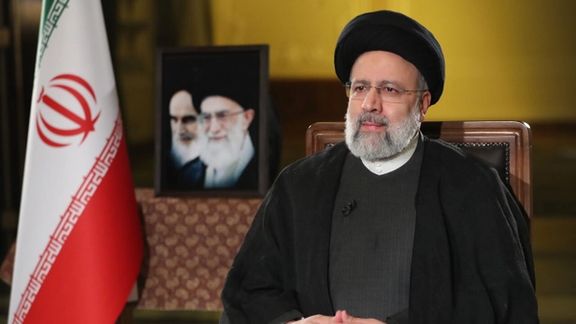
Iran's President Ebrahim Raisi in TV interview. December 5, 2021

Media in Iran have criticized President Ebrahim Raisi for evading significant questions during his recent televised, including on the issue of nuclear talks.

The much-advertised interview broadcast by Channel One of the state-run television in a prime time slot had nothing new and concrete to offer, critics of the hardline president say. They allege that the interview was held in a highly controlled "green-house environment", questions were dictated by the interviewee, and it was a "monologue" and propaganda event rather than a real, challenging interview.

"Green-house interviews may shield the President from the harms of exposure to the media sun, rain, and wind. But this makes him equally vulnerable as he may catch a cold even if a small media breeze suddenly gets through a window!" Reformist Etemad daily wrote Tuesday.

The conservative Jomhouri Eslami newspaper also warned that officials of the Islamic Republic will never be able to convince the public as long as they avoid interviews with free and independent journalists.

The hardliner media affiliated with the Revolutionary Guard and ruling circles have stayed mostly silent about the TV program.

Many have also pointed out that the interviewer repeatedly sang praises of the Raisi administration and its "achievements" while posing his questions. "Niceties [by the presenter] were so exaggerated that it appeared as if an employee is paying lip service to his employer," conservative Asr-e Iran website charged in a commentary Monday entitled "This Is Not an Interview, It's a PR Talk Between Boss and Civil Servant".

The presenter only asked about the nuclear talks in Vienna towards the end of the one-hour talk, to which Raisi gave a very general and short answer.

He avoided referring to the revival of the 2015 nuclear deal, Joint Comprehensive Plan of Action (JCPOA) and only talked about the importance of "lifting of sanctions", a matter of great importance to the Iranian economy, which nevertheless needs an agreement with the United States.

The conservative Jomhouri Eslami newspaper and some other media outlets have also criticized the president for offering completely irrelevant answers to some pre-determined questions.

Raisi told his audience there was no money in the government's coffers when it was handed over to him and claimed that notwithstanding the fact, his administration managed to pay civil servants' salaries without borrowing from the Central Bank. When asked how the government managed this, he responded that the government must harness tax evasion and sell government assets such as real estate that are not in active use.

"The presenter had not asked about your plans to secure budgetary resources, he was asking how this could happen in the three months [since you took office]," Asr-e Iran website asked in another commentary Monday entitled "What Was Raisi's Response to the Most Important Question?"

In fact, Iran’s former central bank chief Abdolnasser Hemmati said after Raisi’s TV talk, that the government has simply borrowed for state and quasi-state banks and they in turn borrowed money from the central bank. He said this is tantamount to printing more money, which the new government has pledged not to do.

Most Viewed

Ideology may be fading in Iran, but not in Kashmir's ‘Mini Iran'
1
INSIGHT

Ideology may be fading in Iran, but not in Kashmir's ‘Mini Iran'

2
INSIGHT

Hardliners push Hormuz ‘red line’ as US blockade tests Iran’s leverage

3
VOICES FROM IRAN

Hope and anger in Iran as fragile ceasefire persists

4

US sanctions oil network tied to Iranian tycoon Shamkhani

5

Iran International says it won’t be silenced after London arson attack

Banner
Banner

Spotlight

  • Hardliners push Hormuz ‘red line’ as US blockade tests Iran’s leverage
    INSIGHT

    Hardliners push Hormuz ‘red line’ as US blockade tests Iran’s leverage

  • Ideology may be fading in Iran, but not in Kashmir's ‘Mini Iran'
    INSIGHT

    Ideology may be fading in Iran, but not in Kashmir's ‘Mini Iran'

  • War damage amounts to $3,000 per Iranian, with blockade set to add to losses
    INSIGHT

    War damage amounts to $3,000 per Iranian, with blockade set to add to losses

  • Why the $100 billion Hormuz toll revenue is a myth
    ANALYSIS

    Why the $100 billion Hormuz toll revenue is a myth

  • US blockade targets Iran oil boom amid regional disruption
    ANALYSIS

    US blockade targets Iran oil boom amid regional disruption

  • Iran's digital economy battered by prolonged blackout
    INSIGHT

    Iran's digital economy battered by prolonged blackout

•
•
•

More Stories

Government Orders Measures As Air Pollution Engulfs Tehran

Dec 7, 2021, 09:49 GMT+0

Authorities in Iran’s capital Tehran and suburbs will close educational institutions two days a week as air pollution has reached a dangerous level in winter.

Tehran province governor’s office announced on Tuesday that measures were necessary to reduce pollution and protect citizens by closing all educational institutions and limiting commercial activities on Wednesdays and Thursdays each week.

Air pollution is a persistent problem in large Iranian cities, especially in cold and hot weather when more electricity is used and power stations resort to using heavy dirty diesel fuels because of natural gas shortages. Last winter, power plants had to be shut down prompting power cuts that led to some protests. The situation is expected to get worse in January and February.

Iran has the world’s second largest natural gas reserves, but consumption is much higher than in other countries while production remains flat due to lack of investment and new technologies.

Authorities have also banned operations of polluting industrial plants for two days a week and will clamp down on vehicles without a clean bill of health. Many private and large vehicles in Iran are old, using outdated technology as the government strictly limits imports of modern vehicles to support local manufacturing.

Syria Says Israeli Planes Fire Missiles At Port City

Dec 7, 2021, 09:19 GMT+0

AP - Syria's military said Israeli warplanes fired missiles on the port of the coastal city of Latakia early on Tuesday without inflicting any human losses.

Syria's state media quoted an unnamed military official as saying that several missiles struck the containers area in the port setting some of them on fire.

The official gave no further details.

It was a rare attack on the port of Latakia, a vital facility where much of Syria's imports are brought into the war-torn country.

Syrian state TV reported that five explosions were heard in the port and a huge fire erupted in the containers area and fire engines have rushed to the port.

There was no comment from the Israeli military.

Israel has staged hundreds of strikes on targets inside government-controlled Syria over the years but rarely acknowledges or discusses such operations.

Some of the strikes in the past had targeted the main airport in the capital Damascus.

Israel has acknowledged, however, that it targets the bases of Iran-allied militias, such as Lebanon's Hezbollah group that has fighters deployed in Syria.

Israel says Iranian presence on its northern frontier is a red line, justifying its strikes on facilities and weapons inside Syria.

Pundits Say Iran’s Conservatives Divided, Raisi Unlikely To Succeed

Dec 7, 2021, 08:37 GMT+0
•
Iran International Newsroom

Iran’s conservatives supporters Supreme Leader Ali Khamenei, are divided like an archipelago with many small islands linked by loose bridges, a pundit has said.

Speaking in an interview with Khabar Online website, conservative analyst Hossein Kanani Moqaddam said every single one of those tiny islands has its own ruler.

Kanani Moqaddam, the political secretary of the Iranian conservative camp's Resilience Front also tried to define the conservative's status in Iran's politics by explaining that although they are in power, they lack coherence.

However, unlike Kanani Moqaddam, prominent conservative analyst Naser Imani has said that conservatives in Iran are better organized than the country's reformists, although both are more unpopular today as they have ever been.

Other analysts, including Tehran University academic Kiumars Ashtarian separates the traditional conservative camp from its newest wing that is nicknamed as "the revolutionary current." It consists of young hardliner conservatives in the Iranian parliament. According to Ashtarian, those who belong to this group are driven by their dreams and illusions, a characteristic that brings them under the general label of idealists.

However, Ashtarian believes that these young hardliners will be soon diverted to the main track of conservatism in Iran once they experience the reality of Iranian politics and come face to face with its barriers at the parliament.

Another non-traditional wing of Iran's conservative camp is known as the ultraconservative Paydari party, who are mostly former supporters and officials of ex-president Mahmoud Ahmadinejad.

Like many other observers, Kanani Moqaddam believes that Paydari always finds it difficult to be a team player. The party has been frequently accused of preventing coherence in the conservative camp by disrupting any balancing coalition at the last moment. This has been happening over and over in all parliamentary and presidential elections after the 2009 presidential election.

Asked to pass his judgment about the status of President Raisi and Ahmadinejad in the conservative camp, Kanani Moqaddam said Ahmadinejad has never been a conservative. He simply used Iran's conservatives as a ladder to climb the political structure and claim the President's seat. Once he made it to the presidency, he let down his conservative allies, Kanani Moqaddam said.

His judgment about Rouhani was different. According to Kanani Moqaddam, a former lawmaker said that Rouhani was a conservative who made it to the presidential palace by an alliance with Iran's reformists and moderates. However, according to Kanani Moqaddam, the main element that led to Rouhani's victory in the election was the bad record of President Ahmadinejad and his populist administration. The people did not want another president like Ahmadinejad, he said.

Meanwhile, Kanani Moqaddam added that Raisi's election as President has led to a fierce rivalry among conservative groups and further divided the conservative camp as every group tried to seize as much power and financial resources as they could.

On the likelihood of Raisi's success in the absence of non-conservative challengers in Iran's political landscape, Kanani Moqaddam opined that regardless of the situation Raisi is unlikely to be able to solve Iran's problems during the first four years of his presidency. However, he did not say what is likely to happen if few vote for him for a second term, or if Khamenei who engineered his victory in June 2021, concludes that Raisi should be replaced.

Yemen Houthis Bury Their Dead As Marib Fighting Rages

Dec 6, 2021, 16:46 GMT+0

Yemen's Iran-backed Houthis held military funerals on Monday for 25 fighters killed in battles with the Saudi-led coalition in the Marib region.

Fighting shows no sign of abating despite intense international diplomacy to end the seven-year-old conflict.

The funerals took place as fighting has raged in the gas-rich Marib region, while warplanes from the coalition have intensified their bombing of Sanaa, Marib and other areas.

The Houthis have also stepped up cross-border attacks on Saudi Arabia using armed drones and missiles.

An honor guard carried the coffins - draped with flags, flowers and photographs of the dead - with military music through the capital Sanaa. Relatives gathered to mourn their loved ones.

"We are in these days inspired by these martyrs' pride and dignity and say to them: 'congratulations! You have preceded us to a paradise as wide as the heavens and earth'," said Ali Muhyaddin, a relative of one of the dead.

The war in Yemen has killed tens of thousands and caused what the United Nations describes as the world's largest humanitarian crisis.

UN-led efforts to agree a ceasefire have stalled in the conflict, which is seen largely as a proxy war between Saudi Arabia and Iran.

Report by Reuters

Iran's Defense Ministry Sets Up 'Economic Headquarters'

Dec 6, 2021, 14:49 GMT+0
•
Mardo Soghom

Iran’s defense ministry is creating an “economic headquarters” to coordinate and marshal its capabilities for more effective business and commercial operations.

In a meeting of the ministry’s Strategic Council on Monday chaired by Defense Minister Mohammad-Reza Gharaei Ashtiani, a host of other officials were present, including directors of “ideological-political” offices, intelligence and counterintelligence, and managers of the ministry’s business subsidiaries, official government news website IRNA reported.

Iran’s defense ministry operates within the framework of the presidential administration, but the chief commander of all armed forces is Supreme Leader Ali Khamenei. The armed forces are divided to two separate armies, the Islamic Revolution Guard Corps (IRGC) and the traditional army, the Artesh. The IRGC carries tremendous political and economic power in the country, in effect controlling the traditional army.

The main tasks of the defense ministry is development of weapons and equipment for the armed forces. Most of the Islamic Republic’s homegrown military and dual-use technologies, such as drones, are developed by the ministry. This role was highlighted in the meeting of the Strategic Council, where the defense minister praised Mohsen Fakhrizadeh, the nuclear-military scientist who was assassinated near Tehran in November 2020, most likely by Israel.

The defense minister said that Fakhrizadeh was “a source of great services to the holy Islamic regime and he was able to make great strides in developing military industries.”

It is not clear what the exact plans for an economic coordination taskforce would be and the state-controlled media did not elaborate. But from the brief announcement made it seems that the defense ministry wants to marshal its capabilities to play a larger role in helping the economy in an environment of tough United States sanctions.

It is also possible that in a tough economic environment the ministry wants to establish more control over companies it controls. Various people or interest groups are benefitting from the ministry's resources, businesses and factories. Creating an economic task force could allow the leadership to channel all economic activities to benefit the ministry in a more meaningful way.

Ashtiani, mentioned the keyword “centralization” of economic activities as a necessity.

Since the early 1990s, after the end of the Iran-Iraq war, the IRGC was allowed to set up businesses and get involved in the economy. Then-president Akbar Hashemi Rafsanjani who made the decision thought that it could benefit both the country and the tens of thousands of veterans who had fought for years in the battlefield. But IRGC’s business ventures turned into a quest of building an economic empire that today dominates the country. The military force has become the biggest public works contractor in Iran, sweeping aside private businesses.

The same was emulated by the defense ministry to a lesser extent. Fakhrizadeh, who was a top defense ministry official had set up businesses, an Iran International report revealed last year after his assassination. His family indirectly respondedin an interview with the state TV in early December 2020, in which they acknowledged that he did indeed owned “knowledge-based” companies.

Occasionally, the president of the country and even Khamenei have urged to military to curtail their economic activities, but these calls have been met with IRGC’s pushback. In July 2017, President Hassan Rouhani had to retreat after speaking of a “government with guns”, referring to IRGC’s political and economic power.

On Monday, Ashtiani referred to the president and Khamenei when he said the new economic headquarters is meant to help meet their “expectations”.

He also mentioned, “Monitoring both domestic and foreign economic environment, identifying corresponding opportunities, economic policy-making,” and a host of coordinating tasks for the economic headquarters.