• العربية
  • فارسی
Brand
  • Iran Insight
  • Politics
  • Economy
  • Analysis
  • Special Report
  • Opinion
  • Podcast
  • Iran Insight
  • Politics
  • Economy
  • Analysis
  • Special Report
  • Opinion
  • Podcast
  • Theme
  • Language
    • العربية
    • فارسی
  • Iran Insight
  • Politics
  • Economy
  • Analysis
  • Special Report
  • Opinion
  • Podcast
All rights reserved for Volant Media UK Limited
volant media logo

Iran Hardliners Blast The US, Israel Ahead Of Nuclear Talks In Vienna
Iran International Newsroom
Nov 29, 2021, 07:39 GMT+0Updated: 17:25 GMT+1
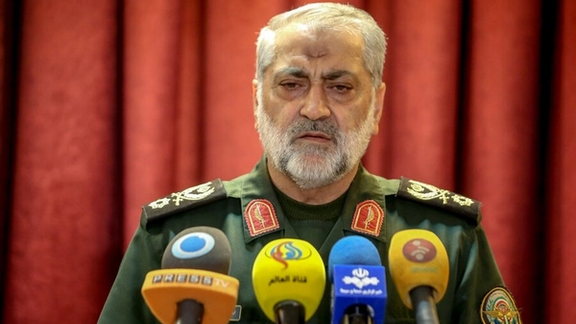
General Abolfazl Shekarchi, spokesman of Iran's armed forces. FILE PHOTO

Hardliners in Iran call the new negotiating team sent to Vienna “revolutionary forces”, and pouring scorn on the United States, while also attacking Israel.

The spokesman for Iran’s armed forces said Sunday that Tehran will continue to strive for Israel’s destruction, adding that there is no way to come to terms with the United States.

General Abolfazl Shekarchi said that annihilating Israel is the Islamic Republic's biggest objective, reported the state-owned news agency ISNA on Sunday, November 28. He explained that the Iranian armed forces see Israel as a part of "international Zionism." Shekarchi further claimed that "Even Muslim countries that help Israel are part of the Zionist regime."

Meanwhile, Shekarchi stressed that there is no way Iran could compromise with America, adding that "Regrettably, some people in Iran believe we can come to terms with the United States as the Great Satan while America would never step back from its position of plundering the resources of the oppressed nations."

Speaking one day before the resumption of negotiations to revive the 2015 nuclear deal, he said "How can we come to terms with a country that looks at itself as the master and sees other nations as slaves? Making any compromise with such a country would undermine all our religious and revolutionary ideals."

Shekarchi said, "America's presence in this region is illegitimate. Our presence in the Red Sea or Syria is aimed at restoring security, but America is not in this region to restore security." He claimed, "This region will be insecure as long as the United States is present here. Its presence in this region cannot be tolerated by Iran or other regional nations."

The spokesman added that in his view "America's allies think like America but they have less power." He called US officials "Very Foolish" and at the same time called the UK and France "lesser Satans."

As the Iranian delegation is in Vienna to take part in negotiations with JCPOA partners and hold "indirect talks" with the United States, hardline media in Iran have renewed their attacks on the United States with a new momentum. Shekarchi's statements are part of this media blitz.

Hardline daily Kayhan, funded by Supreme Leader Khamenei's office, even went as far as accusing the United States of being behind recent protests in Esfahan and called the protesting farmers who were attacked by IRGC shotguns on Friday "the United States' foot soldiers." Meanwhile, in a commentary the daily reminded Iranian negotiators that their talks with the West begin on the anniversary of the killing of Iranian nuclear scientist Mohsen Fakhrizadeh who was assassinated in Tehran a year ago purportedly by Israeli agents.

The IRGC-linked newspaper Javan also carried two stories against the negotiations and the United States on its front page on Sunday. The leading story refers to threats made by Washington of having other options if the Vienna talks fail and argues that "America has new plans and the statements made by US diplomats and other officials indicate that Washington has forgotten about the JCPOA. Their negotiators talk about total prevention of oil sales by Iran and bombing Iran's nuclear establishments."

Javan's commentary on the negotiations also claims that the US delegation's agenda is exerting redoubled pressures on Iran. The commentary points out that the United States is not directly involved in the talks but says Washington is planning to use other Western partners of the JCPOA, i.e., the Europeans, to exert pressure on Iran.


Most Viewed

State media slam Araghchi's Hormuz tweet, say it let Trump claim victory
1

State media slam Araghchi's Hormuz tweet, say it let Trump claim victory

2

Iran International says it won’t be silenced after London arson attack

3
VOICES FROM IRAN

Hope and anger in Iran as fragile ceasefire persists

4
INSIGHT

How Tehran bends its own red lines to boost state rallies

5

Iran halts petrochemical exports to supply domestic market

Banner
Banner

Spotlight

  • Too early to tell who is winning Iran war, experts say
    PODCAST

    Too early to tell who is winning Iran war, experts say

  • How Tehran bends its own red lines to boost state rallies
    INSIGHT

    How Tehran bends its own red lines to boost state rallies

  • Iran blackout cripples freelancer, small business incomes
    VOICES FROM IRAN

    Iran blackout cripples freelancer, small business incomes

  • Ideology may be fading in Iran, but not in Kashmir's ‘Mini Iran'
    INSIGHT

    Ideology may be fading in Iran, but not in Kashmir's ‘Mini Iran'

  • US blockade enters murky phase as tankers spoof signals and buyers hesitate
    ANALYSIS

    US blockade enters murky phase as tankers spoof signals and buyers hesitate

  • Why the $100 billion Hormuz toll revenue is a myth
    ANALYSIS

    Why the $100 billion Hormuz toll revenue is a myth

•
•
•

More Stories

UK, Israel To Work Together To Stop Iran Gaining Nuclear Weapons

Nov 29, 2021, 06:30 GMT+0

Britain and Israel will "work night and day" to prevent Iran from becoming a nuclear power, the foreign ministers of the two countries wrote in a joint article.

"The clock is ticking, which heightens the need for close cooperation with our partners and friends to thwart Tehran's ambitions," the UK's Liz Truss and her Israeli counterpart Yair Lapid wrote in the Telegraph newspaper on Sunday.

Lapid is visiting Britain in what Israeli media last week said is part of Israel’s diplomatic push to warn allies of the dangers of concessions to Tehran.

Israeli Prime Minister Naftali Bennett said earlier in the day that his country was "very worried" that world powers will remove sanctions on Iran in exchange for insufficient caps on its nuclear program, as negotiators convene in Vienna on Monday in a last-ditch effort to salvage a nuclear deal.

Meanwhile, Israel and Britain will sign a 10-year agreement on Monday to work closely on areas such as cybersecurity, technology, trade and defense, according to the Telegraph.

The foreign ministers added in the article that Israel will officially become Britain's "tier one" cyber partner, in a bid to improve its cyber defense as countries around the world face increased threats.

Report by Reuters

Make-Up Of Iran's Nuclear Negotiating Team Shows Focus On Sanctions

Nov 28, 2021, 17:48 GMT+0
•
Maryam Sinaiee

The heavy presence of financial officials in Iran's new negotiating team highlights Tehran’s focus on lifting US sanctions in talks starting in Vienna, Monday.

"Actions now matter more than mere words. We should be offered a clear and transparent mechanism to ensure that sanctions will be removed," Iran's chief negotiator, Ali Bagheri-Kani wrote in an op-ed in the Financial Times Sunday about Iran's approach to the talks in Vienna.

"We will be starting these new discussions under circumstances influenced by the unfortunate fate of the JCPOA," he wrote, referring to US president Donald Trump's decision to withdraw from the 2015 nuclear deal, the Joint Comprehensive Plan of Action, in 2018. Bagheri-Kani also emphasized that sanctions relief must be verifiable, and a guarantee should be offered that there will be no future withdrawal from any agreement reached between the parties.

The six-member team headed by Ali Bagheri-Kani will resume the talks Iran suspended in June, two days after the presidential elections that brought hardliner Ebrahim Raisi to power. The new team insists that all sanctions imposed after 2018, which include sanctions related to human rights, support for terrorism and money laundering, have to be lifted in addition to nuclear sanctions.

Austrian journalist Stephanie Liechtenstein said in a tweet that Iran's delegation that arrived in Vienna Saturday is very large with up to forty members.

The presence of "prominent experts and officials involved with the phenomenon of unjust sanctions in recent years" and the new team's "considerable differences" with the negoting team in the previous administration demonstrates Iran's resolve for a "clear-cut and complete political and economic agreement," the official news agency (IRNA) wrote Sunday.

The new team consists of Reza Najafi, deputy foreign minister for legal and international affairs and Iran's former envoy to the IAEA. The rest are banking and financial experts: Ebrahim Shaybani, former Central Bank governor, Gholamreza Panahi, Central Bank deputy governor for international affairs, Ali Fekri, deputy economy minister and head of the Investment Organization, Ahmad Asadzadeh, caretaker of oil ministry's international and trade department, and Mehdi Safari, the economic diplomacy deputy of the ministry of foreign affairs.

Nearly all the team's members have also served as envoys or representatives to international organizations in the past.

Since June, Iran has vastly expanded its stockpile of 60-percent enriched uranium which according to Iran's nuclear chief Mohammad Eslami has now reached 25kg.

Given that 15kg of 90% enriched uranium is needed to build a nuclear bomb, Iran could be a month away from acquiring enough fissile material, the Revolutionary Guards (IRGC) affiliated Fars news agency said in a commentary Sunday. But it added that this assumption based on "Western logic", while Iran's nuclear program is peaceful and claimed that it continues to be supervised by Non-Proliferation Treaty (NPT) safeguards.

Iran and the UN nuclear watchdog IAEA failed to reach an agreement over monitoring of nuclear sites during IAEA chief Rafael Grossi's visit to Tehran last week.

Western powers may suggest in the new round of talks, Fars said, to offer Iran the easing of oil sanctions in return for stopping its 60% enrichment and allowing IAEA to resume its inspections within the framework of NPT's Additional Protocol the voluntary implementation of which Iran has stopped.

The news agency that often reflects the views and positions of the IRGC argued that such an offer and an interim agreement could only be considered if "Iran's presence in the oil market" was "guaranteed".

Iran Hardliners Say US Instigated Protests As Pressure Before Nuclear Talks

Nov 28, 2021, 11:59 GMT+0
•
Maryam Sinaiee

Hardline media in Iran claim that the United States instigated protests in Esfahan to put pressure on Tehran ahead of nuclear talks set to resume on Monday.

Ultra-hardliner Kayhan daily, financed by Supreme Leader Ali Khamenei Sunday claimed, "America's foot soldiers" perverted farmers’ water protest in Esfahan on Friday to "sow unrest and reap sanctions" ahead of Vienna nuclear Talks.

The newspaper claimed in a commentary that Western powers always incite unrest in Iran to "impair the resilience" of the regime and the people against US sanctions to force the regime to return to negotiate over its nuclear program.”

Farmers had been protesting in Esfahan city center for two weeks demanding their traditional water rights from the Zayabdeh Roud river, which has been mostly dry in the past decade. The call to protest on Friday came after security forces stormed the farmers' makeshift camp in the dry riverbed in the early hours of Thursday and burned their tents. Social media reports said they were given fifteen minutes by security forces to leave their tents before they went up in flames.

As people gathered on Friday to continue the protest, Security forces used tear gas, batons and pellet shots to disperse protesters whose slogans grew more and more anti-governmentlater in the day with many chanting slogans against Supreme Leader Ali Khamenei, clerical rule, and security forces.

Kayhan claimed that farmers were not involved in the Friday protests, which it said were hijacked by "paid thugs". Farmers had ended their protest on Wednesday and stayed away from the Friday protests, Kayhan claimed.

The newspaper is ardently opposed to negotiations with the West over Iran's nuclear program. In another commentary Sunday, the newspaper's chief editor, Hossein Shariatmadari, opposed any direct talks with US representatives in Vienna on Monday and said to avenge the blood of Iran's assassinated nuclear scientists including Mohsen Fakhrizadeh a year ago, Iran's envoys in the talks should continue to 'humiliate the US" by refusing direct talks.

The Revolutionary Guards (IRGC)-affiliated Fars news agency also claimed that farmers were not involved in the Friday protests. "It appears that ahead of the new round of talks for lifting sanctions, [US] democrats have once again resorted to their usual policy of "riot inside [Iran] and sanctions from outside to weaken Iran's position," Fars wrote.

The conservative Jomhouri Eslami newspaper in a commentary Sunday criticized the hardline media and called their claims a "distortion of truths". "Cracking down on people and then resorting to propaganda to distort the truth will not only fail to convince the public. It will damage people's trust in authorities and in the propaganda apparatus," it wrote.

"Deeply concerned about the violent crackdown against peaceful protestors in Isfahan. The people of Iran have a right to voice their frustrations and hold their government accountable," US State Department Spokesman Ned Price tweeted Saturday.

Videos posted on social media Friday showed thousands of protesters in the city's dry riverbed and its adjacent boulevards chanting slogans peacefully and refusing to leave despite heavy use of tear gas, firing guns in the air and paramilitary and plainclothes motorcyclists driving into crowds. As the day grew, however, reports said security forces heavy-handedly suppressed the demonstrations that had spread to nearby boulevards. Some protesters threw stones at anti-riot forces.

Iranian authorities invariably blame "thugs and hooligans" for any antigovernment protest. "It was the police who did this, don't go and claim later that they were thugs and hooligans," a wounded old man, apparently one of the farmers said in one of the videos from Esfahan protests.

Israel Worries Iran Will Get Sanctions Relief Without Capping Nuclear Program

Nov 28, 2021, 10:30 GMT+0

Israel worries Iran will secure a windfall in sanctions relief in renewed nuclear talks but will not sufficiently roll back its bomb-making potential, Israeli Prime Minister Naftali Bennett said on Sunday.

Negotiators will convene in Vienna on Monday in a last-ditch effort to salvage a nuclear deal which the United States under then-President Donald Trump quit in 2018, reimposing sanctions on Iran. That led to breaches of the deal by Tehran, and dismayed the other powers involved.

Israel, which is not a party to the talks, opposed the original 2015 pact as too limited in scope and duration. Israeli leaders have long threatened military action against Iran if they deem diplomacy a dead end for denying it nuclear weaponry.

"Israel is very worried about the readiness to remove the sanctions and to allow a flow of billions (of dollars) to Iran in exchange for unsatisfactory restrictions in the nuclear realm," Bennett told his cabinet in televised remarks.

"This is the message that we are relaying in every manner, whether to the Americans or to the other countries negotiating with Iran."

Few expect a breakthrough in the talks as Iran's uranium enrichment activities have escalated in an apparent bid to gain leverage against the West.

Reporting by Reuters

While US Talks Of More Pressure, Iran Believes It Already Has Leverage

Nov 28, 2021, 09:12 GMT+0

The United States and its partners are likely to exert pressure on Iran if it uses talks in Vienna to accelerate its nuclear program, the US said on Saturday.

"If Iran thinks it can use this time to build more leverage and then come back and say they want something better it simply won't work. We and our partners won't go for it," US Special Envoy for Iran, Robert Malley, told the BBC News Hour.

But Iran has already built leverage, according to Fars news agency in Tehran affiliated with the Revolutionary Guard. In an article signed by a writer with hardliner credentials on Sunday, questioning an interim or partial deal, the hardline media outlet said that Western estimates of Iran being a few weeks away from having enough enriched uranium for a bomb are true.

Indirect nuclear talks between the United States and Iran, with the participation of major powers, resume on Monday after a five-month hiatus, while the idea of an interim deal has been mentioned in recent days. Iran has rejected the idea, but the Fars article leaves the door ajar.

It seems that negotiations have already started even before the first meeting convenes in Vianna. "If that's Iran's approach, which is to try to use the negotiations as cover for an accelerated nuclear program, and as I say, drag its feet at the nuclear table, we will have to respond in a way that is not our preference," said Malley, who heads up the US negotiating team. "Nobody should be surprised if at that point there is increased pressure on Iran.

"We hope not to get that there, but if we are, then pressure will have to increase to send a message to Iran that the choice it is making is the wrong one. That it has a different path available to it, but it's not a path open indefinitely because Iran's nuclear program is putting the very essence of the deal negotiated (in 2015) at risk," he said.

But Fars said in its article that the West has few tools to exert more pressure on Iran, given the energy crunch in the world, arguing that some countries are willing to clandestinely buy oil from Iran.

Fars also said that the West is clearly concerned about advances Iran has made and its decision to restrict monitoring by UN’s International Atomic Energy Agency (IAEA). That is why they are eager for a partial agreement that would stop Iran’s higher-degree uranium enrichment in exchange for reduction of sanctions on Iran’s oil exports. But the US is not willing to provide permanent guarantees that reduced sanctions would not be reversed in the future, Fars argued.

The article went on to say that interim or partial agreements in Iran’s 18-year nuclear talks with the West is not a new idea and was tried before with mixed results, and will not work in this case. Iran has been demanding the full removal of all US sanctions imposed since 2018 and if Tehran accepts an interim deal, it will mean it buckled under the pressure of sanctions.

But the Fars article does not reject the idea of an interim deal altogether and says, “If the West is willing to make serious concessions over Iran’s oil sales and the repatriation of the proceeds, it might be possible to theoretically consider [an interim deal], provided that Iran’s presence in the global oil market is guaranteed.”