• العربية
  • فارسی
Brand
  • Iran Insight
  • Politics
  • Economy
  • Analysis
  • Special Report
  • Opinion
  • Podcast
  • Iran Insight
  • Politics
  • Economy
  • Analysis
  • Special Report
  • Opinion
  • Podcast
  • Theme
  • Language
    • العربية
    • فارسی
  • Iran Insight
  • Politics
  • Economy
  • Analysis
  • Special Report
  • Opinion
  • Podcast
All rights reserved for Volant Media UK Limited
volant media logo

Iranian Government Urged to Get Off Its High Horse In Nuclear Talks
Nov 15, 2021, 09:53 GMT+0Updated: 18:15 GMT+0
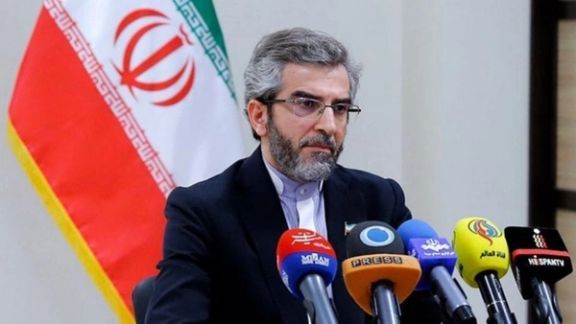
Ali Bagheri-Kani Iran's chief nuclear negotiator. FILE Photo

Some Iranian analysts across the country's political spectrum suggest that Tehran should step down from its hardline positions in a bid to forge a nuclear deal.

During the past week, an increasing number of analysts and political commentators in Iran have pointed out that some of Tehran's expectations including the lifting of all sanctions and demanding guarantees of a permanent US commitment to the Joint Comprehensive Plan of Action (JCPOA) might be farfetched.

It is not yet clear whether they are urging the government to make life easier for Iranians or it is the government that directs the commentators to make remarks politicians might want to use to justify a dramatic change in their positions once nuclear talks resume at the end of November.

Hardline analyst Mehdi Poursafa wrote in a commentary published by IRGC-linked Fars news agency on November 14 that "Negotiations only aiming at lifting the sanctions will not bear any particular fruit when looked at from a legal standpoint." He suggested that "instead, Iran should make sure that it has some verifiable financial gains."

Safapour argued that the United States has regularly awarded exemptions to Iran sanctions, allowing limited oil exports and natural gas sales. He implied that the same approach could apply to some of the current sanctions in the future.

It appears that analysts like Safapour would be happy with such exemptions. He also mentioned the example of US exemptions about trade with China regardless of sanctions imposed in the 1980s following the Tiananmen Square atrocities.

The biggest advantage Iranian negotiators can gain in the next round of negotiations with the West is "a framework that enables Iran to benefit from trade deals with the West", Safapour maintained, regardless of formal commitments.

Meanwhile, moderate conservative Khabar Online summarized debates on Clubhouse among Iranian analystsabout the same matter. Hassan Lasjerdi, one of the editors of the website said that negotiators from all sides normally brag about their expectations during the weeks before talks begin. He said most of the preconditions, including lifting all the sanctions before negotiations start are not achievable. Lasjerdi said he was sure negotiators' remarks will become more reasonable once the talks start.

Mehrdad Pashangpour, a political analyst also opined that the call for the lifting all the sanctions against Iran is "a good political bluff."

Political activist Hadi Mousavi said individuals around former nuclear negotiator Saeed Jalili, including Bagheri, have begun thinking that the nuclear issue is not the main topic of the upcoming talks. It is a pretext based on which other matters could be discussed between Iran and the West.

He argued that the United States gave as many concessions to Iran as it could during the previous rounds of talks and now it is Iran that should be ready to give concessions. As a matter of fact, Mousavi said, because of opposition to the JCPOA in the US Senate, America might even take back some of the concessions it had previously offered.

Mohammad Mohajeri, another editor at Khabar online said that Zarif and his team were against the December 2020 legislation that called for the reduction of Iran's commitments under the JCPOA while hardliners at the time supported the bill. Mohajeri said that now the hardliners have also realized that the legislation is not in Iran's best interest, and it is likely to be overturned overnight with a decree from the Supreme Council of National Security.


Most Viewed

State media slam Araghchi's Hormuz tweet, say it let Trump claim victory
1

State media slam Araghchi's Hormuz tweet, say it let Trump claim victory

2

Iran International says it won’t be silenced after London arson attack

3
INSIGHT

How Tehran bends its own red lines to boost state rallies

4
OPINION

The Hormuz get out of jail card turned to a grave

5

Iran halts petrochemical exports to supply domestic market

Banner
Banner

Spotlight

  • Too early to tell who is winning Iran war, experts say
    PODCAST

    Too early to tell who is winning Iran war, experts say

  • How Tehran bends its own red lines to boost state rallies
    INSIGHT

    How Tehran bends its own red lines to boost state rallies

  • Iran blackout cripples freelancer, small business incomes
    VOICES FROM IRAN

    Iran blackout cripples freelancer, small business incomes

  • Ideology may be fading in Iran, but not in Kashmir's ‘Mini Iran'
    INSIGHT

    Ideology may be fading in Iran, but not in Kashmir's ‘Mini Iran'

  • US blockade enters murky phase as tankers spoof signals and buyers hesitate
    ANALYSIS

    US blockade enters murky phase as tankers spoof signals and buyers hesitate

  • Why the $100 billion Hormuz toll revenue is a myth
    ANALYSIS

    Why the $100 billion Hormuz toll revenue is a myth

•
•
•

More Stories

Iran Confirms Accessing Frozen Funds - Says It Invited Grossi To Visit

Nov 15, 2021, 08:39 GMT+0
•
Iran International Newsroom

Iran’s foreign ministry on Monday implicitly confirmed recent claims that Tehran has accessed some of its frozen funds abroad but it refused to provide details.

Last week, the CEO of the government’s news agency IRNA and a newspaper affiliated with the Revolutionary Guard claimed Iran had freed $3.5-4 billion dollars of its frozen funds but did not say which country unblocked the assets.

Foreign ministry spokesman Saeed Khatibzadeh was asked by reporters on Monday to comment on the issue. He replied: “Amid sanctions, we do not provide details to anyone. The central bank might comment if it sees fit.”

He added, “We have had many sources abroad and you know that we have been gradually freeing these assets that enter our economy. The fact that we are importing merchandise shows that these resources gradually return to the country, and it is not just from one source. Allow me to say just that much.”

Khatibzadeh’s comments were vague enough to cover a lot of possibilities. In advance of nuclear talks scheduled to resume in two weeks, Iran might be trying to show a full hand by claiming not to be in a dire financial situation. It is also possible that the claim is based on recouping payments from some current illicit oil exports and not necessarily funds officially frozen by other countries, such as South Korea and Iraq.

Khatibzadeh also announced that Rafael Grossi, the head of the International Atomic Energy Agency (IAEA), Rafael Grossi, has been invited to visit Iran and the foreign ministry has proposed a date and is waiting to hear back from him. However, this contradicts comments by Grossi who expressed his disappointment on November 12 at having no contact with the Iranian government.

Grossi told reporters it is “astonishing” that “I have not had any contact with this government” that has been in office for five months, except “technical” conversations with the head of Iran’s atomic energy agency.

Iran has curtailed IAEA’s monitoring access to its nuclear facilities since the beginning of the year, demanding that the United States should lift sanctions imposed since 2018.

Khatibzadeh’s comment about Iran having extended an invitation to Grossi comes days before the IAEA Board of Governors is scheduled to meet in Vienna where Grossi could criticize Tehran for lack of cooperation.

The Iranian spokesman insisted that “technical” interactions with IAEA are “in a good path” and we are waiting for Grossi’s response. If he travels to Iran, he will meet with foreign minister Hossein Amir-Abdollahian. Grossi had complained in October that he had had no meeting with the new foreign minister.

Israel Reportedly Concerned Over US Intention For A 'Partial' Deal With Iran

Nov 14, 2021, 20:16 GMT+0

Israel is increasingly concerned that the US is aiming for a partial nuclear deal with Iran only to stop its uranium enrichment, Israel Hayom reported Sunday.

The publication also said that Prime Minister Naftali Bennett will not meet with US Special Envoy Robert Malley who is visiting Israel to show his displeasure. The American envoy is seen as spearheading ‘a deal at any cost’ approach in the Biden Administration.

According to briefings received by Israeli officials the United States is willing to lift the most important sanctions in exchange for a simple cessation of uranium enrichment by Iran.

That would leave a considerable quantity of 20-percent and 60-percent enriched uranium in Tehran’s possession and all the enrichment equipment it has assembled recently.

The US had pledged to aim for a stronger agreement with Iran after it launched indirect talks in April but is now reportedly focused on stopping further enrichment.

This would be even more than Iran has been demanding during the past months, which is a return to the status quo of May 2018 when former president Donald Trump withdrew form the Joint Comprehensive Plan of Action or JCPOA.

Iran's Raisi Under Fire By Friends And Foes On Day 100 In Office

Nov 14, 2021, 17:07 GMT+0
•
Iran International Newsroom

On his 100th day in office President Ebrahim Raisi has come under fire by both friends and foes for failing to make a dent in Iran’s economic and other crises.

Oddly enough, while reformists and conservatives alike highlighted Raisi’s shortcomings, his only defendant appears to be his father-in-law, the firebrand Friday Prayers Imam of Mashhad in northeastern Iran.

Reformist daily newspaper Sharq in its Twitter account quoted Alamolhioda as having said on Friday that "Problems cannot be sorted out within a hundred days, although one can begin to move toward an improvement." However, Alamolhoda did not say whether Raisi has made the move yet. Meanwhile, Tehran's Friday Prayers Imam Seddighi attributed all economic problems as well as water shortage to the "sins committed by young Iranians."

Reformist analyst Abbas Abdi, told conservative daily Sobh-e No in an interview that there were three positive points in Raisi's track record during the past 100 days: "His provincial visits, boosting nationwide vaccination against COVID-19, and refraining from badmouthing Iranian and foreign individuals and organizations."

However, Abdi warned that that the people might be soon disillusioned with the president’s provincial visits if they see no improvement in their situation. Meanwhile, many critics have pointed out that the progress in vaccination is being highlighted after months of delays in the purchase of vaccines from abroad.

Iran’s Supreme Leader Ali Khamenei banned American and British vaccines in January, thwarting the national vaccination effort until August, when Raisi took office.

Abdi criticized Raisi for his failure to define and pursue a clear a foreign policy, key to solving economic problems, and to sort out issues in the country's domestic politics which is most prominently evident in the appointment of officials' relatives to key posts in the government mindless of their lack of qualifications.

Meanwhile, Gholamreza Noori, a conservative lawmaker in an interview with moderate website Rouydad24 said that "the country's economy is facing a major crisis and criticism of the Raisi administration is gaining momentum on a daily basis." He also criticized Raisi for his provincial visits saying that "It is good that he visits the provinces, but it is not good that he says he visits to find out about their problems." He added that it is regrettable the Raisi administration has started its fourth month in office failing to stabilize skyrocketing prices.

Noori added: "Every day if you listen to parliament proceedings on the radio you will hear conservative lawmakers complaining against the administration's shortcomings." He warned that "There is a limit to the lawmakers' patience."

A similar warning was made by Abdi who said Raisi should note that his honeymoon with the Majles (parliament) is going to end soon.

Like many other conservative and reformist critics, Noori charged that "Raisi has no plan to solve any problem." He added: "The administration has still not responded to lawmakers' questions about how it is going to tackle the budget deficit and how it is going to regulate the markets. And there is no indication that the government is going to take the initiative about problems such as the JCPOA and FATF."

The lack of a plan on the part of the government to solve the country's problems was also highlighted in reformist figure Ali Soufi's article about Raisi's 100 days in office. Soufi said that this will badly harm the government's credibility. Meanwhile, like many other critics affiliated with various political groups, Soufi also denounced nepotism in the government.

Earlier, another lawmaker, Massoud Pezeshkian had warnedthat if these problems are not solved within a reasonable period of time, the nationwide protests that shook Iran in 2018 and 2019 are likely to reoccur.

Budget Office Says Iran Needs Additional $10 Billion For Essential Imports

Nov 14, 2021, 15:11 GMT+0
•
Iran International Newsroom

The head of Iran’s Planning and Budget Organization has told parliament that the government needs $18 billion to import essential foods in the next few months.

Massoud Mirkazemi’s statement on Sunday came after the legislature refused to give priority to a government budget amendment bill that would eliminate a subsidy in the form of cheap dollars for importing essential goods.

Cheap dollars are provided to importers at 42,000 rials, instead of the current free market rate of 280,000 rials to one US dollar. The government has spent an average of $8 billion a year since April 2018 to finance the subsidized essential imports. The elimination of the subsidy would lead to higher food prices, which already average a more than 60-percent inflation compared to last year.

A further jump in food prices might have political consequences for the Islamic Republic’s government that has so far failed to contain the economic damage from US sanctions imposed by former president Donald Trump, who withdrew form the Joint Comprehensive Plan of Action (JCPOA), as the 2015 Iran nuclear deal is called.

Mirkazemi told parliament that drought has upended the government budget plan to appropriate enough money for essential imports. Food production in Iran has seriously declined this year, requiring more grain and animal feed imports.

“We were supposed to buy 11.5 million tons of wheat from Iranian farmers, but so far just 4.6 million tons has become available, and we need to import another 8 million tons until March to have the needed reserves,” Markazemi told lawmakers.

He added that in addition to drought, higher global inflation has also raised the cost of subsidizing food prices. “Oil seeds that we were buying for $433 a ton last year, cost $697 now. Cooking oil base that was $746 last year costs $1,450 now.” The same applies to corn feed and wheat that has jumped from $206 per ton to $340.

The head of the budget office said that while Iran planned to spend $8 billion on subsidized essential imports in the current Iranian year, the cost has jumped to $18 billion, “which is an impossibility for the government.”

Mirkazemi pleaded with lawmakers that the government needs to phase out the subsidy and instead pay a direct handout of 1.1 million rials (around $4) per person to 60 million Iranians monthly.

The difference for the government is that subsidizing imports needs foreign currency while paying rials to people simply needs printing more money. That would worsen inflation but the government can try to muddle its way through.

Iran has lost most of its oil revenues due to US sanctions and although it manages to sell around 500,000 barrels a day to China through intermediaries, that is a far cry from more than 2 million barrels it was exporting before the sanctions. Iran’s economy and government operation have remained heavily reliant on oil income, with little foreign investment and limited non-oil exports.

The only salvation for the Islamic Republic is to reach a quick deal with the United States over its nuclear program and have sanctions lifted. Talks are set to resume in two weeks but Iranian negotiators seem to have hardened their position.

Two Strong Earthquakes Shake Southern Iran

Nov 14, 2021, 13:15 GMT+0

Two strong earthquakes struck southern Iran on the Persian Gulf Sunday, prompting residents to flee their homes and killing at least one person, media reported.

The quakes measured 6.3 and 6.4 magnitude, jolting the province of Hormozgan, state TV said, and the tremors were felt across the gulf in Dubai. The first tremor occurred at 15:36 local time, and the second one followed after one minute, Fars news website said.

The head of Iran’s Red Crescent in the region was quoted as saying that they were strong tremor with potentially devastating damage.

"The quake was felt in several southern Iranian cities in the Hormozgan province," a local official told state TV.

The European Mediterranean Seismological Centre put the magnitude of one of the quakes at 6.5 at a relatively shallow depth of 10 km (6 miles).

Mehrdad Hassanzadeh, director of Hormozgan’s emergency services said telephone and internet services have been disrupted in the region. The tremor was felt in a wide area of southern Iran.

"It was felt in northern and eastern side of the United Arab Emirates without any effect," the UAE's National Centre of Meteorology said in a tweet.

With reporting by Reuters