• العربية
  • فارسی
Brand
  • Iran Insight
  • Politics
  • Economy
  • Analysis
  • Special Report
  • Opinion
  • Podcast
  • Iran Insight
  • Politics
  • Economy
  • Analysis
  • Special Report
  • Opinion
  • Podcast
  • Theme
  • Language
    • العربية
    • فارسی
  • Iran Insight
  • Politics
  • Economy
  • Analysis
  • Special Report
  • Opinion
  • Podcast
All rights reserved for Volant Media UK Limited
volant media logo

After 100 Days In Office, Raisi Asks Why Iran Faces An Economic Crisis
Iran International Newsroom
Nov 14, 2021, 08:48 GMT+0Updated: 17:40 GMT+1
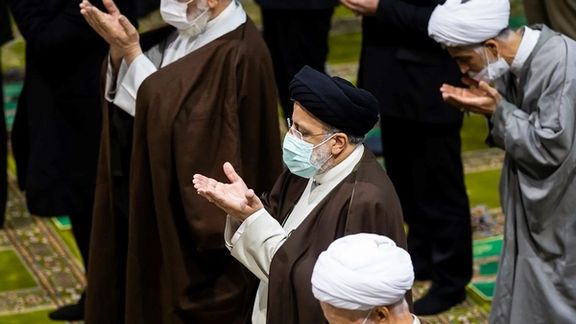
Iran's President Ebrahim Raisi praying on Friday November 12, 2021

In a recent meeting with economists, President Ebrahim Raisi asked basic questions about the sorrow state of Iran's economy, showing a lack of prior planning.

In a meeting with economists in November 9, Raisi had asked "why the economy is not doing well, why Iran has not been able to have a single-digit inflation rate, why the people cannot see the impact of tens of billions of dollars of government subsidies in their daily life, and why Iran's economic growth rate has been less than one percent during the past eight years despite high government spending?

The fact that the president of the country asked these basic questions after 100 days in office, shows a lack of preparation and planning by his government, a point highlighted by many domestic critics.

According to Donyaye Eqtesad (Economic World), a newspaper that generally supported the policies of Iran's previous administration, economists told Raisi conditions are not favorable for businesses in Iran. A decline in domestic and foreign investment, as well as the impact of sanctions have suppressed the country's economic growth.

The long process to get government permits to do business, lack of a good legal framework, and unfair taxation are the main elements leading to unfavorable conditions. Iran's global ranking in terms of ease of running a business is 128, while anything above the rank of 50 is considered unfavorable, the newspaper said.

The daily said that in three major indicators Iran faces serious problems: Economic growth, the rate of inflation and the unemployment rate.

Meanwhile, because of overall unfavorable conditions and the lack of a promising outlook for the future of the economy, there has been a sharp drop in domestic and foreign investment in Iran. Furthermore, this disrupts the trend of economic growth in the long run. With the current trend, economists cannot expect anything more than a 4 percent growth in the best-case scenario, economists told Raisi.

Besides, international sanctions have created a major challenge for the economy. Likening the Iranian economy to a bus, the economists said that the bus is no longer able to run on the main road and has veered off to a rough side road, which has made progress virtually impossible. At the same time, sanctions are one of the major reasons for the drop in investment. More problems are created by the Iranian government's interventionism including the manipulation of prices. All these have led to a drop in employment.

Answering the question of why the government has not been able to bring about economic growth, the economists answered that it is not the government's job to create economic growth. The government only needs to improve the businesses environment to facilitate growth. Meanwhile, lack of expertise among government officials has resulted in wasting a lot of resources that they thought would bring about growth.

On the question of high inflation close to 50 percent, the economists blamed a large budget deficit and constant government borrowing from the central bank. This has led to an unusual growth in liquidity which inevitably gives way to high inflation.

The economists' answer to the question of why hefty government subsidies have not helped ordinary people, was that the hidden subsidies, such as the world’s second cheapest gasoline, help those who consume more, not those who need help. At the same time by depleting government coffers, hidden subsidies lead to structural inflation, which also hurts working class people.


Most Viewed

Ghalibaf defends Iran-US talks amid hardline backlash
1
INSIGHT

Ghalibaf defends Iran-US talks amid hardline backlash

2
ANALYSIS

From instability to influence: Pakistan’s pivotal role in US-Iran diplomacy

3
VOICES FROM IRAN

Bread shortages, soaring prices strain households in Iran, residents say

4
ANALYSIS

100 days on: why Iran’s January protests spread across social classes

5

War-hit homeowners feel abandoned as Iran’s reconstruction aid fades

Banner
Banner

Spotlight

  • Iran diplomacy wobbles as factions compete to avoid looking soft on US
    INSIGHT

    Iran diplomacy wobbles as factions compete to avoid looking soft on US

  • The politics of pink: how Iran uses cuteness to rebrand violence
    ANALYSIS

    The politics of pink: how Iran uses cuteness to rebrand violence

  • Bread shortages, soaring prices strain households in Iran, residents say
    VOICES FROM IRAN

    Bread shortages, soaring prices strain households in Iran, residents say

  • 100 days on: the anatomy of Iran’s January crackdown
    INSIGHT

    100 days on: the anatomy of Iran’s January crackdown

  • Ghalibaf defends Iran-US talks amid hardline backlash
    INSIGHT

    Ghalibaf defends Iran-US talks amid hardline backlash

  • From instability to influence: Pakistan’s pivotal role in US-Iran diplomacy
    ANALYSIS

    From instability to influence: Pakistan’s pivotal role in US-Iran diplomacy

•
•
•

More Stories

Warning Issued Over Heavy Air Pollution In Major Iranian Cities

Nov 13, 2021, 16:09 GMT+0

After a winter weather front passed from central Iran on Friday, the Iranian meteorological agency announced a “yellow” pollution alert for five major cities.

Citizens have been warned not the engage in heavy physical activities outdoors in Tehran, Esfahan Mashhad, Karaj and Arak. Vulnerable people have been told to stay indoors.

It is not yet clear if burning of dirty, heavy fuels for electricity generation has led to the heavy pollution, but Iranian officials had warned months ago that with shortages of natural gas, they would resort to using diesel fuels in winter months.

Consumption of gas and electricity increases during cold winter and hot summer days.

Last winter, Iran burned mazut, a type of dirty diesel that polluted many large cities, which led to protests. Tehran and Esfahan were listed in category red during last December-January.

The same energy crisis happened again in June when air-conditioners kicked in raising electricity consumption. Iran has one of the cheapest electricity rates in the world.

Iranian officials said earlier this year that up to 40,000 people die prematurely every year because of air pollution.

Norway Charges Two Suspects In Assassination Attempt Linked To Iran

Nov 13, 2021, 15:26 GMT+0
•
Iran International Newsroom

Norwegian police have charged a former Iranian diplomat for his alleged role in the 1993 assassination attempt on the publisher of Salman Rushdie’s Satanic Verses.

The Norwegian state broadcaster NRK reported Friday that a senior former Iranian envoy and a Lebanese man were charged over the attempt to kill Nygaard in Oslo.

William Nygaard published the Satanic Verses, a bestseller written by British-Indian novelist Salman Rushdie, who was condemned to death in a fatwa of then-Supreme Leader Ruhollah Khomeini of Iran over his portrayal of the Prophet Muhammad.

Nygaar survived three bullets but spent months in hospital. The police at the time suspected personal motives in the attempted murder according to the New York Times, and for years there was no movement in the case although there was speculation that the attack was politically or religiously motivated. Some sources said the Iranian embassy was always on the police radar.

In October 2018, the Norwegian police announced their intention to file charges against two suspects, but no names or clues were provided.

Iranian journalist Kambiz Ghafouri, who lives abroad, tweeted Saturday that the former diplomat is Mohammad Nik-Khah, who was first secretary of the Iranian embassy in Norway in 1993. Nik-Khah is most probably in Iran. The Iranian embassy at the time announced that the first secretary, who had been in Norway since 1989, had left the country a few days before the attack on Nygaard.

The case now will remain open for another 30 years.

The Norwegian publisher was not the only one targeted over the Satanic Verses, which provoked widespread anger in the Islamic World. In February 1989, six protestors were killed in an attack on the American Cultural Center in Islamabad, Pakistan.

Ettore Capriolo, the Italian publisher of the book, survived a stabbing, but Hitoshi Igarashi, the Japanese translator, was stabbed to death in July 1991.

Iran has been implicated in many assassinations, kidnappings and terror attacks abroad against dissidents and opponents. Several senior Iranian officials have been indicted over various attacks, most controversially over the 1994 bombing of a Jewish community center in Argentina.

In recent years, Assadollah Assadi, an Iranian diplomat based in Austria, was sentenced to 20-years jail in Belgium in February for involvement in plot to bomb a rally in France of the opposition Mujahedin Khalq Organization in France. Assadi had been arrested by German police.

Tehran Newspaper Claims Iran 'Freed' $4 Billion 'Without Negotiating'

Nov 13, 2021, 13:00 GMT+0
•
Maryam Sinaiee

After a claim Friday that $3.5 billion of Iran's frozen funds had been freed, an IRGC newspaper bumped the figure to $4 billion, as a sign of Tehran's victory.

Neither the CEO of government news agency IRNA who had made the initial claim, nor Javan newspaper affiliated with the Revolutionary Guard presented any evidence or quoted an official source to back-up their claims. There have been no foreign official or media reports indicating that the United States has agreed with release of Iranian frozen funds.

An editorial Saturday in Javan said that within 100 days of Raisi taking office, not only had $4 billion been freed "without much negotiation” but also the "capacity of Iran's nuclear program has been growing.”

The paper contrasted these events with the two-year negotiations leading to the 2015 nuclear deal, the JCPOA (Joint Comprehensive Plan of Action), and with the failure of previous president Hassan Rouhani to secure the release of Iranian funds frozen by third parties wary of punitive United States action under its ‘maximum pressure’ sanctions threatening anyone buying Iran’s oil or dealing with its financial sector.

In a dig at Rouhani, whose strategy of deepening economic ties with Europe was thwarted by ‘maximum pressure,’ Javan noted that “sometimes not being eager to negotiate, particularly with Westers powers, produces better results.”

In a tweet Friday the CEO of the government official news agency (IRNA), Ali Naderi, said $3.5 billion of Tehran's frozen funds had been released. Naderi did not say where the assets were frozen but claimed they could soon be used for “trade,” presumably implying they might pay for exports to Iran rather than be transferred as cash.

Javan added $500 million to this figure on the grounds, it said, that the United Kingdom had finally agreed to pay a four-decade-old debt of £400m ($535m) owed Iran for weapons bought in the 1970s but never delivered.

The newspaper linked the release of frozen funds and Britain honoring the debt to the resumption of Vienna talks at the end of November on reviving the JCPOA. The pavements would give “a different perspective to the Vienna process," it said.

Iran has assets frozen in several countries including South Korea and Japan, largely for past purchases of Iranian oil, as well as in Iraq, India, and China. It was reported this week that China imported on average 560,000 barrels per day(bpd) of Iranian oil from the beginning of August until the end of October, but other Asian customers stopped buying it under US pressure.

$50 billion frozen

The semi-official Iranian Students News Agency (ISNA) in a report Saturday said Iran's assets frozen abroad amounted to $50 billion, including $8 billion in South Korea, $3 billion in Japan, and $6 billion in Iraq.

The ISNA report said that suddenly injecting all these assets into the forex market would push the exchange rate for the dollar to 150,000 rials or less. Nonetheless, the rial fell by 1,900 to 285,300 against the US dollar in the unofficial market Thursday.

Iranian officials have repeatedly made claims of the looming release of frozen funds, from Iraq in March for instance, but have not subsequently confirmed the transfer of money.

Last week South Korea’s Yonhap news agency wrote after Korea's first vice minister for foreign affairs, Choi Jong-kun, talked by phone with the US special envoy for Iran, Robert Malley, that Seoul and Washington maintained communication over Iran, especially on Iranian assets locked in South Korean banks, which it put at $7 billion.

Saudi Arabia Concerned Over Iran's Uranium Enrichment, FM Says

Nov 13, 2021, 11:14 GMT+0

Exploratory talks with Iran have been cordial but not substantive, Saudi Arabia’s foreign minister has told France-24 in an interview published on Saturday.

“We are committed to a substantive discussion with Iran on addressing concerns that we and other countries in the region have…but that would require to address all the concerns that we all have,” Prince Faisal bin Farhan Al Saud said.

He added that although no substantive progress has been achieved in four rounds of talks but, “we have made enough progress that would allow us to move forwards.”

Asked about Saudi concerns over the progress of multilateral talks aimed at reviving the 2015 nuclear deal, known as JCPOA, bin Farhan said that his country has “significant doubts” about where the talks are going. He went on to say that these doubts have been reinforced in recent months by Iran’s nuclear activities. He also said Riyadh is concerned about restrictions on IAEA nuclear monitoring in Iran.

Tehran has accelerated uranium enrichment and has said it now has a stockpile of more than 200 kilograms of 20-percent enriched fissile material and another 25 kg of 60-percent purified uranium. This takes Iran closer to the threshold of having enough 90-percent enriched uranium for a nuclear bomb.

Biden Memo Aimed At China Says Oil Imports From Iran Can Be Reduced

Nov 13, 2021, 08:46 GMT+0
•
Iran International Newsroom

US President Joe Biden said in a memo to his officials on Friday that there were sufficient supplies of oil so other countries can reduce purchases from Iran.

The White House is required to affirm every six months that there is enough oil supply globally to maintain sanctions against Iran that were put in place in 2012, during Barack Obama's administration.

Biden's memo sent to Secretaries of State, Treasury and Energy comes in advance of a virtual meeting with China's President Xi Jinping on Monday, in what is expected to be the leaders' most extensive meeting since Biden took office.

Iranian media reported Biden’s statement amid general pessimism about the outcome of the talks to restore the 2015 nuclear agreement (JCPOA) and have the US sanctions lifted. The government’s news website IRNA, however, was quick in trying to instill optimism quoting a member of parliament’s energy committee on Saturday who said exports have gradually increased in the past few months.

China is the largest purchaser of Iranian oil, averaging purchases of more than 500,000 barrels a day over the last three months.

Chinese purchases of Iranian crude have continued this year despite sanctions that, if enforced, would allow Washington to cut off those who violate them from the US economy.

The Biden administration is currently not enforcing those sanctions ahead of forthcoming negotiations with Iran to revive the JCPOA.

"Consistent with prior determinations, there is a sufficient supply of petroleum and petroleum products from countries other than Iran to permit a significant reduction in the volume of petroleum and petroleum products purchased from Iran by or through foreign financial institutions," Biden said in the memo.

Biden administration diplomatic attempts to enforce the oil sanctions by persuading China to reduce purchases remain confidential, but critics believe the administration has not acted with determination to stop the trade.

Biden’s argument about sufficient oil supplies, however, is not so strong amid prices that have exceeded $80 a barrel. As gasoline prices have been rising in the United States, there is talk this week of the government releasing supplies form the Strategic Petroleum Reserves (SPR).

Almost all of Iran’s oil to China is shipped in illicit ways, with tankers transferring oil on high seas and documents fabricated to show other sources for cargoes. But Iranian officials and government-controlled media have claimed in recent months that Iran has been successful in exporting more oil to China.

No one knows how Chinese importers pay Tehran amid US banking sanctions on Iran but the role of intermediaries in selling cargoes to China and making payments to Iran has been reported. This means Iran is not recouping the full value of its exports.

With reporting by Reuters