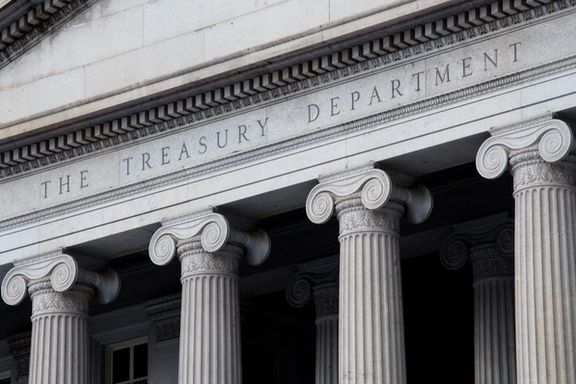
US Department of Treasury in Washington DC. FILE PHOTO
After a claim Friday that $3.5 billion of Iran's frozen funds had been freed, an IRGC newspaper bumped the figure to $4 billion, as a sign of Tehran's victory.
Neither the CEO of government news agency IRNA who had made the initial claim, nor Javan newspaper affiliated with the Revolutionary Guard presented any evidence or quoted an official source to back-up their claims. There have been no foreign official or media reports indicating that the United States has agreed with release of Iranian frozen funds.
An editorial Saturday in Javan said that within 100 days of Raisi taking office, not only had $4 billion been freed "without much negotiation” but also the "capacity of Iran's nuclear program has been growing.”
The paper contrasted these events with the two-year negotiations leading to the 2015 nuclear deal, the JCPOA (Joint Comprehensive Plan of Action), and with the failure of previous president Hassan Rouhani to secure the release of Iranian funds frozen by third parties wary of punitive United States action under its ‘maximum pressure’ sanctions threatening anyone buying Iran’s oil or dealing with its financial sector.
In a dig at Rouhani, whose strategy of deepening economic ties with Europe was thwarted by ‘maximum pressure,’ Javan noted that “sometimes not being eager to negotiate, particularly with Westers powers, produces better results.”
In a tweet Friday the CEO of the government official news agency (IRNA), Ali Naderi, said $3.5 billion of Tehran's frozen funds had been released. Naderi did not say where the assets were frozen but claimed they could soon be used for “trade,” presumably implying they might pay for exports to Iran rather than be transferred as cash.
Javan added $500 million to this figure on the grounds, it said, that the United Kingdom had finally agreed to pay a four-decade-old debt of £400m ($535m) owed Iran for weapons bought in the 1970s but never delivered.
The newspaper linked the release of frozen funds and Britain honoring the debt to the resumption of Vienna talks at the end of November on reviving the JCPOA. The pavements would give “a different perspective to the Vienna process," it said.
Iran has assets frozen in several countries including South Korea and Japan, largely for past purchases of Iranian oil, as well as in Iraq, India, and China. It was reported this week that China imported on average 560,000 barrels per day(bpd) of Iranian oil from the beginning of August until the end of October, but other Asian customers stopped buying it under US pressure.
$50 billion frozen
The semi-official Iranian Students News Agency (ISNA) in a report Saturday said Iran's assets frozen abroad amounted to $50 billion, including $8 billion in South Korea, $3 billion in Japan, and $6 billion in Iraq.
The ISNA report said that suddenly injecting all these assets into the forex market would push the exchange rate for the dollar to 150,000 rials or less. Nonetheless, the rial fell by 1,900 to 285,300 against the US dollar in the unofficial market Thursday.
Iranian officials have repeatedly made claims of the looming release of frozen funds, from Iraq in March for instance, but have not subsequently confirmed the transfer of money.
Last week South Korea’s Yonhap news agency wrote after Korea's first vice minister for foreign affairs, Choi Jong-kun, talked by phone with the US special envoy for Iran, Robert Malley, that Seoul and Washington maintained communication over Iran, especially on Iranian assets locked in South Korean banks, which it put at $7 billion.
Prince Faisal bin Farhan Al Saud, foreign minister of Saudi Arabia. FILE PHOTO
Exploratory talks with Iran have been cordial but not substantive, Saudi Arabia’s foreign minister has told France-24 in an interview published on Saturday.
“We are committed to a substantive discussion with Iran on addressing concerns that we and other countries in the region have…but that would require to address all the concerns that we all have,” Prince Faisal bin Farhan Al Saud said.
He added that although no substantive progress has been achieved in four rounds of talks but, “we have made enough progress that would allow us to move forwards.”
Asked about Saudi concerns over the progress of multilateral talks aimed at reviving the 2015 nuclear deal, known as JCPOA, bin Farhan said that his country has “significant doubts” about where the talks are going. He went on to say that these doubts have been reinforced in recent months by Iran’s nuclear activities. He also said Riyadh is concerned about restrictions on IAEA nuclear monitoring in Iran.
Tehran has accelerated uranium enrichment and has said it now has a stockpile of more than 200 kilograms of 20-percent enriched fissile material and another 25 kg of 60-percent purified uranium. This takes Iran closer to the threshold of having enough 90-percent enriched uranium for a nuclear bomb.
President Joe Biden in a cabinet meeting. November 12, 2021
US President Joe Biden said in a memo to his officials on Friday that there were sufficient supplies of oil so other countries can reduce purchases from Iran.
The White House is required to affirm every six months that there is enough oil supply globally to maintain sanctions against Iran that were put in place in 2012, during Barack Obama's administration.
Biden's memo sent to Secretaries of State, Treasury and Energy comes in advance of a virtual meeting with China's President Xi Jinping on Monday, in what is expected to be the leaders' most extensive meeting since Biden took office.
Iranian media reported Biden’s statement amid general pessimism about the outcome of the talks to restore the 2015 nuclear agreement (JCPOA) and have the US sanctions lifted. The government’s news website IRNA, however, was quick in trying to instill optimism quoting a member of parliament’s energy committee on Saturday who said exports have gradually increased in the past few months.
China is the largest purchaser of Iranian oil, averaging purchases of more than 500,000 barrels a day over the last three months.
Chinese purchases of Iranian crude have continued this year despite sanctions that, if enforced, would allow Washington to cut off those who violate them from the US economy.
The Biden administration is currently not enforcing those sanctions ahead of forthcoming negotiations with Iran to revive the JCPOA.
"Consistent with prior determinations, there is a sufficient supply of petroleum and petroleum products from countries other than Iran to permit a significant reduction in the volume of petroleum and petroleum products purchased from Iran by or through foreign financial institutions," Biden said in the memo.
Biden administration diplomatic attempts to enforce the oil sanctions by persuading China to reduce purchases remain confidential, but critics believe the administration has not acted with determination to stop the trade.
Biden’s argument about sufficient oil supplies, however, is not so strong amid prices that have exceeded $80 a barrel. As gasoline prices have been rising in the United States, there is talk this week of the government releasing supplies form the Strategic Petroleum Reserves (SPR).
Almost all of Iran’s oil to China is shipped in illicit ways, with tankers transferring oil on high seas and documents fabricated to show other sources for cargoes. But Iranian officials and government-controlled media have claimed in recent months that Iran has been successful in exporting more oil to China.
No one knows how Chinese importers pay Tehran amid US banking sanctions on Iran but the role of intermediaries in selling cargoes to China and making payments to Iran has been reported. This means Iran is not recouping the full value of its exports.
Protests against water shortage in Esfahan, Iran. November 12, 2021
Hundreds of residents of Esfahan joined farmers protesting against water shortage and the drying up of the river, Zayandeh Roud, that flows through the city.
Footage aired by state television and social-media posts showed protesters marching in the dry river bed towards the 17th-century Khajou Bridge Friday.
But the water crisis has been getting worse in Iran for the past decade because of mismanagement in constructing unnecessary dams, encouraging water-thirsty crops like rice and political influence in water distribution.
Zayandeh Roud – which starts from the Zagros Mountains, whirls through Esfahan and disappears in wetlands east of the city – has been completely dry most of the year for two decades. Esfahani farmers started a new round of protests Monday.
Protesters sleeping in tents pitched in the dry riverbed at night say water “traditionally” allocated to farmers has gone to businesses or to other provinces, and that the Esfahani farmers cannot sow autumn crops, including wheat, while their livestock is damaged.
Ali-Akbar Mehrabian, the energy minister, flew to Esfahan Friday to investigate the situation, with some protestors blaming power industries for using water.
"We have come from east and west to seek what is our right. We are neither thugs and hooligans, nor preying on other's livelihood. We are a group of hardworking farmers with calluses on our hands and bare feet. Our men and women's subsistence depends on farming, " one farmer said in a speech to protesters on Tuesday alluding to often-used accusation of being "thugs and hooligans" brought against protesters by the authorities.
Farmers in Esfahan have held several protests this year despite a warning by Esfahan's Revolutionary Prosecutor's Office on April 24 to avoid rallies without a permit. The prosecutor warned that unlicensed protests risked "misuse" by people with "destructive goals." Khuzestan protests in July over water lasted for nearly two weeks, in which at least 12 people were killed when security forces used force.
Government critics blame the water situation an emphasis on attempts to achieve self-sufficiency in agriculture, including water-intensive crops such as rice and other grains.
Ali Salajegheh, Iran’s representative at Cop26 in Glasgow, Scotland, told the BBC Thursday, that Iran would sign the Paris accords once sanctions were lifted. "Iran has been impacted by climate change like every other place in the world," he said. "This has reduced our rainfall per annum and also the inflow of water into our rivers has reduced by 40 percent this has affected our agriculture and affected our industrial and drinking water."
Iran is the world's eighth largest CO2 emitter yet is one of the few countries not to ratify the 2015 Paris pact.
View of Baneh in Iran's Kurdistan province. FILE PHOTO
Scores of Iranian Kurds have been arrested in two regions in the Iranian Kurdistan province, two human rights monitoring groups reported on Friday.
Several residents in villages around the town of Saqez were rounded up by security forces and taken to an unknown location, Hengaw, a Kurdish rights group said. Abdollah Mahjuz, a former political prisoner and his cousin Mohammad Mahjuz were among those detained.
The reason for the arrests is not clear, but security forces regularly detain Kurdish citizens on suspicions of political activities or membership in underground groups.
Hengaw also reported that 20 people were arrested around the town of Baneh in Kurdistan. The Kurdistan Human Rights Network, another monitoring group, also reported that dozens of agents in civilian clothes stormed several other villages near Baneh and arrested ten people. Local sources told the rights group that agents entered home and after confiscating personal items, detained citizens with verbal and physical violence. In some cases, agents beat up family members who prevented their illegal entry into their homes.
These reports also said that security personnel are present in Baneh’s streets and nearby villages.
Ali Motahari, outspoken Iranian politician. FILE PHOTO
A former parliamentary leader in Iran says that refusing to directly negotiate with the United States is an “obvious mistake” and against national interests.
Supreme Leader Ali Khamenei has banned direct talks with the United States and the current key foreign policy players appointed by President Ebrahim Raisi who took office in August are known as hardliners close to Khamenei’s office. In recent weeks, Iranian diplomats have been demanding the US free Iran’s frozen funds as a “goodwill gesture” before Iran shows flexibility.
Motahari in his tweet went on to say that “In these past few years it became clear that Russia, China and Europe” are not the critical actors. Addressing the hardliners, he wrote that if Qasem Soleimani’s assassination is the reason for refusing to directly negotiate with the US, the decision to punish the perpetrators remains in place.
Soleimani, who was Iran’s top military and intelligence operator in the Middle East was killed in a US drone strike ordered by former president Donald Trump on January 3, 2019.
As Iran has delayed rejoining the Vienna talks for five months its economic crisis has deepened with the national currency rial falling 20 percent since Raisi took office.
Economists and financial experts in Tehran say that uncertainty about the nuclear talks is the main reason why the rial is losing value against major currencies. On Friday, two economists told the Fararu website that for the stability of rial all major sanctions should be lifted, but in the meantime negative and ambiguous statements by Iranian officials dissipates confidence and leads to rial’s fall.
Reports say that demand for US dollars has increased in recent days as people take advantage of their annual prerogative to buy up to $2,000 from legal currency dealers.
There is also the issue of approving financial reform bills that have languished for more than three years. The international Financial Action Task Force (FATF) has blacklisted Iran demanding legislation against money laundering and financing of terrorism. The designation by itself is enough to keep Iran’s banking relations with other countries restricted.
Iran has been spending from its currency reserves since US oil sanctions were imposed in 2018 and has resorted to printing money, which in turn has pushed inflation for essential goods to above 60 percent. Now, it planning to stop subsidizing food and medicine, which will push prices even higher, with all its political risk.
More and more public figures, including high-ranking clerics and politicians, such as Motahari, have been appealing to decision makers to speed up nuclear talks. Hardliners in charge of the government, on the other hand, are posturing to get more concessions from the United States.