• العربية
  • فارسی
Brand
  • Iran Insight
  • Politics
  • Economy
  • Analysis
  • Special Report
  • Opinion
  • Podcast
  • Iran Insight
  • Politics
  • Economy
  • Analysis
  • Special Report
  • Opinion
  • Podcast
  • Theme
  • Language
    • العربية
    • فارسی
  • Iran Insight
  • Politics
  • Economy
  • Analysis
  • Special Report
  • Opinion
  • Podcast
All rights reserved for Volant Media UK Limited
volant media logo

Former Central Banker Says Lack Of Optimism On Nuclear Talks Drives Iran's Currency Lower

Nov 9, 2021, 07:34 GMT+0
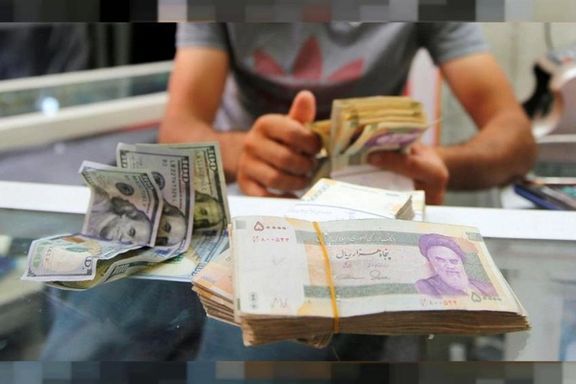
Foreign currency dealer in Tehran counting banknotes. Undated

Lack of optimism in the outcome of nuclear talks is the reason why Iran’s currency has declined in recent days, a former deputy of Iran’s Central Bank has said.

Kamal Seyyed-Ali former director of the central bank’s foreign currency desk on Tuesday told Khabar Online website in Tehran that the news about resumption of nuclear talks at the end of November has not convinced currency dealers and the public that economic conditions will improve.

Iran International reported Sunday that Iran’s rial had dropped to 280,000 against the US dollar, despite confirmation last week that multilateral nuclear talks will resume in Vienna, where an agreement could remove US economic sanctions imposed on Iran since 2018.

The former central banker said that conditions Iran is putting forward might not be accepted and this “increases nervousness among dealers” regarding the value of the rial. He added that in the absence of oil exports and foreign currency inflows, the smallest demand for dollars boosts its exchange rate.

Seyyed-Ali said that the fall of the rial during President Ebrahim Raisi’s first hundred days “is not a good sign” and it shows the market’s reaction to negative posturing by officials over the nuclear deal (JCPOA).

Most Viewed

100 days after carnage: Iran economy reels from war, inflation, unemployment
1
INSIGHT

100 days after carnage: Iran economy reels from war, inflation, unemployment

2
INSIGHT

Ghalibaf defends Iran-US talks amid hardline backlash

3
INSIGHT

A nation in limbo: 100 days after the massacre, has the world moved on?

4
ANALYSIS

From instability to influence: Pakistan’s pivotal role in US-Iran diplomacy

5
ANALYSIS

100 days on: why Iran’s January protests spread across social classes

Banner
Banner

Spotlight

  • War-hit homeowners feel abandoned as Iran’s reconstruction aid fades

    War-hit homeowners feel abandoned as Iran’s reconstruction aid fades

  • 100 days on: the anatomy of Iran’s January crackdown
    INSIGHT

    100 days on: the anatomy of Iran’s January crackdown

  • Ghalibaf defends Iran-US talks amid hardline backlash
    INSIGHT

    Ghalibaf defends Iran-US talks amid hardline backlash

  • 100 days on: why Iran’s January protests spread across social classes
    ANALYSIS

    100 days on: why Iran’s January protests spread across social classes

  • From instability to influence: Pakistan’s pivotal role in US-Iran diplomacy
    ANALYSIS

    From instability to influence: Pakistan’s pivotal role in US-Iran diplomacy

  • A nation in limbo: 100 days after the massacre, has the world moved on?
    INSIGHT

    A nation in limbo: 100 days after the massacre, has the world moved on?

•
•
•

More Stories

Criticism Of Raisi Continues Despite His Good Ties With Media

Nov 8, 2021, 22:31 GMT+0

Only two days after a "promising" meeting between Iran's president and managing editors of reformist newspapers, they continued criticizing his performance.

The dailies' managers even criticized President Ebrahim Raisi during the meeting lashing out at him for many of his appointments that have been widely condemned as examples of nepotism. Raisi responded that he will tell his ministers to explain the appointments to the public.

Nonetheless, it appears there is no end to such appointments, as the administration has introducedMassoud Fayazi, a relative of Tehran's mayor, to the Majles as the candidate for the post of the Minister of Education.

The event took place on the same day that the culture ministry's Press Supervisory Board banned Kelid daily in Tehran for depicting Supreme Leader Ali Khamenei's hand, drawing the poverty line in Iran. The ban was contrary to what Raisi had promised about press freedom during his campaign in May when he told the conservative daily Resalat that he guarantees the freedom of the press.

Following the November 6 meeting with managing editors and proprietors, Mansour Mozaffari the managing editor of reformist daily Aftab Yazd wrote in a commentary that Raisi must have realized during the past three months that there is a certain gap between the expectations of the public and the abilities of his cabinet ministers.

Mozaffari wrote that the first 100 days of every administration provide a reasonable ground for judging its performance and its officials and suggested that after his first year in office Raisi should decide which ministers to keep and which ones to drop. Mozaffari added that Raisi is likely to make that decision even before the first year and before the parliament warns him about his ministers' poor performance.

Incidentally, some lawmakers pointed out the weakness of some of Raisi's ministers at the parliament's session on Sunday when lawmakers were discussing shortcomings in the nation's livelihood and the unresolved problems of Iran's foreign policy.

According to Mozaffari, Raisi told the editors that his first and foremost preoccupation was to solve the people's economic problems. He also said that Raisi responded to their concern about the appointment of several Revolutionary Guard generals as provincial governors, by saying that all of them were educated in the areas of management and civil engineering with some executive experience.

Meanwhile, Mohammad Ali Vakili, the managing editor of reformist daily Ebtekar wrote in a commentary that Raisi spent the first two hours of the meeting listening to what the journalists had to say. Vakili also agreed with Mozaffari that the most significant criticism put forward was about the appointments within the administration. Vakili praised Raisi for being a good listener. However, he criticized him for not having a clear roadmap for the country in the areas of the economy and foreign policy. "We are facing serious problems and dangerous situations in these areas," Vakili wrote.

He pointed out that wasting time and failing to address these issues during the administration's first 100 days in office will trigger alarms, adding that what has been done so far portrays no promising outlook.

Vakili pointed out that regardless of winning the presidential election in a low turnout vote, the people still have hope in Raisi. "His only bad luck is that, unlike his predecessors, he does not have too much time to solve the problems as the country faces a more critical situation."

Recalling President Hassan Rouhani poor relations with the press, Vakili pointed out that Raisi's good ties with the media are one of his points of strength."

Despite all this, criticism of the Raisi administration particularly in the areas of foreign policy and the economy continues in the press. Reformist Arman daily's front-page article on Monday saying that the country's problems will not be solved by managers who have no executive experience is shared by many papers and websites.
Syria Reports Israeli Air Strikes On Multiple Targets

Nov 8, 2021, 19:59 GMT+0

Syria’s military has said Israel carried out airstrikes Monday night on central and western provinces, wounding two soldiers and causing material damage.

The military said Israeli warplanes fired missiles while flying over neighboring Lebanon.

It claimed that Syrian air defenses shot down most of the Israeli missiles without elaborating.

The strikes came amid an increase in reported attacks by Israel on Syria in recent weeks.

Israel has staged hundreds of strikes on Iran-linked military targets in Syria over the years but rarely acknowledges or discusses such operations.

Israel has acknowledged, however, that it is targeting bases of Iran-allied groups, such as the powerful Lebanese militant Hezbollah group. Iran has been involved in the Syrian war since 2011, deploying its own Revolutionary Guard and Afghan, Iraqi and other militias.

Israel says an Iranian presence on its northern frontier is a red line, and it has repeatedly struck what it has described as Iran-linked facilities and weapons convoys destined for Lebanon’s militant Hezbollah group.

There are no independent or other reports about possible militia casualties.

Iran Daily Banned Over Graphic Of Khamenei's Hand Drawing Poverty Line

Nov 8, 2021, 19:29 GMT+0
•
Maryam Sinaiee

Iran's media watchdog has banned a newspaper after it published a frontpage graphic showing Supreme Leader Ali Khamenei's left hand drawing a “poverty line.”

Allaudin Zohurian, the board’s secretary announced it had voted to revoke the publication license of Kelid (Key) but gave no reason. After six years’ publication, the newspaper’s website has gone offline.

The decision to ban the newspaper was taken two days after social media uproar over a graphical version of a much-circulated photo of Khamenei'sleft hand holding a blue pen and writing. The newspaper splashed a headline "Millions of Iranians Under Poverty Line."

The hand depicted in the graphic, bearing a ring with an amber stone, left no doubt as to whose hand it was. Khamenei's other hand, the right, was paralyzed in a June 1981 bombing, widely attributed to the now Albania-based Mujahedin-e Khalq Organization (MEK), when he narrowly escaped death when a Friday imam in Tehran.

Newspaper graphic depicting Khamenei's hand drawing a poverty line.
100%
Newspaper graphic depicting Khamenei's hand drawing a poverty line.

Many hardliners on social media immediately detected defamation, with some blaming reformists although Kelid (Key) is known for strong conservative leanings and criticism of the former centrist president Hassan Rouhani.

The Young Journalists Club (YJC), an affiliate of the state broadcaster IRIB, had recognized the hand in the Kelid graphic. Director General for Domestic Media, Iman Shamsaei, told YJC that the Press Supervisory Board would investigate the case the next day.

The board has revoked licenses of dozens of newspapers in the past two decades for various for alleged violations including anything that could be interpreted as criticism of the Supreme Leader. Iran International journalist Morteza Kazemian said that its action over Kelid showed red lines governing criticism of Khamenei and that “journalists must navigate in a minefield to work.” He said the ruling would lead to “even more self-censorship on the part of all journalists."

Chief editor of the London-based opposition Kayhan newspaper, Elahe Boghrat, tweeted Monday that Kelid had illegally lifted from the Internet the graphic, drawn by Ali Eshtyagh for Kayhan in March 2021, removing the artist’s signature.

After three years of United States ‘maximum pressure’ sanctions, Iran faces more than 45 percent general inflation and more than 60 percent food price inflation. Real expenditure per person peaked in 2017, the year before the US left the Iranian nuclear deal and introduced the sanctions.

The World Bank reported in October that“the loss in household incomes due to the pandemic (owing to lockdowns) and rising living costs due to inflation [had] added more pressures on low-income households.” The bank concluded that “these shocks are likely to have determined a sizeable increase in poverty.”

The head of Iran’s largest state charitable organization, the Imam Khomeini Relief Committee, Morteza Bakhtiari, claimed August 15 that a 22-fold increase in living expenses between 2001 and 2019 was responsible for 33 percent of the Iranian population being under the poverty line.

Iran-Backed Houthis Push To Take Yemen's Oil-Rich Marib

Nov 8, 2021, 18:28 GMT+0

Fighting continued near the city of Marib in Yemen on Sunday between Iran-backed rebels and forces loyal to Yemen's internationally recognized government.

Last week, security officials said at least 200 fighters were killed in clashes between Yemen's government forces and Houthi rebels in and around the strategic central province of Marib over two days.

Most of the casualties belonged to the Houthi forces, who have recently wrestled from their rivals most of Marib's 14 districts, according to the officials, who spoke on condition of anonymity because they were not authorized to brief the media.

The Houthis have for years attempted to take oil-rich Marib to complete their control over the northern half of Yemen.

The kingdom is leading a military coalition that has been fighting on the government side against the Houthis.

Yemen has been convulsed by civil war since 2014 when the Houthis captured the capital, Sanaa, and much of the north of the country, forcing the internationally recognized government to flee to the south, then to Saudi Arabia.

The Saudi-led coalition entered the war in March 2015, backed by the United States, to try to restore the government to power.

Despite a relentless air campaign and ground fighting, the war has deteriorated largely into a stalemate and spawned the world's worst humanitarian crisis.

Iran's Interior Minister Defends Appointment Of Generals As Governors

Nov 8, 2021, 16:45 GMT+0

Iran’s interior minister has defended the appointment of Revolutionary Guard commanders as civilian governors, insisting that the policy has popular backing.

Ahmad Vahidi, himself an Islamic Revolution Guard Corps (IRGC) general, speaking in the religious city of Qom on Monday said when military leaders are willing to serve in civilian posts, and people welcome the move it can only benefit citizens.

There has been a lot of criticism in Iranian social media as President Ebrahim Raisi’s administration has appointed several IRGC generals to be provincial governors. The move is seen as an attempt to consolidate more power by the Guards who already have vast influence over the economy and politics of the country.

Vahidi also said that the world is waiting for Qom, the Shiite religious center of Iran, to rescue it from “the calamities brought about by the ignorance of Western civilization.” He added, “Western civilization led by America, Zionists and their allies are equipping terrorists all over the world and bombing people in Afghanistan, Yemen and elsewhere.”

The general’s comments come as in the past four years more Iranians have openly turned against the clerical government, coming into streets to protest and demanding a secular political system.