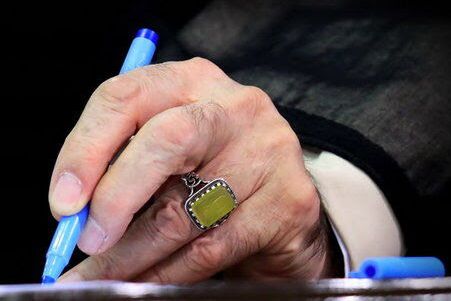
Photo of Ali Khamenei's left hand writing. Undated
Iran's media watchdog has banned a newspaper after it published a frontpage graphic showing Supreme Leader Ali Khamenei's left hand drawing a “poverty line.”
Allaudin Zohurian, the board’s secretary announced it had voted to revoke the publication license of Kelid (Key) but gave no reason. After six years’ publication, the newspaper’s website has gone offline.
The decision to ban the newspaper was taken two days after social media uproar over a graphical version of a much-circulated photo of Khamenei'sleft hand holding a blue pen and writing. The newspaper splashed a headline "Millions of Iranians Under Poverty Line."
The hand depicted in the graphic, bearing a ring with an amber stone, left no doubt as to whose hand it was. Khamenei's other hand, the right, was paralyzed in a June 1981 bombing, widely attributed to the now Albania-based Mujahedin-e Khalq Organization (MEK), when he narrowly escaped death when a Friday imam in Tehran.
Newspaper graphic depicting Khamenei's hand drawing a poverty line.
Many hardliners on social media immediately detected defamation, with some blaming reformists although Kelid (Key) is known for strong conservative leanings and criticism of the former centrist president Hassan Rouhani.
The Young Journalists Club (YJC), an affiliate of the state broadcaster IRIB, had recognized the hand in the Kelid graphic. Director General for Domestic Media, Iman Shamsaei, told YJC that the Press Supervisory Board would investigate the case the next day.
The board has revoked licenses of dozens of newspapers in the past two decades for various for alleged violations including anything that could be interpreted as criticism of the Supreme Leader. Iran International journalist Morteza Kazemian said that its action over Kelid showed red lines governing criticism of Khamenei and that “journalists must navigate in a minefield to work.” He said the ruling would lead to “even more self-censorship on the part of all journalists."
Chief editor of the London-based opposition Kayhan newspaper, Elahe Boghrat, tweeted Monday that Kelid had illegally lifted from the Internet the graphic, drawn by Ali Eshtyagh for Kayhan in March 2021, removing the artist’s signature.
The World Bank reported in October that“the loss in household incomes due to the pandemic (owing to lockdowns) and rising living costs due to inflation [had] added more pressures on low-income households.” The bank concluded that “these shocks are likely to have determined a sizeable increase in poverty.”
The head of Iran’s largest state charitable organization, the Imam Khomeini Relief Committee, Morteza Bakhtiari, claimed August 15 that a 22-fold increase in living expenses between 2001 and 2019 was responsible for 33 percent of the Iranian population being under the poverty line.
Fighting continued near the city of Marib in Yemen on Sunday between Iran-backed rebels and forces loyal to Yemen's internationally recognized government.
Last week, security officials said at least 200 fighters were killed in clashes between Yemen's government forces and Houthi rebels in and around the strategic central province of Marib over two days.
Most of the casualties belonged to the Houthi forces, who have recently wrestled from their rivals most of Marib's 14 districts, according to the officials, who spoke on condition of anonymity because they were not authorized to brief the media.
The Houthis have for years attempted to take oil-rich Marib to complete their control over the northern half of Yemen.
The kingdom is leading a military coalition that has been fighting on the government side against the Houthis.
Yemen has been convulsed by civil war since 2014 when the Houthis captured the capital, Sanaa, and much of the north of the country, forcing the internationally recognized government to flee to the south, then to Saudi Arabia.
The Saudi-led coalition entered the war in March 2015, backed by the United States, to try to restore the government to power.
Despite a relentless air campaign and ground fighting, the war has deteriorated largely into a stalemate and spawned the world's worst humanitarian crisis.
Ahmad Vahidi, Iran's interior minister in military uniform. FILE PHOTO
Iran’s interior minister has defended the appointment of Revolutionary Guard commanders as civilian governors, insisting that the policy has popular backing.
Ahmad Vahidi, himself an Islamic Revolution Guard Corps (IRGC) general, speaking in the religious city of Qom on Monday said when military leaders are willing to serve in civilian posts, and people welcome the move it can only benefit citizens.
There has been a lot of criticism in Iranian social media as President Ebrahim Raisi’s administration has appointed several IRGC generals to be provincial governors. The move is seen as an attempt to consolidate more power by the Guards who already have vast influence over the economy and politics of the country.
Vahidi also said that the world is waiting for Qom, the Shiite religious center of Iran, to rescue it from “the calamities brought about by the ignorance of Western civilization.” He added, “Western civilization led by America, Zionists and their allies are equipping terrorists all over the world and bombing people in Afghanistan, Yemen and elsewhere.”
The general’s comments come as in the past four years more Iranians have openly turned against the clerical government, coming into streets to protest and demanding a secular political system.
Assistant Secretary General of the Arab League, Hossam Zaki, speaks at the presidential palace in Baabda, Lebanon November 8, 2021.
A top Arab League envoy was in Beirut on Monday to explore ways to resolve an unprecedented diplomatic rift between Lebanon and Saudi Arabia.
The crisis emerged following comments by Lebanon's information minister, who is close to Iran-backed Hezbollah, criticizing the war in Yemen that a Saudi-led coalition is waging against the Iran-backed Houthi rebels.
Arab League official Hossam Zaki said his visit was "an initiative to put the crisis on the right track."
Zaki, the league's deputy chief, told reporters after meeting Lebanese President Michel Aoun that he was ready to visit Saudi Arabia but that some tangible moves to ease the crisis have to be felt first.
Lebanon has said that Information Minister George Kordahi's remarks about Yemen, aired in late October, do not represent official government views.
Zaki later Monday also met Lebanese Prime Minister Najib Mikati and parliament speaker Nabih Berri.
The spat has threatened to destabilize Mikati's government, formed in September after a 13-month deadlock between rival Lebanese groups.
Mikati has urged Kordahi to "do what needs to be done" — an apparent appeal for him to step down but the minister has so far refused to apologize or resign.
Saudi Arabia has withdrawn its ambassador from Beirut and asked the Lebanese envoy to leave the kingdom.
Damage at the residence of Iraqi Prime Minister. November 7, 2021
A drone attack that targeted the Iraqi prime minister on Sunday was carried out by at least one Iranian-backed militia group, Reuters reported on Monday.
The Iraqi security sources and sources close to the militias, who spoke to Reuters on Monday on condition of anonymity, said the drones and explosives used in the assault were Iranian-made.
A spokesperson for one Iran-aligned paramilitary group declined to comment immediately on the attack or on who carried it out. Other Iranian-backed groups could not be reached immediately for comment.
The Iranian government in Tehran did not immediately respond to requests for comment. On Sunday, Tehran condemned the attack and the official media tried to distance Iran from the incident, claiming that it was a plot against “resistance forces” in Iraq.
Prime Minister Mustafa al-Kadhimi escaped unhurt from the attack on his residence in the Iraqi capital Baghdad, which was carried out using explosives-laden drones.
Two Iraqi security officials and three sources close to the militia groups that Iran has supported in Iraq said the attack was committed by at least one of those groups but gave slightly different assessments of exactly which factions.
The two security officials said that the powerful Kataib Hezbollah and Asaib Ahl al-Haq groups carried it out in tandem.
One militia source said that Kataib Hezbollah was involved and that he could not confirm the role of Asaib.
Neither of those groups immediately commented for the record.
The incident could be seen as another sign of Iran’s interventionist regional policies that for years have alarmed some Arab states and the West.
No group has claimed responsibility for the attack, which raised tension in Iraq a few weeks after a general election disputed by Iran-backed militias including Kataib Hezbollah and Asaib.
The political parties that represent Iran-aligned paramilitary groups in parliament suffered crushing defeats at the polls on October 10, losing dozens of the seats they have controlled for several years.
On Friday their supporters targeted security forces guarding Baghdad’s green zone by throwing stones and injuring some servicemen. Security forces opened fire at the protesters and at least one was killed.
The Iran-backed armed militias do not like the prime minister who tries to maintain a balance between the Washington and Tehran and has good relations with the West.
The election defeat comes as the Islamic Republic boasts to its domestic audience about the influence of its Shiite ideology in neighboring Iraq. Iranian critics of the clerical regime say that after spending billions of dollars to gain influence in a Shiite-majority country, the people reject its local allies and its presence.
Iran and African countries have remained silent about Israeli media claims that Mossad had foiled Iranian plots to “target” Israeli nationals or Jews in Africa.
Israel's Channel 12 reported Sunday night that five people with African passports had been arrested by “local intelligence in these countries,” after Mossad, the external Israeli intelligence agency, had thwarted multiple Iranian “plots” against Israeli tourists and businessmen in Tanzania, Senegal, and Ghana.
The channel claimed the five had been trained in Lebanon and returned to Africa posing as religious students to identify Israeli targets, including tourists on safari in Tanzania, to attack.
In February, American and Israeli officials said Iran was behind a thwarted operation against the United Arab Emirates embassy in the Ethiopian capital, Addis Ababa, and that a cell of 15 had been arrested in Ethiopia and Sweden. Iran, which had condemned the ‘normalization’ of relations between the UAE and Israel, denied the accusations. In September Cyprus said it had arrested an Azerbaijani national over an Iranian plot to attack Israeli businessmen there.
Iran has always denied such allegations, either denying the Islamic Republic’s and IRGC's affiliation with the accused or claiming that these incidents were only plots to paint Iran in a bad light in the international community.
Iran has blamed Israel – and Israeli officials have appeared to confirm – acts of violence in Iran including explosion at Natanz enrichment facility in July 2020 and the killing of nuclear scientist, Mohsen Fakhrizadeh in November 2020.
Iranian officials recently also accused Israel and the United States of being behind a cyberattack that disrupted sales of subsidized gasoline to motorists. Gholamreza Jalali, head of Passive Defense Organization (PDO), which is in charge of cyber security, told Iranian state TV that Iran was sure that the US and Israel had planned attacks on Iran’s railways in July and the Shahid Rajaee port in May 2020. Five days after the fuel distribution attack, a group called ‘Black Shadow’ targeted an Israeli data and internet company.
Both Iran and Israel have stepped up their rhetoric since Fakhrizadeh's assassination. Last month a top Israeli official told Iran International that an attack against Iran's nuclear targets was a priority and Israeli media reported the military was beginning training. Channel 12 reported last month that Israel had allocated $1.5 billion for attacks on Iran.