• العربية
  • فارسی
Brand
  • Iran Insight
  • Politics
  • Economy
  • Analysis
  • Special Report
  • Opinion
  • Podcast
  • Iran Insight
  • Politics
  • Economy
  • Analysis
  • Special Report
  • Opinion
  • Podcast
  • Theme
  • Language
    • العربية
    • فارسی
  • Iran Insight
  • Politics
  • Economy
  • Analysis
  • Special Report
  • Opinion
  • Podcast
All rights reserved for Volant Media UK Limited
volant media logo

In Washington, UN Nuclear Chief Feeds Confusion Over Iran Censure
Iran International Newsroom
Oct 22, 2021, 11:31 GMT+1Updated: 17:39 GMT+1
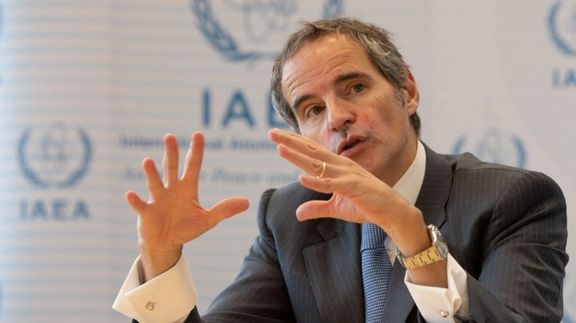
Rafael Grossi Director General of the IAEA. File Photo

An interview carried out by a US think tank with IAEA head Rafael Grossi has highlighted his disquiet over Iran’s reduced co-operation with the UN agency.

At one point in the interview, carried out by Brian Finlay of the Stimson Center, Grossi, the IAEA director-general replies "yes" when asked if he would support censuring Iran at the agency’s late November board meeting, but Finlay fails to ask a single follow-up question, even to query the grounds for censure.

This led to considerable confusion in media reports but Grossi or the IAEA have not denied that he said “yes” to the question about censuring Iran. It would be uncommon if the IAEA chief would publicly endorse censure, a decision that member states should make.

Throughout the rest of the interview, Grossi makes the clear distinction characteristic of the IAEA between its technical role as the body responsible for monitoring Iran’s nuclear sites and any political decisions taken by the nation-states who are IAEA members and sit on its board.

By the time he sat down with Finlay Thursday for a session broadcast live on Zoom, Grossi had met US Secretary of State Antony Blinken, National Security Adviser Jake Sullivan, as well as senators and members of congress. Asked about the ‘plan b’ or “other options” touted by Blinken should nuclear talks with Iran fail, Grossi said: “This is a national thing, or a multinational thing, and I don’t have an opinion on that.”

Grossi described the situation with Iran as a “difficult juncture” and stressed the importance of explaining the agency’s actions to the US government and “of course to listen to them.”

The IAEA head explained how the agency’s role interacted with the Vienna nuclear talks, which until suspended in June had sought to revive Iran’s 2015 nuclear deal, the JCPOA (Joint Comprehensive Plan of Action).

With the US, which left the JCPOA in 2018, taking part indirectly in Vienna alongside remaining JCPOA signatories – China, France, Germany, Iran, Russia and the United Kingdom – the talks have struggled to agree which US sanctions contravene the JCPOA and exactly how Iran’s nuclear program, expanded and improved since 2019, should be returned to JCPOA limits.

“When it comes to the JCPOA I am not a party to the negotiations,” Grossi said. “The IAEA is an essential element as a guarantor and a verifier, and we are in constant deliberation with the negotiators as to whether what they are doing is in line what we might be needed to be verifying and so forth. It’s an immensely dense process…”

Grossi explained that the IAEA’s role had entered a “new phase” not with the new administration of president Ebrahim Raisi (Raeesi), which took office in August, but with last December’s vote by the Iranian parliament requiring the government, should the US not lift sanctions, to both increase uranium enrichment and reduce IAEA monitoring to that required by the Nuclear Non-Proliferation Treaty. “Parliament was telling the government what to do with an amazing degree of specificity,” Grossi noted.

Keeping the patient stable

This had led Grossi to reach a temporary arrangement in February, extended in September, for IAEA access by maintaining its cameras, giving it the opportunity should the Vienna talks succeed to restore a full picture of Iran’s nuclear work.

Grossi said that in his talks in Tehran in February he had argued that keeping such a level of monitoring might help keep Iran’s “partners” within the JCPOA “simply because they would be able to avoid a big black hole” in terms of their knowledge of Iran’s activities. “We have been keeping the patient stable in terms of the amount of information and quality of information we can put on the table,” he noted.

Grossi has raised several matters of concern recently over Iran, including past unexplained nuclear work and the agency being stopped from servicing equipment at a site in Karaj.

But he clearly told the Stimson Center it was too early to anticipate what would happen at the IAEA board of governors meeting in November. At the last meeting September, the US did not raise a motion of censure, as it had been speculated, possibly because Russia made clear it would object.

Grossi said the board meeting was in his “mental structure” so far away that it was part of the 23rd century. “There is so much going on, and so much that may influence what may or may not happen there. I am concentrating on the immediate challenges that we have …There are many actors.”

The Iranian media generally played down the Grossi interview. Outlets most critical of the JCPOA have criticized the IAEA for following a political agenda coming from Washington.


Most Viewed

US blockade enters murky phase as tankers spoof signals and buyers hesitate
1
ANALYSIS

US blockade enters murky phase as tankers spoof signals and buyers hesitate

2
INSIGHT

Ideology may be fading in Iran, but not in Kashmir's ‘Mini Iran'

3
INSIGHT

Hardliners push Hormuz ‘red line’ as US blockade tests Iran’s leverage

4
VOICES FROM IRAN

Hope and anger in Iran as fragile ceasefire persists

5

US sanctions oil network tied to Iranian tycoon Shamkhani

Banner
Banner

Spotlight

  • Hardliners push Hormuz ‘red line’ as US blockade tests Iran’s leverage
    INSIGHT

    Hardliners push Hormuz ‘red line’ as US blockade tests Iran’s leverage

  • Ideology may be fading in Iran, but not in Kashmir's ‘Mini Iran'
    INSIGHT

    Ideology may be fading in Iran, but not in Kashmir's ‘Mini Iran'

  • War damage amounts to $3,000 per Iranian, with blockade set to add to losses
    INSIGHT

    War damage amounts to $3,000 per Iranian, with blockade set to add to losses

  • Why the $100 billion Hormuz toll revenue is a myth
    ANALYSIS

    Why the $100 billion Hormuz toll revenue is a myth

  • US blockade targets Iran oil boom amid regional disruption
    ANALYSIS

    US blockade targets Iran oil boom amid regional disruption

  • Iran's digital economy battered by prolonged blackout
    INSIGHT

    Iran's digital economy battered by prolonged blackout

•
•
•

More Stories

US Is Using IAEA’s Grossi To Exert Pressure On Iran, Says IRGC Paper

Oct 22, 2021, 07:59 GMT+1
•
Iran International Newsroom

IRGC-affiliated media in Iran has suggested that the US is using IAEA chief Rafael Grossi to exert pressure on Tehran to return to nuclear talks in Vienna.

Javan daily newspaper published a commentary by Hadi Mohammadi on Thursday that the United States is using the International Atomic Energy Agency (IAEA) to monitor Iran's nuclear activities and to inspect its nuclear installations on its behalf, based on the authority vested in the UN nuclear watchdog by the Non-Proliferation Protocol (NPT) and some of the clauses in the Iran nuclear deal, JCPOA.

The United States and the West benefit from the intelligence gathered by the IAEA for them free of charge, Mohammadi claimed in the commentary. Meanwhile, he opined that this intelligence gathering mechanism was badly harmed with the reduction in Iran's commitments under the JCPOA. However, the IAEA Chief is trying to get back the initial concessions given to the West by the JCPOA, Javan maintained.

Last December, Iran passed a law limiting IAEA’s monitoring access to its nuclear sites, demanding that the US should lift its sanctions. A limited and temporary deal is in place now, but Grossi has complained that Iran is curtailing his agency’s ability to do its job.

The commentary further stressed that in fact, it is the United States that is under ‘maximum pressure’ by Iran to return to the negotiations as it has failed to force Iran to make new concessions.

Javan insisted that there is no room for the inclusion of talks about Iran's missile programs in the new negotiations, and the West can only hope to harness Iran's nuclear program, but it needs to give concessions to make that possible.

It described Grossi's call for having a political discussion with Iran's Foreign Minister Hossein Amir-Abdollahian as naïve and warned the IAEA chief that Iran is not under any commitment to go beyond the discussion of technical matters within the frameworks of NPT. Mohammadi added that Grossi should know that the members of Tehran's new negotiating team are different from their predecessors.

The commentary said that Grossi can only talk with Iran's nuclear chief Mohammad Eslami rather than hoping to meet with the foreign minister. "He should distance himself from the idea of holding talks in Iran by proxy for the United States," the commentary said, adding that a chat with Eslami is the most he can get if he visits Tehran. The US, said the commentary, should forget about the division of labor with Grossi and instead should make concessions.

Meanwhile, in another article entitled "Winding in Washington," another IRGC media outlet likened Grossi to a clock that Washington has winded to make its moves in Tehran. This article also repeated the argument of the commentary about Grossi being used by the US as a tool to exert pressure on Tehran before starting the talks to revive the JCPOA.

The article added that Washington is also planning to use Grossi to exert pressure on other countries, including China, via the International Atomic Energy Agency. This was a reference to US officials' statements about asking China to stop buying oil from Iran.

Grossi asked to meet with Amirabdollahian following his meetings with US officials including Secretary of State Antony Blinken this week. During the meeting, Blinken said that Iran should remain committed to the verification of its nuclear activities, stop provocative actions and return to diplomacy.

Subsequently, Grossi told the Financial Times Monday that "a temporary arrangement for the International Atomic Energy Agency (IAEA) to monitor Iran’s nuclear sites was no longer intact." Grossi told the newspaper he wanted "an urgent meeting – 'contact at the political level' − with Iran’s foreign minister Hossein Amirabdollahian to discuss surveillance arrangements."

“I haven’t been able to talk to [Iran’s new] foreign minister,” Grossi told the FT. “I need to have this contact at the political level. This is indispensable. Without it, we cannot understand each other.”

Saudi Foreign Minister Discusses Iran With EU Coordinator

Oct 21, 2021, 22:27 GMT+1

Saudi foreign minister discussed the Iran nuclear negotiations with the European Union envoy coordinating talks on reviving the Iran nuclear deal on Thursday.

Prince Faisal bin Farhan al-Saud discussed the Iran nuclear talks with the European Union envoy, Enrique Mora, the Saudi Foreign ministry said on Thursday.

"They discussed developments regarding the Iranian nuclear program talks, and international efforts to ensure that Iran does not violate international agreements and treaties in this regard," it added in a statement.

Iran has been enriching uranium far beyond limits set by the 2015 nuclear agreement, JCPOA. The West and many regional countries are concerned at the possibility of Iran becoming a nuclear threshold state.

Prince Faisal met with US Special envoy Rob Malley on Thursday also to discuss the Iran nuclear talks. Saudi Arabia, which opposed the JCPOA and backed former president Donald Trump in leaving the deal in 2018, wants the US to introduce new issues, including Iran’s missile program and links with regional allies.

Saudi Arabia has tempered its approach since US president Joe Biden took office in January committed to restoring the JCPOA and has held a series of exploratory talks with Iran in Baghdad designed to explore easing tensions.

Exclusive - Russia Wants Focus On Iran Nuclear Talks In Vienna, Soon

Oct 21, 2021, 15:53 GMT+1
•
Iran International Newsroom

Russia has signaled its continued commitment to collective nuclear diplomacy with Iran in Vienna and emphasized the need for an early Iranian return to talks.

In a no-nonsense interview Wednesday with Iran International TV, Mikhail Ulyanov, Russia’s ambassador to the International Atomic Energy Agency, confronted what he called “misunderstanding” and “misinterpretation.”

Ulyanov was probably in part referring to reports that Iran had requested a meeting with the European Union in Brussels to slow down the resumption of talks in Vienna over reviving the 2015 deal as tactic to gain an advantage. “Further delay may be counterproductive,” he said.

The envoy clearly downplayed reports that Iran is seeking to persuade the EU to influence the United States over the talks, which have been suspended since June in their efforts to revive the 2015 deal, the JCPOA (Joint Comprehensive Plan of Action).

“My good colleague Enrique Mora from the European Union visited Tehran October 14, the Iranian side in its turn expressed willingness to pay a visit to Brussels before the end of the month,” said Ulyanov. “So what?”

The ambassador pointed out that Mora − the EU foreign policy chief who coordinates the JCPOA Joint Commission, the formal body for the Vienna talks − could not negotiate for other state signatories.

“Real negotiations can take place only in Vienna in a multilateral format with proper proxy participation of the United States,” said Ulyanov. Washington, which left the JCPOA in 2018, takes part indirectly in Vienna alongside the remaining JCPOA signatories – China, France, Germany, Iran, Russia and the United Kingdom.

While the US state department said Monday it saw no need for the possible Brussels meeting, Ulyanov compared the proposal in terms of “normal diplomatic practice” to Iranian foreign minister Hossein Amir-Abdollahian’s October 6 visit to Moscow and Amir-Abdollahian’s October 15 phone-call with Sergei Lavrov, the Russian foreign minister. As an attendee of the Moscow meeting, Ulyanov said he had found it productive.

The remaining 10%

Nonetheless, “close contacts with Iranian counterparts…should not be interpreted as a separate track of negotiations between Russia and Tehran on nuclear issues,” Ulyanov said.

The envoy expressed Moscow’s understanding that the new Iranian administration of President Ebrahim Raisi (Raeesi) “some time to be prepared, to establish a new negotiating team,” just as it had taken the US administration of President Joe Biden two months in office to enter the Vienna talks.

But Ulyanov also said Russia had “expected the talks to resume in a couple of weeks” and that it was now “high time” to resume. He pointed out it was four calendar months since the sixth round in Vienna ended June 20.

Ulyanov judged that 90 percent of the challenges involved in reviving the JCPOA had been settled in Vienna. The remaining 10 percent were “rather controversial” issues, but despite this and the “time-consuming” process, he said the “chances for success are rather high.”

The “10 percent” reportedly involved reaching agreement over which US sanctions, including those imposed as it left the JCPOA in 2018, needed to be lifted for Washington to return to the nuclear deal, and how Iran should reverse the steps it has taken since 2019 in expanding and improving its nuclear program.

Israeli Minister Says Conflict With Iran 'Only A Matter Of Time'

Oct 21, 2021, 15:33 GMT+1

Israel’s Finance Minister has fired off another warning on Thursday, saying conflict over Iran's nuclear program was inevitable and only a matter of time.

As multilateral nuclear talks with Iran remain suspended and its uranium enrichment continues to generate fissile material, Liberman told Walla news site that “a confrontation with Iran is only a matter of time, and not a lot of time.”

While the United States and its European allies still insist that agreement can be reached if Iran does not delay the talks, Liberman said that “no diplomatic process or agreement will stop Iran’s nuclear program.

Israeli officials have been warning in recent months that Iran is getting close to the point of no-return and Israel cannot afford to wait for intricate diplomatic processes. Liberman reiterated the point that for Israel Iran’s nuclear program is perceived as an existential threat.

Liberman said that Iran is a bigger threat for Israel that it is for other countries. “They have stated that their policy is the destruction of Israel, and they mean it.”

The government has asked parliament for $1.5 billion more military budget citing the danger from Iran and the need to prepare for it.

US, European Diplomats To Discuss Iran On Friday In Paris -Sources

Oct 20, 2021, 22:26 GMT+1

The US special envoy for Iran will meet European diplomats in Paris on Friday to discuss stalled Iran nuclear talks, three diplomatic sources said on Wednesday.

While saying for weeks it would return to talks "soon," Iran has yet to announce a date to resume discussions in Vienna about reviving the pact under which it curbed its nuclear program in return for relief from U.S., EU and UN economic sanctions.

Then-US President Donald Trump abandoned the pact in 2018 and reimposed harsh U.S. sanctions. About a year later, Iran started violating some of the deal's limits on uranium enrichment. Enriching uranium can provide a path to obtain the fissile material for an atomic bomb, an ambition Iran denies.

The diplomatic sources, who spoke on condition of anonymity, said US Special Envoy for Iran Rob Malley would meet with the political directors of the British, French and German foreign ministries, a group know as the E3, in Paris on Friday.

One of the sources said he hoped the meeting would provide some clarity on how world powers might act in the coming weeks if Iran continued to "buy time" and delay returning to Vienna. US officials have said time is running out to revive the deal.

Report by Reuters