• العربية
  • فارسی
Brand
  • Iran Insight
  • Politics
  • Economy
  • Analysis
  • Special Report
  • Opinion
  • Podcast
  • Iran Insight
  • Politics
  • Economy
  • Analysis
  • Special Report
  • Opinion
  • Podcast
  • Theme
  • Language
    • العربية
    • فارسی
  • Iran Insight
  • Politics
  • Economy
  • Analysis
  • Special Report
  • Opinion
  • Podcast
All rights reserved for Volant Media UK Limited
volant media logo

Views Clash In Debate Over Iran's Foreign Economic Relations
Oct 16, 2021, 11:08 GMT+1Updated: 15:00 GMT+0
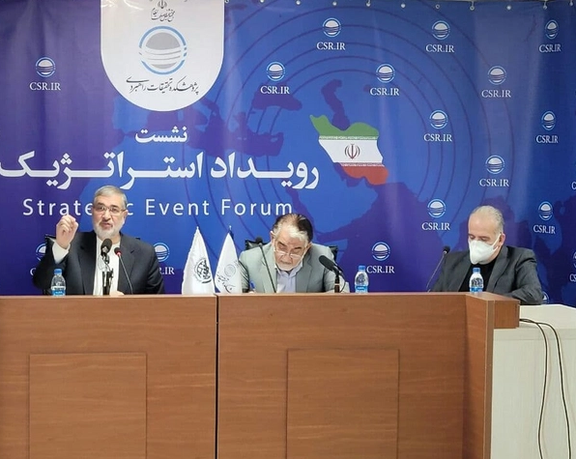
Asghar Ebrahimi-Asl, former deputy oil minister speaking at a Tehran forum. October 16, 2021

A roundtable discussion in Tehran has revealed two different visions about the economic future of Iran - improved ties with the world or reliance on the East.

Two local research institutes jointly sponsored a mini conference about economic diplomacy, which mainly revolved around the merits of the current emphasis by Iran on expanding ties with China and Russia to save its economy from crisis and a subtle rebuttal by one of the speakers.

At the two ends of the spectrum, a former ambassador to South Africa and former deputy oil minister Asghar Ebrahimi-Asl defended the strategy of relying on East, while the head of the Iran-China chamber of commerce Majid Reza Hariri spoke about the importance of foreign investments and strong ties with all economic powers.

Ebrahimi-Asl, who is a petroleum engineer reportedly with an MS degree from the University of Southern California (USC), criticized what he said was the policy of the former Rouhani administration in trying to improve ties with Europe and the United States. He was referring to nuclear negotiations with world powers that resulted in the 2015 nuclear deal later abandoned by former US president Donald Trump and the imposition of harsh sanctions.

Ebrahimi-Asl argued for Iran’s self-reliance, echoing arguments by Principlists and hardliners who follow Supreme Leader Ali Khamenei’s dictum. The former deputy oil minister insisted that fossil fuels will remain important well into the next decades and Iran has plenty of oil and gas reserves it can rely on. He also defended the view that the US is not a reliable country and will continue to plot against Iran.

Clearly, Ebrahimi-Asl said, the United States has faced defeats and failures while countries in the East and members of BRICS have become economic powers that Iran can rely on.

Majid Reza Hariri, with carefully observing the redlines of the Islamic Republic in public discourse, tried to put the emphasis on the acute need for foreign investments, which need good relations with the rest of the world.

First, he argued that the recent media and official emphasis on ‘economic diplomacy’ to boost trade suffers from a lack of clear definition. Iran’s decision makers should clarify what the term economic diplomacy means.

Hariri said that Iran chooses military influence in the region over influence in commerce with countries such as Iraq, Syria and Lebanon, but economic power is another important factor in strengthening national security.

The head of the China chamber of commerce implicitly referred to Iran’s policies which encouraged self-isolation after the 1980s Iran-Iraq war and said that if foreign companies had come and stayed in Iran and invested, it would have been much harder for others to impose sanctions on the country.

Hariri also drew attention to capital flight from Iran. He said capital that has left the country is three times more than foreign investments in the past three decades. He argued that state entities and three consecutive presidents since 1997 have failed to reach their targets in industrial development and expansion.

Hariri’s remark means that he is pinpointing inherent and systemic problems with Iran’s economic vision and policies, even before serious sanctions were imposed first by the United Nations from 2011-2015 and then by the US in 2018.

Hariri, at the end, emphasized the importance of economic ties with China but he also highlighted Iran’s favorable geo-economic position in the Persian Gulf and the Sea of Oman and argued for the country to expand on commerce and serve as an international commercial hub.


Most Viewed

100 days after carnage: Iran economy reels from war, inflation, unemployment
1
INSIGHT

100 days after carnage: Iran economy reels from war, inflation, unemployment

2
INSIGHT

Ghalibaf defends Iran-US talks amid hardline backlash

3
INSIGHT

A nation in limbo: 100 days after the massacre, has the world moved on?

4
ANALYSIS

From instability to influence: Pakistan’s pivotal role in US-Iran diplomacy

5
ANALYSIS

100 days on: why Iran’s January protests spread across social classes

Banner
Banner

Spotlight

  • War-hit homeowners feel abandoned as Iran’s reconstruction aid fades

    War-hit homeowners feel abandoned as Iran’s reconstruction aid fades

  • 100 days on: the anatomy of Iran’s January crackdown
    INSIGHT

    100 days on: the anatomy of Iran’s January crackdown

  • Ghalibaf defends Iran-US talks amid hardline backlash
    INSIGHT

    Ghalibaf defends Iran-US talks amid hardline backlash

  • 100 days on: why Iran’s January protests spread across social classes
    ANALYSIS

    100 days on: why Iran’s January protests spread across social classes

  • From instability to influence: Pakistan’s pivotal role in US-Iran diplomacy
    ANALYSIS

    From instability to influence: Pakistan’s pivotal role in US-Iran diplomacy

  • A nation in limbo: 100 days after the massacre, has the world moved on?
    INSIGHT

    A nation in limbo: 100 days after the massacre, has the world moved on?

•
•
•

More Stories

Iran Farmers Demand Lawmaker To Deliver On Promise To Pray For Rain

Oct 16, 2021, 08:48 GMT+1

Farmers in Esfahan entered the office of a lawmaker and demanded he deliver on his promise of prayers for rain, saying they would not leave until it rains.

Iranian media published a video of the farmers sitting in the office Hossein Mirzaei a cleric and a member of parliament representing a district of Esfahan. Mirzaei had earlier said that special prayers for rain could help alleviate drought in the province. Farmers who have long blamed the government for mismanaging water resources decided to stage a protest.

Farmers around the ancient city of Esfahan have been protesting since 2017 for lack of irrigation water that has been diverted by the government to the neighboring Yazd province. These protests at times have been rowdy but so far authorities have failed to solve the problem.

During the sit-in at the lawmaker’s office, the farmers said they will wait until he shows up and prays for rain and will leave only when it rains.

The Islamic Republic newspaper wrote, “This gathering is in reality a protest to those who instead of taking practical steps to solve problems, invite the people to pray.”

IRGC Official Says Media In Iran Should Extol The Supreme Leader

Oct 16, 2021, 06:42 GMT+1

The new head of the Revolutionary Guard’s Media Basij Organization, a propaganda outfit, says Supreme Leader Ali Khamenei is not happy with the media in Iran.

Abbas Mohammadian, who was appointed to the post by IRGC Commander Hossein Salami earlier this week, has told the media in Tehran on Friday that his organization, the Media Basij, will strive to direct the media in a way that they would explain the Islamic Republic's underlying theme of Velayat-e Faqih, (Guardianship of the Jurisconsult), or the principle of Supreme Leader’s legitimacy to the people.

Basij is IRGC's paramilitary force, and its members are embedded in all government offices, industrial entities and social institutions to uphold and reinforce the regime's authority. The organization maintains 144 battalions whose job is to help shore up the regime’s authority among the public.

Mohammadian explained that Khamenei believes "the media have forgotten spirituality," and is unhappy because they have not met his expectations. Mohammadian reiterated that the media have done very little in explaining the virtues of the Supreme Leader to the people.

He went on to say that this is a matter to be followed up by the Culture Ministry. Recently, Culture MinisterMohammad Mehdi Esmaili announced an extensive plan to restructure the state media system to make it more consistent with the hardline nature of the governing Islamic system.

Morteza Kazemain, a journalist in London, told Iran International TV Friday morning that Khamenei's unhappiness about the media reflects his interest in consolidating his authoritarian rule. Kazemian added that the IRGC uses the Media Basij to convince the people about the regime's authority and to spread disinformation to serve the regime's interests.

Kazemian further said that thousands of Media Basij members all over Iran create content on social media to counter news and information dissemination by other traditional and social media outlets including foreign-based news organizations.

An indication of Khamenei's unhappiness with the media is that he did not extend the mandate of former state TV chief Abdolali Ali Askari after his first five years, and the director before him, Mohammad Sarafraz wrote in his memoir that he had to resign his post after only two years as the IRGC intervened in his responsibilities.

Meanwhile, as Kazemian pointed out, Khamenei has always had a negative attitude toward the media. He has not had any interviews with the press or his own state TV during the 32 years he has been Iran's Supreme Leader.

According to several polls conducted by state-owned polling agencies, the state television's popularity has been constantly dropping during the past years, particularly in the past three years when the state TV lost another 15 percent of its viewers.

At the same time, as Ensaf News website observed, the daily readership of Iranian newspapers has plummeted dramatically during the past two years, declining to as little as 1,000-3,000 copies for flagship dailies. The papers contested the website's report not because it was not true, but because they keep pretending to have a high readership to get more subsidies from the government.

Censorship and government control has not left anything interesting in the press. Readers, instead turn to social media where some of the platforms are highly popular. Instagram has over 22 million users and Telegram has more than 45 million users according to government officials. This is probably the reason why the Iranian government is so adamant to block access to social media such as Facebook and You Tube.

US Role Unclear As EU Confirms Nuclear Talks With Iran In Brussels

Oct 15, 2021, 18:08 GMT+1

EU Foreign Policy Chief Josep Borrell said Friday that he would meet with Iranian diplomats for nuclear talks in Brussels instead of Vienna, the main venue of talks.

Enrique Mora, the EU coordinator of the Iran nuclear talks in Vienna, has failed in a visit to Tehran to agree a concrete date for resuming negotiations.

Mora met Thursday with Ali Bagheri, a new deputy foreign minister who appears to lead for Iran’s new administration on the nuclear issue, to discuss stalled efforts to revive Iran’s 2015 nuclear deal with world powers, the JCPOA (Joint Comprehensive Plan of Action).

The Iranian foreign ministry after the meeting said in a statement there had been agreement to continue dialogue in Brussels in coming days.

Borrell said that Iran wants to meet in Brussels with EU officials who are coordinating indirect talks between the United States and Iran along with some other parties to the 2015 nuclear deal.

There was no mention of a US presence if a meeting takes place in brussels, which would mean that Iran in effect stops the process of indirect talks with the Biden Administration.

Borrell told reporters in Washington that he was ready to meet the Iranians, but could not say when that might happen.

"I am ready to receive them, if needed," Borrell said, adding that he did not think talks in Brussels were absolutely necessary but that he had to be willing to be somewhat "patient on this issue, because we cannot afford to fail."

Not yet ready

An EU official said that while Tehran was “not yet ready for engaging in Vienna” it was “absolutely decided to go back to Vienna…They insisted they want practical talks…with a final agreement on how to bring the JCPOA back to life.”

The Vienna talks were suspended in June for Iran’s presidential election and transition to the administration of President Ebrahim Raisi (Raeesi). Tehran has insisted it needs time to review the process.

Signaling growing impatience in Europe, a French foreign ministry spokesman said Friday Iran needed to show by action its willingness to resume talks.With European Union foreign policy chief Josep Borrell in Washington for soundings, his spokesman Peter Stano said Thursday: “We are awaiting the Iranians' response…There is an urgent need to resume discussions very soon."

“If Iran demands more or offers less, these negotiations will not succeed," US Press Secretary Jen Psaki said in her Thursday briefing, adding that she was not going to "get into hypotheticals.”

Washington takes part in the Vienna talks only indirectly, although removing US sanctions are Iran’s key demand. President Joe Biden has continued ‘maximum pressure’ sanctions against Iran despite his campaign pledge to return to JCPOA, from which President Donald Trump withdrew the US in 2018.

Good-will gesture

Iran’s foreign minister Hossein Amir-Abdollahian last week said he had suggested to the US that they release $10 billion of Tehran’s blocked funds as a good-will gesture. There have also been reports that Iran wants guarantees the US would not again leave any agreement and re-impose sanctions.

In a tweet Mikhail Ulyanov, Russia’s envoy in Vienna, said that Amir-Abdollahian and Russian foreign minister Sergei Lavrov had reaffirmed in a phone call Thursday that restoring the JCPOA "in initial configuration" was the only way to “ensure all parties' rights and interests." Moscow is committed to the original logic of the JCPOA as a non-proliferation agreement and has distanced itself from reports that the US wants to include defense and security issues in the talks.

In another tweet, reacting to remarks from Mora Thursday, Ulyanov stressed Moscow’s shared position with the Europe while noting Russia saw "no reason for pessimism."

Other options

On Wednesday, US Secretary of State Antony Blinken and his British, French and German counterparts all described Mora’s trip as critical in bringing Iran back to the table. Blinken said the US would look to “other options” if Iran refused to cut its nuclear program back to JCPOA limits, which Tehran began to exceed in 2019 in response to US ‘maximum pressure’ sanctions.

In an interview Tuesday Rob Malley, the US special envoy on Iran, said Washington wanted to “get back to the JCPOA to calm things down,” but there has also been wide media coverage of US-Israel consultation, with former Mossad chief Yossi Cohen stressing Israel’s option of bombing Iran’s nuclear sites.

Saudi Arabia Says Iran's Nuclear Program Endangering Region

Oct 15, 2021, 18:01 GMT+1

Saudi Arabian Foreign Minister Prince Faisal bin Farhan said on Friday that Iran was accelerating its nuclear activities and putting the region in “a very dangerous place”.

Diplomatic efforts since April to bring Tehran back into the 2015 nuclear deal have not succeeded as Iran continues enriching uranium and getting closer to the threshold of having enough fissile material for a bomb.

Israeli, Saudi and Emirati top officials in Washington this week discussed the stalled Iran nuclear negotiations with top US officials. The US regional allies have been concerned over the Biden Administration’s plans to revive the 2015 nuclear deal (JCPOA), which they think is inadequate to address their concerns over Iran’s policies.

In an interview with the Financial Times earlier bin Farahan said bilateral talks between Riyadh and Tehran have been “cordial” and “exploratory”, adding that Saudi Arabia has a serious approach to the negotiations, but they have not made substantial progress and to reach a stage for normalization of relations.

Riyadh severed ties with Tehran after rioters ransacked its diplomatic mission in Iran in January 2016.

Bin Farhan gave a wide-ranging news conference in Washington on regional developments during his visit to the United States.

Iran Condemns Shiite Mosque Deadly Bombing In Afghanistan

Oct 15, 2021, 16:57 GMT+1

Iran’s foreign ministry harshly condemned a terror attack on a Shiite mosque in Afghanistan on Friday that killed at least 35 people, blaming Sunni extremists.

The embassy of Iran, Afghanistan's neighbor and the region's largest Shi'ite power, condemned the attack. "We hope Taliban leaders take decisive action against these wicked terrorist incidents," it said in a tweet.

A large explosion tore through the mosque in the southern Afghan city of Kandahar, the second week in a row that militants bombed Friday prayers and killed dozens of worshippers from the minority sect.

There was no immediate claim of responsibility for Friday's attack in Kandahar, but Islamic State claimed the similar bombing that killed scores of Shi'ites in the northern city of Kunduz a week earlier.

The attacks have caused shock and terror among members of Afghanistan's Shi'ite minority and undermine the ruling Taliban movement's claim to have restored security since taking control of the country in August.

Kamal Kharazi, a top foreign policy advisor to Supreme Leader Ali Khamenei said on Wednesday that Iran expects the Taliban to respect Iran’s interests, and the protection of Shiites and Persian speakers is at the top of the list.

The foreign ministry Friday warned about plots “by enemies of Islam” in Afghanistan and called for unity among Sunnis and Shiites.

Haji Sarwar Hazara, a local construction contractor who worships at the mosque and arrived soon after the blast, said there had been at least three attackers. One attacked security guards at the entrance, allowing two suicide bombers to get into the mosque in the confusion.

"When I arrived at the mosque, I saw injured, dead bodies, and people who had fallen on top of each other," he said, adding that he had seen the bodies of two attackers.

"I do not know who did this work, it is the enemy of Islam. But they cannot bring differences among Muslims," he said.

Taliban spokesman Zabihullah Mujahid said security forces had been ordered to capture the perpetrators and bring them to justice under Islamic law.

Sunni Muslim fighters of Islamic State have repeatedly targeted Shi'ites in the past with large-scale attacks intended to kill civilians, including one that killed scores of schoolgirls in a Shi'ite district of Kabul in May last year.

The Taliban are also strict Sunni Muslims but consider Islamic State their enemy and have pledged to protect all ethnic and sectarian groups since sweeping into power in August as U.S. forces withdrew.

The UN mission in Afghanistan said those responsible should be held to account.

Taliban special forces arrived to secure the site and an appeal went out to residents to donate blood for the wounded.

The blast, coming so soon after the Kunduz attack, underlined uncertainty over security in Afghanistan as the Taliban grapple with an escalating economic and humanitarian crisis that threatens millions with hunger.

With reporting by Reuters