• العربية
  • فارسی
Brand
  • Iran Insight
  • Politics
  • Economy
  • Analysis
  • Special Report
  • Opinion
  • Podcast
  • Iran Insight
  • Politics
  • Economy
  • Analysis
  • Special Report
  • Opinion
  • Podcast
  • Theme
  • Language
    • العربية
    • فارسی
  • Iran Insight
  • Politics
  • Economy
  • Analysis
  • Special Report
  • Opinion
  • Podcast
All rights reserved for Volant Media UK Limited
volant media logo

Iran Wants US Sanctions-Waiver To Send Fuel To Lebanon
Oct 8, 2021, 16:57 GMT+1Updated: 10:15 GMT+1
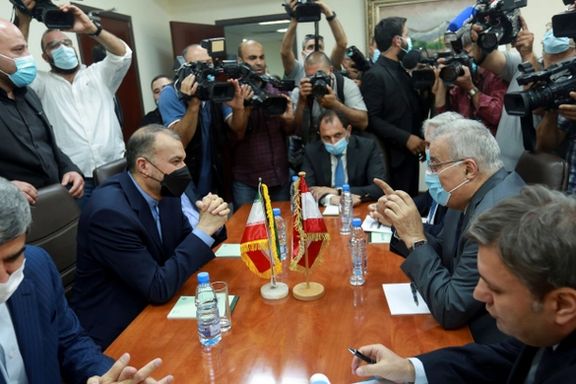
Lebanese Foreign Minister Abdallah Bou Habib meets with Iranian Foreign Minister Hossein Amir-Abdollahian, in Beirut, October 7, 2021.

Iran wants to continue sending fuel to Lebanon and hopes for an agreement with Beirut, foreign minister Hossein Amir-Abdollahian said in Beirut on Friday.

The Tehran-backed Lebanese Shi'ite Hezbollah group has been co-ordinating Iranian fuel shipments to Lebanon since August despite United States sanctions threatening punitive action against buyers of Iranian oil sales. Lebanon faces acute shortages of gasoline and diesel − the latter widely used to generate electricity – after an economic meltdown including a collapsed Lebanese pound.

Amir-Abdollahian held talks with President Michel Aoun and Prime Minister Najib Mikati Thursday. Mikati has said the Iranian fuel shipments breach his country's sovereignty.

"At any point in time if the Lebanese government asks Iran formally within the context of their brotherly ties … Iran is ready to send fuel products," Amir-Abdollahian said at a news conference.

While Hezbollah has been happy to draw kudos its role in the fuel shipments – coming by truck from Baniyas port in Syria after arriving by sea – the party’s critics and opponents say it is usurping state authority.

“Broadly speaking, fuel from a country subject to extensive sanctions like Iran is not very clearly a sustainable solution to Lebanon’s energy crisis,” US State Department spokesman Ned Price told reporters in his briefing Thursday. “This is…Hezbollah playing a public-relations game, not engaged in constructive problem solving.”

Amir-Abdollahian said Friday that given the dire situation in Lebanon – where 75 percent of the population now live in poverty – he hoped the US would waive sanctions to allow Iran to help. However Iran itself faces a serious economic crisis, with little to spare and a population that resents expenditures in foreign countries.

Flouting sanctions

Sending fuel via Syria to Hezbollah, which it can sell partly on the open market to raise money, flouts a range of US sanctions against Syria, Hezbollah and Iran.

With Lebanon – where most political groups have regional affiliations – squeezed in recent years by tensions between Saudi Arabia and Iran, Amir-Abdollahian Friday reiterated Tehran’s commitment to further talks with Riyadh, which he said had been going in the right direction.

“We and Saudi Arabia have reached some agreements in certain areas, and we welcome these talks,” he said. “Our talks with Saudi Arabia benefit the region. Iran and Saudi Arabia are two important countries that play a vital role in guaranteeing security in the region.”

The new Iranian government of President Ebrahim Raisi (Raeesi) has been talking up the importance of developing diplomatic and economic relations with its neighbors. It has attached little urgency to restarting Vienna talks over resuming its 2015 nuclear deal with world powers, talks that were prioritized by the previous government of President Hassan Rouhani.

Amir-Abdollahian said Iran would not “not waste time with negotiations” if other parties were “not serious about resuming” the Vienna process. The foreign minister has said the onus remains with the US to lift the ‘maximum pressure’ sanctions that it imposed on Iran when it left the nuclear deal in 2018. The Vienna talks have been suspended since June, ostensibly pending the transition in Tehran.


Most Viewed

Iran International says it won’t be silenced after London arson attack
1

Iran International says it won’t be silenced after London arson attack

2

State media slam Araghchi's Hormuz tweet, say it let Trump claim victory

3
VOICES FROM IRAN

Hope and anger in Iran as fragile ceasefire persists

4
INSIGHT

How Tehran bends its own red lines to boost state rallies

5

Iran halts petrochemical exports to supply domestic market

Banner
Banner

Spotlight

  • Too early to tell who is winning Iran war, experts say
    PODCAST

    Too early to tell who is winning Iran war, experts say

  • How Tehran bends its own red lines to boost state rallies
    INSIGHT

    How Tehran bends its own red lines to boost state rallies

  • Iran blackout cripples freelancer, small business incomes
    VOICES FROM IRAN

    Iran blackout cripples freelancer, small business incomes

  • Ideology may be fading in Iran, but not in Kashmir's ‘Mini Iran'
    INSIGHT

    Ideology may be fading in Iran, but not in Kashmir's ‘Mini Iran'

  • US blockade enters murky phase as tankers spoof signals and buyers hesitate
    ANALYSIS

    US blockade enters murky phase as tankers spoof signals and buyers hesitate

  • Why the $100 billion Hormuz toll revenue is a myth
    ANALYSIS

    Why the $100 billion Hormuz toll revenue is a myth

•
•
•

More Stories

German Finance Regulator Bans Bank Melli Iran From Issuing Loans

Oct 8, 2021, 13:07 GMT+1

German finance regulator BaFin said Friday it had banned a Hamburg-based branch of Bank Melli Iran from issuing loans citing infringement of transparency rules.

"BaFin had identified contraventions of the requirements for proper business organisation within the meaning of section 25a (1) of the German Banking Act caused by infringement of the four-eyes principle," BaFin said in a statement.

BaFin said its order became final on Oct. 7. It is not clear if the infringements had anything to do with US banking sanctions on Iran.

Iranian banks have opaque practices and an international watchdog, the Financial Action Task Force (FATF) has put Iran on its blacklist along with North Korea for lack of financial transparency. This has put limits on Iran's banking relations with the world.

US sanctions have also impacted Iran's banking system. Former US President Donald Trump withdrew from the 2015 nuclear accord between Iran and world powers, including the European Union, and reimposed a wide array of sanctions on the Islamic Republic, which made it almost impossible for Iranian banks to do business in the West.

The Biden administration wants to revive the accord.

Turkey Drawn Into Iran-Azerbaijan Transport Tensions

Oct 8, 2021, 12:53 GMT+1
•
Maryam Sinaiee

Reports of a halt in Iranian trucks entering Turkey were "completely fake and mischievous," Iran's Consul-General in Erzurum, eastern Turkey, said Thursday.

Sajjad Soltanzadeh, said he had been told by Turkish customs that trucks were moving both ways as usual between the two countries and that 400 Iranian trucks had entered Thursday.

Ozjan Alash (Özcan Alaş in Turkish), president of the Turkish Association for Development of Trade with Iran, told Russia's RIA Novosti Thursday that Ankara had stopped Iranian trucks in retaliation for Iran denying entry to Turkish trucks. “The trade turnover between Iran and Turkey has been completely suspended due to the tense situation on the border between Iran and Azerbaijan,” Alash said.

Alash expressed concern over any restrictions, given trade had already plummeted due to the Covid-19 pandemic. United States ‘maximum pressure’ sanctions introduced in 2018 slashed Iran-Turkey trade from around $10 billion to 5.6 billion in 2019. From January until the end of Julythis year it was $2.5 billion.

Turkey is a close ally of Azerbaijan and has supported it over rising tensions with Iran, which have centered on Tehran’s vehicular access to Armenia through territory occupied by Azerbaijan since last year’s Armenia-Azerbaijan war.Azerbaijan has arrested some Iranian truck drivers and introduced taxes for using the land corridor through which Iranian commerce reaches Armenia, Russia, and Europe.

Baku also began military drills with Turkey and Pakistan September 12, while Tehran has held its own extensive military exercises near the Azerbaijani border.

Mostafa Ayati, former transit director general of the Iranian Customs Organization, told Eghtesad Online Wednesday that Iran should improve its maritime infrastructures in the Caspian Sea as way to Europe without using land routes through Azerbaijan, Armenia, and Turkey.

Ayati said that Iranian truck drivers travelling through Armenia had lately tried to enter Russia through Georgia, rather than Azerbaijan, but had found the border closed for refurbishment.

But Ruhollah Latifi, spokesman of Iranian Customs Organization, denied reports that Georgia had denied entry, saying traffic through Armenia and Azerbaijan to Georgia continued as usual.

An official of Iran-Georgia Chamber of commerce, Maryam Soltani, told the Iranian Labour News Agency (ILNA) Thursday that she had confirmed with the Georgian embassy in Tehran its borders had not been closed to Iranian trucks. She stressed that Iranian drivers preferred the route through Azerbaijan due to the difficulty and extra cost of using the mountainous road through Armenia.

According to Azerbaijan's national carrier, Azal, Yerevan on 6 October opened its airspace to Azerbaijani planes going to its enclave, the Nakhchivan Autonomous Republic (NAR). This followed reports that Iran had closed its airspace to Azeri military traffic going to NAR.

Victims Of Torture Want Iran's Raisi Arrested If He Travels To Scotland

Oct 8, 2021, 12:35 GMT+1

A group of plaintiffs have made a formal request for the arrest of Iran's President Ebrahim Raisi if he travels to Scotland to attend a climate conference.

The Cop26 climate summit in Glasgow will take place in November and some reports from Tehran indicate Raisi might attend the gathering. President Joe Biden and Pope Francis are scheduled to take part.

Raisi is accused of being part of a group in 1988 that executed thousands of Iranian political prisoners serving time. Before becoming president in June, Raisi spent decades in Iran’s notorious judicial system as a judge and prosecutor.

Human rights organizations and UN experts have demanded accountability fro the Iranian president and international investigation of his role in the killings.

Human rights activists, victims of torture and their relatives have asked the police in Scotland to investigate Raisi using the legal concept of universal jurisdiction, whereby any country can charge an individual suspected of crimes against humanity.

Another Iranian citizen is now on trial in Sweden for his role in the 1988 killings based on the same legal principle.

Iran's Envoy To IAEA Leaving Post For Non-Diplomatic Assignment

Oct 8, 2021, 10:10 GMT+1

Kazem Gharibabadi, Iran’s envoy to international organizations in Vienna, including the International Atomic Energy Agency, will leave his post on October 15.

Fars news agency close to Iran’s Revolutionary Guard reported late Thursday that Gharibabadi has been appointed as the head of Islamic Republic Judiciary’s international affairs department.

The post was held by hardliner functionary Ali Bagheri-Kani until he was appointed as deputy foreign minister by Iran’s new foreign minister Hossein Amir-Abdollahian.

Gharibabadi, who has held the post for the past three years is the son-in-law of former Revolutionary Guard general Mohammad-Bagher Zolghadr, who is currently the secretary of the Islamic Republic’s Expediency Discernment Council, a constitutional body.

Fars reports that Gharibabdi’s name had been mentioned as a possible foreign minister or head of the foreign ministry’s international legal department when President Ebrahim Raisi (Raeesi) was selecting his cabinet in July and August.

He was appointed by former foreign minister Mohammad Javad Zarif.

He had previously served as ambassador to Holland.

Iran FM Pledges Support In Meeting With Hezbollah's Nasrallah

Oct 8, 2021, 08:56 GMT+1

On the second day of his visit to Lebanon, Iran’s foreign minister Hossein Amir-Abdollahian met with the leader of Hezbollah, Hasan Nasrallah on Friday.

Reports by semi-official sources did not reveal many details about the meeting, except that the two sides praised one another and their mutual cooperation.

Amir-Abdollahian pledged full support for Lebanon, which is experiencing an unprecedented economic crisis. Iran recently shipped fuel to alleviate a serious shortage in Lebanon, but beyond that Tehran itself faces an economic crisis mainly because of US sanctions.

Nasrallah thanked the Islamic Republic of Iran for standing next to Lebanon and the “resistance forces”, a reference to Tehran’s allies and proxies in the region.

“Iran has proven that it is an honest and faithful friend, who does not leave its friends alone no matter how difficult circumstances might be,” the Hezbollah leader said.

Hezbollah, with overwhelming influence in Lebanon in the last decade, and traditional Lebanese politicians are blamed for the economic crisis that ensued in 2019, by repeated political deadlocks and factional discord.





