• العربية
  • فارسی
Brand
  • Iran Insight
  • Politics
  • Economy
  • Analysis
  • Special Report
  • Opinion
  • Podcast
  • Iran Insight
  • Politics
  • Economy
  • Analysis
  • Special Report
  • Opinion
  • Podcast
  • Theme
  • Language
    • العربية
    • فارسی
  • Iran Insight
  • Politics
  • Economy
  • Analysis
  • Special Report
  • Opinion
  • Podcast
All rights reserved for Volant Media UK Limited
volant media logo

UAE adviser says Hormuz control in Iran’s hands would set dangerous precedent
May 22, 2026, 10:23 GMT+1

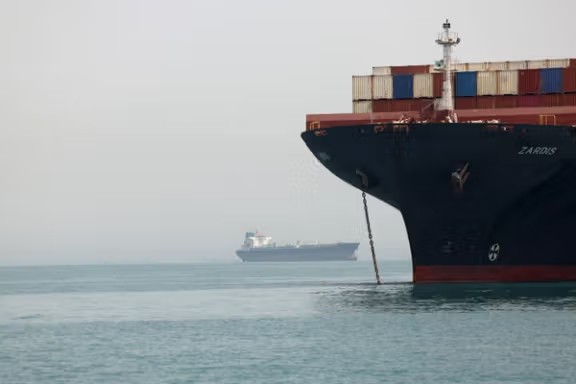
A senior adviser to the UAE president warned that any Iranian control over the Strait of Hormuz would set a serious precedent and risk being politicized by Tehran.

“Any control over the Strait of Hormuz will set a serious precedent,” Anwar Gargash said, adding that it would be “politicized in Iran’s hands.”

Gargash said any change in the strait would have serious consequences, including for Europe, because of the waterway’s role in energy and trade.

Gargash said the UAE had learned that Iran was capable of using “any weapon that it has in its hand,” and that Iran’s nuclear program had moved from being the UAE’s “second or third worry” to its first.

He said another round of fighting between the United States and Iran would “only complicate things,” adding that the UAE wanted a political solution but was concerned any deal could create new complications in the region.

“Finding a diplomatic way forward is important,” he said. “It should not be at the expense of creating further complications in the future.”

He also said the United States had become more central to every Persian Gulf country’s calculations, calling the link with Washington “a spinal cord” in national defense.

On Europe’s role, Gargash said any European initiative on Hormuz was designed to take effect only once the conflict was over, but said it remained unclear what it would do after that point.

He added that the UAE was losing out under OPEC production limits and had been thinking for three years about leaving the group, saying the country sees itself close to “the autumn of the hydrocarbon age” and wants to use its production capacity while it still can.


Most Viewed

Tit-for-tat under ceasefire: Experts warn of new normal in Mideast conflict
1

Tit-for-tat under ceasefire: Experts warn of new normal in Mideast conflict

2

Iran officials threaten Hormuz escalation as Trump says deal is near

3

Iran says US MoU may be signed in days as hardliners warn of retreat

4
ANALYSIS

The uneasy mix of diplomacy and pressure in Canada’s Iran policy

5

US-Iran deal appears close but Tehran is split and Hormuz remains tense

Banner
Banner

Spotlight

  • Iran officials threaten Hormuz escalation as Trump says deal is near

    Iran officials threaten Hormuz escalation as Trump says deal is near

  • How Nourabad Mamasani became an early flashpoint of Iran’s January bloodshed

    How Nourabad Mamasani became an early flashpoint of Iran’s January bloodshed

  • As prices soar, Iranian diets shrink to survival level
    VOICES FROM IRAN

    As prices soar, Iranian diets shrink to survival level

  • Iranian teens say rising costs turn simple wishes into distant dreams
    VOICES FROM IRAN

    Iranian teens say rising costs turn simple wishes into distant dreams

  • Faith in diplomacy further dented by Iran-Israel exchange
    INSIGHT

    Faith in diplomacy further dented by Iran-Israel exchange

  • 'Nothing is over':  Iran-Israel conflict enters a new phase
    ANALYSIS

    'Nothing is over': Iran-Israel conflict enters a new phase

•
•
•

More Stories

Iran internet blackout enters day 84, NetBlocks says

May 22, 2026, 10:00 GMT+1

Iran’s internet blackout has entered its 84th day, with international networks largely cut off for more than 1,992 hours, internet monitor NetBlocks said.

NetBlocks said each passing hour was widening social and economic divides, as contact with the outside world remained gated by “status, compliance and privilege.”

Inflation pushes Iranians to buy food in installments

May 22, 2026, 09:47 GMT+1
Inflation pushes Iranians to buy food in installments
100%
File photo of people walking through a traditional market in Iran.

Rising inflation in Iran has pushed households to buy even basic food items in installments, reshaping consumer habits.

Official figures published this year showed point-to-point inflation climbing above 73%, sharply increasing the cost of household essentials compared with the previous year. Food prices rose particularly fast, with some staples more than doubling in price.

The shift has extended installment payments beyond traditionally expensive products such as refrigerators and washing machines to groceries and supermarket packages, according to local media reports.

Chain stores and smaller retailers now advertise food, hygiene products and household supplies with payment plans spread over several months.

File photo of shoppers browsing goods inside a supermarket in Iran.
100%
File photo of shoppers browsing goods inside a supermarket in Iran.

“When even basic necessities are sold in installments, it clearly reflects the pressure inflation has placed on household finances,” Tehran-based Eghtesad News wrote in a report published on Thursday.

Second-hand market expands

The inflation surge has also accelerated demand for second-hand appliances, furniture and electronics as many households move away from buying new goods outright.

A Tehran mother identified only as Maryam told the outlet she bought a used refrigerator for roughly half the price of a new one after concluding the retail cost was no longer manageable.

“It is better to take some risk and buy second-hand than pay the heavy cost of a new product all at once,” she said.

Negin, a university student whose classes are now held online rather than in person, needed a laptop to continue her studies. Faced with soaring prices, she settled for a lightly used second-hand laptop. “This option allowed me to continue my studies without taking out a loan,” she said.

File photo of second-hand household appliances displayed for sale in Iran.
100%
File photo of second-hand household appliances displayed for sale in Iran.

Vendors in electronics and appliance markets also reported higher demand for used goods, with some sellers describing increases of between 40% and 60% compared with previous years.

Food and housing costs squeeze budgets

Economists and local observers say the change reflects deeper structural pressure on household budgets as spending on food, housing, utilities and services consumes a growing share of monthly income.

Annual inflation has surpassed 53%, according to official data, while prices for dairy, meat, rice, cooking oil and eggs have climbed sharply.

The report said many consumers now view installment purchases and second-hand goods not as cheaper alternatives, but as the only practical way to maintain daily living standards under prolonged inflationary pressure.

Rubio says no country should accept Iran tolls in Hormuz

May 22, 2026, 09:33 GMT+1

US Secretary of State Marco Rubio said Friday there had been “slight progress” on Iran but warned that any Iranian attempt to create a tolling system in the Strait of Hormuz would be unacceptable.

Rubio, speaking ahead of a NATO meeting in Helsingborg, Sweden, said “no nation should accept” such a system in the strategic waterway.

He also said NATO must work for all members and that allies need a clear understanding of expectations before a leaders’ summit in Ankara later this year.

“Like any alliance, it has to be good for everyone who’s involved,” Rubio said. “There has to be a clear understanding of what the expectations are.”

Iran lawmaker says missiles should replace diplomats after US sanctions

May 22, 2026, 09:28 GMT+1

Ebrahim Rezaei, spokesperson for Iran’s parliament National Security Committee, said US sanctions on Mohammadreza Raouf Sheibani, the Islamic Republic’s expelled ambassador to Lebanon, amounted to “sanctioning diplomacy.”

In a post on X, Rezaei said sanctioning a Foreign Ministry diplomat showed Washington was not serious about talks.

“This negotiation is also probably deception, and the Americans have no desire for diplomacy,” he wrote.

“Now that they have sanctioned an Iranian diplomat too, send missiles instead of diplomats to negotiate with the devil so it understands what it is dealing with,” Rezaei added.

Germany preparing to join UK-led Hormuz security effort

May 22, 2026, 08:59 GMT+1

German Foreign Minister Wadephul said Germany is preparing to take part in efforts to secure the Strait of Hormuz under British leadership, but said he did not see it as a NATO mission.

He said talks with the United States indicated Washington would coordinate any burden-shifting with European allies.

Wadephul also welcomed President Donald Trump’s decision to deploy 5,000 additional US troops to Poland.

He said Germany was inviting the United States to stick with its original plan to deploy long-range missiles to Germany.