UN maritime chief says 1,500 ships, 20,000 crew trapped in Persian Gulf
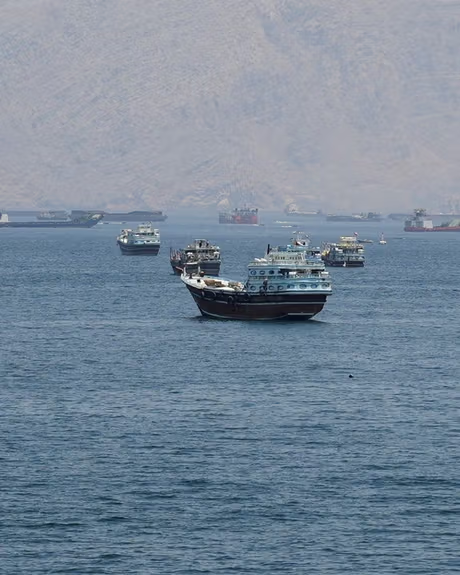

Around 1,500 ships and 20,000 crew members are trapped in the Persian Gulf because of Iran’s threats in the Strait of Hormuz, the head of the UN’s International Maritime Organization said.
“Right now, we have approximately 20,000 crewmen and around 1,500 ships trapped,” IMO Secretary-General Arsenio Dominguez told the Maritime Convention of the Americas in Panama.
Dominguez said the stranded crew members were “innocent people who are doing their jobs every day for the benefit of other countries,” but had been caught in geopolitical tensions beyond their control.
He said more than 30 attacks on vessels had killed 10 sailors, urging companies to avoid sending more ships into the Persian Gulf to prevent further casualties and economic losses.





Pakistan’s foreign minister said Islamabad had asked Singapore to help facilitate the welfare and repatriation of 11 Pakistani and 20 Iranian seafarers aboard vessels seized by US authorities and currently near Singaporean waters.
Deputy Prime Minister and Foreign Minister Ishaq Dar said he spoke with Singaporean Foreign Minister Vivian Balakrishnan and requested Singapore’s support in the case.
Dar said he also spoke with Iran’s Foreign Minister Abbas Araghchi and that Pakistan remained in close coordination with Tehran.
He added that Pakistan was ready to help facilitate the safe repatriation of Iranian nationals to Iran via Pakistan.
Dar said Pakistan’s Foreign Office and relevant authorities were coordinating with US authorities and others to ensure the safety, welfare and earliest possible return of Pakistani nationals.
Iranian media have welcomed Beijing’s unusually sharp rhetoric in support of Tehran, portraying recent Chinese diplomacy as evidence of a deepening strategic partnership.
Much of the coverage has focused on Foreign Minister Abbas Araghchi’s visit to Beijing and his meetings with senior Chinese officials.
During the trip, Chinese Foreign Minister Wang Yi delivered some of Beijing’s strongest language to date on the conflict, condemning what he called “warmongering by the US and Israel” and warning that the region had reached a “decisive turning point.”
Iranian outlets quickly cast the remarks as evidence that China was moving closer to Tehran.
But beneath the celebratory tone lies a more complicated reality: China sees Iran as a useful junior partner, not an ally worth sacrificing its broader economic interests for.
Read the full article
Oil prices could rise above $167 a barrel if the Strait of Hormuz remains closed through September, the Washington Post reported, citing projections from the Federal Reserve Bank of Dallas.
Such levels would likely push US gasoline prices above $5 a gallon, up from the current national average of $4.46, according to AAA.
The report said some analysts see an even more severe scenario, with major banks including Macquarie warning crude prices could hit $200 a barrel by early summer.
Based on previous energy shocks, the Post noted, that could send US gasoline prices above $7 a gallon, potentially enough to trigger a global recession.
US President Donald Trump warned Iran to quickly sign an agreement with Washington, saying Tehran would face severe consequences if there is no ceasefire or deal.
“If there’s no ceasefire, you’re just going to have to look at one big glow coming out of Iran,” Trump said at the Lincoln Memorial Reflecting Pool. “They better sign the agreement fast. If they don’t sign, they’re going to have a lot of pain.”
Trump said negotiations with Iran were still underway and referred to the passage of three US destroyers through the Strait of Hormuz amid clashes with Iranian forces.
“We’re negotiating with the Iranians,” Trump said. “You probably heard, we took our three destroyers, and we rammed them through some pretty big stuff today, and we knocked the hell out of them. The destroyers weren’t hurt in any way.”
The surge in diesel prices triggered by the Iran war is expected to accelerate China’s transition toward electric heavy trucks, potentially speeding the decline in fuel demand in the world’s largest oil importer, analysts and automakers say.
Electric heavy trucks, once a niche segment, accounted for nearly a third of new heavy truck sales in China in 2025, driven by government subsidies, lower refuelling costs and expanding charging infrastructure.
According to data provider CVWorld.cn, sales of new-energy heavy trucks rose 45% year-on-year to 44,000 units in early 2026, accounting for more than a quarter of the market, up from less than 20% a year earlier.
