• العربية
  • فارسی
Brand
  • Iran Insight
  • Politics
  • Economy
  • Analysis
  • Special Report
  • Opinion
  • Podcast
  • Iran Insight
  • Politics
  • Economy
  • Analysis
  • Special Report
  • Opinion
  • Podcast
  • Theme
  • Language
    • العربية
    • فارسی
  • Iran Insight
  • Politics
  • Economy
  • Analysis
  • Special Report
  • Opinion
  • Podcast
All rights reserved for Volant Media UK Limited
volant media logo
PODCAST

‘Permit for a terrorist’: Canada opposition asks who cleared IRGC-linked official’s entry

Negar Mojtahedi
Negar Mojtahedi

Iran International

May 2, 2026, 09:28 GMT+1
Canada's Prime Minister Mark Carney and Foreign Minister Anita Anand

Canada’s Official Opposition has accused the government of bypassing its own rules after Iran International reported that an IRGC-linked Iranian football official was granted special permission to enter the country despite being inadmissible.

Iran International’s reporting was followed by political backlash in Ottawa, international coverage and Mehdi Taj being turned back within hours of landing in Canada.

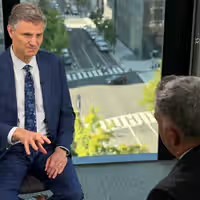
Speaking to Iran International’s Eye for Iran, Melissa Lantsman, deputy leader of Canada’s Conservative Party, said the case raised serious questions about who approved Mehdi Taj’s entry and why.

“We need to know who did it, when it happened, how it happened, why it happened, and why it’s never going to happen again,” Lantsman said.

Taj, president of Iran’s football federation, had been expected to travel to Vancouver for the FIFA Congress on April 30 at the Vancouver Convention Center.

Iran International previously reported that Taj was issued a Temporary Resident Permit, or TRP, a tool that allows Canadian authorities to admit a person who would otherwise be barred under immigration law.

Canada listed the IRGC as a terrorist entity in 2024, making people linked to the force inadmissible. Taj has longstanding ties to the Islamic Republic’s security establishment and previously served as an intelligence commander in the IRGC in Isfahan.

Lantsman said the permit showed that the issue was not simply a screening failure.

“Somebody actively made this decision to circumvent our own rules,” she said.

“I can’t believe that I work in a place with a minister who would issue a terrorist a permit.”

Taj was able to board a flight to Canada and land in Vancouver. He was sent back within hours, after Iran International’s reporting on the case had already become public.

That sequence has become central to the political fallout in Ottawa. Critics say the government acted only after the case drew public attention, while ministers have declined to discuss details, citing privacy rules.

Lantsman rejected that explanation in the podcast interview.

“We don’t give privacy to terrorists,” she said. “There is no privacy to people who are inadmissible to our country.”

The issue quickly reached Parliament.

Opposition MPs pressed ministers to explain how a person barred under Canada’s own rules received permission to enter the country.

At Thursday’s meeting of the Standing Committee on Public Safety and National Security in Ottawa, Conservative MP Frank Caputo asked Immigration Minister Lena Diab how a person deemed inadmissible had been granted entry.

Caputo said “the rule of law demands transparency” and asked “who gave him a visa,” saying Iran International’s reporting had brought the case to public attention.

Prime Minister Mark Carney declined to comment on Taj’s case, citing privacy laws, but defended the government’s position on the IRGC.

“Members of the [Iranian] Revolutionary Guard rightly have been prohibited from entering this country and they will not enter this country,” he said.

Foreign Affairs Minister Anita Anand suggested the permit may have been granted and later revoked, saying her understanding was that “there is a revocation of the permission” and that “it was unintentional.”

Lantsman said that response only deepened the need for answers.

“If they unintentionally gave him a permit, then we need to know how that happened and why it happened,” she said. “And if the unintentionality of it was about the revocation, that’s even worse.”

The controversy has turned a single immigration decision into a broader political test of Canada’s handling of officials tied to the Islamic Republic.

Although Canada has formally banned the IRGC, Temporary Resident Permits allow authorities to override inadmissibility in certain cases. Taj’s case has raised questions about how such exceptions are approved and what safeguards exist when national security concerns are involved.

The controversy also comes as anger continues over the Islamic Republic’s crackdown on protests in January, with the IRGC at the center of the state response. Rights groups and Iranian activists have described the violence as among the deadliest episodes in modern Iranian history.

At least three Iranian footballers have been killed during the unrest. Ali Karimi, Iran’s former national team captain, has criticized FIFA’s silence and called on the organization to condemn the killing of athletes and speak out against the crackdown.

Lantsman said the opposition has submitted formal questions in Parliament and would continue pressing the government for details.

“This cannot happen,” she said. “We’re going to continue to keep the pressure on.”

The case has also drawn wider attention beyond Canada. The New York Times, USA Today, Agence France-Presse and The Canadian Press have covered the incident, citing Iran International’s reporting.

For Lantsman, the central issue remains who approved the permit and why.

“Somebody in Canada, somebody very high up in the ministry, decides that it’s in public interest of Canada to have this person here,” she said.

The government has yet to publicly identify who authorized the permit, why it was issued, or what measures are being taken to prevent a similar case.

Most Viewed

Pezeshkian, Ghalibaf seek Araghchi’s ouster over 'subservience' to Guards
1
EXCLUSIVE

Pezeshkian, Ghalibaf seek Araghchi’s ouster over 'subservience' to Guards

2
INSIGHT

Economics may decide outcome of Iran-US standoff

3

US forms new coalition to secure Hormuz, asks partners to join

4

Tehran residents face eviction from hotels after war damage

5
INSIGHT

Iran faces internal instability fears as US blockade tests regime loyalists

Banner
Banner

Spotlight

  • Tehran hardens stance on Hormuz as ‘non-negotiable’
    INSIGHT

    Tehran hardens stance on Hormuz as ‘non-negotiable’

  • ‘Permit for a terrorist’: Canada opposition asks who cleared IRGC-linked official’s entry
    PODCAST

    ‘Permit for a terrorist’: Canada opposition asks who cleared IRGC-linked official’s entry

  • Iran war cannot end with Revolutionary Guards still in control
    OPINION

    Iran war cannot end with Revolutionary Guards still in control

  • Economics may decide outcome of Iran-US standoff
    INSIGHT

    Economics may decide outcome of Iran-US standoff

  • Soaring prices push medicine beyond Iranians' reach

    Soaring prices push medicine beyond Iranians' reach

  • Tehran is pricing out its daughters
    TEHRAN INSIDER

    Tehran is pricing out its daughters

  • Ottawa on defensive after Iran football chief linked to IRGC entered Canada

    Ottawa on defensive after Iran football chief linked to IRGC entered Canada

  • Iran football chief with IRGC ties sent back by Canada after arrival

    Iran football chief with IRGC ties sent back by Canada after arrival

•
•
•

More Stories

Two more men hanged in Iran as authorities ramp up executions

May 2, 2026, 07:51 GMT+1

Iran executed two more men on Saturday after the Supreme Court upheld their death sentences for spying for Israel and cooperating with the Mossad intelligence service.

The judiciary’s media center said Yaghoub Karimpour and Nasser Bekrzadeh were hanged in Urmia Central Prison following legal proceedings.

The hangings come as authorities continue to carry out daily executions, taking place against the backdrop of a fragile ceasefire following the conflict that erupted on Feb. 28.

Authorities said Karimpour, a law graduate from Miandoab and a member of the Yarsan religious minority, maintained contact with Mossad and transmitted sensitive information. Rights group Hengaw said Karimpour was arrested in connection with the 12-day war between Iran and Israel last June.

The judiciary said Bekrzadeh, a 26-year-old Kurdish political prisoner, gathered and sent information on key locations, including the Natanz nuclear site, after he was recruited online.

  • Iran executes former atomic agency employee over alleged spying for Israel

    Iran executes former atomic agency employee over alleged spying for Israel

  • Iran refuses to return body of executed teen protester to family

    Iran refuses to return body of executed teen protester to family

  • Iran executes protester over January uprising

    Iran executes protester over January uprising

Hengaw said Bekrzadeh’s death sentence was upheld in a fast-track process. "His death sentence was confirmed within just 10 days for the third time by Branch 39 of the Supreme Court and communicated to him on April 25," the group said.

Hengaw expressed concern over the transfer of the men and a third prisoner, 27-year-old Kurdish man Mehrab Abdollahzadeh, to execution cells under "vague pretexts." Abdollahzadeh was arrested during the "Woman, Life, Freedom" protests and sentenced to death on charges of armed rebellion.

"Hengaw warns of the serious and immediate danger of the execution of these three prisoners. Hengaw emphasizes that Nasser Bekrzadeh, Yaghoub Karimpour, and Mehrab Abdollahzadeh were sentenced to death in completely non-transparent processes, under torture, and without access to a fair trial," the group said.

UN human rights chief Volker Turk said this week Iran has executed at least 21 people and arrested more than 4,000 on national security charges since the start of the latest conflict in February.

"I am appalled that — on top of the already severe impacts of the conflict — the rights of the Iranian people continue to be stripped from them by the authorities, in harsh and brutal ways," Turk said.

Tehran hardens stance on Hormuz as ‘non-negotiable’

May 2, 2026, 07:31 GMT+1
•
Maryam Sinaiee

Iran’s leadership is hardening its stance on the Strait of Hormuz, framing the waterway as a strategic and non-negotiable asset amid rising tensions and US pressure.

Statements have intensified following a message for National Persian Gulf Day attributed to Supreme Leader Mojtaba Khamenei.

In the message, he described the strait as a “strategic asset” and outlined a vision for the region’s future as “a future without America,” emphasizing the importance of “Iranian management of the strait.”

Parliament speaker Mohammad Bagher Ghalibaf signaled the shift most clearly, linking current policy to both strategic doctrine and historical precedent.

“Today as well, by exercising management over the Strait of Hormuz, Iran will ensure that it and its neighbors enjoy the valuable prospect of a future free from the presence and interference of America,” he wrote on X.

In a separate English-language post, he mocked the feasibility of a US naval blockade, sharing a map of the United States and arguing that even drawing walls from coast to coast would still fall short of Iran’s total border length.

“If you build two walls, one from New York to the West Coast and another from Los Angeles to the East Coast, the total length will still be about 1,000 kilometers shorter than Iran’s borders,” he wrote. “Good luck blockading a country with those borders.”

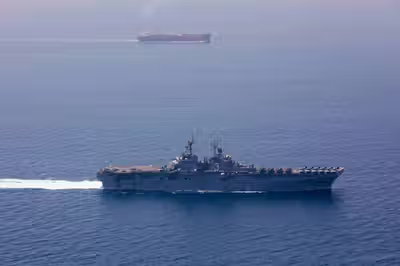
The tougher messaging comes as Washington pursues a strategy of sustained economic pressure, including a naval blockade aimed at restricting Iran’s oil exports. The Strait of Hormuz—through which roughly a fifth of global oil supply passes—has become the central point of confrontation in the standoff.

Reports from US media suggest the Trump administration is seeking international backing for a maritime coalition to secure shipping routes, while also rejecting Iranian proposals to reopen the strait as part of interim negotiations.

Masoud Foroughi, deputy managing editor of the conservative newspaper Farhikhtegan, described Khamenei’s message as more than routine rhetoric, calling it a “strategic signal” and arguing that it rejects the idea—raised by some in Tehran—that the strait could be used as a bargaining chip.

Other officials struck an even harder line. Deputy parliament speaker Ali Nikzad said the strait “must not return to its previous state,” while describing it as Iran’s “atomic bomb”—a remark underscoring its perceived strategic leverage.

Friday prayer leaders reinforced the message. Ahmad Alamolhoda, the Supreme Leader’s representative in Khorasan-e Razavi, said negotiations with the United States amount to surrender and argued that control over the strait allows Iran to “deal with the world” without talks.

In Tehran, interim Friday prayer leader Mohammad-Javad Haj Ali-Akbari said the Persian Gulf and the Strait of Hormuz are not only non-negotiable but will operate under a “new legal regime” shaped by Iran and regional partners.

Yet the rhetoric has not been entirely uniform, and diplomatic contacts have not entirely ceased.

Iran’s state news agency IRNA reported that Tehran submitted a new proposal to the United States via a Pakistani intermediary this week, underscoring the dual track of pressure and limited engagement.

President Masoud Pezeshkian also struck a more measured tone, warning against the continuation of a blockade while reaffirming Iran’s commitment to freedom of navigation and maritime safety—except for hostile countries.

“Any effort to impose a naval blockade or maritime restrictions in the Persian Gulf is contrary to international law and a threat to the interests of regional nations and global peace and stability,” he said, adding that responsibility for any insecurity would lie with the United States and Israel.

Even as some voices warn of the risks of prolonged confrontation, the dominant message from Tehran’s political, clerical and media circles is that control over the strait is a red line rather than a negotiating tool.

That stance suggests that, despite mounting economic and military pressure, Tehran is seeking to redefine the Strait of Hormuz not as leverage—but as a fixed pillar of its regional strategy.

Jailed Iranian Nobel laureate hospitalized after losing consciousness twice

May 1, 2026, 21:05 GMT+1

Iranian Nobel Peace Prize laureate Narges Mohammadi was urgently transferred from Zanjan Prison to a hospital on Friday after losing consciousness twice and suffering a severe deterioration in her health, her lawyer and the Narges Foundation said.

The Narges Foundation said in a statement Mohammadi was moved by ambulance to a local hospital in Zanjan in northwestern Iran after prison doctors concluded her condition could no longer be managed inside the prison.

She was admitted to the coronary care unit, according to her lawyer Mostafa Nili.

Nili said Mohammadi had experienced extreme blood pressure fluctuations, acute chest pain and repeated episodes of severe distress in recent days. He said she first fainted after a sudden drop in blood pressure and was given IV fluids and anti-nausea medication in the prison clinic.

After emergency services arrived, Mohammadi initially declined transfer to a Zanjan hospital, citing warnings from two cardiologists that her history of three angiographies and stent placement made treatment in Zanjan dangerous and required care by her own medical team, Nili said.

A few hours later, she lost consciousness again. A neurologist then ordered urgent hospitalization, saying her neurological condition had become the immediate clinical priority despite her serious cardiac issues.

The foundation said Mohammadi’s family had sought proper medical care for weeks and described the hospital transfer as a “last-minute” step that may have come too late.

It said specialists had recommended her transfer to Pars Hospital in Tehran, where her own medical team could treat her.

According to the foundation, Zanjan’s forensic medical commission had already recommended a one-month suspension of her sentence for medical treatment, but prosecutors made it contingent on approval from Tehran.

Mohammadi was re-arrested on December 12, 2025, and sentenced on February 8, 2026, to an additional seven and a half years in prison, bringing her cumulative sentence to more than 18 years.

Tehran residents face eviction from hotels after war damage

May 1, 2026, 10:06 GMT+1

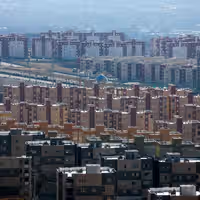
Dozens of residents in Tehran displaced by a 40-day war with the US and Israel said municipal authorities ordered them to vacate temporary hotel housing despite unsafe homes and limited aid, according to interviews published by Etemad newspaper on Thursday.

Several of those affected said they were told to leave by the end of the week after calls from Tehran’s crisis management body, even though official inspections had deemed their homes uninhabitable.

“I was told I had to leave the hotel by the end of the week, even though my home is unsafe and I have nowhere to go,” one resident said, describing a call from a municipal official who noted reconstruction had not begun due to lack of funds.

People inspect the site of a residential building damaged by a strike, amid the US-Israeli conflict with Iran, in Karaj, Iran, April 3, 2026.
100%
People inspect the site of a residential building damaged by a strike, amid the US-Israeli conflict with Iran, in Karaj, Iran, April 3, 2026.

Unsafe homes, no rental support

A resident, who lived in a seventh-floor apartment damaged by a nearby missile strike in March, described shattered windows and debris that rendered both the unit and building access unusable. Emergency services later confirmed the structure was unsafe.

Despite this, the resident said no rental assistance or deposit support had been offered. “They told me I should find housing myself because there is no budget,” the resident added.

  • War damage amounts to $3,000 per Iranian, with blockade set to add to losses

    War damage amounts to $3,000 per Iranian, with blockade set to add to losses

Other displaced residents reported receiving similar instructions. Many said they lacked the financial means to rebuild or secure new housing, leaving them at risk of homelessness.

Under earlier municipal pledges, affected households were to receive temporary accommodation, rental support, and reconstruction assistance.

Updated figures increased aid for household goods to 4 billion rials (about $2,200), rental deposits to 20 billion rials (about $11,000), and monthly rent support to 400 million rials (about $220).

However, residents said these commitments have not been consistently fulfilled.

Average income in Iran is around $150 to $200 per month, while the minimum wage is typically below $100.

Civilians react on a street as tensions rise during the US–Israeli conflict with Iran, with one man speaking on the phone while others look on in concern. (undated)
100%
Civilians react on a street as tensions rise during the US–Israeli conflict with Iran, with one man speaking on the phone while others look on in concern.

Delays and conditions on compensation

Some families whose homes were destroyed said they were instructed to pay for basic household items upfront and submit receipts for reimbursement, which could take up to 10 months.

Others said even smaller grants had limited impact. One resident who received 2.5 billion rials (about $1,400) said it was insufficient to replace essential items such as a refrigerator, stove, and bedding.

“We lost everything in the strike and could not even recover clothes,” the resident said. “With that money, we could only buy a few basic items.”

In some cases, families forced to leave hotels reported moving into improvised spaces. One household said they had lived for months in a 30-square-meter storage room after being unable to afford rent.

  • War-hit homeowners feel abandoned as Iran’s reconstruction aid fades

    War-hit homeowners feel abandoned as Iran’s reconstruction aid fades

Insurance payouts also stalled

Residents with damaged vehicles described similar difficulties in seeking compensation. Several said they were told by representatives of insurance that earlier claims from a previous conflict in June had not yet been settled.

“They told me there is no timeline for paying these damages,” one vehicle owner said after visiting an insurance office.

Official figures show that thousands of vehicles and tens of thousands of residential units were damaged in the 40-day conflict, adding to earlier destruction from a previous 12-day escalation in June.

A man inspects a car buried under rubble inside a damaged building following strikes during the US–Israeli conflict with Iran. (undated)
100%
A man inspects a car buried under rubble inside a damaged building following strikes during the US–Israeli conflict with Iran.

City council response highlights gaps

A spokesperson for Tehran’s city council acknowledged reports of inconsistencies and said cases of forced eviction without support should be reviewed.

“This should not happen, and if such cases exist, they must be followed up,” Alireza Nadali said, adding that municipal policy ties the end of hotel stays to securing alternative housing.

The official also pointed to the scale of damage and budget constraints, adding that assistance programs were introduced voluntarily and may face delays.

At the same time, the council emphasized that reconstruction responsibilities differ depending on the level of damage and local planning rules, which has led to varied outcomes across districts.

  • War leaves its mark on Iran's cultural heritage

    War leaves its mark on Iran's cultural heritage

Oversight concerns emerge

The accounts raise questions about the oversight role of the city council and the implementation of municipal commitments. Residents interviewed said many promises remained unfulfilled months after the initial damage.

Efforts to obtain direct comment from municipal crisis officials were unsuccessful, according to the report.

Ottawa on defensive after Iran football chief linked to IRGC entered Canada

May 1, 2026, 09:21 GMT+1
•
Negar Mojtahedi

Canada’s government is under pressure to explain how Mehdi Taj, Iran’s football chief and a former intelligence officer of the Revolutionary Guards, was briefly allowed into the country after being granted a special permit despite Canada’s IRGC ban.

Speaking to reporters Thursday, Prime Minister Mark Carney declined to discuss Taj’s case, citing privacy laws, but defended the government’s position on the IRGC.

“Members of the [Iranian] Revolutionary Guard rightly have been prohibited from entering this country and they will not enter this country,” he said.

The comments followed reporting by Iran International on how Taj, president of Iran’s football federation and a former intelligence commander in the Islamic Revolutionary Guard Corps, received a Temporary Resident Permit, or TRP. The permit allows Canadian authorities to admit a person who would otherwise be barred under immigration law.

The issue moved quickly to Parliament. At Thursday’s meeting of the Standing Committee on Public Safety and National Security in Ottawa, Conservative MP Frank Caputo pressed Immigration Minister Lena Diab to explain how a person deemed inadmissible had received permission to enter Canada.

Caputo said “the rule of law demands transparency” and asked “who gave him a visa,” saying it took Iran International’s reporting to bring the case to public attention.

  • Iran football chief with IRGC ties sent back by Canada after arrival

    Iran football chief with IRGC ties sent back by Canada after arrival

Who is Mehdi Taj, and what happened?

Taj, the president of Iran’s football federation, has longstanding ties to the Islamic Republic’s security establishment. After the 1979 revolution, he served as an intelligence commander in the IRGC in Isfahan, where units were involved in monitoring internal dissent, including among Kurdish populations.

Canada listed the IRGC as a terrorist entity in 2024, a move that makes people linked to the force inadmissible. Even so, Taj was issued a TRP to attend the FIFA Congress in Vancouver.

Sources who spoke to Iran International said Taj arrived in Canada but was turned back within hours. He and two people accompanying him left at 10:05 p.m. Tuesday after being questioned by authorities.

The immigration ministry commented only after his departure. It declined to name him, citing privacy laws, and said broadly that people linked to the IRGC are not welcome in Canada.

Taj’s brief presence came just before the FIFA Congress at the Vancouver Convention Centre, where members of the Iranian diaspora had planned protests after Iran International’s report.

A protester holds demonstration placards outside the Vancouver Convention Centre during the 76th FIFA Congress on April 30, 2026.
100%
A protester holds demonstration placards outside the Vancouver Convention Centre during the 76th FIFA Congress on April 30, 2026.

Political backlash in Ottawa

The case has put the government under pressure from opposition figures who say Taj’s short stay does not answer the central question of why he was issued a permit at all.

Opposition Leader Pierre Poilievre criticized the government publicly, raising concerns about how a person deemed inadmissible was granted entry in the first place.

Conservative Deputy Leader Melissa Lantsman also pointed to Iran International’s reporting as she pressed the government for answers.

“Good riddance. He didn’t just get on a plane and come here to be sent back. Did the Liberal government issue him a permit? Yes or no?” she said.

Conservative MP Michelle Rempel Garner rejected the argument that the system had worked because Taj was ultimately refused entry.

“Come on, this guy was issued a permit. They made a conscious decision,” she told reporters Thursday in Ottawa.

She has described the case as evidence of serious immigration screening failures and called for accountability.

In the Senate, opposition leader Leo Housakos pressed the government in sharper terms.

“Your government can't seem to show the IRGC the door, but it can find a way to roll out the welcome mat… What’s the point of listing the IRGC if you're not serious about throwing him out of our country?” he said.

Foreign Affairs Minister Anita Anand suggested the permit may have been granted and later revoked.

“It’s not my personal lead, but my understanding is that there is a revocation of the permission. It was unintentional,” she said, pointing to a possible breakdown in the process.

International coverage and fallout

The case, first reported by Iran International, has since moved into wider international coverage. The New York Times, USA Today, Agence France-Presse and The Canadian Press have all covered the incident, citing the reporting that brought Taj’s entry to light.

The episode has turned a single immigration decision into a broader test of Canada’s policy toward officials tied to the Islamic Republic.

Canada has formally listed the IRGC as a terrorist entity, barring people linked to it from entering the country, yet discretionary tools like Temporary Resident Permits allow authorities to override that inadmissibility.

For critics, Taj’s case has exposed the space between the government’s public position and the way exceptions can be made in practice.

The controversy also comes amid deep anger over the Islamic Republic’s human rights record, including what has been described as one of the deadliest crackdowns in modern history earlier this year, adding to concern among Iranian-Canadians over how Western governments handle officials tied to Tehran.

Demonstration placards are seen outside the Vancouver Convention Centre during the 76th FIFA Congress
100%
Demonstration placards are seen outside the Vancouver Convention Centre during the 76th FIFA Congress

Questions still facing the government

Taj’s brief entry and rapid removal have left the government facing the same basic issue that first put the case in public view: who approved the permit, why it was granted despite Canada’s inadmissibility rules, and what safeguards are in place to prevent a similar decision.

What began with Iran International’s reporting has become a political fight in Ottawa, one that now sits at the crossing point of immigration law, national security and Canada’s approach to the Islamic Republic.