• العربية
  • فارسی
Brand
  • Iran Insight
  • Politics
  • Economy
  • Analysis
  • Special Report
  • Opinion
  • Podcast
  • Iran Insight
  • Politics
  • Economy
  • Analysis
  • Special Report
  • Opinion
  • Podcast
  • Theme
  • Language
    • العربية
    • فارسی
  • Iran Insight
  • Politics
  • Economy
  • Analysis
  • Special Report
  • Opinion
  • Podcast
All rights reserved for Volant Media UK Limited
volant media logo

EU extends Iran human rights sanctions until April 2027

Mar 30, 2026, 16:03 GMT+1

The Council of the European Union said on Monday it had extended its sanctions regime over serious human rights violations in Iran until April 13, 2027, citing ongoing concerns over repression and abuses.

“The Council today decided to extend EU restrictive measures responding to serious human rights violations in Iran until 13 April 2027,” the Council of the EU said in a statement.

The sanctions list now includes 262 individuals and 53 entities, after one deceased individual was removed, the statement added.

The EU first introduced the sanctions regime in 2011 and has extended it annually, expanding measures in recent years amid concerns over rights violations.

Most Viewed

IRGC-linked media hints at threat to Persian Gulf undersea internet cables
1

IRGC-linked media hints at threat to Persian Gulf undersea internet cables

2

Iran Guards say two ships seized in Hormuz after ceasefire extension

3
EXCLUSIVE

Strikes on petrochemical hubs leave Iran short of plastics

4
TEHRAN INSIDER

The future has been switched off here

5
INSIGHT

War or economic collapse: can Iran withstand the pressure?

Banner
Banner

Spotlight

  • Iran turns to citizenship and assets as tools of pressure beyond its borders

    Iran turns to citizenship and assets as tools of pressure beyond its borders

  • As Tehran digs in, ordinary Iranians pay the price
    INSIGHT

    As Tehran digs in, ordinary Iranians pay the price

  • Internet Pro or Censor Pro? Iran rolls out a new service
    ANALYSIS

    Internet Pro or Censor Pro? Iran rolls out a new service

  • Strikes on petrochemical hubs leave Iran short of plastics
    EXCLUSIVE

    Strikes on petrochemical hubs leave Iran short of plastics

  • Diplomacy tolls at Hormuz as conflict returns to its doorstep
    OPINION

    Diplomacy tolls at Hormuz as conflict returns to its doorstep

  • Opposition to US talks grows in Tehran as ceasefire deadline nears
    INSIGHT

    Opposition to US talks grows in Tehran as ceasefire deadline nears

•
•
•

More Stories

World must get used to new Mideast order, IRGC-QF chief says

Mar 30, 2026, 15:01 GMT+1

“Get used to the new order in the region," IRGC Quds Force commander Esmail Qaani said in a post on X on Monday.

He said that attacks by Iran-aligned groups had undermined what he described as Israeli Prime Minister Benjamin Netanyahu’s plans to expand a regional security belt, warning that a new regional order was emerging.

“Netanyahu dreamed of expanding a security belt in the region, but the smart and courageous fire of our brothers in Hezbollah in the north and Ansar Allah in the south exposed the regime’s false assurances,” he wrote.

“The dream of the martyred commanders of the resistance has been realized: the war room of the axis of resistance is one.”

Presence of Iraqi militias in Iran sparks fears of renewed repression

Mar 30, 2026, 14:51 GMT+1

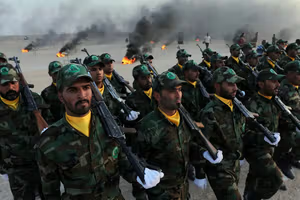
Dismay and alarm are spreading among Iranians over reports and images showing Iraqi Popular Mobilization Forces, or Hashd al-Shaabi, inside Iran, with messages sent to Iran International describing fear, anger and a growing sense of insecurity.

The strongest reaction has come from people in cities where the forces have reportedly been seen, especially in the southwest.

Viewers who contacted Iran International said the arrival of Hashd al-Shaabi fighters in Abadan had made the city feel “unsafe and frightening,” and said residents were worried about their children.

One viewer described the forces as “terrorists” and said their entry into Iran, particularly in Ahvaz, Khorramshahr and Abadan, was aimed at “another massacre of the people.”

Another message asked: “Hashd al-Shaabi convoys entered Iran with armored vehicles. Why are Israel and America not targeting them?”

A message from Abadan said: “I’m sending this message from Abadan. The presence of these forces with flags and military uniforms has made the city frightening.”

Another viewer said: “These forces have come to kill people. We have not forgotten the January killings, when the government used them to help kill people.”

Anger was also directed at the cost of hosting such forces at a time of economic hardship.

One viewer wrote: “In these terrible economic and inflationary conditions that people are facing, why should the Islamic Republic pay for Hashd al-Shaabi terrorists and even house and feed their families for free?”

Other messages sent to Iran International suggested a wider pattern of deployment.

One said Hashd al-Shaabi forces had gathered in warehouses belonging to the Arvandan company in Dehloran county in Ilam province.

Another said the forces had been stationed since the previous day at the Persian Gulf Hotel in Genaveh, Bushehr province.

A more detailed message from Abadan said: “Around 1:30 a.m. on March 30, Hashd al-Shaabi forces arrived with several Hilux vehicles at the Basij base opposite the City Center to be stationed there, and along the route there were several checkpoints with a large number of IRGC forces inspecting people so they could not film.”

The reports followed footage circulated this week showing a convoy of Iran-backed militias in Iraq moving toward Iran.

Iran International audiences also reported on Sunday that Iraqi militias had been housed in residential units belonging to Revolutionary Guards personnel on Otobusrani Street in Bandar Abbas.

Dadban, a legal advisory and training center for activists, warned this week that the purpose of deploying Hashd al-Shaabi forces inside Iran was “participation in repression.”

According to its report, Iraqi militias crossed into Iran and entered Abadan and Khorramshahr in Khuzestan province, where they were received by officials of the Islamic Republic.

Dadban said the organized and armed presence of foreign forces inside the country, without going through a legal process, had no legal basis and pointed to Article 146 of Iran’s constitution, which bars the establishment of foreign military forces in Iran.

It also warned that using foreign forces to suppress domestic protests would amount to an escalation in violations of citizens’ fundamental rights, including the right to assembly and personal security.

Reaction on social media echoed many of the concerns raised in messages sent to Iran International.

Users described the presence of Hashd al-Shaabi as a violation of national sovereignty and a sign that the authorities were preparing for a harsher phase of internal repression.

One user, referring to reports of their presence in Khorramshahr, wrote: “God freed Khorramshahr, and with the help of the disgraceful Islamic Republic it has been occupied again.”

Another wrote: “Hashd al-Shaabi terrorists have officially entered Iran. This is the invasion of Iranian soil by a foreign ground force. We must stand against it completely.”

Another user mocked pro-government rhetoric by writing: “What happened to the people who said domestic problems must be solved inside the family? Is Hashd al-Shaabi family too? Here, a foreign force is acceptable? But if we ask for help, we are traitors?”

Another post said the government knew “the final battle will be decided on the streets of the big cities, especially Tehran,” and argued that Hashd al-Shaabi had been brought in to help defend the state at that front.

Together, the messages and online reactions suggest that for many Iranians, the issue is not only the arrival of an allied militia, but what its presence may signal about the Islamic Republic’s readiness to use outside forces to intimidate and suppress people at home.

  • Iran’s Covert War: How Iraqi Shia Militants Work With the IRGC

    Iran’s Covert War: How Iraqi Shia Militants Work With the IRGC

  • Iran’s security chief to push Iraqi Shia factions to approve militia integration law

    Iran’s security chief to push Iraqi Shia factions to approve militia integration law

Iraqi criticism of support for Iran

The backlash has not been limited to Iran.

In an exclusive interview with Iran International, Sheikh Abdullah al-Jughayfi, a member of the Security and Defense Committee and adviser to the Anbar governorate, confirmed that “Hashd al-Shaabi forces in recent days have transferred financial and non-financial aid to Iran.”

He said the aid had been sent over the past three days “with Hashd al-Shaabi flags raised.”

Al-Jughayfi criticized the move and warned that “this action could further complicate Iraq’s relations with the United States and increase the likelihood of new sanctions.”

At the same time, Jalil al-Lami, deputy head of the Iraq Center for Strategic Affairs, told Iran International from Baghdad that the move amounted politically to “a clear alignment by Iraq” and warned that it effectively ended Baghdad’s balancing policy between Washington and Tehran.

He added that “the presence of Hashd al-Shaabi forces inside Iran could expand the range of targets inside Iraq, whether through direct attacks or indirect escalation, pushing the country toward an open atmosphere of confrontation.”


Rubio says 'people of Iran are incredible' but leadership is the problem

Mar 30, 2026, 13:59 GMT+1

US Secretary of State Marco Rubio said the United States distinguishes between the Iranian people and their leadership, and expressed hope for change, while warning Washington was prepared if that does not happen.

“The people of Iran are incredible people. The people who lead them are the problem,” Rubio said in an interview with George Stephanopoulos on ABC’s Good Morning America on Monday.

He added, “If there are new people now in charge with a more reasonable vision of the future, it would be good news for the entire world. But we must be prepared if that isn’t the case.”

Contacts and diplomacy

Rubio said the US was engaged in indirect contacts with Iranian figures through intermediaries and was testing whether they could deliver change.

“There are messages being relayed back and forth… including through intermediaries,” he said, adding some individuals were “saying some of the right things privately.”

He said it remained unclear whether those figures had the authority to act.

Military objectives remain central

Rubio said US operations aimed to degrade Iran’s military capabilities, including its navy, missile launchers and weapons production.

“We are destroying Iran’s navy… their missile launchers by a significant percentage… and we’re going to wipe out their defense industrial base,” he said.

He added the US was “on or ahead of schedule” and expected to meet its goals “in a matter of weeks, not months.”

Rubio said Iran would not be allowed to control the Strait of Hormuz, calling such a move unacceptable.

“That will never be allowed to happen,” he said, adding President Donald Trump had multiple options available.

US says will take control of Strait over time, sees oil market well supplied

Mar 30, 2026, 13:36 GMT+1

US Treasury Secretary Scott Bessent said on Monday the United States would “take control” of the Strait of Hormuz over time, as tensions with Iran affect global oil markets.

Speaking to Fox News, Bessent said the market was “well supplied” and that any additional supply would be helpful.

He added the US was seeing more oil supply as countries struck deals with Iran.

Iran says Israel behind Kuwait desalination plant attack

Mar 30, 2026, 13:16 GMT+1

A spokesperson for Khatam al-Anbiya Central Headquarters said on Monday that Israel had struck a desalination facility in Kuwait, after Kuwait said an Indian worker was killed in an Iranian attack on a power and water plant.

The spokesperson said the strike was carried out “to blame the Islamic Republic,” and warned that US bases and Israeli interests in the region would remain targets.

The statement urged regional countries to be alert to what it described as efforts by the US and Israel to destabilize the region.