• العربية
  • فارسی
Brand
  • Iran Insight
  • Politics
  • Economy
  • Analysis
  • Special Report
  • Opinion
  • Podcast
  • Iran Insight
  • Politics
  • Economy
  • Analysis
  • Special Report
  • Opinion
  • Podcast
  • Theme
  • Language
    • العربية
    • فارسی
  • Iran Insight
  • Politics
  • Economy
  • Analysis
  • Special Report
  • Opinion
  • Podcast
All rights reserved for Volant Media UK Limited
volant media logo

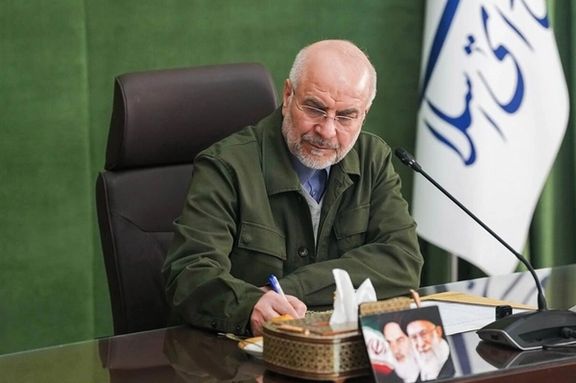
Ghalibaf and Trump escalate rhetoric as prospects for talks remain vague

Maryam Sinaiee
Maryam Sinaiee

Iran International

Mar 31, 2026, 10:36 GMT+1

As the war enters its fifth week, tensions between Tehran and Washington are rising, with both sides sending mixed signals over diplomacy and the risk of further escalation.

At the diplomatic level, reports suggest indirect contacts are continuing, even as the gap between public rhetoric and behind-the-scenes diplomacy appears wider than ever.

In Tehran, Mohammad Bagher Ghalibaf has emerged as a key voice. Reportedly playing a leading role in managing indirect contacts with Washington, he has maintained a consistently hard line.

In a four-page message issued on March 29 to mark the 30th day of the war, he dismissed recent US diplomatic messaging, including reports of a 15-point proposal, as unrealistic. He said Washington was trying “to achieve through talks what it could not win on the battlefield.”

Ghalibaf accused the United States of duplicity, saying Washington was publicly speaking of negotiations while privately preparing for escalation. He warned that Iranian forces were ready to inflict heavy losses on any US troops attempting a ground operation, as well as on their regional allies.

He also argued that US and Israeli objectives had already been scaled back. According to him, their objectives had shifted “from regime change to merely securing the Strait of Hormuz,” and disruptions to shipping had forced Iran’s adversaries to “beg” for talks.

Iranian military officials echoed the same defiant tone. A military spokesperson said on Sunday that Iranian forces had long awaited a possible US ground operation and warned Donald Trump not to “drag his soldiers into the jaws of captivity and death and not to plunge the American people into widespread mourning.”

Senior political figures reinforced the same line. First Vice President Mohammad-Reza Aref said negotiations over key issues such as the Strait of Hormuz would be possible only if Iran’s adversaries “pledge not to invade and recognize Iran’s international rights.”

On social media, pro-government users in Iran also largely rejected the idea of compromise. One post on X said: “There continues to be no form of negotiation or message exchange between Iran and America… Iran's decision is to continue the war until the complete achievement of objectives.”

Washington: Optimism and threats

By contrast, Washington has projected a mix of cautious optimism and mounting threats.

US Secretary of State Marco Rubio said on Monday that indirect contacts with Iranian figures were continuing through intermediaries.

He said some figures within Iran’s leadership were “saying some of the right things privately,” but added that it was still unclear whether they had the authority to act.

Trump, however, has struck a much more aggressive tone. While insisting that talks are going “extremely well,” he has repeatedly threatened military action, including strikes on critical infrastructure.

In a post on Truth Social on Monday, he wrote: “If for any reason a deal is not shortly reached… we will conclude our lovely ‘stay’ in Iran by blowing up and completely obliterating all of their Electric Generating Plants, Oil Wells and Kharg Island.”

He also suggested the United States could maintain a presence there, adding to the pressure behind his warnings.

Claims and counterclaims

Trump has also said that Iran recently allowed 20 oil tankers to pass through the Strait of Hormuz “as a tribute” to the United States.

He said the permit was granted under the authority of Ghalibaf, whom he portrayed as playing an increasingly influential role within Iran’s power structure.

Iranian officials have not publicly confirmed the claim.

In an interview with the Financial Times, Trump said he was dealing with a “very reasonable” new group in Iran and suggested an agreement could be near. He also claimed Tehran had already accepted “most of the points” in his proposed framework.

Last week, Elias Hazrati, head of Iran’s government information council, dismissed reports of a US peace proposal as “media speculations” and a “wish list.”

Information warfare and market signals

Beyond the military and diplomatic rhetoric, both sides appear to be engaged in a parallel battle over information and perception.

In a widely shared English-language post, Ghalibaf accused Trump of trying to move financial markets through strategic messaging. He advised observers to treat such statements as reverse signals, writing: “Do the opposite: If they pump it, short it. If they dump it, go long.”

The post, which drew around 10 million views by Monday, showed Tehran’s awareness of what it sees as US information warfare aimed at influencing market volatility.

Online reactions reflected the same view. One Iranian user commented: “They’re playing mind games with the American public to crash the market. And honestly, they’re playing it well. Extremely, extremely well.”

Most Viewed

US terminates green cards of 3 Iranians tied to Islamic Republic
1

US terminates green cards of 3 Iranians tied to Islamic Republic

2
PODCAST

Worst outcome is Islamic Republic’s survival, ex-CIA official says

3
ANALYSIS

Iran brings unusually broad team to US talks to blunt future blame

4
INSIGHT

Tehran sends tough message but keeps diplomacy door open

5

Zoroastrian religious figure arrested in Iran

Banner
Banner

Spotlight

  • Tehran sends tough message but keeps diplomacy door open
    INSIGHT

    Tehran sends tough message but keeps diplomacy door open

  • Worst outcome is Islamic Republic’s survival, ex-CIA official says
    PODCAST

    Worst outcome is Islamic Republic’s survival, ex-CIA official says

  • Why the Iran-US truce is more likely to buy time than peace
    ANALYSIS

    Why the Iran-US truce is more likely to buy time than peace

  • Engaged but uncommitted: China watches Iran and US fight and talk
    ANALYSIS

    Engaged but uncommitted: China watches Iran and US fight and talk

  • A truce for the world, a reckoning for Iran’s economy
    ANALYSIS

    A truce for the world, a reckoning for Iran’s economy

  • Why the world failed to bypass the Strait of Hormuz
    ANALYSIS

    Why the world failed to bypass the Strait of Hormuz

•
•
•

More Stories

Talks with Iran would 'let cancer spread', dissident behind viral video says

Mar 31, 2026, 07:28 GMT+1
•
Negar Mojtahedi

An Iranian man whose viral plea for Donald Trump’s help drew millions of views says he was forced to flee the country after being targeted by the Revolutionary Guard, warning from exile that negotiating with Tehran would allow its repression to continue.

Ali Rezaei Majd still looks toward the rugged peaks of the Zagros Mountains — just beyond them now, across the border in Iraqi territory.

More than six feet tall, with a muscular build, tattoos etched across his body, and long, thick, curly hair, Majd is a presence that’s hard to ignore.

He looks like a fighter. The truth is — he is one.

A proud Lor from Iran’s tribal province of Lorestan, Majd comes from a people known for their deep connection to their land — and for their resilience. The Lors are an Iranian ethnic group rooted in the Zagros region, with a long history shaped by life in the mountains and a culture that values strength, independence and loyalty.

His life has been on the run since early January, when he posted a video from his hometown that would soon be seen around the world.

In it, holding up his Iranian ID, he made a direct plea to then-President Donald Trump and the American people:

“I’m speaking to you from inside Iran… not as a politician, not as a soldier, but as a human being living under fear and oppression every single day… Please don’t forget us.”

The video struck a nerve — garnering over nine million views on Instagram. The English version was also viewed nearly two million times.

But it also made him a target.

Majd says the Islamic Revolutionary Guard Corps (IRGC) began searching for him. With operatives closing in, he fled — crossing mountainous terrain with the help of Kurdish people.

“I was in a prison for 30 years. Iran was like a prison for me,” he told the Eye for Iran podcast.

“When you grow up in a prison, you risk everything for freedom — even for one day.”

Today, his safety remains uncertain, with threats from a regime never far behind.

Now in exile, he is speaking out — with one message above all:

“We cannot make a deal with them. Dealing with them means letting this cancer continue.”

Majd says many of his friends were killed when the regime unleashed force — including heavily armed units — against what he describes as a largely defenseless population.

“When you come to the streets in Iran, you’re going to die,” he said. “They don’t shoot to stop you — they shoot to kill.”

He also has a message for the West — and for the media.

Watching coverage from abroad, Majd says he is frustrated by calls to halt military operations, arguing they misunderstand the reality inside Iran.

“I see many channels trying to stop this operation… saying this is the wrong way,” he said. “But this regime is a threat to the whole world.”

For him, this moment represents something else — a rare opportunity.

“This is the best chance to stop this regime,” he said. “If you don’t stop them, they will become more dangerous.”

He considers himself lucky to be alive.

And now, he says, it is his responsibility to carry the voices of those who can no longer speak.

“The best of us — the bravest — they are gone. So I have to speak for them.”

Majd described the violence he witnessed in chilling terms: “It was like a video game. They were just shooting people — so easily.”

Despite the danger and despite what he says are ongoing threats from regime operatives — Majd continues to speak publicly.

Because for him — and for those who can no longer speak — silence is not an option.

The day the Iran war reached a school in Minab

Mar 30, 2026, 03:19 GMT+1
•
Maryam Sinaiee

Newly released surveillance footage appears to show repeated strikes hitting a primary school in the southern Iranian city of Minab on the first day of the war, an attack Iranian authorities say killed more than 100 children and teachers.

The Shajareh Tayyebeh primary school, located in Minab in Hormozgan province, served boys and girls aged 7 to 12.

The school building stood in an area that once formed part of a Revolutionary Guards naval base but had reportedly been separated from the military compound by a wall for several years. Iranian officials say the school was privately run.

Research by Amnesty International’s Crisis Evidence Lab and its Iran team says US authorities could—and should—have known the building was a school and failed to take feasible precautions to avoid civilian harm.

Amnesty said the findings point at best to a serious intelligence failure by the US military and warned the strike could constitute an indiscriminate attack in violation of international humanitarian law.

Reuters has reported that two sources familiar with the matter said the strike may have resulted from outdated intelligence used during targeting, while an internal US military review found American forces were likely responsible for the attack.

The first strike occurred around 10 a.m. on February 28, when students were resting during a break. The explosion destroyed roughly half of one of the school’s buildings.

Mikail Mirdoraghi (9) killed in the school strike
100%
Mikail Mirdoraghi (9) killed in the school strike

Teachers gathered surviving children in the school’s prayer hall and called parents to collect them. Shortly afterward, a second missile struck the same building, killing many of the remaining children, teachers and some parents who had rushed to the scene.

Iranian officials, including the mayor of Minab and the Ministry of Education, say the school was struck three times in total.

Images published by Iranian media in the days after the attack showed rescue workers pulling remains, severed limbs and children’s backpacks from beneath the rubble.

Iranian authorities say 168 people were killed, including about 120 children, as well as teachers and several parents who had come to retrieve their children after the first explosion. Nearly 100 others were reported injured.

The Norway-based human rights group Hengaw says it has independently identified 58 victims so far, including 48 children and 10 adults.

Behind the casualty figures are the stories of children whose lives ended in ordinary moments between lessons.

Among them were three girls—Mahdis Nazari, 7, and Sonar and Niayesh Salehi, both 9—members of their school’s skating team. Photos shared online before the attack show them at training sessions and competitions.

Iran’s skating federation later confirmed their deaths.

100%

Another child whose story has circulated widely online is nine-year-old Mikail Mirdoraghi, a third-grade student. A photograph of him standing on the stairs of his home with a water bottle slung over his shoulder, waving goodbye, has been widely shared.

Mikail’s family had moved from Andimeshk in Khuzestan province to Minab because of his father’s job. After the attack, his 31-year-old mother, Shakiba Derikvand, identified his body among victims placed in refrigerated vehicles.

He was found lying beside his friend Alireza, still clutching his school backpack. His body was largely intact, though his face was bloodied, his mother said.

He was buried three days later in Andimeshk. A widely circulated image shows his grandfather lying beside the flower-covered grave.

“Mikail was afraid of the dark,” he reportedly said. “We always slept beside him. I don’t want him to be alone here at night.”

One of the most haunting details to emerge is a drawing Mikail reportedly made the night before the strike.

Found later in his backpack, it shows a school building with the Iranian flag above it, five children standing in the yard and three missiles descending toward them.

Iran’s former diplomats warn of prolonged regional war

Mar 26, 2026, 21:14 GMT
•
Behrouz Turani

Former Iranian diplomats are warning that the war between Iran, the United States and Israel could fundamentally reshape the Middle East’s security order, with some predicting a prolonged conflict and deeper regional instability.

The comments come as U.S. President Donald Trump said Thursday he would pause planned strikes on Iran’s energy infrastructure for 10 days until April 6, saying the move followed a request from Tehran and that negotiations were continuing.

Iranian officials have confirmed receiving proposals for talks but say they are reviewing them while insisting Iran will not accept ultimatums.

The war, now entering its fourth week, has already drawn in multiple regional actors and heightened tensions around strategic chokepoints such as the Strait of Hormuz, raising concerns that a wider confrontation could disrupt global energy flows and destabilize the region further.

Saba Zanganeh, a former diplomat close to the office of Iran’s Supreme Leader, told the moderate outlet Fararu on March 25 that the conflict should prompt regional governments to reconsider their security policies and alliances.

He said regional governments have often acted as secondary players under foreign influence, worsening conflicts rather than resolving them. The current war, he added, offers a stark lesson that continuing the existing model will deepen regional crises.

He argued that decades of instability stem from what he described as “a flawed strategic paradigm shared by regional states and external powers,” which he said has repeatedly produced destruction and fragmentation in countries including Iraq, Syria, Lebanon, Libya, Sudan, Somalia and Yemen.

Hossein Mousavian, Iran’s former ambassador to Germany, offered a more confrontational assessment.

Speaking to Etemad Online, he said Iranian officials increasingly view Persian Gulf Arab states as partners in the conflict, sharing what he described as a common objective of the “complete destruction of Iran.”

Mousavian said Tehran is preparing for the possibility of a broader confrontation involving the United States and its regional allies.

Another former diplomat, Kourosh Ahmadi, suggested the conflict may last far longer than initially expected.

Speaking to Fararu, he noted that both Trump and Israeli Prime Minister Benjamin Netanyahu first suggested the war might last only four to seven days before revising their estimates to several weeks. Even those expectations may prove unrealistic, he said.

Ahmadi pointed to Iran’s ability to restrict or control shipping in the Strait of Hormuz as a decisive factor in prolonging the conflict. As long as Tehran maintains that leverage over one of the world’s most critical energy chokepoints, he argued, the war is unlikely to end quickly.

“Israel seeks the collapse and incapacitation of Iran, not merely political concessions,” he said, arguing that Washington’s goals were more limited and often diverged from that of Israel.

Despite their different emphases, the three former diplomats share a similar underlying assessment: the current conflict risks evolving into a prolonged regional crisis whose consequences could reshape the Middle East for years.

IRGC rhetoric frames US island assault as chance to capture troops

Mar 26, 2026, 02:29 GMT
•
Behrouz Turani

Some Tehran commentators say any US attempt to seize Iranian islands in the Persian Gulf could play directly into the IRGC’s long-standing strategy of capturing American troops for leverage.

Much of the commentary in Iranian media and political circles frames such a scenario as an opportunity rather than a risk for Tehran, arguing that deploying US forces on Iranian territory would expose them to capture by the Islamic Revolutionary Guard Corps (IRGC) and potentially inflict a political humiliation on Washington.

The idea has deep roots in Iran’s political rhetoric. Mohsen Rezai, the former IRGC commander who once floated the proposal of capturing US troops and demanding large sums for their release, now serves as a senior military adviser to Iran’s new Supreme Leader, Mojtaba Khamenei.

Former IRGC commander Hossein Kanani Moghaddam said last week that one scenario allegedly considered by the United States involved focusing on Iran’s southern islands and attempting to seize them to gain control over Persian Gulf oil routes.

“If Trump were to deploy air and naval forces along with Delta Force commandos in a ground operation, the battlefield would shift entirely in our favor,” Kanani Moghaddam said. “By killing or capturing American soldiers, we could raise the level of US losses to a point where they would quickly regret their actions.”

He added that such losses could trigger a political backlash in Washington and even lead to impeachment proceedings against President Donald Trump.

The prospect of an occupation of an Iranian island has also been linked in Iranian commentary to the broader diplomatic standoff between Tehran and Washington.

Despite Trump’s references to “constructive negotiations,” Iranian officials argue that US military threats undermine any possibility of diplomacy.

On March 25, Foreign Ministry spokesman Esmail Baghaei said Iran had already experienced “two catastrophic examples” of trusting US diplomacy. “Over the past nine months, the United States has attacked Iran twice in the middle of negotiations,” he said. “This was a betrayal of diplomacy.”

In a March 23 interview with the Iranian outlet Fararu, Jalal Sadatian, Iran’s former chief diplomat in London, said Trump could not simultaneously threaten military action against Iranian territory while expecting Tehran to accept ceasefire proposals.

Sadatian also warned that Iranian retaliation could expand beyond direct confrontation with US forces. He pointed to the IRGC’s earlier warnings that electricity-generation facilities and desalination plants in regional countries could be targeted if Iran’s own critical infrastructure were attacked.

According to Sadatian, Tehran had long warned that any attack on Iran would trigger a broader regional war. He argued that Washington underestimated Iran’s willingness and ability to strike US bases across the region.

Reports of Ghalibaf-Trump channel sparks political storm in Tehran

Mar 25, 2026, 02:38 GMT
•
Maryam Sinaiee

Remarks by Donald Trump suggesting backchannel contacts with a figure inside Iran’s government have stirred intense political debate in Tehran.

The controversy intensified after reports by Israel’s Channel 11 and Politico suggested that Parliament Speaker Mohammad-Bagher Ghalibaf could be the “pragmatic partner” potentially engaging with the Trump administration.

According to the Politico report, “at least some White House officials see him as someone who could lead Iran and negotiate in a next phase of conflict with the Trump administration.” However, the report added that the White House “is not yet ready to bet on a single figure” and is exploring multiple options.

The mere suggestion that a sitting Iranian parliament speaker could be engaged—formally or informally—with Washington carries significant implications within Iran’s political system, where any perception of independent diplomatic outreach can trigger backlash, particularly during periods of heightened tension.

Iran’s Revolutionary Guards (IRGC)-linked media outlets have strongly rejected claims of secret negotiations.

Fars News Agency described the reports as a “psychological operation,” asserting that the narrative was designed with three goals: “character assassination of Ghalibaf, incitement toward possible physical targeting, and sowing division in the country.”

Similarly, Tasnim News Agency called the reports a “complex enemy design to create the perception of internal tension,” arguing that it aimed to distract political forces from the ongoing conflict.

Even political figures outside Ghalibaf’s immediate camp have echoed concerns about psychological warfare.

Mohammad-Javad Azari-Jahromi, telecommunications minister under President Hassan Rouhani, wrote on X that Trump’s contradictory statements—and media suggestions that Ghalibaf could be conducting secret talks—are intended to “create division within the government and among military forces.”

Hesameddin Ashena, a former media adviser to Rouhani, also warned of “character assassination,” describing the amplification of such claims as effectively “aligning with the enemy.”

Iranian officials have acknowledged indirect communications with Washington through intermediaries. Foreign Minister Abbas Araghchi and spokesman Esmail Baghaei said countries such as Egypt, Turkey, and Pakistan have been exchanging messages between the two sides in recent days in an effort to reduce tensions.

At the same time, Iranian officials stressed that Tehran’s core positions remain unchanged.

These include its stance on the potential closure of the Strait of Hormuz—a position that has contributed to escalating rhetoric, including reported threats by Trump to target Iran’s energy infrastructure and impose a short deadline.

An Iranian official told Al Jazeera that Washington has so far refused to meet Tehran’s key conditions for negotiations: “payment of war reparations and acknowledgment of aggression against Iranian territory.”

Meanwhile, reports from Reuters and The Wall Street Journal suggest that potential talks to end the conflict could take place in Pakistan or Turkey, possibly involving figures such as Steve Witkoff, Jared Kushner, and Vice President J. D. Vance in the coming days.

Despite official denials, the issue has gained traction on social media—particularly among Iranians abroad, given severe internet restrictions inside Iran since the war began.

Thousands of responses to Ghalibaf’s denial of secret talks with Washington on X framed the issue in terms of suspicion and alleged betrayal.

Some users pointed to his absence from certain recent public events, while others noted that his name had not appeared in US bounty lists targeting Iranian officials, interpreting this as suspicious though without evidence.

Others revived longstanding allegations of financial corruption and nepotism raised by hardline factions such as the Paydari Front and supporters of Saeed Jalili—claims that have circulated in Iran’s political rivalries for years.







