• العربية
  • فارسی
Brand
  • Iran Insight
  • Politics
  • Economy
  • Analysis
  • Special Report
  • Opinion
  • Podcast
  • Iran Insight
  • Politics
  • Economy
  • Analysis
  • Special Report
  • Opinion
  • Podcast
  • Theme
  • Language
    • العربية
    • فارسی
  • Iran Insight
  • Politics
  • Economy
  • Analysis
  • Special Report
  • Opinion
  • Podcast
All rights reserved for Volant Media UK Limited
volant media logo

Pakistan hosts regional de-escalation talks on Iran war

Mar 29, 2026, 09:23 GMT+1
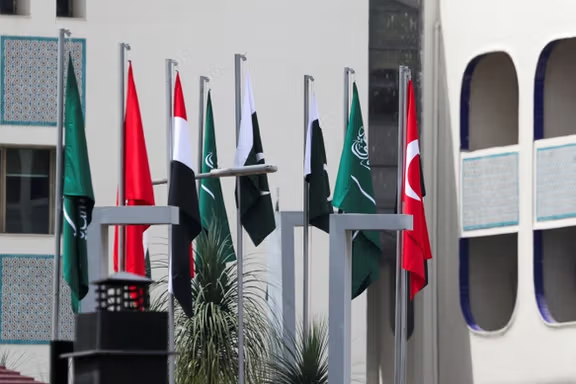
The national flags of Pakistan, Saudi Arabia, Turkey and Egypt stand hoisted outside the Ministry of Foreign Affairs office, on the day Pakistan hosts talks with Saudi Arabia, Turkey and Egypt to discuss regional de-escalation in Islamabad, Pakistan, March 29, 2026.

Pakistan hosted talks in Islamabad on Saturday with the foreign ministers of Turkey, Saudi Arabia and Egypt to discuss regional de-escalation amid the US-Israel conflict with Iran.

Turkish Foreign Minister Hakan Fidan met Pakistan’s Deputy Prime Minister and Foreign Minister Mohammad Ishaq Dar on the sidelines of the gathering.

The meetings come as regional powers step up diplomatic contacts in search of ways to contain the fallout from the war.

Most Viewed

Behind Tehran’s unity show: The secret letter to the shadow king
1
INSIGHT

Behind Tehran’s unity show: The secret letter to the shadow king

2
EXCLUSIVE

Disputes within Iran leadership blocked negotiators’ trip to Islamabad

3
INSIGHT

Power vacuum in Tehran emboldens hardliners

4
ANALYSIS

Rapid deterioration of Iran-UAE ties threatens a critical trade lifeline

5
VOICES FROM IRAN

Inflation spikes, basic goods slip out of reach for Iranians, citizens say

Banner
Banner

Spotlight

  • Iran’s economy after the March war: how bad can it get?
    ANALYSIS

    Iran’s economy after the March war: how bad can it get?

  • Behind Tehran’s unity show: The secret letter to the shadow king
    INSIGHT

    Behind Tehran’s unity show: The secret letter to the shadow king

  • Rapid deterioration of Iran-UAE ties threatens a critical trade lifeline
    ANALYSIS

    Rapid deterioration of Iran-UAE ties threatens a critical trade lifeline

  • Tehran stocks head for reopening, but it risks triggering a new crisis
    ANALYSIS

    Tehran stocks head for reopening, but it risks triggering a new crisis

  • Power vacuum in Tehran emboldens hardliners
    INSIGHT

    Power vacuum in Tehran emboldens hardliners

  • Inflation spikes, basic goods slip out of reach for Iranians, citizens say
    VOICES FROM IRAN

    Inflation spikes, basic goods slip out of reach for Iranians, citizens say

•
•
•

More Stories

After 30 days of war, parliament speaker says Iran rejects surrender and talks

Mar 29, 2026, 09:07 GMT+1

Iran’s parliament speaker Mohammad Bagher Ghalibaf said the war had reached a “critical stage,” praising public mobilization while warning the United States against pursuing what he described as surrender terms under the guise of negotiations.

In a message marking 30 days of what officials call “national defense,” Ghalibaf said public presence in the streets had become a central front in the conflict.

“The street in these 30 nights was the manifestation and mirror of the social power of a nation that does not know defeat,” he said, adding that “the enemy is angered and disturbed by the street.”

He said public rallies and slogans had bolstered military action, adding: “With the chant ‘no compromise, no surrender, fight against America,’ you gave strength to the missiles.”

The Islamic Republic has staged pro-government rallies across cities since the start of the war.

He also pointed to what he described as setbacks for the United States and its allies, saying “the symbols of American power, from F-35s to aircraft carriers and regional bases, have suffered major blows,” while adding that strikes against Israel had been “effective, precise and foundational.”

At the same time, he accused Washington of sending mixed signals on diplomacy. “The enemy publicly sends messages of negotiation and dialogue, and in secret plans for a ground attack,” he said.

Ghalibaf dismissed reported US proposals, saying: “America is presenting its wishes and what it did not achieve in war in the form of a 15-point list and is seeking it through diplomacy.”

He warned that any attempt to force Iran into submission would be resisted. “As long as the Americans seek Iran’s surrender, our answer is clear: ‘We will not submit,’” he said.

He added that Iranian forces were prepared for further escalation, saying “our men are waiting for the ground entry of American soldiers to set them ablaze,” while insisting that missile strikes and military operations would continue.
IRGC warns US, Israeli universities in region could be targeted

Mar 29, 2026, 08:25 GMT+1

The Revolutionary Guards said American and Israeli universities in West Asia would be considered “legitimate targets” after what it said was the bombing of Tehran University of Science and Technology.

In a statement, the IRGC said such universities would remain targets until two universities were struck in retaliation for damaged Iranian campuses. It urged employees, professors, students and nearby residents to stay at least one kilometer away.

The statement also gave Washington until 12 p.m. Tehran time on Monday, March 30, to officially condemn the bombing of universities, warning that otherwise the threat would remain in force and be carried out.

Explosions reported near military-linked sites in Tehran and surrounding areas

Mar 29, 2026, 08:07 GMT+1

Witnesses reported a fresh wave of explosions across Tehran and nearby areas on Sunday morning, including near the Masoudieh military base, Daghayeghi township, Heravi, Tehransar and Eshtahard in Alborz province, according to messages sent to Iran International.

Residents said loud blasts were heard from the direction of the Masoudieh base and surrounding areas in eastern Tehran, which had also come under attack on Saturday.

Separate reports said around 10 explosions were heard within minutes near Daghayeghi township, a residential area west of Lavizan Park known for housing Revolutionary Guards members and commanders.

In northeastern Tehran, witnesses reported three heavy explosions in the Heravi area.

In western Tehran, residents said an area of Tehransar was hit at least twice. The area lies near Mehrabad airport as well as facilities used by the Revolutionary Guards’ aerospace force and police units.

Outside the capital, witnesses in Eshtahard in Alborz province reported a heavy explosion, fighter jet activity and black smoke rising in the area.

Iranian MP says US-linked companies in region would be ‘legitimate targets'

Mar 29, 2026, 07:11 GMT+1

An Iranian lawmaker warned that Israel would face a strong response for strikes on Iran’s power and industrial infrastructure, and said any company in the region with US ownership would be considered a “legitimate target.”

Mostafa Taheri, a member of parliament’s industries and mines committee, said damage to the Mobarakeh Steel Complex and the Khuzestan Steel Company sites was reparable.

Khuzestan Steel Company said its production lines have been shut down following attacks on Friday.

Israel says it struck mobile command centers in Tehran

Mar 29, 2026, 06:59 GMT+1

Israel’s military said it completed another wave of airstrikes on Saturday against mobile command centers and weapons production facilities in Tehran.

The military said Iranian authorities had shifted command operations into mobile units after many of their command centers were hit over the past month, and that several temporary command posts and the commanders inside them were targeted.

It added that ballistic missile production and storage sites, as well as air defense systems, were also struck.