• العربية
  • فارسی
Brand
  • Iran Insight
  • Politics
  • Economy
  • Analysis
  • Special Report
  • Opinion
  • Podcast
  • Iran Insight
  • Politics
  • Economy
  • Analysis
  • Special Report
  • Opinion
  • Podcast
  • Theme
  • Language
    • العربية
    • فارسی
  • Iran Insight
  • Politics
  • Economy
  • Analysis
  • Special Report
  • Opinion
  • Podcast
All rights reserved for Volant Media UK Limited
volant media logo

Israel strikes key Iran naval missile site, military says
Mar 27, 2026, 07:23 GMT+0

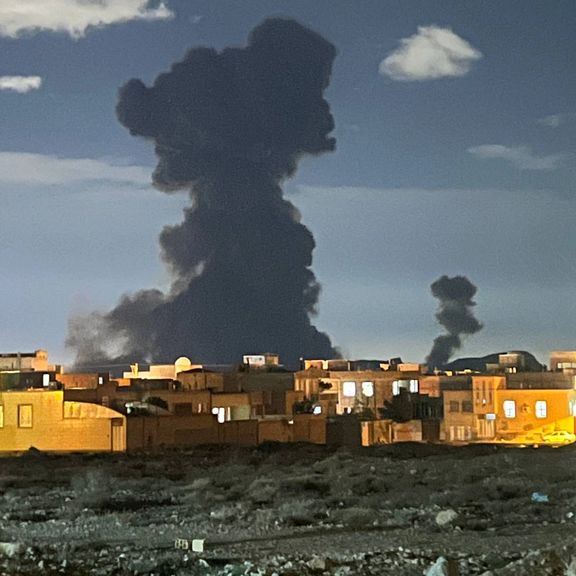
Israel bombed what it described as Iran’s most central facility for producing naval missiles and mines, the Israeli military said on Friday.

The military said the site in Yazd was used to plan, develop, assemble and store advanced missiles designed for launch from ships, submarines and helicopters toward maritime targets.

“This is a site where most of the missiles and naval mines are developed by the Iranian navy forces,” the military said.

The strike was carried out using intelligence from the Military Intelligence Directorate and Naval Intelligence Division, and dealt a significant blow to the naval forces’ production capabilities, according to the military.

Overnight, Israeli aircraft also struck ballistic missile production sites and air defense systems across Iran, the military said.

In Tehran, the strikes targeted infrastructure used for weapons production, with an emphasis on ballistic missile facilities, while in western parts of the country missile launchers and storage sites were hit, according to the military, which said the targets posed a threat to Israel.

The military said further details on the overnight strikes would be released later.

The attacks come a day after Israel killed the commander of the Islamic Revolutionary Guards Corps Navy and other senior officers.


Most Viewed

Behind Tehran’s unity show: The secret letter to the shadow king
1
INSIGHT

Behind Tehran’s unity show: The secret letter to the shadow king

2

Iran executes protester over January uprising

3
PODCAST

US should use Iran talks leverage to help Iranian people, veteran journalist says

4

Iranian national charged in US over migrant smuggling scheme

5

Iran officials project unity after Trump leadership remarks

Banner
Banner

Spotlight

  • US should use Iran talks leverage to help Iranian people, veteran journalist says
    PODCAST

    US should use Iran talks leverage to help Iranian people, veteran journalist says

  • Iran’s economy after the March war: how bad can it get?
    ANALYSIS

    Iran’s economy after the March war: how bad can it get?

  • Behind Tehran’s unity show: The secret letter to the shadow king
    INSIGHT

    Behind Tehran’s unity show: The secret letter to the shadow king

  • Rapid deterioration of Iran-UAE ties threatens a critical trade lifeline
    ANALYSIS

    Rapid deterioration of Iran-UAE ties threatens a critical trade lifeline

  • Tehran stocks head for reopening, but it risks triggering a new crisis
    ANALYSIS

    Tehran stocks head for reopening, but it risks triggering a new crisis

  • Power vacuum in Tehran emboldens hardliners
    INSIGHT

    Power vacuum in Tehran emboldens hardliners

  • Inflation spikes, basic goods slip out of reach for Iranians, citizens say
    VOICES FROM IRAN

    Inflation spikes, basic goods slip out of reach for Iranians, citizens say

•
•
•

More Stories

Huge strikes hit Tehran, Isfahan, reports say

Mar 27, 2026, 05:28 GMT+0

Air strikes struck multiple areas of Tehran and Isfahan, with explosions reported across several districts and nearby towns early Friday, according to accounts circulating on social media and initial reports.

The Israeli military also announced a new wave of attacks targeting the Islamic Republic, after which explosions were heard across central, western, eastern and northern parts of the capital.

Reports also described blasts in surrounding areas including Robat Karim, Rey, Varamin and Shahriar.

In Isfahan, accounts pointed to sustained strikes hitting different parts of the city over an extended period. Explosions were also reported in Kashan and Shahin Shahr.

The scale and intensity of the strikes were described by users online as unprecedented, underscoring a widening scope of the confrontation.

Iran’s former diplomats warn of prolonged regional war

Mar 27, 2026, 03:05 GMT+0

Former Iranian diplomats are warning that the war between Iran, the United States and Israel could fundamentally reshape the Middle East’s security order, with some predicting a prolonged conflict and deeper regional instability.

The comments come as US President Donald Trump said Thursday he would pause planned strikes on Iran’s energy infrastructure for 10 days until April 6, saying the move followed a request from Tehran and that negotiations were continuing.

Iranian officials have confirmed receiving proposals for talks but say they are reviewing them while insisting Iran will not accept ultimatums.

Continue reading.

Republican lawmaker warns of ‘endless war’ with Iran, cites lack of exit strategy

Mar 27, 2026, 02:20 GMT+0

Republican Representative Nancy Mace said on Thursday she has “grave concerns” about the risk of a prolonged conflict with Iran, adding she has not seen a clear exit strategy from the Trump administration.

Speaking to CBS News, Mace said a recent House Armed Services Committee briefing on Iran “left most of our questions unanswered,” and that she would oppose sending US ground forces.

“I haven’t seen an exit strategy yet,” she said, warning against a potential “20-year-plus endless war.” While expressing support for President Donald Trump and saying recent operations had degraded Iran’s missile capabilities, Mace urged him to “declare victory” rather than risk further escalation.

Iran still depends on Hormuz despite years of workarounds

Mar 27, 2026, 01:45 GMT+0
•
Dalga Khatinoglu

Iran’s plans to reduce its reliance on the Strait of Hormuz appear to have delivered little practical change so far, according to tanker-tracking data from Kpler obtained by Iran International.

For more than a decade, Tehran has invested heavily in the Jask oil terminal, a project designed to shift part of its crude exports to the Gulf of Oman and create an alternative export route outside the Persian Gulf in times of crisis. Yet the data suggests the terminal has so far played only a marginal role in Iran’s export system.

According to Kpler data, Iran loaded an average of about 1.84 million barrels per day (bpd) of crude during the first 25 days of March. The contribution of the Jask terminal remained minimal.

Average loadings from Jask stood at roughly 81,000 bpd during this period—less than 5% of Iran’s total crude exports.

Historical patterns suggest this limitation may be structural. Iran first initiated exports from Jask in October 2024 amid heightened military tensions with Israel. Even then, volumes remained modest at around 77,000 bpd. In March 2025, exports from the terminal averaged roughly 54,000 bpd.

This is despite the fact that Jask is connected to Iran’s main oil-producing regions through a pipeline stretching nearly 1,000 kilometers, an infrastructure investment intended to enable significant export capacity outside the Persian Gulf.

In practice, Iran’s dependence on Kharg Island remains overwhelming.

Kpler data indicates that more than 84% of Iran’s oil exports in March were loaded from Kharg, while Jask accounted for just 4.4%. Another roughly 10% originated from the Soroush and South Pars terminals in the Persian Gulf.

Such concentration creates a clear strategic vulnerability: any disruption at Kharg could severely cripple Iran’s oil exports.

The question has gained renewed relevance as the war between Iran and the United States and Israel has intensified. The Strait of Hormuz—through which roughly a fifth of global oil trade passes—has become a central point of tension, with Tehran periodically restricting maritime traffic.

At the same time, reports have emerged of expanding US military operations in the region, including contingency planning involving strategic islands near the Strait of Hormuz that could be used to control access to the waterway.

In such a scenario, Iran’s continued reliance on export infrastructure concentrated around Kharg would leave its oil trade exposed to disruption.

Overall, the export data underscores a fundamental reality: despite years of investment, Iran has not succeeded in meaningfully reducing its dependence on the Strait of Hormuz—or, more critically, on the Kharg export hub.

In a volatile regional environment, that dependence represents a significant structural weakness.

UAE air defenses intercept 15 missiles and 11 drones from Iran

Mar 27, 2026, 00:56 GMT+0

The United Arab Emirates’ air defense systems intercepted 15 ballistic missiles and 11 drones launched from Iran on Thursday, the UAE Ministry of Defense said, as part of an ongoing wave of attacks.

"Since the start of the Iranian assaults, UAE air defenses have engaged 372 ballistic missiles, 15 cruise missiles and 1,826 drones," UAE defense ministry posted on X.

"The attacks have killed two UAE service members and a Moroccan civilian contractor, along with eight foreign nationals from Pakistan, Nepal, Bangladesh, Palestine and India," the post said. "Another 169 people were injured, ranging from minor to severe, including nationals from more than 25 countries."