EU chief urges negotiations to end Iran war
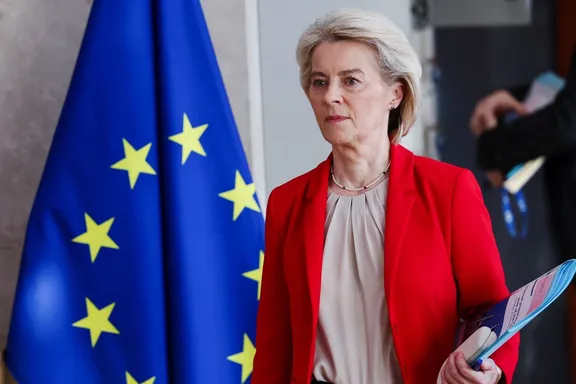

European Commission President Ursula von der Leyen said Tuesday it was time for negotiations to end the hostilities involving Iran, warning the conflict is having global economic consequences.
“The situation is critical for the energy supply worldwide. We all feel the knock-on effects on gas and oil prices, our businesses and our societies,” von der Leyen said at a news conference with Australian Prime Minister Anthony Albanese.
“It is of utmost importance that we come to a solution that is negotiated and this puts an end to the hostilities that we see in the Middle East,” she said.
Von der Leyen also condemned Iran’s attacks on civilian infrastructure across the region.





North Korean leader Kim Jong Un said his country would strengthen its nuclear forces amid US-Israeli military campaign against Iran, rejecting the idea of disarmament in exchange for economic benefits or security guarantees.
“The current world reality, where the dignity and rights of sovereign states are mercilessly violated by unilateral force and violence, clearly teaches what the true guarantee of a state’s existence and peace is,” Kim said Monday in an address to the Supreme People’s Assembly.
In remarks widely seen as referring to the ongoing Iran war, Kim said that Pyongyang would continue strengthening its nuclear capabilities, presenting the arsenal as essential for safeguarding the country’s sovereignty and long-term security.
Airstrikes targeting a site belonging to Iraq’s Popular Mobilization Forces (PMF) in the western province of Anbar killed at least six fighters, including the group’s local operations commander, security sources told Reuters early Tuesday.
The sources said the dead included Saad al-Baiji, the PMF’s Anbar operations commander, while at least 15 others were wounded in the attack.
The PMF accused the United States of carrying out the strike.
Known in Arabic as Hashd al-Shaabi, the PMF is an umbrella network of mostly Shi’ite paramilitary factions formally integrated into Iraq’s state security forces and includes several groups aligned with Iran.
Traders placed a roughly $580 million bet on falling oil prices shortly before President Donald Trump announced a pause on planned strikes against Iran, according to an exclusive report by Financial Times.
The position, which effectively wagered that oil prices would drop, was placed shortly before Trump said he would postpone military action and described recent contacts with Iran as “productive.”
Oil prices fell following the announcement as markets reacted to the prospect of a de-escalation in tensions in the Middle East.
The timing of the trade has drawn scrutiny from market participants, the FT reported, as analysts examine whether the position reflected unusually accurate market anticipation or access to advance information about the policy shift.
A cluster munition fired from Iran struck the city of Nesher near Haifa, the Israeli military said.
Damage was reported at the impact site, though no injuries were reported, according to Israel’s emergency response service.
Local media reports said the munition damaged a residential building in the Haifa suburb.
At least two vessels transiting the Strait of Hormuz have paid Iran for safe passage, Lloyd’s List Intelligence reported on Monday, noting that commercial traffic is increasingly diverting into Iranian territorial waters through what has been dubbed the “Tehran Toll Booth.”
The route runs between Iran’s Qeshm and Larak islands, where the Islamic Revolutionary Guard Corps is understood to be verifying vessel details and, in some cases, collecting fees.
One fee is reported to have been $2 million, the report said.
Among more than 20 vessels of over 10,000 deadweight tons that have taken the detour so far were two so-called “zombie” tankers sailing under the identities of decommissioned ships, the report said, citing shipping data.
It added that despite the conflict sharply reducing overall traffic through the strait, the pace of transits picked up over the weekend.
At least 16 vessels have crossed the chokepoint since Friday, the analysis suggests, with most tracked sailing along the new corridor through Iranian waters.