US Marines could be used to reopen Strait of Hormuz - WSJ
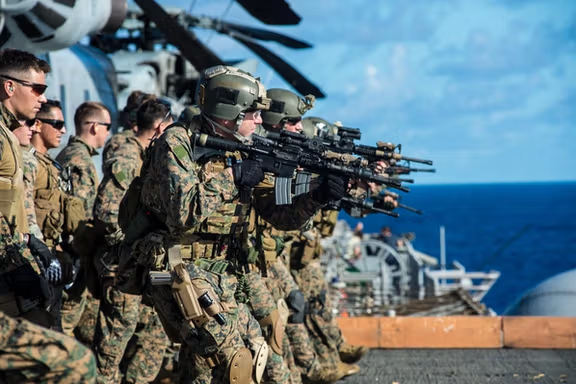

The United States could deploy a Marine unit to help reopen the Strait of Hormuz, including by seizing Iranian-controlled islands, the Wall Street Journal reported on Wednesday, citing current and former officials.
The Pentagon has sent the 31st Marine Expeditionary Unit to the Middle East, where it is expected to arrive in just over a week, providing options to counter Iranian threats to shipping in the waterway, the report said.
The strait, which carries about a fifth of global oil flows, has been disrupted by attacks on commercial vessels since the start of the conflict.




EU foreign policy chief Kaja Kallas said on Thursday that there is a need to find an exit from the war involving Iran and avoid further escalation.
“We need an exit from the Iran war, not an escalation,” Kallas told reporters ahead of a European Council summit in Brussels.
She added that ending the conflict was as important as finding a solution to the war in Ukraine.
An Iranian lawmaker said parliament is considering a proposal to charge fees on ships passing through the Strait of Hormuz, according to state media on Thursday, as the war has disrupted shipping through the strategic waterway.
Iran is considering charging transit fees on ships passing through the Strait of Hormuz, a lawmaker said on Thursday, as officials in Tehran stepped up rhetoric over the strategic waterway after this week’s attacks on energy sites in the Persian Gulf.
Somayeh Rafiei said lawmakers are pursuing a bill under which countries using the strait for shipping, energy transit and food supplies would be required to pay tolls and taxes to Iran, framing it as compensation for providing security along the route.
“In the event that the Strait of Hormuz is used as a secure route for ship traffic, energy transit and food supply, countries will be required to pay tolls and taxes to the Islamic Republic of Iran,” Rafiei said.
Lebanon’s foreign minister said the government is moving to end Iranian influence in the country, during an emergency meeting in Riyadh, according to Lebanese media on Thursday.
Youssef Raggi said Iran’s actions pose a threat to states that have pursued de-escalation, warning of the risks of continued escalation.
“The government is proceeding with efforts to free Lebanon from Iranian influence,” he said, adding that authorities would continue taking decisions to protect sovereignty.
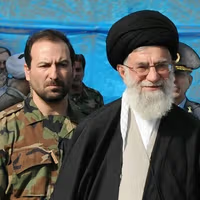
An adviser to Iran’s leadership said the country should use the war to reshape its position in the Strait of Hormuz, according to state media on Thursday.
Mohammad Mokhber said the situation offers “one of the most important opportunities” to redefine Iran’s role in the strategic waterway.
“After the imposed war, by defining a new regime for the Strait of Hormuz, Iran will move from being under sanctions to a powerful position in the region and the world,” he said.
He added that Western powers had previously “restricted” Iran but said the outcome of the war could shift that balance.
A projectile that landed near Iran’s Bushehr nuclear power plant likely came from the north rather than the Persian Gulf, David Albright, a former UN nuclear inspector and founder of the Institute for Science and International Security, said on Thursday, citing satellite imagery.
High-resolution images taken on March 18 show an impact around 350 meters from the reactor, with a debris pattern suggesting an incoming projectile from the north, he said.
“This adds Iran to the suspect list, along with Israel and the United States, although an Iranian projectile would certainly have been inadvertent,” Albright said in a post on X.
He echoed calls by International Atomic Energy Agency chief Rafael Grossi to avoid strikes near nuclear facilities and urged that communication channels with Russia remain open to reduce risks.