• العربية
  • فارسی
Brand
  • Iran Insight
  • Politics
  • Economy
  • Analysis
  • Special Report
  • Opinion
  • Podcast
  • Iran Insight
  • Politics
  • Economy
  • Analysis
  • Special Report
  • Opinion
  • Podcast
  • Theme
  • Language
    • العربية
    • فارسی
  • Iran Insight
  • Politics
  • Economy
  • Analysis
  • Special Report
  • Opinion
  • Podcast
All rights reserved for Volant Media UK Limited
volant media logo

Iran’s Araghchi says Tehran seeks 'real talks' but warns trust gap with US remains
Feb 9, 2026, 11:22 GMT+0

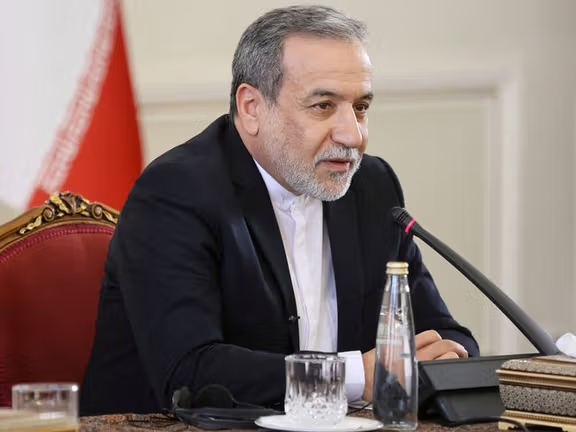
Iran’s Foreign Minister Abbas Araghchi said on Monday that Tehran was seeking “real negotiations” aimed at reaching results, but said progress depended on seriousness from the other side.

“We are very serious in the negotiations and are looking for real talks to reach results, provided the other side also shows seriousness and readiness for outcome-oriented negotiations,” Araghchi said.

He said a lack of trust toward Washington remained a major obstacle, adding that “a wall of distrust toward the United States exists, caused by America’s own behavior.”

Araghchi said Iran hoped trust could still be built. “We hope the necessary confidence can be created so that negotiations can lead to a result,” he said.

Speaking to foreign diplomats based in Tehran, Araghchi expressed regret over difficulties, including the internet shutdown, adding that, “I assure you that all of these was for your own safety and the safety of the people of Iran.”


Most Viewed

Ghalibaf defends Iran-US talks amid hardline backlash
1
INSIGHT

Ghalibaf defends Iran-US talks amid hardline backlash

2
INSIGHT

A nation in limbo: 100 days after the massacre, has the world moved on?

3
ANALYSIS

From instability to influence: Pakistan’s pivotal role in US-Iran diplomacy

4
ANALYSIS

100 days on: why Iran’s January protests spread across social classes

5

War-hit homeowners feel abandoned as Iran’s reconstruction aid fades

Banner
Banner

Spotlight

  • War-hit homeowners feel abandoned as Iran’s reconstruction aid fades

    War-hit homeowners feel abandoned as Iran’s reconstruction aid fades

  • 100 days on: the anatomy of Iran’s January crackdown
    INSIGHT

    100 days on: the anatomy of Iran’s January crackdown

  • Ghalibaf defends Iran-US talks amid hardline backlash
    INSIGHT

    Ghalibaf defends Iran-US talks amid hardline backlash

  • 100 days on: why Iran’s January protests spread across social classes
    ANALYSIS

    100 days on: why Iran’s January protests spread across social classes

  • From instability to influence: Pakistan’s pivotal role in US-Iran diplomacy
    ANALYSIS

    From instability to influence: Pakistan’s pivotal role in US-Iran diplomacy

  • A nation in limbo: 100 days after the massacre, has the world moved on?
    INSIGHT

    A nation in limbo: 100 days after the massacre, has the world moved on?

•
•
•

More Stories

Khamenei urges turnout for Feb. 11 rallies in video message

Feb 9, 2026, 10:05 GMT+0

Iran’s Supreme Leader Ali Khamenei released a video message calling on people to take part in rallies marking 22 Bahman, the February 11 anniversary of the 1979 Islamic Revolution.

In the message, published on Monday, Khamenei said that “today the Iranian nation shows itself through marches in the streets,” despite the anniversary falling on Wednesday, language Iranian state media often uses in advance to frame turnout for the event.

He urged participation as a show of national resolve, saying strength came from public will and unity rather than military power.

“National power has less to do with missiles and aircraft than with the will of nations and their resilience. You showed resilience, and you showed your will. You must show it again in other moments as well,” he said.

The message came a day after Khamenei skipped the annual February 8 meeting with air force commanders for the first time in 37 years, breaking a long-standing tradition amid heightened tensions with the United States.

Iran hardliner rejects win-win talks with US

Feb 9, 2026, 08:16 GMT+0

A senior Iranian conservative figure said the idea of a win-win outcome in negotiations with the United States is fundamentally wrong, even as Iran’s government says it has put forward proposals in talks with Washington.

Mohammad Javad Larijani, a former senior advisor to Iran’s Supreme Leader, said the concept of win-win talks with the US was “completely wrong,” according to comments published on Monday by Iran’s Mehr news agency.

“Some officials previously said we should trust the United States and reach an understanding,” Larijani said. “But the experience of the [2015] nuclear deal revealed all these assumptions. The idea of desperation was wrong, the win-win theory turned out to be incorrect, and trust was a complete mistake."

Larijani said those officials believed Iran had no remaining options and that the only solution was to satisfy Washington in order to secure partial sanctions relief.

“They believed all the country’s paths were closed and nothing could be done,” he said. “They thought the only way was to convince the United States to lift part of the sanctions and pay its cost in return, and they called this courage.”

“This is not courage,” Larijani said. “This is a kind of inverted courage. Real courage lies in resistance and attack, not in surrender.”

His comments come as Iran’s foreign minister, Abbas Araghchi, said over the weekend that Tehran was ready to pursue negotiations aimed at a fair, win-win outcome on its nuclear program, while ruling out zero uranium enrichment.

Speaking to Qatar-based Al Jazeera on Saturday, Araghchi said Iran was prepared to reach a reassuring agreement on enrichment and to build confidence through realistic negotiations. He said enrichment was a guaranteed right for Iran and would continue, though Tehran was ready to reduce enrichment levels.

Iran parliament says nuclear industry is ‘red line’ in talks with US

Feb 9, 2026, 07:43 GMT+0

Iran’s parliament said nuclear talks must proceed from a position of strength, with the country’s nuclear industry treated as a non-negotiable red line.

Abbas Goudarzi, spokesman for the parliament’s presiding board, said the negotiating team should keep the experience of the 2015 nuclear deal firmly in mind, warning that the United States has a record of “breach of commitments and bad faith.”

He said diplomacy must safeguard Iran’s nuclear industry “as an untouchable red line” and be conducted strictly on that basis.

Iran parliament holds closed-door session on talks with US

Feb 9, 2026, 07:04 GMT+0

Iran’s parliament held a closed-door session on Monday to discuss negotiations between the Islamic Republic and the United States, state media reported.

Major General Abdolrahim Mousavi, chief of staff of Iran's armed forces, and Foreign Minister Abbas Araghchi attended the session as guests, the reports said.

Mohammad Bagher Ghalibaf, the speaker of the parliament, said issues related to diplomacy and defense were reviewed during the closed-door session.

Hospital data show at least 1,800 killed in Jan 8.Tehran protest crackdown

Feb 8, 2026, 21:49 GMT+0

At least 1,800 people were killed in Tehran during a crackdown on protests on Jan. 8, according to aggregated hospital data presented at an emergency meeting of medical officials, people familiar with the matter told Iran International.

The emergency session, held on the morning of Jan. 9, heard from a senior health official who said consolidated figures from medical centers across the city indicated that at least 1,800 people had died in the violent suppression of protests the previous night.

The figures cover only data from civilian medical facilities within Tehran city, not the wider province, and include those whose bodies were transferred to hospitals between 8 p.m. on Jan. 8 and 10 a.m. on Jan. 9, as well as individuals who died of their injuries while receiving treatment.

The toll does not include casualties from violence reported later on Jan. 9, which sources said was more deadly.