• العربية
  • فارسی
Brand
  • Iran Insight
  • Politics
  • Economy
  • Analysis
  • Special Report
  • Opinion
  • Podcast
  • Iran Insight
  • Politics
  • Economy
  • Analysis
  • Special Report
  • Opinion
  • Podcast
  • Theme
  • Language
    • العربية
    • فارسی
  • Iran Insight
  • Politics
  • Economy
  • Analysis
  • Special Report
  • Opinion
  • Podcast
All rights reserved for Volant Media UK Limited
volant media logo

Iranian, Venezuelan dissidents call for US action to reclaim lost homelands

Jan 27, 2026, 22:30 GMT+0
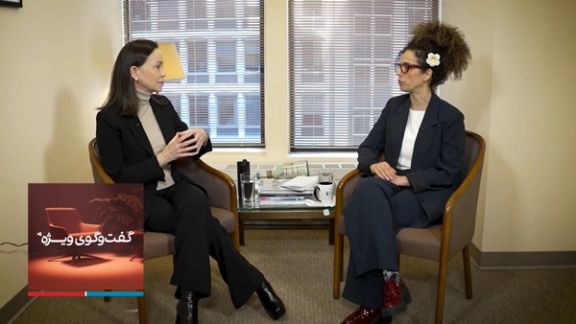
Special conversation between Masih Alinejad and María Machado, leader of the Venezuelan opposition and Nobel Peace Prize winner

Iranian and Venezuelan opposition figures in a meeting in Washington DC urged the United States and its allies to act against what they described as an axis of repression between their two countries.

Iranian activist Masih Alinejad met with Venezuelan opposition leader and Nobel Peace Prize laureate Maria Corina Machado in Washington, where the two discussed the situation in Iran and Venezuela and called for stronger international action.

“Today I am in Washington, DC. The capital of the free world,” Alinejad said. “I am here with one of the most courageous woman who is leading the democratic opposition movement in Venezuela, Maria Corina Machado.”

The meeting comes amid one of the deadliest periods of deadly violence in Iran's history. Iranian authorities have responded to nationwide protests with a massacre, with at least 36,500 people killed by security forces from Jan 8-9.

Alinejad said the Venezuelan and Iranian struggles are linked, arguing that the governments of Nicolás Maduro and Iran’s Supreme Leader Ali Khamenei support one another.

“Maduro is not alone. Ali Khamenei is his ally,” Alinejad said. “Ali Khamenei and Revolutionary Guards invaded Venezuela.”

Machado said that cooperation between the heavily sanctioned authoritarian governments has been underway for years.

“The tyrannies we’re facing have been cooperating for many years, exchanging resources, information technology agents, weapons, weapons, certainly,” Machado said. “And now at the same time, we see our people getting up and committing themselves in an unprecedented citizen movement for freedom.”

Machado’s remarks come weeks after US forces captured Maduro in Caracas and flew him to New York, where he has pleaded not guilty to drug trafficking charges.

She rejected criticism of such actions as foreign intervention.

The meeting also follows repeated warnings by US President Donald Trump that Washington would respond if Iranian authorities escalated violence against protesters — statements that activists say raised expectations among Iranians seeking international backing.

Alinejad said Iran is currently facing mass violence by state forces.

“Right now, Iranians are facing massacre,” she said. “Up to 20,000 people have been killed ... with empty hands, unarmed people cannot win."

Machado welcomed the US military intervention which captured Maduro this month, calling it a turning point. The attack killed 83 people, according to Venezuela's defense ministry.

“Finally, in Venezuela, we’re seeing President Trump making a tremendous important decision,” she said. “January 3rd, when President Trump brought Nicolas Maduro to justice.”

“Venezuela will be free and Iran will be free as well,” she added.

Most Viewed

Ghalibaf defends Iran-US talks amid hardline backlash
1
INSIGHT

Ghalibaf defends Iran-US talks amid hardline backlash

2
ANALYSIS

From instability to influence: Pakistan’s pivotal role in US-Iran diplomacy

3
ANALYSIS

100 days on: why Iran’s January protests spread across social classes

4

War-hit homeowners feel abandoned as Iran’s reconstruction aid fades

5
INSIGHT

100 days on: the anatomy of Iran’s January crackdown

Banner
Banner

Spotlight

  • Bread shortages, soaring prices strain households in Iran, residents say
    VOICES FROM IRAN

    Bread shortages, soaring prices strain households in Iran, residents say

  • War-hit homeowners feel abandoned as Iran’s reconstruction aid fades

    War-hit homeowners feel abandoned as Iran’s reconstruction aid fades

  • 100 days on: the anatomy of Iran’s January crackdown
    INSIGHT

    100 days on: the anatomy of Iran’s January crackdown

  • Ghalibaf defends Iran-US talks amid hardline backlash
    INSIGHT

    Ghalibaf defends Iran-US talks amid hardline backlash

  • 100 days on: why Iran’s January protests spread across social classes
    ANALYSIS

    100 days on: why Iran’s January protests spread across social classes

  • From instability to influence: Pakistan’s pivotal role in US-Iran diplomacy
    ANALYSIS

    From instability to influence: Pakistan’s pivotal role in US-Iran diplomacy

•
•
•

More Stories

A protester’s final wish: 'Bury me wrapped in the lion and sun flag'

Jan 27, 2026, 21:17 GMT+0
•
Azadeh Akbari

Mojtaba (Shahmorad) Shahpari, a protester from the southwestern Iranian city of Izeh who was injured during the nationwide protests and later found dead in a cold storage warehouse in Isfahan, was laid to rest wrapped in the lion and sun flag, fulfilling his final wish.

Shahpari was shot by security forces on January 8, 2026, during protests in Baharestan, Isfahan province, people familiar with the matter told Iran International.

The sources, who asked not to be named for fear of retaliation, said security forces opened fire indiscriminately on protesters that night.

“They opened fire on everyone that night, men and women, young and old,” the source said.

Videos sent to Iran International show gunshots being heard as protesters chant “long live the King” in Baharestan on January 8.

Security forces shot Shahpari in the leg on Isar Street in Baharestan sometime between 8:30 p.m. and 9 p.m. local time, causing him to fall to the ground, a source said.

Wounded but alive, he was taken by ambulance to Al-Zahra Hospital in Isfahan.

“He was not dead when he was taken to hospital,” the source added.

For days afterward, Shahpari’s family searched hospitals across Isfahan. Authorities repeatedly told them he was wounded and alive but refused to say where he was, the source said.

“Then there was nothing. No answers.”

Three days later, the family’s search ended near Bagh-e Rezvan cemetery, Isfahan’s main burial ground.

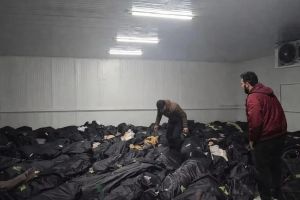
With the cemetery morgue full, bodies were being kept in a storage warehouse used for fruit and vegetables near Bagh-e Rezvan cemetery, the source said.

“There was no space ... They had put the bodies in a warehouse. As far as the eye could see, there were bodies,” putting the total at a minimum of 500.

When the body was found, a gunshot wound was visible on the side of his head, which the source said was not present when he was taken to hospital.

The source said they believed it was a gunshot to execute him and that he had been operated upon on his abdomen without his family's knowledge and later stitched back up.

About 18 miles southeast of Baharestan, also in Isfahan province, in the provincial capital, another source told Iran International that at the height of protests, “several containers of bodies” were brought to Bagh-e Rezvan in the middle of the night and unloaded into warehouses.

According to the source, some of the bodies were still alive and semi-conscious.

100%

Shahpari, 32, was originally from Izeh in Khuzestan province in southwestern Iran, but had moved to Baharestan in search of work.

To support himself, he worked nights as a building security guard and spent his days unloading cargo as a laborer.

“He was a freedom-seeker,” a source said. “He opposed religion and supported the monarchy.”

Shahpari was buried on January 18, 2026, in the village of Nashil-e Do near Izeh.

“He was buried wrapped in the lion and sun flag, just as he wished...just as we all do.”

Iranians burying slain protest youths mourn with dancing and defiance

Jan 27, 2026, 20:10 GMT+0
•
Negar Mojtahedi

Iranian families are turning funerals of youths killed in a deadly protest crackdown this month into celebrations of life, with dancing and wedding music aimed at defying their heartbreak and state repression.

The transformation of funerals into celebrations is a deliberate act of resistance, said Siavash Rokni, an expert on Iranian popular culture.

“If you, the Islamic regime, are telling me that I need to cry at the deathbed of my child, I will laugh just to defy your existence," Rokni told Iran International

Rokni said the funerals-turned-celebrations strike at one of the clerical establishment's defining pillars, overturning the Islamic Republic’s long-standing use of grief and martyrdom as a galvanizing force.

With the internet crackdown still in place, footage from these funerals is only now beginning to surface.

Traditionally in Iran, funerals are defined by grief: mournful music, Islamic sermons and Quranic recitations. But what is unfolding now looks completely different.

The songs being played are the kind usually reserved for weddings. People clap. They dance.

Across Iran, families are transforming burials into acts of resistance.

The relatives and close friends of slain protesters Mohammad-Hossein Jamshidi and Ali Faraji honored their memory with music and applause as they were laid to rest at Hesar Cemetery in Karaj, west of Tehran, according to a video obtained by Iran International.

In Lordegan, mourners chanted “Death to Khamenei” and “This is the final battle — Pahlavi will return” during the funeral of Ali Khaledi, with the pre-1979 Lion and Sun flag raised above the crowd.

Sina Haghshenas, a young florist from northern Iran, was also killed during the nationwide uprisings by the Islamic Republic. At his funeral, mourners celebrated his life even in death — refusing silence, and turning grief into a final act of pride and defiance.

It is not customary in Iran to hold funerals with dancing and clapping, but this has become a form of protest among families who have lost loved ones.

Holly Dagres, a senior fellow at the Washington Institute, said the scenes reflect a profound shift in Iranian society.

"For the Islamic Republic, that is a very worrying thing, that instead of these people mourning and being traumatized by what has happened, which they are to an extent, they're celebrating. And that means to me and signifies that this is a people that's no longer afraid of the Islamic Republic.”

By rejecting religious rituals and replacing them with wedding music, families are sending a clear and defiant message.

“Whether you're simply looking at the fact that Iranians are calling their martyrs, not martyrs but Javid Nam, or 'long-lived name,'" said Behnam Ben Taleblu, director of the Foundation for Defense of Democracies’ Iran Program.

"There are many, many signs that the Iranian population, even as they grieve are trying to push past the discourse imposed on them by the Islamic Republic," he said.

More than 36,500 Iranians were killed by security forces during the January 8-9 crackdown on nationwide protests, according to documents reviewed by Iran International's Editorial Board, making it the deadliest two-day protest massacre in history.

For many Iranians, the celebrations are not a denial of loss but a declaration that fear has broken.

In the face of mass killings, families are reclaiming the meaning of death from a theocratic system that has long weaponized mourning and turned funerals into acts of national resistance, where even in grief, their message of defiance is clear.

Iran’s repeated use of 3,117 fuels doubts about official statistics

Jan 27, 2026, 08:50 GMT+0

A single number – 3,117 – has appeared repeatedly in Iranian official statistics, from protest deaths to public health data, raising doubts about the credibility and methodology behind state-reported statistics.

In a joint statement, Iran’s Martyrs Foundation and the Legal Medicine Organization said 3,117 people were killed during the nationwide protests in January.

The number itself, however, is strikingly familiar.

The same figure – 3,117 – has appeared in multiple, otherwise unrelated official datasets over recent years, including public health statistics, economic reports, and earlier protest-related announcements.

Variants of the number, particularly 1,039 and its multiples, have also been cited repeatedly in COVID-19 infection and hospitalization figures released by state bodies.

Analysts say that while identical numbers can recur by chance, the repeated use of a non-rounded figure across different sectors and time periods is statistically unlikely.

  • Over 36,500 killed in Iran's deadliest massacre, documents reveal

    Over 36,500 killed in Iran's deadliest massacre, documents reveal

The pattern has prompted questions about whether such figures reflect genuine record-keeping, administrative shortcuts, or the use of standardized numbers in situations where full data are unavailable or politically sensitive.

Independent human rights organizations and international media have consistently challenged official casualty figures following protest crackdowns.

Their estimates – based on eyewitness testimony, hospital documentation, verified video evidence, and reports of serious injuries and enforced disappearances—point to significantly higher death tolls than those acknowledged by authorities.

According to documents reviewed by Iran International, more than 36,500 Iranians were killed by security forces during the January 8-9 crackdown on nationwide protests, making it the deadliest two-day protest massacre in history.

Official statements, by contrast, have offered little supporting detail. Names, locations, dates, and provincial breakdowns have not been released, limiting independent verification and intensifying criticism that casualty figures may be framed to downplay the scale of violence, particularly as international attention grows, including at the UN Human Rights Council.

The reappearance of 3,117 has reinforced long-standing skepticism over the reliability of official statistics in moments of crisis—when numbers carry political weight well beyond their face value.

US renews nuclear and missile demands on Iran as ‘armada’ arrives

Jan 27, 2026, 00:47 GMT+0

The Trump administration wants Tehran to halt its nuclear “escalations,” ballistic missile program and support for regional proxy groups, a spokesperson for the Department of State told Iran International on Monday.

"Iran, the world’s leading state sponsor of terror, must stop its nuclear escalations, its ballistic missile program, and its support for its terrorist proxies," the spokesperson said.

"For decades, the Iranian regime has willfully neglected the nation’s economy, agriculture, water, and electricity to instead squander Iranian people’s vast wealth and future on terrorist proxies and nuclear weapons research."

The spokesperson made the remarks when asked about an Iranian state media report claiming that “recognition of Israel” has been added to the Trump administration’s preconditions for peace with Tehran.

Tehran has long rejected heeding a US diplomatic push for it to rein in its nuclear program and military activities as a violation of its sovereignty by an enemy power.

US President Donald Trump told Axios earlier in the day the situation with Iran is “in flux” after he sent a “big armada” to the region but believes Tehran is eager to cut a deal. “They want to make a deal. I know so. They called on numerous occasions. They want to talk."

Separately, Axios quoted US officials as saying any potential agreement with Tehran would require the removal of all highly enriched uranium from Iran, strict limits on the country’s long-range missile stockpile, a change in Iran’s policy of supporting regional proxy groups, and a ban on independent uranium enrichment inside the country.

US Central Command on Monday confirmed the deployment of the USS Abraham Lincoln Carrier Strike Group to the Middle East. "The Abraham Lincoln Carrier Strike Group is currently deployed to the Middle East to promote regional security and stability."

The deployment came weeks after Trump promised help for Iranian protesters amid a brutal crackdown where at least 36,500 people were killed. He said he had cancelled all meetings with Iranian officials, and that "help is on its way" for Iranian people.

The State Department spokesperson said on Monday "the Iranian people want and deserve a better life."

"The regime’s brutal suppression of the Iranian people is on full display," the spokesperson said.

Why 'locked and loaded’ US is still holding back on Iran

Jan 26, 2026, 20:06 GMT+0
•
Shahram Kholdi

US President Donald Trump’s dramatic naval buildup in the Middle East appears to have generated more strategic uncertainty than clarity both in Tehran and in Washington.

Over the weekend, as the USS Abraham Lincoln carrier strike group moved closer to the Persian Gulf, US Central Command Commander Admiral Brad Cooper travelled to Israel—a visit widely interpreted as evidence of intensified coordination ahead of a potential move against Iran.

Trump has framed the possibility of intervention in explicitly humanitarian terms, warning Tehran against the killing of protesters and asserting that US pressure has already halted hundreds of planned executions.

Yet despite naval deployments, repeated warnings, and unmistakable signaling, no kinetic action has followed.

This restraint has endured even as credible estimates from human rights organisations and the United Nations place civilian deaths from the crackdown at over 20,000. Iran International’s editorial statement of January 25 cites a figure of 36,000 killed, making this the bloodiest episode in the Islamic Republic’s history.

Jurists and international lawyers have argued that the scale and systematic nature of the violence may fall within the jurisdictional scope of the International Criminal Court under the Rome Statute.

Washington’s response has followed a different rhythm: maximalist language paired with deliberate restraint. Carrier deployments have provided leverage; sanctions and tariffs have expanded; diplomatic and military signaling has intensified. But strikes—despite the scale of civilian killing—have not materialized.

Restraint as policy

What, then, is actually holding President Trump back?

Humanitarian concern looms large in Trump’s public messaging. But this framing sits in visible tension with the administration’s broader strategic doctrine.

The National Security Strategy of November 2025 reiterates an America First approach, prioritizing US interests while explicitly seeking to avoid committing American forces to conflicts that risk metastasizing into “endless wars.”

The 2026 National Defense Strategy adopts a markedly harsher register toward Iran. It accuses Tehran of having “American blood on its hands,” framing it not only as an abusive authoritarian regime but as an enduring strategic adversary.

And yet, in a notable departure from Trump’s instinctive aversion to foreign entanglement, he has drawn explicit red lines around the execution of protesters and the use of lethal force against demonstrators. Any prospective action, he has suggested, would be framed not as conquest or regime change, but as rescue.

The evidence, however, suggests that humanitarian imperatives function more as legitimizing rhetoric than as decisive drivers of policy. Had halting mass killing been the primary determinant, intervention might plausibly have followed the peak of repression in early January.

Instead, Trump has oscillated between “locked and loaded” warnings and expressions of hope that force will not be required.

Strategic calculations

The deeper constraints lie elsewhere—in hard strategic and political realities that humanitarian language alone cannot dissolve.

First, escalation risk dominates the calculus.

Tehran has made clear that any US strike would trigger retaliation across multiple theatres: Israel, American bases in the region, and potentially global energy routes. The prospect of asymmetric escalation—through ballistic missiles, proxy warfare, cyber operations, or disruption of the Strait of Hormuz—carries profound economic and security consequences.

Regional partners, including Israel, are widely reported to have urged caution, acutely aware that even a limited strike could spiral into a broader conflagration.

In this context, the “armada” functions less as a prelude to war than as a tool of coercive signaling: capability without commitment. Trump’s repeated insistence that he “would rather not see anything happen” reflects not humanitarian restraint, but an aversion to cascading costs that could rapidly exceed any political or strategic gain.

Second, domestic political calculations weigh heavily.

American fatigue with Middle Eastern military entanglements remains deep-seated. Polling consistently shows majority opposition to new wars, even when framed around humanitarian catastrophe.

Trump’s political identity remains rooted in rejecting the interventionist excesses of the post–Cold War era. Forceful rhetoric projects resolve, carrier deployments demonstrate action, sanctions impose pain—all without exposing U.S. forces to open-ended conflict.

Third, strategic leverage without war remains attractive.

The current posture weakens Iran indirectly. Pressure on the nuclear program intensifies. Economic isolation deepens through secondary sanctions and tariffs on third-party trade. Internal regime fissures may widen as elites confront the costs of isolation without the rallying effect of a foreign attack.

Humanitarian language helps justify this approach publicly, but the underlying strategy prioritizes containment, deterrence, and attrition—not Responsibility-to-Protect-style intervention.

All tabs open

Taken together, Trump’s posture reflects a president operating within a narrow corridor between moral outrage, strategic constraint, and political risk. Restraint, however, should not be mistaken for permanence.

The current alignment keeps open a range of options that could be activated rapidly should circumstances shift.

A limited, precision strike aimed at degrading Tehran’s capacity for internal repression would suggest a convergence between humanitarian rhetoric and coercive deterrence. A broader campaign would signal that strategic imperatives had finally eclipsed restraint.

For Iranians facing repression, this uncertainty itself exerts pressure—on the regime no less than on Washington.

For policymakers, the lesson is neither complacency nor inevitability, but clarity: intervention, if it comes, will arrive not as a moral reflex, but at the moment when humanitarian catastrophe, strategic threat, and political risk briefly align.