• العربية
  • فارسی
Brand
  • Iran Insight
  • Politics
  • Economy
  • Analysis
  • Special Report
  • Opinion
  • Podcast
  • Iran Insight
  • Politics
  • Economy
  • Analysis
  • Special Report
  • Opinion
  • Podcast
  • Theme
  • Language
    • العربية
    • فارسی
  • Iran Insight
  • Politics
  • Economy
  • Analysis
  • Special Report
  • Opinion
  • Podcast
All rights reserved for Volant Media UK Limited
volant media logo

TV host Levin calls Iran ‘a concentration camp,’ urges US to act

Jan 23, 2026, 00:59 GMT+0Updated: 17:48 GMT+0
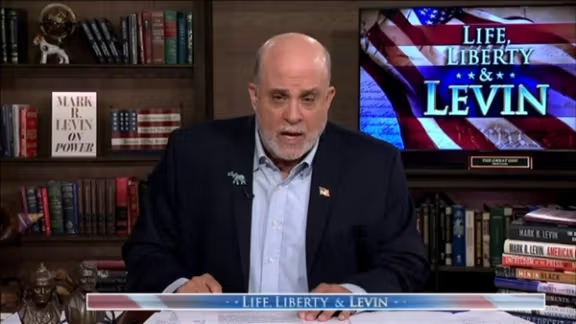
Mark Levin, host of Life, Liberty and Levin on Fox News

US conservative commentator Mark Levin told Iran International on Thursday that Iran has effectively become a “concentration camp” amid a deadly crackdown on protests, urging the United States to act to help topple the Islamic Republic.

“I can only speak for myself. I don’t need any more reminding about how bad this regime is and that somebody better do something about it, because if it’s not us, nobody’s going to do anything about it,” Levin said.

Levin said recent reports of increased US military deployments to the region suggested Washington was keeping its options open, although he said he had no insight into whether military action was being considered.

“Most revolutions, including America’s own, needed outside help,” he said. “What is happening in Iran is a counter-revolution against a regime that rules by force and fear.”

Levin also criticized decades of US engagement with Tehran, arguing that successive administrations believed the Islamic Republic could be managed through negotiations.

“This is an ideological regime,” he said. “They talk, they negotiate, but they have no intention of abandoning their mission, and that is why they so brutally suppress their own people.”

Iran has faced widespread internet disruptions during renewed unrest, with only limited information reaching the outside world through satellite connections and virtual private networks.

“I can tell you that tens of millions of Americans stand with the people of Persia. There’s no question about it,” Levin said. “We know the regime there is Hitleresque, Nazi-like. The regime is slaughtering innocent people, especially young people, raping them, and pillaging towns. We know that regime is the enemy of the American people. They’ve made that abundantly clear.”

Iran International has reported that at least 12,000 people have been killed since the protests began, while CBS News has cited estimates placing the death toll as high as 20,000.

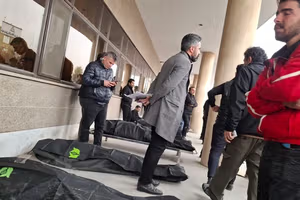
Sources told Iran International on Wednesday that hospitals and morgues are facing shortages of body bags, forcing authorities to store bodies in corridors and other areas.

“We know they still want to build nuclear weapons. They back terrorism in our country, throughout Europe, and across the Middle East, but the people they terrorize the most are the Persian people,” Levin said. “I feel horrible about what’s taking place, and all I can do is use my platforms to draw as much attention to this as I can.”

Levin said Iranians possess a long civilizational history distinct from other countries in the region and said those who emigrate to the United States often integrate successfully and contribute to American society.

“If the people of Iran were free, the contributions they could make to science, culture, and technology would be extraordinary,” he said. “Instead, they are focused on survival under repression.”

Most Viewed

Ghalibaf defends Iran-US talks amid hardline backlash
1
INSIGHT

Ghalibaf defends Iran-US talks amid hardline backlash

2
VOICES FROM IRAN

Bread shortages, soaring prices strain households in Iran, residents say

3
ANALYSIS

From instability to influence: Pakistan’s pivotal role in US-Iran diplomacy

4
ANALYSIS

100 days on: why Iran’s January protests spread across social classes

5

War-hit homeowners feel abandoned as Iran’s reconstruction aid fades

Banner
Banner

Spotlight

  • Iran crackdown reaches cemeteries as graves of slain protesters defaced
    EXCLUSIVE

    Iran crackdown reaches cemeteries as graves of slain protesters defaced

  • Iran diplomacy wobbles as factions compete to avoid looking soft on US
    INSIGHT

    Iran diplomacy wobbles as factions compete to avoid looking soft on US

  • The politics of pink: how Iran uses cuteness to rebrand violence
    ANALYSIS

    The politics of pink: how Iran uses cuteness to rebrand violence

  • Bread shortages, soaring prices strain households in Iran, residents say
    VOICES FROM IRAN

    Bread shortages, soaring prices strain households in Iran, residents say

  • 100 days on: the anatomy of Iran’s January crackdown
    INSIGHT

    100 days on: the anatomy of Iran’s January crackdown

  • Ghalibaf defends Iran-US talks amid hardline backlash
    INSIGHT

    Ghalibaf defends Iran-US talks amid hardline backlash

•
•
•

More Stories

Iranian teen hid in body bag among slain protestors to survive - rights group

Jan 22, 2026, 22:24 GMT+0

A wounded Iranian protester played dead inside a plastic body bag for three days to hide from security forces and heard what he believed to be fellow protestors being summarily executed, a rights group reported on Thursday.

The IHRDC reported that the teenager, whose name it withheld for his safety, was held among bodies of slain protestors transferred to the Kahrizak Forensic Center south of Tehran where he stayed motionless until his family eventually found him alive.

It added it was not able to independently verify the account as a nationwide internet blackout persists in Iran.

The youth, who is under 18, was in critical condition after suffering gunshot wounds.

“During the three days he was held among the bodies transferred to Kahrizak, he heard the ringing of cell phones among the corpses and smelled the intense stench of decay,” the Iran Human Rights Documentation Center said, citing the teenager’s account.

The group said the young man described hearing gunfire after sounds from wounded detainees, suggesting they were summarily executed.

“The witness reported that whenever groans from the wounded were heard, they were shortly followed by the sound of gunfire and the cessation of the groaning, strongly indicating that security forces delivered fatal shots to wounded individuals who were still alive,” IHRDC said.

“These details raise serious concerns regarding the treatment of the wounded, violations of the right to life, and extrajudicial killings, including of minors, during the suppression of protests,” the rights group added.

Iran seizes assets to punish dissent

Jan 22, 2026, 18:58 GMT+0
•
Hooman Abedi

Tehran has broadened its attack on dissent after the deadliest crackdown on protests in the Islamic Republic's history by seizing assets of those accused of supporting the unrest, in a tactic first deployed amid the state's chaotic birth.

Judicial authorities in Qom province last week announced the confiscation of all assets and bank accounts belonging to Mohammad Saeedinia, the founder of a popular cafe chain operating in several Iranian cities.

Saeedinia had been arrested a day earlier and officials linked the move to his alleged support for strikes and protests after he temporarily closed his cafés following calls for strikes and work stoppages.

State-affiliated Fars News reported that assets linked to Saeedinia—including cafe chains, a roadside complex and food-industry businesses—were valued at between 25 and 27 trillion rials ($17.5–19 million).

Prosecutors said similar cases had been opened against dozens of other cafes, as well as actors, athletes and signatories of protest statements, adding that some assets had already been seized to compensate for damage to public property.

No violent crime, financial fraud or national-security offense has been publicly substantiated in Saeedinia’s case. Instead, it illustrates how economic pressure has emerged as an element of state repression in a practice with a long pedigree.

The owner of the Saedinia café chain Mohammad Saeedinia attending a public event (Undated)
100%
The owner of the Saedinia café chain Mohammad Saeedinia attending a public event

Confiscation codified

From the earliest months after the 1979 revolution, confiscation was used not only to dismantle the ancien régime’s economic base, but to restructure ownership and concentrate power within institutions aligned with the new state.

In the chaotic post-revolutionary period, seizures were carried out in what amounted to a legal vacuum. Revolutionary courts and ad hoc committees confiscated property under broad ideological justifications, often before a coherent judicial framework existed.

Decrees issued by Ruhollah Khomeini concerning “ownerless” or “illegitimate” property created elastic categories through which private assets could be absorbed by revolutionary bodies.

Although framed as redistribution, these measures laid the economic foundations of new power centers.

Over time, confiscation was institutionalized through bodies such as the Foundation of the Oppressed and the Execution of Imam Khomeini’s Order, as well as through legal provisions including Article 49 of the constitution, which targets “illegitimate wealth” without defining the term.

100%

Among the early and most consequential targets was Ahmad Khayami, a pioneer of Iran’s modern auto industry and co-founder of Iran National, later Iran Khodro. The seizure of his assets and removal of private control over the company marked a decisive break with Iran’s pre-revolutionary model of industrial entrepreneurship.

Another prominent case was Habib Sabet, an entrepreneur active in media, construction and commerce, and the founder of Iran’s first private television network. His assets were confiscated in the revolution’s aftermath, reflecting how independent capital—even without overt political involvement—was treated as incompatible with the new order.

Private sector hobbled

The execution of Habib Elghanian, a leading industrialist and head of Tehran’s Jewish community, sent a particularly chilling signal. After a summary revolutionary trial in 1979, his assets were seized and he was put to death, accelerating capital flight and underscoring the risks facing private enterprise in the new Islamic Republic.

The impact on Iran’s modern private sector was significant.

Entrepreneurs who had built manufacturing, retail and financial enterprises over decades were removed, their assets transferred to state or quasi-state structures. Many left the country.

Others were sidelined through prosecution or regulatory exclusion.

Habib Elghanian, a prominent leader of Iran's Jewish community, seen during his trial in Iran that led to his 1979 execution.
100%
Habib Elghanian, a prominent leader of Iran's Jewish community, seen during his trial in Iran that led to his 1979 execution.

As revolutionary fervor faded, the practice evolved rather than disappeared. Highly publicized trials and executions gave way to asset freezes, license revocations and selective enforcement. Confiscation became less spectacular but more routine, embedded in administrative and judicial processes.

Recent protest cycles have again brought these mechanisms to the fore. Business closures, account seizures and professional bans have accompanied crackdowns, reinforcing the message that economic activity remains conditional on political compliance.

The seizure of Saeedinia’s assets fits squarely within this longer trajectory. It is not an isolated response to unrest, but part of a system in which control over property has, from the outset, served as a means of political management.

Come what may in Iran, Russia will adapt to preserve influence

Jan 22, 2026, 15:57 GMT+0
•
Mark N. Katz

Russia likely views Iran’s mass anti-regime protests with deep unease, but may ultimately adapt just as it did in Syria to preserve influence whether the Islamic Republic survives or a new political order emerges.

After the loss of longtime Russian allies Bashar al-Assad in Syria and Nicolas Maduro in Venezuela, the Kremlin can hardly wish to suffer further loss of an ally in Tehran.

Supreme Leader Ali Khamenei may yet remain in power—thanks partly to ongoing Russian-Iranian cooperation. But even if he does not, Vladimir Putin may still be able to salvage the situation.

Moscow, according to an analysis by the Carnegie Endowment, does not seem likely to intervene militarily in Iran to defend the Islamic Republic against its opponents. Russian forces, after all, are preoccupied with the war in Ukraine.

Yet, as detailed in an article in Foreign Policy, Moscow has long provided Tehran with electronic and other tools of repression. Since the Iranian demonstrators are not an armed opposition, Russian military intervention may not be needed to contain or suppress the unrest.

The situation might change, of course, if US president Donald Trump follows through on his threats to intervene in Iran. Both Tehran and Moscow want to avoid this. But how?

While Putin himself has been remarkably quiet about events in Iran, the one initiative Russia has engaged in so far is mediation between Iran and Israel. Both governments have reportedly conveyed to Moscow that neither will preemptively attack the other.

This Russian mediation effort may be highly important for protecting the Islamic Republic. Unlike just before and during the June 2025 twelve-day war—when Israeli Prime Minister Benjamin Netanyahu was urging the United States to join attacks on Iran—Netanyahu is now reportedly counseling restraint in Washington regarding military intervention.

While Israel has long opposed Iran’s acquisition of nuclear weapons, Netanyahu may prefer that a weakened Islamic Republic remain in power rather than be overthrown and replaced by either a more hostile regime, or one more closely aligned with the West in ways Israel cannot shape.

Netanyahu has already found himself at cross-purposes with Trump over Syria, where the United States has sought to cooperate with the new leadership under Ahmed al-Sharaa, while Israel views the government in Damascus as a threat.

Moscow’s coordination with Israel may therefore increase Putin’s ability to dissuade Trump from intervening in Iran.

For Moscow, the best outcome in the current crisis is that the Islamic Republic defeats its internal opponents and survives. But Russia may still retain significant influence and cooperation with Iran after a change in leadership—or even regime.

In Syria, Moscow has kept its naval and air bases despite the fall of Assad. In Venezuela, Russia has moved quickly to re-engage with the post-Maduro authorities, seeking to preserve economic and strategic ties despite a major political rupture.

If Khamenei falls but the Islamic Republic remains intact, Tehran is likely to continue cooperating with Russia despite any newfound willingness to work with the United States.

Even if the Islamic Republic collapses, its replacement will almost certainly continue to envision Iran as a regional great power.

A new Iranian government may pursue more cooperative relations with Washington while still seeking ties with Russia, China, and others—much as new leaderships elsewhere have attempted to diversify their external partnerships.

Moscow, for its part, will actively seek cooperation with any new authorities in Tehran to prevent Iran from becoming overly dependent on the West.

With regard to Ukraine, Putin has shown little flexibility, pressing ahead despite extraordinary human and financial costs. But when it comes to supporting anti-Western allies in the Global South, Moscow has been more pragmatic.

The demands of the war in Ukraine limit Russia’s ability to defend embattled partners elsewhere, while Putin’s long-standing efforts to cultivate relations with traditionally pro-Western governments have reduced the strategic necessity of rigid ideological allies.

It is undoubtedly embarrassing for Moscow to see longtime partners fall from power, but this is hardly unique to Russia—as the collapse of the Western-backed government in Afghanistan demonstrated.

Putin appears to understand that the downfall of any government in the Global South is typically followed by competition among outside powers for influence. This is not a moment to lament losses, but to adapt—to engage new leaders eager to keep their options open rather than rely on a single great-power patron.

Moscow’s preferred outcome in Iran remains the survival of the Islamic Republic and the continuation of close cooperation. But if leadership—or even regime—change occurs, Russia will move quickly to adjust.

If Putin’s success in retaining Russian bases in Syria despite backing the losing side is any guide, he may well succeed in doing so in Iran as well.
Iran protest crackdown toll may top 20,000, UN rapporteur says

Jan 22, 2026, 13:30 GMT+0

The number of civilians killed in Iran’s crackdown on protests may be more than 20,000, the UN special rapporteur on human rights in Iran said, citing reports from doctors inside the country, Bloomberg reported.

Mai Sato said earlier this week that civilian deaths were estimated at 5,000 or more, adding that medical reports suggested the toll could be far higher, at about 20,000 or more.

The US-based Human Rights Activist News Agency (HRANA) said it has verified 4,902 deaths since unrest erupted in late December and is reviewing a further 9,387 suspected fatalities, while more than 26,000 people have been arrested, according to a statement on its website.

Iran’s National Security Council on Wednesday issued its first official toll, reporting 3,117 deaths, including 2,427 described as “innocent,” among them members of the security forces, without providing a civilian breakdown.

Iran International reported earlier this month that more than 12,000 people were killed during the crackdown largely on January 8 and 9.

  • At least 12,000 killed in Iran crackdown during internet blackout

    At least 12,000 killed in Iran crackdown during internet blackout

  • Iran crackdown left 16,500 dead, 330,000 injured - Sunday Times

    Iran crackdown left 16,500 dead, 330,000 injured - Sunday Times

Iran still among world’s worst countries for torture of jailed journalists – CPJ

Jan 22, 2026, 01:00 GMT+0

Iran remains one of the world’s worst countries for abusing detained journalists, with reporters subjected to torture and harsh prison conditions amid intensified repression following nationwide protests, according to a new report by the Committee to Protect Journalists (CPJ).

"Iran held five journalists as of December 1, down from a peak of 55 three years earlier, but has generated the highest number of documented torture and beating cases against imprisoned media workers since records began in 1992," CPJ’s 2025 global prison census published on Wednesday said.

The report said Iran’s record worsened following nationwide protests, with journalists frequently detained for covering demonstrations and dissent.

CPJ links Iran’s earlier spike in journalist jailing to nationwide protests in recent years, and rights groups say reporters have been repeatedly detained for covering demonstrations and dissent.

Rights groups also report that many of those detained have been held in notorious facilities such as Tehran’s Evin Prison under harsh conditions.

Iran has been under a near-total internet and telecommunications blackout since early January amid nationwide protests, severely restricting the flow of information from inside the country.

Internet monitoring groups including NetBlocks recorded sharp drops in connectivity across Iran as authorities sought to limit access to social media, messaging services and independent news coverage.

The Middle East and North Africa remains the region with the third-highest number of jailed journalists worldwide. CPJ said Iran is among several states where authorities routinely treat critical reporting as a security threat, using broadly defined anti-state or terrorism-related accusations to justify arrests.

The report warned that Iran continues to arrest reporters, particularly those covering protests and economic grievances. Detainees face harsh conditions, prolonged pre-trial detention and due-process violations in breach of international law, the organization said.

It said the global trend of jailing and mistreating journalists in countries including Iran not only reflects authoritarian governance but also enables corruption and abuse of power by shielding them from public scrutiny.