• العربية
  • فارسی
Brand
  • Iran Insight
  • Politics
  • Economy
  • Analysis
  • Special Report
  • Opinion
  • Podcast
  • Iran Insight
  • Politics
  • Economy
  • Analysis
  • Special Report
  • Opinion
  • Podcast
  • Theme
  • Language
    • العربية
    • فارسی
  • Iran Insight
  • Politics
  • Economy
  • Analysis
  • Special Report
  • Opinion
  • Podcast
All rights reserved for Volant Media UK Limited
volant media logo

Iran leans into state-run intranet amid lingering blackout

Negar Mojtahedi
Negar Mojtahedi

Iran International

Jan 21, 2026, 07:30 GMT+0
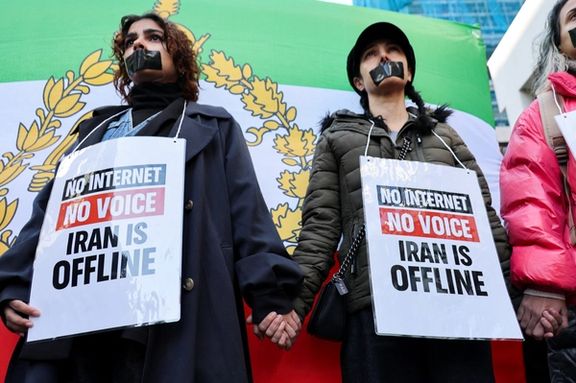
Iranians living in Japan, with taped mouths and carrying signs, march in support of nationwide protests in Iran, in Tokyo, Japan, January 18, 2026.

Iran is ramping up its control of domestic cyberspace with a closed new state-run intranet, according to a US-based advocacy group, after a nationwide internet blackout cloaked the deadliest crackdown on protests in nearly half a century.

“Like North Korea, the Islamic Republic has been working to build an intranet, and it is scary. It will be blocking off Iran," said Neda Bolourchi, the executive director of the Public Affairs Alliance of Iranian Americans.

The Washington-based PAAIA works to amplify Iranian American voices and advocate for policy solutions on Capitol Hill.

Iran's internet blackout began on January 8 as the uprisings spread nationwide and security forces launched a sweeping crackdown.

At least 12,000 people were killed, most of them over January 8 and 9 according to medics and government sources who spoke to Iran International.

Iran’s Supreme Leader Ali Khamenei has since acknowledged that “several thousands” were killed, while doctors say most deaths occurred over just two days during what they describe as the most violent phase of repression in the Islamic Republic’s 47-year history.

With near-total internet and phone shutdowns in place, independent verification remains extremely difficult, and medical sources warn the true toll could be higher.

Where does the blackout stand now?

Bolourchi said the shutdown remains severe but not absolute, and that the small openings are not born of restraint but aim to support a bare minimum of business activity especially in the banking sector.

“We’re getting reports that landlines are sporadically available and that some of the throttling has been reduced,” she said.

A limited number of calls and messages are still getting out through platforms such as WhatsApp, though at dramatically reduced levels.

The Islamic Republic, she explained, cannot fully cut connectivity without paralyzing its own systems. Banks, hospitals and parts of the economy still depend on the internet to function, forcing authorities to allow just enough access to keep the state running while the broader population remains largely cut off.

Satellite internet, once a critical lifeline, has also come under heavy pressure. Bolourchi said authorities are using jamming equipment to disrupt Starlink connections while simultaneously confiscating receivers, which are visible and easy to locate.

She warned that possession of such tools has become increasingly dangerous, as the clerical establishment expands the use of severe charges traditionally reserved for enemies of the state.

The length of the blackout itself, Bolourchi said, points to something more permanent taking shape.

Unlike previous shutdowns that proved economically unsustainable after a few days, this current outage has persisted, suggesting the Islamic Republic has made significant progress in separating government infrastructure from public access.

That shift, she warned, could leave ordinary Iranians trapped inside a sealed digital ecosystem, unable to communicate freely with the outside world even after protests subside.

Bolourchi argued that the United States still has leverage if it chooses to use it, pointing to legislation already passed by Congress that was intended to fund internet circumvention tools for Iran, including support for satellite connectivity and VPNs.

Congress, she said, went further than requested by approving $15 million annually for these efforts.

“A lot could have been done over the past year that would be helping the people of Iran right now,” Bolourchi said, citing bureaucratic and funding delays. “Instead, we’re always in a reactive position.”

Most Viewed

100 days after carnage: Iran economy reels from war, inflation, unemployment
1
INSIGHT

100 days after carnage: Iran economy reels from war, inflation, unemployment

2
INSIGHT

Ghalibaf defends Iran-US talks amid hardline backlash

3
INSIGHT

A nation in limbo: 100 days after the massacre, has the world moved on?

4
ANALYSIS

From instability to influence: Pakistan’s pivotal role in US-Iran diplomacy

5
ANALYSIS

100 days on: why Iran’s January protests spread across social classes

Banner
Banner

Spotlight

  • War-hit homeowners feel abandoned as Iran’s reconstruction aid fades

    War-hit homeowners feel abandoned as Iran’s reconstruction aid fades

  • 100 days on: the anatomy of Iran’s January crackdown
    INSIGHT

    100 days on: the anatomy of Iran’s January crackdown

  • Ghalibaf defends Iran-US talks amid hardline backlash
    INSIGHT

    Ghalibaf defends Iran-US talks amid hardline backlash

  • 100 days on: why Iran’s January protests spread across social classes
    ANALYSIS

    100 days on: why Iran’s January protests spread across social classes

  • From instability to influence: Pakistan’s pivotal role in US-Iran diplomacy
    ANALYSIS

    From instability to influence: Pakistan’s pivotal role in US-Iran diplomacy

  • A nation in limbo: 100 days after the massacre, has the world moved on?
    INSIGHT

    A nation in limbo: 100 days after the massacre, has the world moved on?

•
•
•

More Stories

Iran after the crackdown: serenity on screens, grief on the streets

Jan 21, 2026, 01:58 GMT+0
•
Maryam Sinaiee

After the January 8-9 mass killing of protestors in Iran, state media broadcasts fresh snow falls and other serene scenes bearing little resemblance to the agony of many Iranians reeling from the historic violence.

Official outlets show bundled up children frolicking and families shopping, suggesting normal life restored. Eyewitness accounts from inside Iran and testimony from those who have recently left describe instead a country gripped by grief, fear and economic paralysis.

Prominent journalist Elaheh Mohammadi—whose report about Mahsa Amini, a young woman who died in morality police custody, helped trigger the widespread protests of 2022—described the mood.

“For the past day or two, our VPNs have been working only sporadically—maybe for half an hour to an hour each day—allowing us brief access to the internet. We use that time to let people know we’re still alive,” she said on X.

“The city smells of death. In all my life, I have never seen snow fall in Tehran without anyone even smiling,” she added. “Everyone is in shock; the entire country is in mourning.”

For nearly two weeks, Iran’s internet has been almost entirely shut down, with little sign it will be soon restored. Aside from a handful of government-affiliated outlets and state television, access to news has been virtually nonexistent.

Fleeing the tragedy

Those who have managed to leave Iran by land or air have become key sources of information. Yet many say that once across the border, they too fall into an information vacuum, cut off from reliable updates from home.

Mortaza, who left Iran for a neighboring country several days after the killings, says satellite television has become the primary source of news for many inside the country. Even those broadcasts, he adds, are intermittently disrupted by jamming.

Without exception, those interviewed say the scale of the killings far exceeded what many had anticipated. Violence was so widespread, they say, that almost everyone knows at least one of the dead personally.

Across neighborhoods, families and friends have erected traditional mourning displays—hejleh—decorated with flowers, candles, mirrors, lights and framed photographs of young victims.

The structures resemble wedding canopies, symbolizing lives cut short before marriage.

Banners announcing the victims’ “passing,” often accompanied by poetry or phrases such as “martyr of the homeland,” are visible throughout cities.

What tragedy?

News programs on the state broadcaster repeatedly air footage of vehicles and buildings allegedly set ablaze by protesters—now described not merely as “rioters,” but as “US- and Israel-backed terrorists.”

These segments are interspersed with televised interrogations and forced confessions of individuals who have not appeared in court, alongside images of daily life and repeated claims that foreign-backed "terrorist" plots have been thwarted.

In recent days, the judiciary has issued repeated warnings promising harsh punishment and “no leniency” for those accused of participating in the unrest.

Continued repression

The crackdown has extended well beyond those who took part in protests.

Mohammad Saedi-Nia, a prominent investor and owner of the Saeedi-Nia café chain, was arrested after closing his cafés during calls to protest by exiled Prince Reza Pahlavi. His businesses—along with those of former national footballer Voria Ghafouri—were shut down for supporting protesters.

Saeedi-Nia’s assets, estimated at around $20 million, have reportedly been confiscated.

Dozens of athletes, artists and intellectuals who expressed support for the demonstrations have also had cases opened against them; some have been detained.

The judiciary says assets have been seized to ensure that, if convictions follow, alleged damage to public or private property can be recovered.

Mostafa, who communicated with Iran International via Starlink from his workplace, says traffic in Tehran is unusually light. Only a small number of street-facing shops have opened, he said, and the gold market remains shut.

Economic standstill

Most universities are closed, with final exams moved online. Many businesses are effectively dormant: transactions have stalled because prices depend on the dollar, and the currency market has frozen without a clear exchange rate.

Eyewitnesses also report growing shortages of basic goods. Cooking oil is scarce and selling at several times its previous price when available.

Prices of staples such as rice, eggs, chicken and meat have surged, while consumers limit purchases to essentials and shopkeepers hesitate to sell non-perishable goods.

State media deny that conditions resemble martial law, but eyewitnesses insist otherwise.

Many people have deleted photos and videos of protests from their phones, fearing random stops and searches by security forces.

Some witnesses say young people have been forced to expose their bodies in public to show they bear no marks from pellet guns or rubber bullets—signs authorities use to identify those who took part in demonstrations.

IAEA chief warns Iran nuclear standoff ‘cannot go on forever’

Jan 21, 2026, 01:00 GMT+0

The UN nuclear watchdog’s chief warned Tuesday that a standoff with Iran over inspections and its near-bomb-grade uranium stockpiles cannot continue indefinitely, raising the prospect that Tehran could be declared in non-compliance with its obligations.

“This cannot go on forever because at some point I will have to say, ‘I don’t have any idea where this material is,’” International Atomic Energy Agency (IAEA) Director General Rafael Grossi said.

“This cannot go on like this for a long time without me having to declare them in non-compliance.”

Grossi said he was exercising diplomatic restraint but stressed that Iran, as a signatory to the Nuclear Non-Proliferation Treaty, does not have the option to pick and choose which obligations to meet.

Iran said in December last year it will not yield to international pressure to allow renewed inspections of nuclear sites hit by the United States in June.

Grossi also acknowledged parallel diplomatic efforts aimed at easing tensions between Iran and the United States, saying he hoped they would avert renewed military confrontation.

The IAEA has long sought answers from Iran over past nuclear activities and the whereabouts of undeclared nuclear material, issues Grossi has said cannot be resolved without access to relevant sites.

Pro-government editors wiped Iran rights abuses from Wikipedia - watchdog

Jan 20, 2026, 21:17 GMT+0

As Iranian security forces carried out a deadly crackdown on protesters, a media watchdog found pro-government editors coordinated to reshape Wikipedia’s past record of events in the country in an effort the group branded information warfare.

The investigation by UK-based investigative media outlet Neutral Point of View (NPOV), published on Tuesday, said the effort aimed to control how Iranian events were recorded on Wikipedia.

"This is what authoritarian information warfare looks like in 2026," NPOV said.

"The Islamic Republic isn’t just killing protesters. It’s erasing the evidence that they existed at all, it added.

Wikipedia edits and Iran’s rights record

NPOV said Wikipedia entries had been edited over a period years to sanitize Iran’s human rights record. The report cited a 2024 Times investigation that detailed key information about the 1988 mass executions were removed, including references to women and children killed extrajudicially and the involvement of senior officials in the death commissions.

Information about Iranian official Hamid Nouri’s 2022 life sentence in Sweden for war crimes had disappeared from Wikipedia, it added. References to the 2018 expulsion of two Iranian diplomats from Albania over their alleged involvement in a bomb plot against dissidents were also removed.

AI and downstream platforms

NPOV said the impact extended beyond Wikipedia because major platforms drew from Wikipedia content. The report said that when users queried AI systems such as ChatGPT about Iranian leaders or events, the systems often drew from Wikipedia articles that NPOV described as compromised.

NPOV said the narrative did not remain on Wikipedia and instead propagated into downstream products and services trained on or influenced by Wikipedia content, shaping what users saw across the broader information ecosystem.

Editing tactics and coordination

NPOV said the operation exploited Wikipedia’s consensus model through tactics including what it called “abrasive deletion,” in which small edits gradually eroded sections before larger removals were justified as trimming or the removal of trivial material.

The report said editors used “source reliability” disputes as another mechanism. On the “2017–2018 Iranian protests” page, NPOV said editor Mhhossein deleted paragraphs describing conditions inside Iran after the protests ended, citing disputes over whether dissident outlet Iran News Wire was reliable.

NPOV said coordinated groups acted as voting blocs on article Talk Pages, while “authorship dominance” allowed a small number of editors to maintain control over most of an article’s text by reverting challenges.

The report said a Wikipedia arbitration case documented editors citing state-linked outlets including irdiplomacy.ir. It also said the so-called “Gang of 40” controlled more than 90% of dozens of articles.

Key editors named in the report

NPOV said two editors exemplified the campaign.

It said Mhhossein had acted as a gatekeeper on historical coverage, citing his editing of Iran's Supreme Leader Ali Khamenei's page and other Iran-related topics. NPOV said Mhhossein edited 2,228 pages over more than 11,000 edits.

NPOV said Iskandar323 continued editing sensitive Iran-related atrocity content, including the 1988 mass executions, as recently as Jan. 18. The report said Wikipedia was running a site-ban process against him following years of systematic narrative manipulation, and it detailed his editing history across thousands of pages.

Live battleground: 2025–2026 protest page

NPOV said Wikipedia’s “2025–2026 Iranian protests” article had drawn on more than 400 sources and remained relatively distributed at the time of writing. However, it said the Talk Page showed pressure in real time, including disputes over language and whether opposition figures such as Reza Pahlavi should be included.

NPOV highlighted a newly created account, SwedishDutch, which disputed casualty figures and challenged the reliability of outlets including The Sunday Times and Iran International, before the account was deleted hours later.

Iran Interior Ministry official defects, urges Trump to intervene

Jan 20, 2026, 17:45 GMT+0

A serving official at Iran’s Interior Ministry has defected from his post and joined the protests, urging US President Donald Trump to intervene against the Islamic Republic, he said in a message to Iran International.

The official said in an audio message recorded on Sunday that he stayed away from work after a call by exiled Crown Prince Reza Pahlavi.

Iran International is withholding the official’s identity for security reasons.

The official said he took part in recent demonstrations and witnessed the Islamic Republic’s use of live fire against protesters.

He said protesters were facing armed forces with no means to defend themselves. “People have done everything they can and made their demands clear,” he said, adding that security forces were deliberately targeting demonstrators with live ammunition.

The official appealed directly to Trump to act, saying many Iranians were waiting for US intervention. “People are waiting for Trump, and if he does nothing, widespread hatred toward him will emerge among Iranians,” he said.

He accused security forces of using G3 rifles against civilians and warned that patience inside Iran was running out.

The official also described what he called de facto martial law in several provinces, with traffic tightly controlled, motorcycle units deployed, and armored vehicles patrolling streets to prevent gatherings.

According to the official, the scale of protests on January 8 and 9 was unprecedented in the history of the Islamic Republic, prompting authorities to restrict internet access and block the flow of images and videos.

“The Islamic Republic is ruthless and will do anything,” he said, adding that agents were operating openly with weapons in the streets.

The Interior Ministry official said he believed Trump would ultimately act but stressed that expectations among protesters were growing as violence continued.

Trump has previously warned Tehran that if Iranian authorities fired on protesters, the United States would respond in kind. Days later, he said he had been told executions in Iran were halted following his warning.

In his most recent comments to Politico, Trump spoke openly about the need for leadership change in Iran, calling Supreme Leader Ali Khamenei “a sick man.”

Eyewitness lives to tell tale of 'next-level brave' Iran protests

Jan 20, 2026, 17:33 GMT+0
•
Negar Mojtahedi

After returning from Iran to Canada, Mona Bolouri said the unity and size of protests she witnessed firsthand convinced her that the Islamic Republic was doomed after she left the country a day before a deadly crackdown.

“I know it’s over,” Bolouri said, referring to the Islamic Republic. “I’m not afraid to say this openly, because I believe the regime will be a different regime.”

Bolouri, a 40-year-old Iranian Canadian, traveled to Iran in late December to visit family and was in Mashhad as protests erupted on January 8.

What she witnessed, she said, was unlike anything she had seen during earlier protest waves.

“It was the most magnificent thing I’ve ever seen,” Bolouri said. “The crowd was so huge that I couldn’t even get to the front line.”

She described Vekilabad Boulevard, one of Mashhad’s largest and most prominent central avenues, filled shoulder to shoulder with demonstrators chanting slogans against Supreme Leader Ali Khamenei and calling for the return of Reza Pahlavi, the son of Iran’s deposed Shah.

The scale of the turnout initially made her feel safe, she said, despite the city’s reputation as a conservative stronghold and its symbolic closeness to Khamenei’s power base.

That sense of safety quickly evaporated as security forces moved in. Live gunfire and tear gas intensified as protesters pushed forward, with the gas becoming so thick it left people disoriented and unable to see.

She recalled being helped away by strangers after losing her vision and struggling to breathe amid the chaos.

What struck her most, she said, was the bravery of younger protesters who repeatedly surged toward security forces even as shots rang out.

“I am a brave person, but they are on a next-level brave,” she said. “Aren’t they afraid of their lives?”

As night fell, Iran’s internet was cut, severing communication and access to the outside world. Bolouri said she realized her messages were no longer sending and feared her parents would be unable to reach her.

“It’s a different city now,” she recalled telling her family once she was back home.

She described streets stripped of traffic signs and surveillance cameras, pulled down by protesters to block motorcycle units and avoid identification. Fires burned at sites linked to the security apparatus, including banks associated with the Islamic Revolutionary Guard Corps.

The damage, she said, was deliberate and defensive rather than random.

One moment, she said, stayed with her. An ambulance drove toward the crowd—the only vehicle moving against the flow. At first, she thought it was responding to a medical emergency.

“I was like, why is it coming this way?” Bolouri said. “Why wouldn’t it go around? The other streets were still open for cars.”

She soon realized that ambulances were being used to transport security forces. “That’s when it made sense,” she said.

Although she did not personally witness fatalities, Bolouri said she saw multiple injured protesters being carried away as gunfire flashed through clouds of tear gas.

She later learned from relatives that the violence intensified the following night.

Her uncle, who remained in Mashhad, told her that from early evening until nearly midnight, the sound of continuous gunfire echoed through residential neighborhoods.

“They were crying at home,” she said, describing how older family members panicked simply from the noise, aware that something terrible was unfolding outside.

Bolouri’s flight out of Iran was canceled, but she managed to leave via a domestic route to Istanbul. Her family believed she might not survive if she stayed another night.

Now back in Canada, she says the experience has left her unexpectedly hopeful. Comparing the protests she witnessed in Iran with rallies abroad, Bolouri said what stood out inside the country was unity and certainty.

“In Iran, there was no hesitation,” she said. “Everybody was on the same page.”

Despite the violence and mass killings, she believes the uprising marked a turning point.

The scale of participation, the open calls for regime change, and the willingness of protesters to face live fire convinced her that this movement had gone beyond anything she had previously witnessed.

Bolouri said she would normally avoid speaking publicly about her experience, out of concern for being able to return to Iran, but decided to speak out because she firmly believes the Islamic Republic is finished.