• العربية
  • فارسی
Brand
  • Iran Insight
  • Politics
  • Economy
  • Analysis
  • Special Report
  • Opinion
  • Podcast
  • Iran Insight
  • Politics
  • Economy
  • Analysis
  • Special Report
  • Opinion
  • Podcast
  • Theme
  • Language
    • العربية
    • فارسی
  • Iran Insight
  • Politics
  • Economy
  • Analysis
  • Special Report
  • Opinion
  • Podcast
All rights reserved for Volant Media UK Limited
volant media logo
ANALYSIS

As US weighs attack, fate of Iran protests may hang in the balance

Negar Mojtahedi
Negar Mojtahedi

Iran International

Jan 12, 2026, 21:48 GMT

As Iran steps up a deadly crackdown on nationwide demonstrations, some analysts warned that if US President Donald Trump does not act on his vow to protect protestors, the unrest he helped galvanize may be stamped out.

Trump said on Sunday that Iranian officials had reached out seeking talks on a nuclear deal and said the United States may meet with them after repeatedly warning Tehran against killing demonstrators and mooting "very strong" military options.

Former British Army officer and military analyst Andrew Fox told Iran International that the Islamic Republic is deliberately applying maximum force early to crush the protests before Washington can act decisively.

“If (Trump) limits his intervention to just rhetoric, then clearly that is, of course, strategic restraint, but also an absolute betrayal at a critical moment,” Fox said.

“He’s made promises. It’s very clear that there were promises that the Americans were not ready to deliver.”

Trump, in a post on Truth Social last week, warned that the United States is “locked and loaded” and ready to intervene in Iran if authorities violently suppress demonstrators — statements that analysts say emboldened many to take to the streets.

“It’s questionable that this many people would have protested had Mr. Trump not made those promises,” Fox said. “So at the moment,” he added, “America potentially has blood on its hands quite frankly.”

Publicly, Iranian officials struck a defiant tone. Foreign Minister Abbas Araghchi said Iran was open to negotiations but also “fully prepared for war,” insisting the situation inside the country was under control.

Behind the scenes, however, US officials say Tehran is sending a different message.

White House Press Secretary Karoline Leavitt said an Iranian official had reached out to US Special Envoy Steve Witkoff “expressing a far different tone than what you’re seeing publicly.”

Axios earlier reported a phone call between Araghchi and Witkoff during which the two sides discussed both the protests and Iran’s nuclear program.

On the ground, the crackdown has intensified amid a near-total internet shutdown.

Medics and eyewitnesses told Iran International that the preliminary death toll over more than two weeks of unrest had surged in recent days to as many as 2,000 people.

The full scale remains impossible to verify due to communications blackouts.

New evidence suggests the state response is being conducted as a wartime operation.

A physician who treated large numbers of wounded protesters described mass-casualty conditions, overwhelmed hospitals, and the use of live ammunition and military-grade weapons by Islamic Revolutionary Guard Corps and Basij forces according to the Center for Human Rights in Iran.

The doctor said security forces operated under orders that eliminated accountability and treated civilian protests as a battlefield scenario, with injured protesters systematically identified inside hospitals and communications deliberately shut down.

To intervene or not?

Trump’s own mixed messaging, analysts say, risks compounding the damage.

“President Trump’s comments on Air Force One contained something for everyone in them,” said Jason Brodsky, the policy director for United Against Nuclear Iran (UANI), pointing to the combination of military threats, diplomacy with Tehran and outreach to the opposition.

While unpredictability can have tactical benefits, Brodsky warned that a US meeting with Iran’s leadership now “will provide relief for the regime.”

“It can prop-up the currency while demoralizing the Iranian freedom fighters on the ground,” he said. “There is great benefit for Iran in a negotiating process with the US. But no benefit for the US.”

Such talks, Brodsky said, would be “perceived by the Iranian people as external American intervention on the side of the Islamic Republic, not the Iranian people.”

“We should be giving time, space, and resources to the Iranian people,” he said, “not the Islamic Republic.”

Confidence that US military action was imminent has meanwhile begun to waver.

“Do I believe President Trump will strike Iran? Yesterday I was more confident of an attack, today, not quite as much,” said Dr. Eric Mandel, director of the Middle East Political Information Network (MEPIN).

Mandel said he had spoken with Israeli analysts saying they were confident Trump would strike but “did not know sooner or later.”

He said Washington still retains options short of a full-scale war, including seizing oil tankers tied to Iran’s shadow fleet exporting more than two million barrels of oil a day, CIA covert actions, cyber operations, kinetic action against the Islamic Revolutionary Guard Corps and Basij and restoring communications through satellite internet systems such as Starlink.

Trump said Sunday he would speak to Elon Musk about restoring internet access in Iran.

As the death toll rises and Iran remains largely cut off from the outside world, analysts warn the moment for measures is rapidly disappearing.

What comes next, they say, will determine not only the fate of Iran’s uprising — but whether US warnings are remembered as deterrence or as words that raised hope just long enough to deepen a sense of betrayal.

Most Viewed

Worst outcome is Islamic Republic’s survival, ex-CIA official says
1
PODCAST

Worst outcome is Islamic Republic’s survival, ex-CIA official says

2
ANALYSIS

Iran brings unusually broad team to US talks to blunt future blame

3
INSIGHT

Tehran sends tough message but keeps diplomacy door open

4

Zoroastrian religious figure arrested in Iran

Banner
Banner

Spotlight

  • What the US naval blockade would mean for Iran’s economy
    INSIGHT

    What the US naval blockade would mean for Iran’s economy

  • Tehran sends tough message but keeps diplomacy door open
    INSIGHT

    Tehran sends tough message but keeps diplomacy door open

  • Worst outcome is Islamic Republic’s survival, ex-CIA official says
    PODCAST

    Worst outcome is Islamic Republic’s survival, ex-CIA official says

  • Why the Iran-US truce is more likely to buy time than peace
    ANALYSIS

    Why the Iran-US truce is more likely to buy time than peace

  • Engaged but uncommitted: China watches Iran and US fight and talk
    ANALYSIS

    Engaged but uncommitted: China watches Iran and US fight and talk

  • A truce for the world, a reckoning for Iran’s economy
    ANALYSIS

    A truce for the world, a reckoning for Iran’s economy

•
•
•

More Stories

Iran seizing satellite dishes amid blackout to block any external access

Jan 12, 2026, 21:09 GMT

Iranian authorities have intensified efforts to choke off information and curb unrest by enforcing a nationwide internet shutdown, confiscating satellite dishes, and seizing footage from private security cameras to identify protesters, sources say.

Informed sources told Iran International that security forces in parts of Tehran started door-to-door operations on Monday, removing satellite dishes and confiscating recordings from private CCTV cameras.

These actions are taking place amid a complete internet blackout and severe disruption to phone networks nationwide that started on January 8, leaving satellite channels as almost the only source of updates.

Agents posed as water and electricity officials to enter homes and seize satellite dishes, residents told Iran International.

Iran has entered its fifth day of a nationwide internet shutdown. NetBlocks said the blackout had reached 100 hours on Monday evening local time.

The loss of internet and phone access has left families inside and outside Iran increasingly cut off from one another. Many people have been unable to contact loved ones, heightening public anxiety and fear, according to messages sent to Iran International.

Protesters disable CCTV cameras

Despite the restrictions, limited footage that has reached the outside world shows protests continuing in several cities.

Videos sent to Iran International show protesters disabling CCTV cameras in Karaj, Alborz province; Mahallat, Markazi province; and Pakdasht, Tehran province.

One video from Karaj, shows a protester disabling a CCTV camera amid a crowd.

Other footage from Mahallat, in central Iran’s Markazi province, shows protesters lighting fires in the street and taking surveillance cameras offline.

A separate video from the funeral of Khodadad Shirvani, a protester killed in Marvdasht, Fars province, shows a mourner disabling a security camera as the crowd chants slogans against the government.

In another video from Pakdasht, southeast of Tehran, a resident says: “Out of fear of the people, they are installing cameras again.”

Why Moscow may be central to Tehran's struggle for survival

Jan 12, 2026, 19:45 GMT
•
Clément Therme

As Tehran faces its sharpest internal challenge since the 2022 Woman, Life, Freedom protests, the ruling elite’s ability to withstand sustained popular protests now rests not only on domestic coercion but increasingly on backing from Moscow.

What began in late December 2025 as protests over economic hardship—initially centered on Tehran’s bazaar and spreading through strikes—has since transformed into a far broader uprising, with demonstrators increasingly calling for an end to theocratic rule.

The unrest has been met with sweeping force, including mass arrests and the use of live ammunition, as authorities imposed near-total internet blackouts to obscure the scale of the crackdown.

Western governments have hardened their stance as the scale of the crackdown has become clearer, with US President Donald Trump vowing to hit Iran “very hard” if repression continued.

In this environment, Russia has remained persistent in its backing of Tehran.

A Times report last week even suggested that supreme leader Ali Khamenei might flee to Russia should his rule be seriously threatened.

While such scenarios cannot be entirely dismissed, they remain speculative and, above all, ideologically improbable.

Khamenei’s legitimacy is deeply rooted in his personal commitment to the ideological tenets of the Islamic Revolution and to the principle of revolutionary endurance.

This stance sharply differentiates him from other segments of the Islamic Republic’s establishment, notably economic and technocratic elites, for whom exit options and external safeguards may constitute a rational form of risk management.

Whether grounded in concrete planning or not, the persistence of such narratives nonetheless underscores how closely external partnerships—especially with Russia—are now perceived to be intertwined with the regime’s internal resilience and survival calculations.

The perception that Moscow backs repression—and offers sanctuary if it fails—may be influencing the calculations of Iran’s ruling elite, hardening the loyalists’ resolve while quietly expanding the exit options available to those at the apex of power.

Material support

Moscow's backing reflects not merely tactical convenience but a deeper strategic convergence rooted in shared opposition to Western norms of governance and intervention.

For Russia—strained by its war in Ukraine and declining influence elsewhere—Iran represents one of the few remaining pillars of resistance to what the Kremlin portrays as an increasingly assertive liberal international order.

Material cooperation lies at the core of this relationship.

While there is no publicly confirmed reporting of Russian military airlifts tied directly to the current protest wave, the depth of the Moscow-Tehran partnership is evident in joint ventures such as Iran’s recent satellite launches aboard Russian rockets and a series of long-term bilateral cooperation agreements.

Together, these developments form the geopolitical backdrop to the current unrest.

Learning repression

Officially framed as security and counterterrorism cooperation, the partnership has also involved political learning and technological convergence.

Iran’s security apparatus has increasingly adopted surveillance practices similar to those used by Russia to manage domestic dissent, including facial-recognition technologies, large-scale data aggregation and advanced communications monitoring that allow security forces to identify and disrupt protest networks with greater precision.

This convergence is reinforced by doctrinal exchanges and intelligence coordination involving the Islamic Revolutionary Guard Corps.

Russian experience in sanctions evasion, electronic warfare and information control has proved valuable to Tehran as it seeks to preserve coercive capacity under mounting economic pressure.

Moscow’s support has become an increasingly important component of Tehran’s ability to contain a protest movement that challenges not only economic governance but the ideological foundations of the Islamic Republic.

Elite calculations

That external backing does not affect all factions within Iran’s power structure equally.

Tehran’s most ideologically committed forces—particularly within the IRGC and the security services—are widely expected to resist collapse at almost any cost.

For these actors, collapse would not simply mean loss of office but could entail prosecution, exile or worse. Their commitment to repression is therefore existential, reinforced by decades of indoctrination and deeply entrenched interests in a closed political system.

By contrast, Iran’s economic oligarchy, though deeply intertwined with the state, appears far less ideologically anchored.

Composed of business elites, semi-private conglomerates and networks enriched through privileged access to state resources, this group has long hedged its political bets.

As the crisis deepens, many are likely to seek exit strategies rather than confrontation. Unlike the ideological core, they possess the financial means and transnational connections to adapt quickly.

In the event of a fundamental political change in Iran, such actors would likely shift allegiances or secure settlement abroad.

Diplomatic protection

Beyond material assistance, Russia also provides Tehran with diplomatic shielding.

In multilateral forums, Moscow has consistently portrayed Iran’s repression as a legitimate exercise of sovereignty in response to foreign-backed destabilization.

This posture has taken on renewed urgency following the dramatic detention of Venezuelan President Nicolas Maduro by US forces—a development that sent shockwaves through governments closely aligned with Russia.

Maduro’s removal represented a setback for Moscow, depriving it of a partner whose geographic proximity to the United States offered a rare opportunity to project influence in Washington’s immediate neighborhood.

Iran’s strategic value to Russia is significant but different. While Tehran’s regional reach and energy leverage matter, its geography does not offer Moscow comparable proximity to US power.

As a result, Russia’s investment in Iran—though politically and symbolically important—appears constrained by a lack of capacity to challenge American influence within its own hemisphere.

Russia has nonetheless intensified its diplomatic defense of Tehran, blocking or diluting resolutions on human rights abuses and portraying Iranian protests as externally engineered “color revolutions.”

Shaping Tehran’s calculus

Russian state media has reinforced Tehran’s preferred narrative, emphasizing sanctions and alleged foreign interference while downplaying corruption, elite predation and long-standing structural mismanagement.

Equally significant is narrative coordination through non-Western platforms such as BRICS and the Shanghai Cooperation Organization, where Russia and Iran have worked to recast unrest as foreign-driven destabilization, emphasizing sovereignty, non-intervention and resistance to “hybrid warfare.”

By signaling that diplomatic backing—and potentially sanctuary—remain available, Moscow reinforces the resolve of ideological hardliners while quietly widening the options available to those at the apex of power.

In this sense, Iran’s internal crisis has become embedded in wider international security networks.

For Moscow, supporting Tehran is not only about regional influence but about defending the principle that political systems can withstand sustained popular challenge through transnational cooperation.

As protests in Iran continue with no clear resolution, their outcome will resonate far beyond the country’s borders, testing the balance between state resilience and popular sovereignty in an increasingly polarized international order.

Tehran talks tough on Washington but tests diplomatic off-ramps

Jan 12, 2026, 17:25 GMT

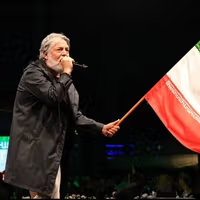
Tehran on Monday escalated its public warnings to Washington, mooting retaliation for any attack while dismissing US president Donald Trump's pledges to protect protestors even as reports emerged of quiet diplomatic outreach intended to avert war.

Senior Iranian officials used coordinated statements to signal resolve against any US attack amid Tehran's deadly crackdown on nationwide protests, portraying Trump’s warnings as both dangerous and unserious.

Parliament speaker Mohammad Bagher Ghalibaf said that any American attack would prompt a sweeping response across the region.

“We have heard that you have threatened Iran,” Ghalibaf told a state-sponsored rally in Tehran on Monday, addressing Trump directly. “The defenders of Iran will teach you an unforgettable lesson.”

“All American centers and forces throughout the region will be our legitimate targets in response to any potential adventurism,” he added. “Come and see how all your capabilities in the region will be wiped out.”

The warnings were echoed by security chief Ali Larijani, who downplayed Trump’s recent remarks linking possible US action to Tehran’s handling of the protests.

“Trump says things like this a lot. Do not take him seriously,” Larijani was quoted as saying by state-affiliated media. “The Iranian nation has shown that it intends to settle accounts with the United States and Israel.”

'Under control'

Iran’s foreign minister, Abbas Araghchi told a group of foreign ambassadors in Tehran on Monday that the situation in the country is “completely under control” but that Iran was ready for war if the United States did not engage in what it called fair talks.

Referring to Trump's warning about a possible attack on Iran if the killing of protesters continues, Araghchi said: “The Islamic Republic is not seeking war, but it is fully prepared for war.”

“The Islamic Republic is also ready for negotiations, but these talks must be fair, based on equal rights, and founded on mutual respect,” he added.

But the remarks came as Axios reported that Araghchi had reached out over the weekend to US Middle East envoy Steve Witkoff, citing two sources with knowledge of the matter.

According to the report, the outreach appeared aimed at de-escalating tensions or buying time amid growing concern in Tehran over potential US moves. One source said Araghchi and Witkoff discussed the possibility of holding a meeting in the coming days.

The contrasting signals reflect the bind facing Tehran as protests continue across the country, and Washington as it gauges various courses of action and their possible consequences.

An array of witness reports and videos reviewed by Iran International points to widespread use of lethal weapons to control dissenting crowds, killing at least 2,000 people across Iran since the protests began.

Digital blackout hits public, spares some state media in Iran

Jan 12, 2026, 16:46 GMT

Iran’s nationwide internet shutdown has completely cut off public access to online platforms since January 8, while many state-linked and security-affiliated media outlets have continued operating on Telegram.

Telegram channels linked to the Revolutionary Guards including Fars and Tasnim, as well as several state-funded outlets such as Mehr, SNN and the Farhikhtegan newspaper, have continued to update their Telegram channels regularly despite the shutdown, according to observations by Iran International.

The state broadcaster's news channel, IRIB News, has also continued posting updates. However, its news agency YJC updated its Telegram channel only during the first few days of the shutdown, until Saturday, and has remained inactive since then.

Meanwhile reformist newspapers Shargh, Etemad, and Hammihan, along with moderate platforms such as Khabar Online, have remained silent on Telegram during the blackout. Another moderate outlet, Asr-e Iran, however, has kept its channel active despite the shutdown.

While Iranian officials including the office of Supreme Leader Ali Khamenei and Foreign Minister Abbas Araghchi have made frequent posts on their Telegram channels, the Iranian government’s official news agency, IRNA, has remained silent since Thursday, when the nationwide digital blackout began in Iran.

In the early hours of the shutdown, many users in the Iranian diaspora expressed outrage after the office of Iran’s Supreme Leader continued to update its X account while much of the country was cut off from the outside world.

Rights groups warn Iran’s nationwide internet blackout is being used to shield lethal crackdowns on protesters, cutting off evidence of state violence as unrest continues across the country.

Cybersecurity expert Amin Sabeti told Iran International that the blackout has severed access to the global internet across much of the country and disrupted domestic online services that remained partially available during previous crackdowns.

“This is the most extreme internet shutdown we’ve ever had,” Sabeti said, adding that its scope signals a significant escalation in Tehran’s use of digital repression amid nationwide unrest.

While some users in Iran have been able to send videos and reports to Iran International through Starlink terminals, director of Washington operations for anti-censorship tool Psiphon says even Starlink uploads have been affected.

US President Donald Trump said on Sunday he will discuss with Starlink chief Elon Musk to provide internet access for Iranian protesters.

Iran revives loyalty rallies after deadly crackdown on protesters

Jan 12, 2026, 16:23 GMT
•
Hooman Abedi

Tehran on Monday conducted large pro-government rallies in several cities intended to counter the nationwide protests challenging its rule, in a strategy it has deployed against previous bouts of mass unrest ultimately crushed by deadly force.

The aim is not necessarily to convince skeptics, but to project an image of control and popular backing at a moment of visible strain.

After days of sustained demonstrations calling for the overthrow of the system, authorities organized counter-rallies in several cities on Monday, presenting them as popular condemnations of the protests themselves.

State television depicted the gatherings as mass denunciations of unrest, echoing official claims that the uprising was driven by “armed terrorists” and foreign adversaries.

100%

A familiar mobilization

The mechanics of the rallies followed a script many Iranians recognize. State bodies drew participants to central locations in Tehran and other major cities, relying on administrative pressure and access to public resources.

Coverage was then amplified by state television and media outlets affiliated with the Islamic Revolutionary Guards Corps.

In recent broadcasts, state outlets released a mix of ground-level footage and aerial images intended to convey scale. Some of the images show visible crowds, underscoring that the authorities retain a base of support.

It is difficult to determine precise numbers, the duration of the gatherings, or whether all images reflect live events from the same day. Similar visual techniques — including the reuse of footage or the circulation of undated aerial shots — have been employed during previous protest cycles.

Even taken at face value, the rallies appeared limited in duration and geographic spread.

By contrast, demonstrations opposing the government have persisted for weeks, erupting across hundreds of locations according to tallies compiled by activists and researchers, despite the risks involved.

The contrast is sharpened by the conditions under which each takes place: pro-government gatherings proceed under heavy security, while protesters have faced gunfire, mass arrests and lethal force.

100%

Information control as context

This round of rallies unfolded amid unusually severe restrictions on communication. For several consecutive days, internet connectivity across much of Iran has been sharply curtailed, according to digital rights groups and user reports, leaving millions unable to communicate freely or share information.

State and Guards-linked outlets, by contrast, have continued to publish without interruption. Agencies such as Tasnim, Fars and Mehr have maintained full access, flooding television and online platforms with official narratives.

The result is a highly asymmetric information environment. While ordinary citizens struggle to document events or verify developments, state-aligned media dominate the public space with curated imagery.

Under such conditions, rallies are presented largely on the authorities’ terms, with limited independent means to corroborate scale, timing or participation.

A recurring sequence

Similar state-organized rallies followed major protest movements in 2009, 2019 and 2022, each time presented as demonstrations of enduring legitimacy. In each case, they coincided with intensified security measures and tighter controls on dissent.

Evidence of the human toll has continued to surface despite efforts to restrict documentation.

Videos circulating online in recent days, which could not be independently verified, appeared to show bodies in a morgue in Kahrizak, with grieving relatives gathered nearby—imagery that contrasted sharply with official broadcasts of unity and resolve.

In a message released Sunday night, Reza Pahlavi described the moment as a new phase in what he called a national uprising, urging supporters to challenge the state’s control over information and public space.

What the competing images ultimately underscore is a question that spectacle alone cannot answer: how Iranian cities would look if opposing sides were able to assemble under comparable conditions.

The return to this familiar choreography comes as protests continue despite severe limits on communication, widespread arrests and the high personal cost of participation.

The repeated staging of loyalty rallies suggests not confidence, but the absence of other tools for demonstrating consent. Carefully framed images may circulate for a time, but they cannot indefinitely substitute for credibility rooted in broad public trust.

In the end, theater may delay recognition of a crisis, but it does not resolve one.

100%