• العربية
  • فارسی
Brand
  • Iran Insight
  • Politics
  • Economy
  • Analysis
  • Special Report
  • Opinion
  • Podcast
  • Iran Insight
  • Politics
  • Economy
  • Analysis
  • Special Report
  • Opinion
  • Podcast
  • Theme
  • Language
    • العربية
    • فارسی
  • Iran Insight
  • Politics
  • Economy
  • Analysis
  • Special Report
  • Opinion
  • Podcast
All rights reserved for Volant Media UK Limited
volant media logo

US curbs on Iranian diplomats prompt appeal to UN
Dec 11, 2025, 14:14 GMT+0Updated: 22:48 GMT+0
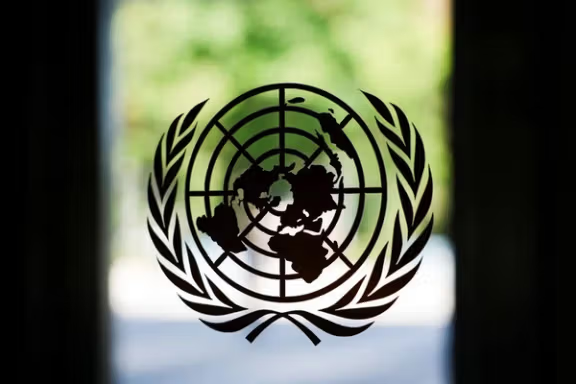
The United Nations emblem is seen through a window in this file photo

Iran has asked the United Nations to intervene after the United States expanded restrictions on the movement and activities of its diplomats, the foreign ministry said on Thursday.

Washington, Tehran said, had intensified restrictions on members of Iran’s mission, including banking hurdles and limits on routine purchases, after earlier curbs imposed during September’s UN General Assembly.

"The United States took action this week to impose maximum pressure on the Iranian regime by restricting their UNGA delegation’s movement and access to wholesale club stores and luxury goods," the state department said in a statement in September.

"We will not allow the Iranian regime to allow its clerical elites to have a shopping spree in New York while the Iranian people endure poverty, crumbling infrastructure, and dire shortages of water and electricity."

In the statement, the ministry said these measures were intended “to disrupt the normal and legal duties of Iranian diplomats.”

“The imposition of extensive restrictions on the residence and movement of Iranian diplomats, tightening restrictions on bank accounts, and imposing restrictions on daily purchases are among the pressures and harassment,” the ministry said.

Washington barred three mission staff

The ministry also criticized the US State Department for blocking continued work by three employees of Iran’s mission. It did not specify when the expanded limits began, though Iranian diplomats were previously permitted to travel only between the UN, their mission, the ambassador’s residence and John F. Kennedy International Airport.

The appeal comes after five rounds of indirect nuclear negotiations between Iran and the United States ended earlier this year. Those talks preceded a 12-day air war in June in which Israel and US forces struck Iranian nuclear sites, an escalation that deepened the diplomatic rupture.

The UN has not publicly addressed the request, but Tehran’s appeal signals mounting friction in an already strained diplomatic environment.


Most Viewed

Iran International says it won’t be silenced after London arson attack
1

Iran International says it won’t be silenced after London arson attack

2
VOICES FROM IRAN

Hope and anger in Iran as fragile ceasefire persists

3

Iran halts petrochemical exports to supply domestic market

4
INSIGHT

How Tehran bends its own red lines to boost state rallies

5

US arrests Iranian national over alleged Basij-linked visa fraud

Banner
Banner

Spotlight

  • Hardliners push Hormuz ‘red line’ as US blockade tests Iran’s leverage
    INSIGHT

    Hardliners push Hormuz ‘red line’ as US blockade tests Iran’s leverage

  • Ideology may be fading in Iran, but not in Kashmir's ‘Mini Iran'
    INSIGHT

    Ideology may be fading in Iran, but not in Kashmir's ‘Mini Iran'

  • War damage amounts to $3,000 per Iranian, with blockade set to add to losses
    INSIGHT

    War damage amounts to $3,000 per Iranian, with blockade set to add to losses

  • Why the $100 billion Hormuz toll revenue is a myth
    ANALYSIS

    Why the $100 billion Hormuz toll revenue is a myth

  • US blockade targets Iran oil boom amid regional disruption
    ANALYSIS

    US blockade targets Iran oil boom amid regional disruption

  • Iran's digital economy battered by prolonged blackout
    INSIGHT

    Iran's digital economy battered by prolonged blackout

•
•
•

More Stories

Iran's Khamenei suggests US moves on Venezuela aim at oil, land grab

Dec 11, 2025, 13:06 GMT+0

Iran’s Supreme Leader Ali Khamenei on Wednesday suggested a US pressure campaign on Venezuela aimed to seize its territory and oil wealth in lengthy diatribe against hegemony of Western countries.

The 86-year-old theocrat styles himself a divinely-appointed protector of the oppressed worldwide and his remarks were couched as a general description of how weaker nations are usurped by more powerful ones led by the United States.

Speaking at a ceremony marking the birth anniversary of Fatemeh Zahra — the daughter of the Prophet Mohammad and a revered figure in Shia Islam — Khamenei said the motives behind what he called hegemonic pressure differ across regions.

“Sometimes it is about expanding territory,” he said, pointing to “what the Americans are doing with some Latin American countries.”

Western designs can also aim at extracting commodities," he said. “They apply pressure so they can take a country’s underground resources — its oil, for example."

Iran's relationship with Washington and Western Europe is at a low ebb since the United States joined a surprise Israeli military offensive against the country in June.

Britain, France and Germany then triggered the reimposition of international sanctions which have throttled Iran's already ailing economy.

Khamenei’s remarks came a day after the United States seized a Venezuela-linked tanker accused of transporting sanctioned Iranian and Venezuelan oil.

Washington says the tanker was part of a network tied to Hezbollah and Iran’s Revolutionary Guards.

Iran’s embassy in Caracas condemned the operation as an illegal act, calling it “robbery in the Caribbean Sea” and a violation of international maritime law.

US forces have mounted the largest buildup of forces in the Caribbean since the 1962 Cuban missile crisis and President Donald Trump has suggested the policy aims at the removal of leftist populist President Nicolas Maduro and has vowed attacks on land.

US air strikes on alleged drug boats in the region have killed at least 87 people.

'Hearts and minds'

Khamenei added that Western states also push to “reshape cultural and religious life,” often by influencing lifestyles and social norms through media. “They try to change how people live, think and believe,” he said.

But he said the most consequential objective is what he described as an engineered identity transformation. “More fundamental than all of these is the effort to change a nation’s identity,” he said.

Iranian officials accuse the West of seeking to foment sedition and rebellion in the country including by fomenting opposition to mandatory veiling laws for women.

The death of a young woman, Mahsa Amini, in morality police custody in 2022 led to nationwide protests dubbed the Woman, Life, Freedom movement which were quashed with deadly force.

Khamenei added that attempts to alter Iran’s cultural and religious foundations stretch back a century. “For a hundred years they have tried to rewrite who we are — our religion, our history, our culture,” he said. “The Islamic Revolution cleared that away, but the pressure continues. And resisting this pressure is essential.”

Khamenei said Iran is progressing despite economic and political pressures. “By God’s grace, the Islamic Republic is moving forward,” he told the audience of religious reciters. He said Iranians continue to show the world that Islam stands for “steadfastness, strength, honesty and justice.”

He also said the country faces a sustained “media and propaganda war” aimed at undermining public morale. “The enemy learned it cannot gain this land through military pressure,” he said. “So it turned to changing hearts and minds. We are standing firm, but the threat is real.”

Iran president’s office says unrestricted internet access will be revoked

Dec 11, 2025, 10:11 GMT+0

Iran’s presidential chief of staff said the government has begun revoking all forms of unfiltered internet access granted to select users – including senior officials – as scrutiny intensifies over privileged connections unavailable to the general public.

The change is already underway and applies to “everyone who uses such lines,” Mohsen Haji-Mirzaei told reporters on Thursday. Any revision of national filtering policy, he added, lies exclusively with the Supreme Cyberspace Council, not the Supreme National Security Council. “The council decided on filtering, and the council must decide on changes,” he said.

Unequal access exposed by platform updates

Iran maintains some of the world’s strictest online controls, blocking X, Facebook, YouTube, Telegram and WhatsApp for ordinary users, who rely on unstable VPNs frequently disrupted by authorities.

But recent updates on X revealed that several lawmakers, government spokespeople and pro-government media figures were posting from inside Iran without VPNs. The disclosures pointed to their use of government-issued unrestricted mobile lines, often referred to domestically as “white SIMs,” which bypass national filtering and throttling systems.

The revelations triggered widespread public anger, highlighting a stark digital divide between citizens and officials at a time when President Masoud Pezeshkian had campaigned on restoring open access.

His administration has yet to lift filtering; in his first meeting of the Supreme Cyberspace Council, Pezeshkian instead stressed implementing the Supreme Leader’s directives on internet governance and ordered action against the thriving VPN market.

Limited room for reform

Asked whether cabinet members would also lose their privileged access, Haji-Mirzaei replied: “Anyone who has such a line.” The council, he said, had set conditions for reconsidering filtering and that preparatory work was underway.

The shift follows weeks of public backlash over unequal access, showing how the administration has so far failed to deliver on its pledge to ease restrictions within Iran’s tightly controlled online system.

Iran reports rising flu deaths as hospitals come under strain

Dec 11, 2025, 09:19 GMT+0

A fast-spreading wave of H3N2 influenza has left hospitals across Iran under pressure, with more than 100 deaths reported since mid-November – most involving unvaccinated patients, health authorities said on Thursday.

The current strain shows unusual transmissibility and reduced vaccine effectiveness, driving a surge in clinic visits, health ministry spokesman Hossein Kermanpour said. He noted that elderly people, those with underlying conditions and several children were among the dead. Officials expect the wave to continue into January.

Schools shut as infections climb

Rapid spread among students prompted school closures in late November across several provinces. Authorities in Isfahan said the move was driven by rising infections rather than air pollution.

Concern grew further on December 4 after the confirmed death of a 26-year-old man with no pre-existing conditions. He developed 70-percent lung involvement and acute respiratory distress syndrome within 24 hours. Health officials in the southern Hormozgan province described the case as evidence of “intense viral circulation” and aggressive disease even in low-risk groups.

Authorities in the central Yazd province have reported 1,138 positive tests and 13 deaths, mostly among older adults and vulnerable patients.

100%

Pollution amplifies the crisis

The outbreak coincides with severe air pollution in major cities. Specialists say pollutants such as PM2.5 weaken the lungs and suppress immune responses, making people “far more vulnerable” to influenza. Global studies show dirty air can increase hospitalization and mortality from flu by 15 to 30 percent.

Infectious-disease expert Minoo Mohraz warned that influenza is “gradually becoming a pandemic” and could worsen death rates, adding that air pollution has “no immediate solution except staying indoors as much as possible.”

Daily burials in Tehran’s main cemetery have risen from 180 to about 220, Mehdi Babaei of Tehran’s city council said, linking the increase to soaring pollution levels.

Armed group claims deadly attack on Guards members in southeast Iran

Dec 11, 2025, 09:08 GMT+0

A Baluch armed group said it carried out an attack on Iran's Revolutionary Guards personnel near Zahedan, a day after Iranian state media reported that several members had been killed during a border security mission in the restive southeast.

Haalvsh, a rights group that documents abuses and unrest in Sistan-Baluchestan, said the Jebhe-ye Mobaarezin-e Mardomi (People’s Fighters Front) claimed responsibility in a statement posted overnight. The group said it targeted a convoy of the IRGC’s Imam Hossein battalion, part of the Salman Brigade, in the Lar district on Wednesday.

A spokesman for the group said the attack was meant as retaliation for what it described as the role of security forces in suppressing residents in Sistan-Baluchestan. He said a vehicle carrying the unit’s commander was struck and that four members were killed and several others wounded.

State-linked media initially reported three dead and three wounded but later said the death toll had risen to four. Haalvsh cited local sources as saying the gunfire occurred as several IRGC vehicles were heading toward their base in the Lar area.

Iran’s southeast, bordering Pakistan and Afghanistan, has long experienced armed attacks on security forces and government sites. The region has seen repeated incidents this year, including a major assault on a courthouse in Zahedan earlier in which nine people were killed. A separate Baluch Sunni militant group, Jaish al-Adl, claimed responsibility for that attack.

Authorities said pursuit operations were underway following Wednesday’s shooting, but have released few details so far.

Iran says three satellites to launch from Russia on December 28

Dec 11, 2025, 07:45 GMT+0

Three Iranian satellites will be launched aboard a Russian Soyuz rocket from the Vostochny Cosmodrome on December 28, Iran’s Nour news agency reported, marking another step in Tehran’s expanding space program.

Nour News, linked to Iran's security establishment, said the satellites will support agriculture, natural resources management and environmental monitoring. Russia last carried an Iranian-made telecommunications satellite into orbit in July.

The announcement follows comments last month by Hassan Salarieh, head of the Iranian Space Agency, who said Iran is preparing to launch three Earth-observation satellites — Zafar-2, Paya and a new batch of Kosar imaging satellites — and conduct its first test launch from the new Chabahar Space Center.

Salarieh said Iran had advanced to developing satellites with imaging resolutions of one meter and below, and described Chabahar, a coastal site in the southeast, as an emerging launch hub able to support heavier liquid-fuel rockets.

He said the center would eventually serve as Iran’s main space gateway, with a position suited for placing satellites into sun-synchronous and geostationary orbits. Iran has also signed private-sector contracts for satellite constellations and highlighted recent launches aboard Russian rockets.

Iran says its space program is civilian and scientific, though Western governments argue that technologies used for satellite launches can support long-range missile development. President Masoud Pezeshkian has said Iran’s missile and space capabilities bolster national deterrence.