• العربية
  • فارسی
Brand
  • Iran Insight
  • Politics
  • Economy
  • Analysis
  • Special Report
  • Opinion
  • Podcast
  • Iran Insight
  • Politics
  • Economy
  • Analysis
  • Special Report
  • Opinion
  • Podcast
  • Theme
  • Language
    • العربية
    • فارسی
  • Iran Insight
  • Politics
  • Economy
  • Analysis
  • Special Report
  • Opinion
  • Podcast
All rights reserved for Volant Media UK Limited
volant media logo

Iran says bombed nuclear sites present radiation risk
Dec 8, 2025, 09:45 GMT+0Updated: 23:13 GMT+0
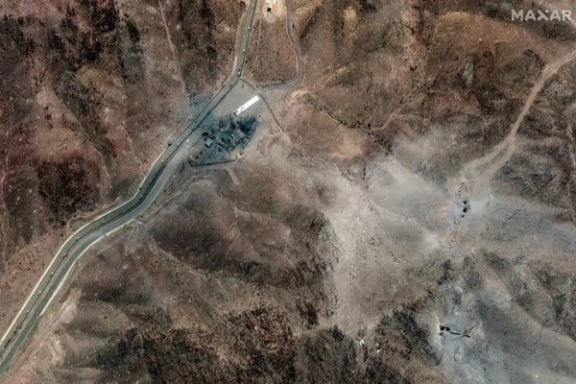
Satellite image of the Fordow nuclear facility after the US strike

Iran’s foreign minister Abbas Araghchi says there is a risk of radiation release at nuclear facilities bombed during the 12-day war in June, contradicting earlier assurances from Tehran.

In an interview with Japan’s Kyodo News on Sunday, Araghchi said strikes on Iran’s nuclear facilities had created serious dangers, including possible radiation exposure and unexploded ordnance.

“We are now facing security threats and safety concerns,” he said.

Following the joint US-Israeli attacks, Iranian authorities refused to evacuate surrounding towns and repeatedly dismissed public fears.

In late June, deputy health minister Alireza Raeisi said enrichment “does not involve nuclear fission” and therefore cannot generate harmful radiation, adding that measurements around Natanz and Fordow showed the areas were completely safe.

The International Atomic Energy Agency (IAEA) likewise reported in June that it had detected no radiation increase around Natanz.

Conditional openness to new talks

Before the 12-day conflict, Tehran and Washington held five rounds of talks that broke down over Iran’s refusal to end domestic enrichment as demanded by US President Donald Trump.

Tehran, Araghchi said, could restart talks with Washington “as soon as they accept a logic of confidence-building” that trades sanctions relief for restrictions on Iran’s nuclear program.

He insisted any framework must recognize Iran’s “right to enrichment.”

Iran, Araghchi added, is prepared to accept supervisory mechanisms “beyond the NPT” and time-limited limits on enrichment levels and centrifuge types, recalling that Tehran had accepted the 3.67-percent cap for 15 years under the JCPOA.

Still, Araghchi told Kyodo News that Iran cannot currently allow the resumption of IAEA inspections halted after the war because no protocol or guideline exists for inspectors entering damaged facilities.

IAEA director general Rafael Grossi has said most of Iran’s enriched-uranium stockpile is being kept at sites in Isfahan, Fordow and Natanz where inspectors lack access, and warned in October that monitors had observed activity around storage locations.

US officials under President Trump have demanded zero enrichment, dismantling of proxy forces and limits on Iran’s missile program – terms Tehran calls unacceptable.


Most Viewed

100 days after carnage: Iran economy reels from war, inflation, unemployment
1
INSIGHT

100 days after carnage: Iran economy reels from war, inflation, unemployment

2
INSIGHT

Ghalibaf defends Iran-US talks amid hardline backlash

3
EXCLUSIVE

Iranian assaulted in London amid concern over threats to regime critics

4

IRGC fires at Indian vessel in Hormuz

5
INSIGHT

A nation in limbo: 100 days after the massacre, has the world moved on?

Banner
Banner

Spotlight

  • War-hit homeowners feel abandoned as Iran’s reconstruction aid fades

    War-hit homeowners feel abandoned as Iran’s reconstruction aid fades

  • 100 days on: the anatomy of Iran’s January crackdown
    INSIGHT

    100 days on: the anatomy of Iran’s January crackdown

  • Ghalibaf defends Iran-US talks amid hardline backlash
    INSIGHT

    Ghalibaf defends Iran-US talks amid hardline backlash

  • 100 days on: why Iran’s January protests spread across social classes
    ANALYSIS

    100 days on: why Iran’s January protests spread across social classes

  • From instability to influence: Pakistan’s pivotal role in US-Iran diplomacy
    ANALYSIS

    From instability to influence: Pakistan’s pivotal role in US-Iran diplomacy

  • A nation in limbo: 100 days after the massacre, has the world moved on?
    INSIGHT

    A nation in limbo: 100 days after the massacre, has the world moved on?

•
•
•

More Stories

US, Israel kick off joint naval drills aimed at regional threats

Dec 7, 2025, 19:14 GMT+0

The US and Israeli naval forces on Sunday launched their annual joint wargames aimed at countering threats in the Middle East, the Israeli military said, two days after Iran’s naval forces held similar drills in the Persian Gulf.

The week-long drills, codenamed the Intrinsic Defender, are held between the Israeli Navy and the US Navy’s 5th Fleet, according to an Israel Defense Force (IDF) statement.

“The purpose of the exercise is to strengthen strategic and operational cooperation between the two navies and practice dealing with various regional threats,” the IDF added.

The wargames, which were also held in 2022 and 2023, came shortly after two-day naval drills by Iran's Revolutionary Guards in the Persian Gulf, Sea of Oman and Strait of Hormuz which started on Thursday.

Tehran said the exercise was a “display of active presence and a warning to foreign fleets, especially the American warships in the region."

On the first day of the drills, IRGC naval units issued a warning to foreign vessels to deliver their firm message against any potential violation, according to state media.

Iran also tested a new unnamed missile with a range exceeding the length of the Persian Gulf, the commander of the IRGC Navy said without specifying the exact distance.

On Monday, US President Donald Trump and Israeli Prime Minister Benjamin Netanyahu discussed regional issues including Iran, CNN reported, as Israeli defense officials warned that a renewed conflict was possible.

Israeli media cited Israeli Defense Ministry Director-General Amir Baram as saying that the country is developing more new technologies to prepare for the next potential war against Iran.

"Enemies are learning and adapting. We are at a pivotal point before a new paradigm takes place," the Jerusalem Post quoted Baram as saying at the International DefenseTech Summit in Tel Aviv on Monday.

“Iran’s rapid force buildup in air defense and ballistic missile capabilities,” driven by “its extremist ideology” means that “all fronts are still open” and the Israeli military must be ready for another conflict, Baram said according to the Jerusalem Post.

Israel may hit Iran next year if enrichment resumes – Al-Monitor

Dec 7, 2025, 12:03 GMT+0

Israel may strike Iran within the next year if it concludes Tehran is moving to restore high-level uranium enrichment, European diplomats told Al-Monitor on Saturday.

One Western diplomat said a new campaign would be “short and intense” but strategically limited. “Iran will evidently retaliate with a missile launch, perhaps hitting buildings the way it did last time,” the diplomat said, adding that the fundamental balance of power would remain unchanged.

Enrichment described as the main red line

The current post-war equilibrium is deeply unstable, Raz Zimmt of the Institute for National Security Studies told Al-Monitor. Israel, he added, has yet to define precise red lines on Iran’s ballistic missile program, but a return to enrichment, weaponization work or attempts to recover the roughly 408 kilograms of uranium enriched to 60 percent believed lost in the June attacks would almost certainly trigger a response.

“The more time passes without the United States and Iran reaching a nuclear agreement, the more likely a new round of conflict becomes,” Zimmt said.

Stalled diplomacy and Iranian pressure

Iran is rebuilding its air defenses, missile systems and protective measures around nuclear sites – a process Zimmt said could continue for up to a year without prompting an Israeli strike. But he warned Iran is effectively stuck in a “no war, no peace” posture, a phrase invoked by Supreme Leader Ali Khamenei, with sanctions eroding the economy while enrichment remains constrained.

Khamenei’s recent remark that the US is “not worthy” of engagement has further complicated prospects for diplomacy. Israeli officials argue any future US-Iran deal must cap enrichment at 3.67 percent, restore intrusive inspections and resolve the fate of the missing enriched uranium. Without those terms, some say, sanctions relief would be unjustified.

Zimmt noted Washington shows little urgency. Trump, he said, appears convinced the 2025 strikes destroyed Iran’s program – a view that reduces US pressure and leaves Israel preparing for what it sees as an increasingly likely confrontation.

Iran's top lawmaker warns GCC over disputed Persian Gulf islands

Dec 7, 2025, 07:55 GMT+0

Iran’s parliament speaker on Saturday condemned a GCC statement rejecting Iranian sovereignty over three Persian Gulf islands, warning that neighbors should not test the Iranian people's will to defend their territorial integrity.

Mohammad Bagher Ghalibaf said the GCC position repeated in the bloc’s closing communiqué after its Bahrain summit on Wednesday relied on “baseless and absurd claims encouraged by outside actors.”

Such language, he said, violated principles of territorial respect and good-neighborliness.

The GCC statement reiterated its backing for the United Arab Emirates, which claims Greater Tunb, Lesser Tunb and Abu Musa – territories controlled by Iran since 1971, when the Shah’s government took over the islands following Britain’s military withdrawal.

Tehran rejects any challenge to its sovereignty, and figures across Iran’s political spectrum oppose UAE claims.

Long-running dispute resurfaces

The islands issue has become a standard feature of GCC ministerial meetings and joint statements with partners including the EU and China. These declarations routinely “support UAE efforts” to resolve the dispute and encourage negotiations or referral to the International Court of Justice.

Iran typically answers such communiqués with statements and diplomatic protests. It summoned EU representatives after the bloc issued similar language in October, and lodged objections with Beijing in 2024 when China echoed the call for a “peaceful settlement.”

The territories, Ghalibaf said, were “pieces of Iran’s body,” urging regional states to avoid actions that could escalate tensions.

Although the three islands remain the core flashpoint, a newer dispute over the Arash/Durra gas field has entered GCC statements.

Kuwait and Saudi Arabia assert joint ownership, while Iran maintains overlapping claims, adding another layer of friction to an already crowded Persian Gulf maritime file.

EU, US press tech giants to facilitate Iranians’ access to free internet

Dec 6, 2025, 21:08 GMT+0

Members of the European Parliament and the US Congress have urged major technology companies to strengthen support for secure, uncensored internet access in Iran, citing a surge in digital repression and discriminatory access systems, Euronews reported.

In a letter addressed to Google, Meta, YouTube and Amazon Web Services, the European Parliament’s Delegation for Relations with the Iranian People warned that Iran’s widening use of AI-driven surveillance, recurrent shutdowns and a “white SIM card” scheme for officials had created a two-tier digital system isolating ordinary citizens.

The Iranian government enforces some of the world’s toughest online restrictions, blocking platforms such as X (formerly Twitter), Facebook, YouTube, WhatsApp, and Telegram for the general public. Most people rely on slow, unreliable VPNs that authorities routinely disrupt.

By contrast, X's new location feature recently revealed that select users receive government-issued SIM cards or whitelisted connections to bypass national filtering and throttling altogether.

The issue drew wide attention over the past few weeks, when the X feature revealed numerous pro-government figures were posting from inside Iran without VPNs – despite long claiming they used the same circumvention tools as ordinary citizens.

The disclosures triggered heavy public criticism, with many describing the system as “digital apartheid” or a “caste-based internet” that rewards political loyalty and entrenches inequality.

EU says firms must bolster anti-censorship tools

Hannah Neumann, who chairs the EU delegation, said a free internet remains the only barrier against propaganda and intimidation. “Technology companies are the guardians of this freedom, and now is the time to take their responsibility seriously,” Neumann said, according to a copy of the letter obtained by Euronews.

She added that companies were capable of measures that “ensure these voices are not silenced.”

Deputy chair Bart Groothuis said digital repression had become central to Iran’s authoritarian model. “By supporting tools to circumvent filters, we can improve secure communication and give Iranians access to the free internet,” he said.

The letter urged firms to fund open-source VPN and censorship-bypass projects, expand encrypted communication features and develop in-app proxies to keep users connected during outages. It also asked Amazon Web Services and human-rights–oriented VPN providers to offer free or discounted server space to stabilize services for Iranian users.

European legislators pressed Google to continue backing Jigsaw, Outline VPN and its SDK, and to consider integrating these tools into major apps. Meta was asked to embed filter-bypass technologies into Instagram, Facebook and Threads. Companies were also urged to provide simple procedures for appealing blocked accounts and to increase cooperation with digital-rights groups.

A young man plays a computer game in an Iranian internet cafe in this file photo.
100%
A young man plays a computer game in an Iranian internet cafe in this file photo.

US lawmakers pursue parallel push

In Washington, lawmakers introduced the FREEDOM Act on Thursday, which would require the secretary of state, the FCC and the Treasury to assess technologies capable of supporting unfiltered internet access for Iranians.

Representative Claudia Tenney highlighted the potential of satellite-to-mobile systems that could “bypass the limitations of censorship and government networks.” The feasibility review will also evaluate UAV-based platforms and counter-jamming tools.

Representative Dave Min, whose district includes a large Iranian-American community, said promoting internet freedom strengthens global family ties while confronting authoritarian practices.

IRGC Navy chief says new missile tested has range beyond Persian Gulf

Dec 6, 2025, 11:16 GMT+0

The commander of Iran’s Revolutionary Guard Navy said a new missile tested during this week’s naval exercises has a range exceeding the length of the Persian Gulf, without specifying the exact distance.

“The Persian Gulf is 1,375 kilometers long – this missile’s range is beyond that,” Rear Admiral Alireza Tangsiri said in an interview with state television. He added that the weapon, built by the IRGC Navy, is fully indigenous and “can be guided after launch.”

His remarks came as the IRGC carried out the second phase of its naval drill, which began Thursday with ballistic and cruise missile fire at targets in the Oman Sea. State media said the exercise also included drone operations and air defense maneuvers around the Strait of Hormuz and Iran’s southern islands.

Tangsiri said all weapons used in the drill were domestically made, including a new ballistic missile with “very high precision.” “Our enemies have seen its accuracy,” he said.

Iran’s missiles have a declared range of up to 2,000 kilometers, which officials say is sufficient for deterrence and covers Israel. The United States and its allies have called on Tehran to restrict missile development to under 500 kilometers, a demand Iran has repeatedly rejected.