• العربية
  • فارسی
Brand
  • Iran Insight
  • Politics
  • Economy
  • Analysis
  • Special Report
  • Opinion
  • Podcast
  • Iran Insight
  • Politics
  • Economy
  • Analysis
  • Special Report
  • Opinion
  • Podcast
  • Theme
  • Language
    • العربية
    • فارسی
  • Iran Insight
  • Politics
  • Economy
  • Analysis
  • Special Report
  • Opinion
  • Podcast
All rights reserved for Volant Media UK Limited
volant media logo

Iran’s drug squeeze hits transplant care as key anti-rejection pill runs out

Dec 1, 2025, 11:34 GMT+0
A patient lies on a bed at Masih Daneshvari Hospital in Tehran on December 1, 2025, as unhealthy air pollution strains vulnerable groups

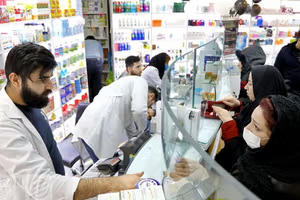
Iran is facing a fresh shortage of the brand-name anti-rejection drug Myfortic with pharmacies halting distribution in several cities and clinicians warning that forced switches to substitutes could endanger a minority of kidney-transplant patients.

Patients in Mashhad said rations shrank from two months to one week before stocks of the drug (mycophenolic acid 360 mg) “fell to zero,” with pharmacists advising a move to domestically made equivalents, the ILNA news agency reported.

Fatemeh Pour-Rezagholi, secretary of Iran’s Kidney Transplant Scientific Association, said originator-brand supplies have not been distributed recently, citing foreign-exchange constraints, sanctions-related frictions and customs delays.

She added that Iranian versions are available and effective for most patients, but unplanned brand changes can be stressful or risky for those early post-transplant or with prior rejection. Importers have indicated the original brand may return later in winter, according to ILNA.

Doctors and pharmacists told ILNA that 70-80% of recipients tolerate domestic formulations, but roughly 10-20% may require a specific brand or closer therapeutic-drug monitoring.

Patient groups and clinicians are urging clearer import timetables, steadier FX allocation for critical transplant drugs and contingency guidance to minimize unplanned switches.

Clinicians say the fiscal and human costs are far higher if grafts fail and patients return to dialysis, and have asked regulators to protect a baseline of imports for high-risk cases while stabilizing domestic supply for the majority.

US sanctions policy formally exempts most medicines and many medical devices, with humanitarian channels – such as Switzerland’s state-backed payment mechanism – designed to process vetted transactions.

In practice, suppliers and aid groups say persistent “over-compliance” by global banks, shippers and insurers fearful of sanctions risk, which can delay or block payments, shipments and insurance even for lawful medical goods.

Economists also point to the rial’s volatility and domestic pricing and procurement rules as recurring hurdles that raise import costs and complicate supply planning.

According to Mehr News on Monday, Iran has raised medicine prices several times in recent months under a “realistic pricing” policy meant to support the domestic pharmaceutical industry, but insurance coverage has not kept pace – leaving patients to shoulder a growing share of drug costs as reimbursements lag behind the hikes.

Most Viewed

Hardliners push Hormuz ‘red line’ as US blockade tests Iran’s leverage
1
INSIGHT

Hardliners push Hormuz ‘red line’ as US blockade tests Iran’s leverage

2

Iran International says it won’t be silenced after London arson attack

3
VOICES FROM IRAN

Hope and anger in Iran as fragile ceasefire persists

4

US sanctions oil network tied to Iranian tycoon Shamkhani

5

Iran halts petrochemical exports to supply domestic market

Banner
Banner

Spotlight

  • Hardliners push Hormuz ‘red line’ as US blockade tests Iran’s leverage
    INSIGHT

    Hardliners push Hormuz ‘red line’ as US blockade tests Iran’s leverage

  • Ideology may be fading in Iran, but not in Kashmir's ‘Mini Iran'
    INSIGHT

    Ideology may be fading in Iran, but not in Kashmir's ‘Mini Iran'

  • War damage amounts to $3,000 per Iranian, with blockade set to add to losses
    INSIGHT

    War damage amounts to $3,000 per Iranian, with blockade set to add to losses

  • Why the $100 billion Hormuz toll revenue is a myth
    ANALYSIS

    Why the $100 billion Hormuz toll revenue is a myth

  • US blockade targets Iran oil boom amid regional disruption
    ANALYSIS

    US blockade targets Iran oil boom amid regional disruption

  • Iran's digital economy battered by prolonged blackout
    INSIGHT

    Iran's digital economy battered by prolonged blackout

  • Iran faces looming medicine shortages as UN sanctions strain drug supply chains

    Iran faces looming medicine shortages as UN sanctions strain drug supply chains

  • Iran drug and medical costs surge 70% after subsidy removal

    Iran drug and medical costs surge 70% after subsidy removal

•
•
•

More Stories

Iran diesel extremely high in sulfur, high-grade gasoline mixed with inferior fuel

Nov 30, 2025, 11:44 GMT+0

Iran’s diesel contains sulfur levels up to 15,000 parts per million (PPM), far above the global standard of 10 PPM, a senior industry representative said, warning that poor-quality fuel is contributing to severe air pollution in major cities.

Hamid Hosseini, spokesperson for the Union of Petroleum Products Exporters, told Didban Iran on Sunday that even Afghanistan does not permit diesel above 2,000 PPM. He said Iran must invest in desulfurization technology to meet international standards.

“Our diesel has about 10,000 to 15,000 PPM of sulfur, while the global standard is 10,” he said.

Hosseini said Iran has the technical ability to produce Euro-4 and Euro-5 standard gasoline, but high domestic consumption leaves the oil ministry little choice but to distribute lower-octane fuel.

High-quality gasoline produced at some refineries is mixed with lower-quality batches before reaching the distribution network, he added.

He said pollution is also driven by aging vehicles and heavy diesel use in urban areas.

Nearly half of Iran’s 20 million registered cars are classified as old or high-emitting, while about four million motorcycles operate in Tehran alone.

Hosseini said Iran consumes roughly 120 million liters of gasoline per day and that scrapping older vehicles could significantly reduce both fuel use and emissions.

He added that sanctions have also limited investment in refinery upgrades, affecting the country’s ability to consistently produce cleaner fuel.

Tehran police detain several prominent actors at birthday party

Nov 30, 2025, 09:38 GMT+0

Iranian police detained more than 20 people during a raid on a birthday party at a film star’s home in Tehran and seized 38 liters of homemade alcohol, Iranian media reported.

Iran International learned that actors Parsa Pirouzfar and Ali Shadman, and actresses Setareh Pesyani and Sahar Dowlatshahi were among more than 20 guests detained.

Shadman and Pesyani remain in custody, with cases opened in Tehran’s Ershad (morality) prosecutor’s office against Shadman and six others on charges including “violating public decency, promoting vice, drinking alcohol, and possession of alcoholic beverages,” according to people familiar with the matter.

Sources said Pirouzfar was taken to hospital after the raid.

Several detainees were released later on undertakings or bail, while separate files were opened for other guests, many from the theater community.

  • Forbidden but flowing: alcohol slips quietly into public life in Iran

    Forbidden but flowing: alcohol slips quietly into public life in Iran

  • Inside Tehran’s nightlife: a hidden world of dance, drinks and defiance

    Inside Tehran’s nightlife: a hidden world of dance, drinks and defiance

  • No taste, no memory: rape drugs are quietly on the rise in Iran

    No taste, no memory: rape drugs are quietly on the rise in Iran

There was no immediate comment from Tehran police or the judiciary on the reported detentions.

Alcohol is banned in Iran and violations carry fines, lashings or prison, with stiffer penalties for production and distribution. The prohibition dates to 1979, but homemade brewing and smuggling have created a steady underground supply. Rights groups and health officials report periodic mass poisonings from counterfeit liquor.

Despite the ban, discreet drinking has edged into some public venues. Iranian and state‐affiliated outlets have acknowledged “secret menus” at a handful of restaurants and cafés, where beer or spirits are served under code names or in disguised containers.

  • Iran Escalates Crackdown on Cafes Serving Alcohol Secretly

    Iran Escalates Crackdown on Cafes Serving Alcohol Secretly

  • Iran shuts down Tehran cafe over alcohol use and dancing

    Iran shuts down Tehran cafe over alcohol use and dancing

Prosecutors and police regularly announce raids and closures for serving alcohol, mixed-gender dancing or hijab violations, part of wider morality crackdowns.

Authorities have stepped up enforcement over the past two years, sealing cafés in Tehran and other cities and publicizing arrests.

Officials say tougher action is needed to deter bootlegging and to uphold Islamic codes. Critics counter that decades of prohibition have pushed consumption into riskier, unregulated channels.

Iran seizes Eswatini-flagged vessel for alleged fuel smuggling

Nov 30, 2025, 08:15 GMT+0

Iran’s Islamic Revolutionary Guard Corps (IRGC) navy said it had seized an Eswatini-flagged vessel in the Persian Gulf carrying about 350,000 liters of smuggled gasoil, according to state-linked media.

Heydar Honarian-Mojarrad, commander of the IRGC Navy’s Second Naval Zone, said the ship was detained under a judicial order and escorted to the coast of Bushehr for offloading, adding that its 13 crew members were from India and a neighboring country.

Iran, which keeps domestic fuel prices low through subsidies and has seen its currency weaken, regularly announces interceptions of boats accused of moving contraband fuel by sea to Persian Gulf states and by land to neighboring countries.

No details were given on the vessel’s ownership, its last port of call, or the timeline of the operation. Authorities did not specify the fate of the crew beyond the seizure.

The announcement follows other recent actions. On Saturday, authorities near the island of Kish said two vessels carrying a combined 80,000 liters of smuggled fuel were stopped under a judicial order, with prosecutors saying the boats had been modified with extra deck tanks to spirit fuel out of the country.

Officials said they would continue operations against trafficking networks that profit from steep price gaps with neighboring states.

Earlier this month, the IRGC said it had seized a Marshall Islands–flagged tanker off the Makran coast in the Gulf of Oman, after maritime security firms reported a ship being diverted toward Iranian waters by small craft.

Tehran says such operations are conducted under court orders to prevent illegal fuel or cargo transfers. Western officials and shipping sources have accused Iran of at times using maritime enforcement to gain leverage in regional and sanctions-related disputes.

Iran’s coastline and the Strait of Hormuz lie astride one of the world’s busiest energy corridors. Iranian forces have increased patrols there, describing the moves as efforts to safeguard national interests and curb smuggling.

Iran warns Isfahan’s drying river and wetland at ‘point of no return’

Nov 30, 2025, 07:14 GMT+0

Prolonged drought and the halt to permanent flows in the Zayandeh-Roud river have driven land subsidence and the Gavkhouni wetland toward an apparent point of no return, raising risks to Isfahan’s drinking-water supply, a provincial environmental official said.

“The continued drying and the cut in permanent flows have brought land subsidence and the death of Gavkhouni to a point of no return and even put drinking water on the threshold of threat,” said Dariush Golalizadeh, the provincial environment department chief.

“The Zayandeh-Roud played a key role in recharging aquifers and preventing subsidence. With multi-year drought and sharply reduced inflows, alongside heavier pumping from wells and wastewater use, subsidence has intensified alarmingly.”

Golalizadeh said the internationally listed Gavkhouni wetland downstream of Isfahan is turning into a dust hotspot. “When the wetland falls apart, it means there are serious problems in water and land management above it.”

  • Isfahan official warns of drinking water crisis within 45 days

    Isfahan official warns of drinking water crisis within 45 days

He linked the ecological stress to livelihoods, saying orchards, urban green spaces and farmers have been hit across the basin. Authorities are now working on support programs for Isfahan’s eastern districts to soften the blow to agriculture, he said.

The official urged emergency measures to keep minimum flows to the river and wetland.

“At present, because of the sharp drop in river yield, drinking water is under threat,” he said. “We are looking to other sources, but rising temperatures and drought have cut inflows to a minimum.”

'Hyped heroism': Iran's state TV draws fire with wartime presenter film

Nov 29, 2025, 21:09 GMT+0
•
Behrouz Turani

The decision by Iran’s state broadcaster to produce a film about a female presenter whose image went viral when Israeli missiles hit its headquarters has sparked a wave of criticism and accusations of political propaganda.

The planned feature, Re-Birth, casts actress Atefeh Habibi as Sahar Emami—presented by state media as a symbol of defiance during Iran’s 12-day war with Israel in June.

Emami was on air when IRIB’s Glass Building in Tehran was bombed on June 16. She rushed out of the studio but returned to present from another set within minutes.

“(She) bravely continued her program after the attack,” the film’s promoter asserted Thursday, branding her a hero.

But many remain unconvinced, accusing the broadcaster of glossing over “real heroes” and victims of the war.

'Propaganda’

“Making a film about Sahar Emami is not a cultural choice. It is a propaganda project,” a commentary in the moderate outlet Rouydad24 argued.

“What is it that makes her stand out from all others?” it asked, offering a characteristically factional answer: “It is easy propaganda that conveys their ideological perspective,” referring to IRIB’s leadership and its ties to the ultrahardline Paydari Front.

The commentary also criticised the lack of scrutiny of the broadcaster itself.

In the days after the attack, state TV filled its programming with tributes to Emami, sponsored billboards across Tehran, and received praise from senior officials—including Supreme Leader Ali Khamenei—for her “bravery.”

Critics said the network was exploiting the incident to deflect attention from its declining viewership.

Dwindling popularity

IRIB holds a legal monopoly over broadcasting in Iran; private television networks are not permitted.

In recent years, however, a proliferation of digital platforms—often backed by different branches of the state or powerful institutions—has begun to challenge that dominance in entertainment.

In news, IRIB’s audience has been shrinking for years, with Persian-language broadcasters in exile becoming the main source of information for most people inside Iran.

An official survey in late 2024 put IRIB’s popularity at just 12.5%, while the head of its internal polling unit claimed it was closer to 72%, adding the figure “could have been higher if, like elsewhere in the world, Generation Z had not turned away from national television.”

A survey by the Netherlands-based polling institute GAMAAN also found that only a small minority of Iranians tuned in to IRIB during and after the June war with Israel.

The broadcaster’s chief has since requested additional funding to rebuild the damaged headquarters, saying rubble will be cleared by January with reconstruction to follow.

Critics note that IRIB’s current budget of 350 trillion rials (more than $300 million) exceeds that of ten ministries combined.

The broadcaster also receives ad-hoc allocations in US dollars from the national reserve alongside lucrative advertising revenue.