• العربية
  • فارسی
Brand
  • Iran Insight
  • Politics
  • Economy
  • Analysis
  • Special Report
  • Opinion
  • Podcast
  • Iran Insight
  • Politics
  • Economy
  • Analysis
  • Special Report
  • Opinion
  • Podcast
  • Theme
  • Language
    • العربية
    • فارسی
  • Iran Insight
  • Politics
  • Economy
  • Analysis
  • Special Report
  • Opinion
  • Podcast
All rights reserved for Volant Media UK Limited
volant media logo

UAE emerges as hub for Iranian funding of Hezbollah - WSJ
Nov 27, 2025, 21:45 GMT+0Updated: 23:49 GMT+0
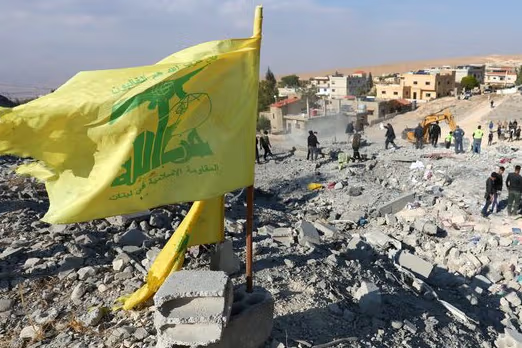
A Hezbollah flag flutters at a site damaged in the aftermath of an Israeli strike on the town of Al-Ain in the Baalbek region, in Lebanon, November 6, 2024

The United Arab Emirates (UAE) remains a central conduit for Iranian funds reaching Hezbollah despite international sanctions, the Wall Street Journal reported on Thursday.

The newspaper cited Arab officials as saying that Iran routes money through UAE-based shell companies and hawala networks, or traditional means of transferring money that mostly skirt easy tracing. Hawala brokers in the UAE convert and move cash without creating bank records.

Hawala is a centuries-old informal money transfer system rooted in trust, operating outside traditional banking. No funds physically cross borders, brokers later settle balances through trade, reverse transfers or cash.

Hezbollah remains one of the most important armed allies of Iran in the region even after it took punishing blows from Israel in a war which was paused late last year.

To evade stricter airport controls, Iran now dispatches more travelers carrying smaller, undeclared amounts of cash and jewelry, the Journal cited the officials as saying.

“One billion used to be their entire annual budget, but after the war they need a lot more,” Hanin Ghaddar of the hawkish US-based thinktank the Washington Institute told the WSJ.

Iran supports an array of armed groups via the Islamic Revolutionary Guards Corps (IRGC), providing funding, training and weapons to advance its regional influence and confront rivals like Israel and the US.

Abu Dhabi has opened investigations and promised cooperation with Western allies, but enforcement has been inconsistent because of deep economic links with Iran, the report said.

Hamas and Hezbollah are quietly rebuilding their military capabilities amid a tense ceasefire with Israel, the Jerusalem Post reported last week. Both groups accuse Israel of violating ceasefires aimed at ending the region's two-year-old conflict.

Israel maintains military outposts on Lebanese territory and has carried out sporadic attacks targeting Hezbollah officials, including the assassination of its military chief of staff on Sunday.

Meanwhile Israeli strikes on what its forces call militant targets in Gaza have killed nearly 350 people in the impoverished enclave since a US-brokered truce last month.

‘Disarmament challenge’

Hezbollah and Iran are also active another front, since the government in Lebanon vowed to disarm the group and give the

Lebanon's government is pushing for Hezbollah to surrender its weapons nationwide by year's end, but the chances of its success appear remote.

Hezbollah insists it will only relinquish arms south of the Litani River in a southern sector adjoining Israel once its enemy fully withdraws from the country and stops its ceasefire violations.

Tehran views the surrender of Hezbollah’s weapons as capitulation to the United States and Israel and has dismissed efforts to seize its arms as fruitless.


Most Viewed

100 days after carnage: Iran economy reels from war, inflation, unemployment
1
INSIGHT

100 days after carnage: Iran economy reels from war, inflation, unemployment

2
INSIGHT

Ghalibaf defends Iran-US talks amid hardline backlash

3
EXCLUSIVE

Iranian assaulted in London amid concern over threats to regime critics

4

IRGC fires at Indian vessel in Hormuz

5
INSIGHT

A nation in limbo: 100 days after the massacre, has the world moved on?

Banner
Banner

Spotlight

  • War-hit homeowners feel abandoned as Iran’s reconstruction aid fades

    War-hit homeowners feel abandoned as Iran’s reconstruction aid fades

  • 100 days on: the anatomy of Iran’s January crackdown
    INSIGHT

    100 days on: the anatomy of Iran’s January crackdown

  • Ghalibaf defends Iran-US talks amid hardline backlash
    INSIGHT

    Ghalibaf defends Iran-US talks amid hardline backlash

  • 100 days on: why Iran’s January protests spread across social classes
    ANALYSIS

    100 days on: why Iran’s January protests spread across social classes

  • From instability to influence: Pakistan’s pivotal role in US-Iran diplomacy
    ANALYSIS

    From instability to influence: Pakistan’s pivotal role in US-Iran diplomacy

  • A nation in limbo: 100 days after the massacre, has the world moved on?
    INSIGHT

    A nation in limbo: 100 days after the massacre, has the world moved on?

•
•
•

More Stories

Iran rebuilding nuclear program, former Mossad official says - HuffPost

Nov 27, 2025, 20:34 GMT+0

Iran is steadily rebuilding its nuclear program and stalled talks with the United States have increased the likelihood of another direct confrontation with Israel, HuffPost Italy reported citing a former senior Mossad official.

“Iran is continually working to rebuild its nuclear program," the former official said, speaking anonymously due to what the outlet described as pressure from Iran.

"The dialogue with the IAEA (International Atomic Energy Agency) has been interrupted, and the one with the United States is stalled and making no progress. Given this situation, there is reason to believe that we could soon find ourselves facing another round of direct war between Iran and Israel,” he added.

Israel launched a surprise military campaign in June which was capped with US attacks on the three key nuclear sites in Esfahan, Natanz and Fordow.

US President Donald Trump said the attacks had "obliterated" Iran's nuclear program but a diplomatic standoff over its fate continues to fester.

The ex-Mossad official said strikes on Iranian nuclear facilities during the twelve-day war in June caused “serious damage” but did not destroy Iran’s nuclear material, adding that Tehran is strengthening defenses around key sites.

Iran’s leadership, the former official assessed, is divided over talks with the United States, with President Masoud Pezeshkian favoring compromise while Supreme Leader Ali Khamenei and the Revolutionary Guards oppose concessions.

"I do not believe the Supreme Leader will allow Pezeshkian to reach an agreement and prevent a war. The situation could deteriorate,” he said.

Iran signals military readiness

His assessment came as Iran’s defense minister issued a fresh warning about the country’s military posture towards any hostile action from its adversaries.

Defense Minister Aziz Nasirzadeh said Iran is “monitoring threats accurately and continuously” and is prepared to respond “more decisively and more harshly than in the past."

"In the twelve-day war, we displayed part of our capabilities, and of course we did not reveal all our defensive power," he said.

"Today, with full strength and complete intelligence oversight, we are ready to respond to any threat ... If our enemies make a miscalculation and any movement or hostile action ... they will undoubtedly face an immediate and regret-inducing reaction," he added.

Mossad operates 'inside' Iran

The former Mossad official's comments followed separate disclosures about Israeli intelligence activity in Iran.

In a separate report on Thursday, Israeli newspaper Haaretz said former Mossad director Yossi Cohen told a private conference that the agency operates “inside Iran itself” and recruits sources directly, according to recordings obtained by the paper.

“(Iran) is not a place where we operate by proxy,” Cohen was quoted as saying.

“We go in to recruit and to bring intelligence,” he added.

Israeli assassinations of Iranian nuclear scientists and hundreds of military personnel and civilians during the June war exposed deep intelligence lapses in the Islamic Republic.

In the aftermath of the 12-day war which culminated in US airstrikes on three Iranian nuclear facilities, Tehran's intelligence forces arrested more than 700 Iranians accused of acting as agents for Israel.

The arrests targeted what authorities described as an “active espionage and sabotage network” that intensified operations after Israeli attacks.

Iran says US preconditions render talks impossible for now

Nov 27, 2025, 17:37 GMT+0

Iran's Foreign Minister Abbas Araghchi said on Thursday that Tehran remained open to resuming talks with Washington but US preconditions rendered negotiations impossible for now.

“Because of the US approach, a balanced and fair negotiation is currently not possible,” Araghchi told reporters. “Negotiation is worlds apart from taking dictation and following orders.”

An impasse over Iran's disputed nuclear program continues to fester even after US President Donald Trump said US strikes on three Iranian facilities in June "obliterated" its capabilities.

Western powers seek the resumption of talks halted by the Israeli-US military campaign, but Tehran says US demands that it rein in missile capabilities and support for armed allies in the region are a non-starter.

Iran's security chief Ali Larijani also said on Thursday that Tehran was open to the idea of talks but without any set goal.

“Iran has not abandoned real negotiations and will not do so,” Larijani said in an interview with Pakistan’s Urdu-language HUM News. "Anyone who truly seeks negotiation does not predetermine the outcome; if they do, then it is not a negotiation."

US talks with Tehran over its disputed nuclear program began earlier this year with a 60-day ultimatum set by Trump. On the 61st day, June 13, Israel launched a surprise military campaign which was capped with US strikes on June 22 targeting key nuclear sites in Esfahan, Natanz and Fordow.

“Trump claimed he stopped and destroyed Iran’s nuclear activity," added Larijani, who is also a key advisor to Supreme Leader Ali Khamenei. "Let's assume Trump is telling the truth; then what do they want? Has their problem been solved?”

Last week, Reuters reported citing two sources familiar with the exchange that Pezeshkian had urged Saudi Crown Prince Mohammed bin Salman to help persuade Trump to revive nuclear talks.

On Wednesday, Araghchi told France 24 in an interview that no direct nuclear negotiations are taking place with the United States, but channels remain open if Washington decided to change its stance.

Asked about the mediation of Saudi Arabia between Iran and the United States, Araghchi said intermediaries were plentiful but the problem was Washington's position.

Iran's Khamenei denies seeking Saudi mediation with US

Nov 27, 2025, 17:32 GMT+0

Supreme Leader Ali Khamenei on Thursday denied reports that Tehran had sought to enlist Riyadh as an intermediary in talks with Washington, saying outreach to President Donald Trump was beneath Iran's dignity.

“They fabricate rumors claiming that Iran has sent a message to the United States through some country. It is pure lies. Nothing of the sort ever happened," Khamenei said in a defiant speech for a day celebrating the country's Basij domestic militia.

"The Americans betray even their own friends ... Because of oil and underground resources, they are willing to ignite conflicts anywhere in the world — and this warmongering has now reached Latin America as well. A government of this kind certainly does not deserve for a state such as the Islamic Republic to seek relations or cooperation with it."

Last week, Reuters reported citing two sources familiar with the exchange that Iran's President Masoud Pezeshkian had urged Saudi Crown Prince Mohammed bin Salman to help persuade US President Donald Trump to revive nuclear talks.

The crown prince visited Washington last week and has a warm relationship with Trump.

Iranian officials have criticized a US military buildup in the Caribbean aimed at Venezuela, an ally which under leftist populist President Nicolas Maduro has been a strong critic of its neighbor to the north.

'US getting more isolated'

Khamenei mocked Trump's bid to resolve the war in Ukraine and said Washington's international standing was on the wane.

“Day by day, the United States is becoming more isolated in the world. Even if the leaders of some countries flatter it, among nations it is becoming more and more disliked," he said.

"It was the United States that started the war in Ukraine, and it has not achieved any results. The current US president had said he would resolve the issue in three days, yet now, after a year, he is trying to force through a 28-point plan," the Supreme Leader said.

'Iran defeated US and Israel'

The 86-year-old theocrat, who is the ultimate decision-maker on domestic and foreign policy, lamented not being able to give the speech to an audience. He spoke from behind a lectern in a video message, having sharply reined in his public appearances after Israeli assassinations of scores of military officials in a surprise June conflict.

"We suffered losses. We lost dear lives — there is no doubt about that. It is the nature of war. But the Islamic Republic showed that it can stand up to the enemy," he said.

Khamenei added that Israel and the United States failed to achieve its objectives in the war, and that its Mideast arch-foe's main goal of provoking an uprising had come to naught.

“They spent 20 years planning for a war to break out in Iran, hoping to provoke the people, rally them to their side, and turn them against the system. But they returned empty-handed; the outcome was the opposite, and they failed," he said.

"Even those who had differences with the system stood by it. A broad public unity emerged — something that must be appreciated."

Despite rising costs of living and a harsh post-war crackdown on political dissent even as some social strictures were relaxed, there have been few large-scale protests against authorities.

'Let us support Pezeshkian'

Khamenei gave a fresh public endorsement to Pezeshkian, a relative moderate who has absorbed wide criticism for the economic malaise and is under pressure from hardliners over his cabinet's performance.

“Let us support the esteemed president and the well-serving government. They have begun good initiatives, and God willing, their results will be seen later," he said. "The government carries a heavy burden. Running the country is not easy, and the government must be supported.”

A drought which is depleting reservoirs has added to Iranians' woes and Khamenei urged people to pray for rain.

Iran denounces Australia’s terror designation for Revolutionary Guards

Nov 27, 2025, 15:40 GMT+0

Iran on Thursday condemned Australia's listing of the Islamic Revolutionary Guard Corps (IRGC) as a state sponsor of terrorism, calling it a politically motivated and unjustified move.

"This irresponsible action is in line with the gross error that the Australian government committed based on completely false and fabricated accusations by the security institutions of the Zionist regime (Israel)," Iran's foreign ministry said in a statement on its Telegram channel.

Earlier in the day, Canberra officially designated IRGC as a state sponsor of terrorism after intelligence linked the group to attacks on Jewish centers in Sydney and Melbourne.

In August, Prime Minister Anthony Albanese publicly accused the IRGC of orchestrating arson attacks on the Lewis' Continental Kitchen in Sydney in October 2024 and the Adass Israel Synagogue in Melbourne in December 2024.

Iran's foreign ministry in its statement alleged that Australian police had already acknowledged “there is no evidence” linking Iran to the attacks.

The Australian government responded to the attacks by passing the Criminal Code Amendment (State Sponsors of Terrorism) Act 2025, which creates a new framework allowing the Government to respond to state-sponsored terrorism.

Domestic spy agency the Australian Security Intelligence Organization (ASIO) assessed that the IRGC used a “complex web of proxies” to carry out attacks on Australian soil.

"Iran's attacks were unprecedented and dangerous acts of aggression orchestrated by a foreign nation on Australian soil, which is why we are listing the IRCG as a state sponsor of terrorism," Australian Foreign Minister Penny Wong said on Thursday. "It has no place in Australia.

Australia’s move follows similar terrorism listings of the IRGC by the United States in 2019 and Canada in 2024.

Anti-drugs body sees Iran, Syria shifting illicit trade to Yemen - AFP

Nov 27, 2025, 14:16 GMT+0

Syrian and Iranian drug manufacturers have shifted their activities to Yemen after the overthrow of the Assad dynasty last year, according to a global anti-drug body and a Yemeni official cited by AFP on Thursday.

Yemen’s internationally recognized government recently seized 447 kilograms of narcotics and performance-enhancing substances – largely amphetamine-based – during coordinated raids carried out on land and at sea.

The World Anti-Doping Agency (WADA) chief Gunter Younger told the agency that the seizure was “a landmark moment,” saying it shows law-enforcement bodies are now taking the trafficking of banned substances far more seriously.

WADA and Yemeni officials assessed, AFP reported, that a safe haven for drugs production in Syria had collapsed with the fall of Bashar al-Assad to rebel forces in December and that the lawless Arabian Peninsula country was taking its place.

"Iran is the one that provided the experts with financial support and modern equipment, and investigations have proven this, as well as the experts' confessions," Major Murad al-Radwany, Interpol's Yemen-based internal security coordinator told AFP on Thursday.

Yemen's internationally-recognized government is at war with the Iran-aligned Houthi movement, which controls most of the country's population centers.

Iranian-backed production and smuggling

The dismantled facility was “the first factory to be set up in Yemen and equipped with the latest modern devices,” Radwany said.

The builders, he said, planned to open additional labs in other cities to produce stimulants for export.

Pills, which according to fighters loyal to the new ruling Syrian body are captagon, are placed inside of an apple-shaped container, on the outskirts of Damascus, Syria, December 12, 2024.
100%
Pills, which according to fighters loyal to the new ruling Syrian body are captagon, are placed inside of an apple-shaped container, on the outskirts of Damascus, Syria, December 12, 2024.

"The Houthis consider it a source of income, facilitating smuggling to neighboring countries,” he added.

"Iran also benefits from this, and its goal is to export drugs and stimulants to Arab countries and destabilize security and stability in Yemen and neighboring countries."

This aligns with earlier reports, which has documented how the collapse of central government control in Syria turned that country – long a global hub for the amphetamine-based drug Captagon – into a major production center. Iran-backed militias and regional proxy groups, according to those reports, have helped smuggle Captagon into Persian Gulf states, fueling instability and militia financing.

A 2025 case in Syria saw the arrest of a militia leader linked to Iran’s Islamic Revolutionary Guards Corps (IRGC) on charges of drug trafficking and antiquities smuggling.

Iran’s response

In response to the allegations, an Iranian foreign-ministry spokesperson told AFP that the accusations are “unfounded.”

Nonetheless, the mounting drug busts and associated intelligence suggest a widening spotlight on Iran’s involvement in regional narcotics – with growing calls for independent investigation and international scrutiny.