• العربية
  • فارسی
Brand
  • Iran Insight
  • Politics
  • Economy
  • Analysis
  • Special Report
  • Opinion
  • Podcast
  • Iran Insight
  • Politics
  • Economy
  • Analysis
  • Special Report
  • Opinion
  • Podcast
  • Theme
  • Language
    • العربية
    • فارسی
  • Iran Insight
  • Politics
  • Economy
  • Analysis
  • Special Report
  • Opinion
  • Podcast
All rights reserved for Volant Media UK Limited
volant media logo

Iran bans public entry to forest zones as wildfire threat persists

Nov 26, 2025, 09:55 GMT+0Updated: 23:50 GMT+0
An aerial view shows fires in Chalus’s Elit Forest, Mazandaran Province, northern Iran.

Iranian authorities have imposed temporary bans on entering forest regions across the north and west of the country after wildfires damaged vast areas of woodland and pasture that officials now say are largely under control.

The commander of Iran’s Forest Protection Unit, Colonel Majid Zakariaei, said fires this year have scorched about 46,000 hectares of national land, forest and rangeland.

He told state media that from March to November more than 2,300 fires were recorded nationwide – a 12-percent rise in the number of incidents compared with the same period last year, though the total burned area was about two percent smaller.

Zakariaei said around 95 percent of fires were linked to human activity, including careless visitors and campers, compounded by drought and rising temperatures.

“Climate change, reduced rainfall, and dryness have turned natural areas into tinder,” he said, calling for better public awareness and faster local response systems.

While the largest recent fires in the Hyrcanian Forests – the ancient, UNESCO-listed woodlands along the Caspian Sea – have been extinguished, authorities warned that dry conditions persist and that access will remain restricted until effective autumn rains arrive.

“The situation is still fragile. Until we have sufficient rainfall, unnecessary entry to the forests is prohibited,” Zakariaei said, announcing that bans now cover the Hyrcanian, Zagros and Arasbaran forest zones.

The measure, which includes parts of Mazandaran, Golestan, Ardabil and North Khorasan provinces, is aimed at preventing new flare-ups.

Firefighting teams remain on full alert and village councils near the forests have been told to prepare local emergency stations.

Political and media reactions

The government’s handling of the fires has triggered debate in Iranian media and on social networks.

The newspaper Farhikhtegan said in an article on Wednesday that several of the northern fires may have been intentionally set, describing them as “organized acts” rather than the result of drought or accident.

The paper cited unnamed officials who said about 20 suspects had been detained.

The article suggested that such incidents were meant to “undermine confidence in the state’s crisis management,” framing the destruction as part of broader attempts to disrupt the country.

Environmental officials have not endorsed those claims and maintain that negligence remains the dominant cause. They say most of the recent fires began near roads, farms or picnic areas rather than in inaccessible terrain.

Iran’s environmental community has urged a focus on prevention with experts saying that weak firefighting infrastructure, limited aerial equipment and late detection continue to leave forests vulnerable.

The Hyrcanian Forests, believed to be among the world’s oldest surviving temperate forests, are home to hundreds of endemic plant and animal species. Prolonged drought and land encroachment have already reduced much of their natural resilience.

Zakariaei said Iran plans to expand its firefighting bases and training programs, with 21 stations now designated nationwide and more in development. “With better readiness and local participation, we hope to reduce next year’s figures,” he said.

Most Viewed

Ghalibaf defends Iran-US talks amid hardline backlash
1
INSIGHT

Ghalibaf defends Iran-US talks amid hardline backlash

2
ANALYSIS

From instability to influence: Pakistan’s pivotal role in US-Iran diplomacy

3
ANALYSIS

100 days on: why Iran’s January protests spread across social classes

4

War-hit homeowners feel abandoned as Iran’s reconstruction aid fades

5

Iran says no decision yet on talks as Pakistan prepares to host US team

Banner
Banner

Spotlight

  • Iran diplomacy wobbles as factions compete to avoid looking soft on US
    INSIGHT

    Iran diplomacy wobbles as factions compete to avoid looking soft on US

  • The politics of pink: how Iran uses cuteness to rebrand violence
    ANALYSIS

    The politics of pink: how Iran uses cuteness to rebrand violence

  • Bread shortages, soaring prices strain households in Iran, residents say
    VOICES FROM IRAN

    Bread shortages, soaring prices strain households in Iran, residents say

  • 100 days on: the anatomy of Iran’s January crackdown
    INSIGHT

    100 days on: the anatomy of Iran’s January crackdown

  • Ghalibaf defends Iran-US talks amid hardline backlash
    INSIGHT

    Ghalibaf defends Iran-US talks amid hardline backlash

  • From instability to influence: Pakistan’s pivotal role in US-Iran diplomacy
    ANALYSIS

    From instability to influence: Pakistan’s pivotal role in US-Iran diplomacy

  • Public criticism mounts over Iran government’s forest fire response

    Public criticism mounts over Iran government’s forest fire response

  • Mismanagement, not drought, pushes Iran toward water bankruptcy

    Mismanagement, not drought, pushes Iran toward water bankruptcy

•
•
•

More Stories

Iran’s troubled energy sector gets an untested tsar

Nov 26, 2025, 07:11 GMT+0
•
Umud Shokri

President Masoud Pezeshkian has drawn fire over his decision to hand leadership over a crucial new energy body tasked with confronting an acute power crisis to a bureaucrat with no background in the sector.

The newly formed Energy Optimization and Strategic Management Organization (EOMSO) was hailed as a technocratic command center for a sector in crisis.

With Esmaeil Saghab Esfahani at its helm, tens of millions of Iranians could soon feel through the consequences of having untested hands manage a key aspect of their daily lives.

Iran’s energy system is under historic strain. Chronic blackouts, aging grids, water scarcity and soaring demand have eroded reliability, while subsidies distort consumption and drain national revenue.

Esfahani held a senior position in the administration of Pezeshkian's hardline predecessor Ebrahim Raisi and his appointment has been attributed by some critics as a potential sop to to the government's conservative opponents.

Lacking expertise

The EOMSO was created in early 2025 to confront these pressures by streamlining policy and coordinating investment across electricity, oil, gas and renewables. Its mandate runs from grid modeling and demand-side management to long-term transition planning.

But Esfahani's previous work centered on administrative reform, social equity programs and government transformation initiatives—useful skills, but far removed from the thermodynamics, market design, regulatory engineering and infrastructure planning that define modern energy governance.

There is no record of experience in electricity economics, energy markets, renewable-integration planning or the operational challenges of Iran’s grid and gas systems.

This gap represents more than a resume mismatch. It signals strategic misalignment at a moment when Iran needs precision and domain-specific leadership most.

Task at hand

The stakes are high because EOMSO is tasked to reduce Iran’s estimated $53 billion in annual energy waste, guiding renewable-energy investment with the National Development Fund, supervising subsidy reform and steering the transition toward cleaner and more resilient energy systems.

Integrating the cultures and functions of multiple legacy institutions into a single strategic entity is itself a formidable challenge.

Doing so under intensifying demand pressures, geopolitical volatility, and deteriorating infrastructure requires leadership that understands both the technical architecture and the political economy of Iran’s energy sector.

Without deep technical grounding, the organization risks drifting toward procedural audits rather than reform. Key initiatives could stall. Policies can be misjudged, wasting limited capital and prolonging Iran’s vulnerability to outages.

Administrative instincts alone are no substitute for practical knowledge.

Political cost

Beyond the technical implications, the appointment carries political and institutional consequences that reach into Pezeshkian’s broader reform agenda.

The moderate president campaigned on professionalizing governance and empowering specialists. Choosing Esfahani undercuts that promise and risks reducing EOMSO to another venue where political balancing supersedes competence.

Public trust, already strained by blackouts and stalled projects, is unlikely to withstand another round of unmet expectations. Energy policy touches households and industries daily; missteps are felt immediately.

The danger is not personal failure on the part of Saghab Esfahani. It is the systemic vulnerability created when a critical institution is led without the technical authority needed to manage its portfolio.

Iran’s energy crisis is too severe, and the EOMSO’s mandate too demanding, for improvisation. The body’s creation could be a step toward coherent energy governance if the administration compensates for the expertise gap.

Without corrective measures—and fast—the appointment risks becoming an energy turning point for all the wrong reasons.
Mismanagement, not drought, pushes Iran toward water bankruptcy

Nov 25, 2025, 19:44 GMT+0
•
Roozbeh Eskandari

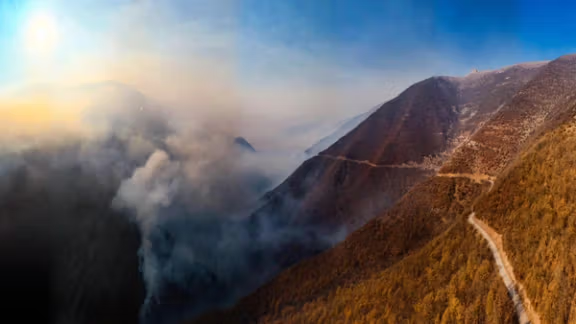
Iran is facing one of its most severe droughts in 60 years, with more than half its plains suffering drastic groundwater depletion and the term “water bankruptcy” becoming more palpable by the day.

But the crisis is rooted less in the sky than in decades of flawed policy: rushed dam-building, inefficient farming and poor governance.

The defining problem is management: lack of coordination among key ministries and short-term crisis fixes that ignore long-term realities.

One striking example came in July 2025, when schools and offices in Tehran and several provinces were temporarily shut down to reduce electricity and water consumption.

The move briefly eased pressure on the grid but underscored the absence of durable policy. No plan yet in sight promises anything near a comprehensive solution.

Daunting figures

A new energy ministry report shows dam inflows this year at just 1.35 billion cubic meters, an extraordinary drop from long-term averages. Total storage in Iran’s 193 major reservoirs has fallen to 34% of capacity, down 25% from last year.

Tehran’s situation is even more alarming.

The capital’s four main dammed reservoirs (Lar, Taleqan, Karaj and Amir Kabir) hold barely 12% of capacity, with Lar at just 2%. Inflow into the capital’s system has plunged 43% year-on-year.

If nothing changes, next summer could bring rationing and widespread drops in water pressure for millions in Tehran and other major cities.

Agriculture: the main drain

The core of Iran’s water crisis lies in agriculture, which consumes over 80% of renewable water resources, often with less than 40% efficiency. Much of the water used in irrigation is simply lost through evaporation, leakage, or outdated techniques.

Households, by contrast, account for just 6-10% of total use, yet are routinely targeted by conservation campaigns. The real problem is structural: water-intensive crops, unrealistic self-sufficiency policies and misallocated resources.

In many plains, groundwater extraction is two to three times higher than natural recharge rates, leading to dried wells, collapsing traditional aqueducts called qanats and land subsidence—up to 30 centimeters a year in some regions.

A test of survival

Climate change has intensified the crisis. Iran’s average temperature has risen 1.8°C over the past decade, triggering the evaporation of billions of cubic meters of water from dams, lakes, and soil.

Evaporation in many regions now exceeds total annual rainfall. Steady rains that once fed aquifers have been replaced by sudden flash downpours that run off quickly instead of replenishing the ground.

Iran can escape its water spiral only through structural reform: overhauling crop patterns and boosting agricultural efficiency, repairing leaky water networks and establishing transparent, data-driven water governance.

But the country's water crisis is ultimately a test of governance and social resilience. Without deep reform, the coming year could turn “thirst” from metaphor into political reality.

Water bankruptcy is not just empty reservoirs. It signals a failing contract between nature, the state and society which badly needs to be renegotiated.

Iran introduces limited gas price rise in sensitive political move

Nov 25, 2025, 15:40 GMT+0

Iran on Tuesday announced a limited fuel price increase in a move which appears aimed at reining in costly government subsidies while avoiding public anger which has previously exploded into protests.

The move will introduce a higher fuel charge to drivers refueling without government-issued smart ration cards or beyond their allowed quotas.

Iran’s cabinet approved the new three-tier fuel pricing system that will introduce a 5,000-toman (4.4 cents per the free market rate) rate for motorists who refuel without their smart cards or after exhausting their lower-priced quotas, according to a government directive published by domestic media.

The initiative, dated November 23, says that the two existing subsidized rates — 1,500 tomans (1.3 cents) for monthly quotas and 3,000 tomans (2.6 cents) for non-quota purchases with personal smart fuel cards — will remain in place but with reduced allocations.

An across-the-board fuel price rise in November 2019 triggered nationwide protests that were quashed with deadly force, with hundreds reported killed and thousands detained.

The increased rate was kept and maintained unchanged until the latest initiative.

From mid-December, refueling with “emergency station cards” will be charged at 5,000 tomans. The rate represents about ten percent of the government’s refinery purchase cost, the directive said.

Reports in Iranian outlets earlier this autumn had indicated that several pricing scenarios were under review.

In late October, President Masoud Pezeshkian said there was “no doubt” that fuel prices would eventually need to rise as domestic consumption continues to climb.

Fuel demand has at times exceeded 140 million liters per day, outpacing production of roughly 110 million liters, driven by inefficient vehicles, smuggling and seasonal spikes, according to officials.

Under the new measures, government-plated vehicles, cars in free-trade and special economic zones, imported cars and newly registered domestic vehicles will no longer receive 1,500- or 3,000-toman quotas.

Instead, they will be allocated a monthly amount priced entirely at the new 5,000-toman tier. Private individuals owning more than one gasoline-powered car will be entitled to quota rates for only one vehicle.

Alongside the new pricing policy, the first cargo of imported super gasoline — 300,000 liters — was sold on Iran’s energy exchange on November 22 at 65,800 tomans (57 cents) per liter.

Tasnim news agency reported that further changes, including adjustments to gas quotas for CNG-powered taxis, are expected to be announced in February.

Iran lawmakers urge action over Tabriz hospital chemo drug scandal

Nov 25, 2025, 12:55 GMT+0

More than 80 Iranian lawmakers called on the judiciary on Tuesday to urgently clarify and pursue a 2024 case in which chemotherapy drugs were allegedly stolen from a hospital in the northwestern city of Tabriz and patients were injected with distilled water instead.

The lawmakers, in a letter to judiciary chief Gholamhossein Mohseni Ejei published by Iranian media, said more than a year after the alleged malpractice at Vali-Asr Hospital, officials have yet to provide a full public account of what happened or who was responsible.

They urged what they described as a “serious and transparent” investigation to protect patients’ rights and public trust.

The case first surfaced in Iranian media in October 2024, when local outlets reported that cancer patients at the privately run hospital had received distilled water in place of high-cost chemotherapy drugs that were allegedly diverted for sale on the black market.

Provincial police said at the time that a hospital aide was detained as a suspect and later identified three alleged accomplices, adding that the drugs had been moved to Tehran and sold in the informal market. According to East Azarbaijan police, 20 judicial case files were opened, including cases involving deceased patients’ families.

Prosecutors in Tabriz said the investigation began after a complaint was filed in November 2024, and that four people were arrested.

The provincial prosecutor’s office has said at least one patient whose medication was stolen died, prompting the case to be referred to a special murder unit, and that more than 30 complainants have registered claims so far.

Health authorities in Tabriz confirmed wrongdoing in the chemotherapy ward but said it involved “individual misconduct” rather than an institutional policy, and that the hospital itself reported the suspects to law enforcement.

Former vice president involved

In their Tuesday letter, lawmakers also raised concerns over a potential conflict of interest involving Shahram Dabiri Oskuei, the hospital’s main shareholder and director.

They said Dabiri had sought to frame the affair only as illegal drug sales and had publicly suggested the missing treatments did not affect patients’ life expectancy because some were in advanced stages of cancer.

The lawmakers said that Dabiri has announced his candidacy to head Iran’s Medical Council Organization, a body that can play a disciplinary role in suchcases, and said this could undermine confidence in the investigation.

DabiriOskuei, a physician and politician who served as Tabriz city council chairman and later as Iran’s vice president for parliamentary affairs in under President Masoud Pezeshkian, has not publicly responded to the lawmakers’ new call, according to Iranian media.

Pezeshkian fired him in April after images surfaced online showing the official on vacation in Argentina and en route to Antarctica during the Iranian new year holidays.

Separately, Iranian media reported a similar case in January at Tehran’s Shariati Hospital, where officials said a staff member was suspended after drugs were allegedly siphoned off and replaced with distilled water, with the matter referred to the courts.

Iran crude piles up at sea as Chinese demand slows, Kpler data show

Nov 25, 2025, 11:13 GMT+0

Iranian crude held on tankers at sea has climbed to its highest level in about two and a half years, indicating softer buying from China even as Iran’s exports remain high, Bloomberg reported citing shipping data cited by market sources.

About 52 million barrels of Iranian oil were sitting in floating storage, the most since May 2023, with roughly half of the volumes parked off Malaysia, data from shipping-intelligence firm Kpler showed.

The offshore build has nearly doubled from a month earlier, the data indicated, and has risen sharply from early-2025 levels as cargoes wait for buyers.

Traders said the backlog has widened discounts on Iranian grades such as Iran Light, in some cases to as much as $8 a barrel below ICE Brent, compared with around $4 in late summer.

Reuters reported this week that that China’s official crude imports from Indonesia have surged to levels far above what Indonesia actually exports, prompting traders and analysts to say the barrels are likely sanctioned Iranian oil being rebranded after ship-to-ship transfers near Malaysia.

They said Iran’s suppliers have long masked origins by labeling cargoes as Malaysian, but tougher scrutiny of Malaysian oil by banks and Malaysia’s clampdown on at-sea transfers have pushed dealers to use Indonesia as a new paper origin.

On Monday, Indonesia announced it will auction the seized Iranian tanker MT Arman 114 and its 1.245 million barrels of crude oil starting December 2.

  • Indonesia to sell seized Iranian tanker and crude cargo at auction

    Indonesia to sell seized Iranian tanker and crude cargo at auction

  • Iran’s oil discounts to China widen as sanctions and quota hit demand

    Iran’s oil discounts to China widen as sanctions and quota hit demand

  • Iran oil sales hit seven-year high despite US sanctions, trackers say

    Iran oil sales hit seven-year high despite US sanctions, trackers say

Even with the relabeling shift, analysts cited by Reuters said most Iranian crude bound for China is still transferred between tankers off Malaysia, and Kpler estimates China has taken about 1.37 million barrels per day of Iranian or suspected Iranian crude this year, mainly via such transfers.

The accumulation comes as the global oil market is well supplied, with OPEC+ easing production curbs and non-OPEC producers adding output, pressuring prices this year.

Despite US sanctions, Iranian exports are still running at their fastest pace in years, leaving more barrels vulnerable to congestion when demand slows.

China remains the dominant buyer of Iranian crude, largely through independent “teapot” refineries that import discounted barrels.

  • Defying 'maximum pressure', China uptake of Iranian oil hits pre-Trump high

    Defying 'maximum pressure', China uptake of Iranian oil hits pre-Trump high

  • Oil sanctions squeeze Iranians as buoyant flows to China enrich elite

    Oil sanctions squeeze Iranians as buoyant flows to China enrich elite

Traders said many teapots have nearly exhausted the import quotas they need to bring in overseas crude, cooling their appetite for new Iranian shipments.

Recent USsanctions on Chinese firms and terminals accused of handling Iranian oil, including the Rizhao Shihua crude terminal, have further complicated offloading, forcing some tankers to divert to alternative ports.