• العربية
  • فارسی
Brand
  • Iran Insight
  • Politics
  • Economy
  • Analysis
  • Special Report
  • Opinion
  • Podcast
  • Iran Insight
  • Politics
  • Economy
  • Analysis
  • Special Report
  • Opinion
  • Podcast
  • Theme
  • Language
    • العربية
    • فارسی
  • Iran Insight
  • Politics
  • Economy
  • Analysis
  • Special Report
  • Opinion
  • Podcast
All rights reserved for Volant Media UK Limited
volant media logo

Smog grips Iran’s big cities despite holiday shutdowns, orange alert issued

Nov 24, 2025, 08:54 GMT+0
A man sits in a park, following the increase in air pollution in Tehran, Iran, November 22, 2025.

Iran issued an orange air-pollution alert on Monday for several major urban centers, with official monitoring showing unhealthy air even as the country observed a public holiday and many schools and universities were closed or moved online.

Forecasters said pollution could intensify through the end of the week in densely populated and industrial areas, warning that stagnant weather and temperature inversions could push air-quality readings in some places into the “very unhealthy” range.

The alert follows days of red readings in cities such as Tehran and Isfahan, highlighting a winter pattern in which vehicle exhaust, industrial output and heavy-fuel use combine with stagnant weather to drive smog spikes.

Tehran has recorded only six clean-air days so far this Iranian year (started on March 21), according to the capital’s Air Quality Control Company, and more than half of days have been unhealthy for sensitive groups – children, older adults, pregnant women and people with heart or lung disease.

With seniors making up about 8.4% of Tehran province’s population – roughly 1.2 million people – health experts warn that prolonged exposure during repeated pollution waves is elevating risks of respiratory and cardiovascular complications, adding to a crisis authorities have struggled to contain beyond temporary closures and driving restrictions.

Most Viewed

Ghalibaf defends Iran-US talks amid hardline backlash
1
INSIGHT

Ghalibaf defends Iran-US talks amid hardline backlash

2
VOICES FROM IRAN

Bread shortages, soaring prices strain households in Iran, residents say

3
ANALYSIS

From instability to influence: Pakistan’s pivotal role in US-Iran diplomacy

4
ANALYSIS

100 days on: why Iran’s January protests spread across social classes

5

War-hit homeowners feel abandoned as Iran’s reconstruction aid fades

Banner
Banner

Spotlight

  • Iran diplomacy wobbles as factions compete to avoid looking soft on US
    INSIGHT

    Iran diplomacy wobbles as factions compete to avoid looking soft on US

  • The politics of pink: how Iran uses cuteness to rebrand violence
    ANALYSIS

    The politics of pink: how Iran uses cuteness to rebrand violence

  • Bread shortages, soaring prices strain households in Iran, residents say
    VOICES FROM IRAN

    Bread shortages, soaring prices strain households in Iran, residents say

  • 100 days on: the anatomy of Iran’s January crackdown
    INSIGHT

    100 days on: the anatomy of Iran’s January crackdown

  • Ghalibaf defends Iran-US talks amid hardline backlash
    INSIGHT

    Ghalibaf defends Iran-US talks amid hardline backlash

  • From instability to influence: Pakistan’s pivotal role in US-Iran diplomacy
    ANALYSIS

    From instability to influence: Pakistan’s pivotal role in US-Iran diplomacy

  • Iran turns to heavy mazut fuel despite worsening air pollution

    Iran turns to heavy mazut fuel despite worsening air pollution

  • US says Iran's theocracy has taken air out of people's lungs

    US says Iran's theocracy has taken air out of people's lungs

•
•
•

More Stories

Public criticism mounts over Iran government’s forest fire response

Nov 23, 2025, 17:16 GMT+0

A fire that has been burning for almost three weeks in northern Iran’s UNESCO-listed forests has triggered growing criticism of officials for what many describe as indifference, incompetence and a failure to prioritize an escalating environmental disaster.

The blaze has affected Elit forest, part of Iran's Hyrcanian forest belt along the southern Caspian Sea coast, a 50-million-year-old ecosystem UNESCO added to the World Heritage list in 2019 for its exceptional biodiversity, including more than 3,200 plant species.

In a report on Sunday, Iran’s semi-official ISNA wrote that the fire in Elit forest has been burning for about 20 days, adding that the head of natural resources in Mazandaran province rejects this and says two separate fires occurred in the area 10 to 15 days apart.

ISNA's said local residents insist the blaze has continued without interruption since November 1, with smoke showing it never fully went out.

The report said pockets of fire remained even after a firefighting aircraft was deployed, and quoted Mazandaran governor Mehdi Younesi as saying 400 to 450 personnel had been sent from neighboring provinces while residents had been on the scene from the first moments.

ISNA added that Iran has asked other countries for help, and cited lawmaker Kamran Pouladi saying Turkey, Russia and Belarus offered assistance and that a Turkish aircraft is already operating at the site.

Public anger over government response

Users on social media expressed anger over the slow and limited response, accusing authorities of neglect and leaving residents to fight the fire with little support.

“The fire climbs up the forest slopes, swallowing the trees, and people with bare hands run after it to stop it,” user Azam Bahrami wrote, criticizing officials for abandoning local residents.

Environmental activist Hamed Tizroyan said in an Instagram Story that “if it were not for public protests, these officials would not even get up from their chairs to see what is happening,” a comment widely shared as users blamed poor oversight, inadequate resources and late managerial presence for the fire’s spread.

Another user, Zahra, linked the blaze to broader environmental pressures, including heavy pollution in Tehran and dam levels at their lowest in decades, saying authorities were focused on unrelated domestic debates “while a UNESCO-listed forest is burning.”

Several users also praised volunteers and local rescue teams, saying the disaster would have been far worse without them, and questioned why Iran still lacks a functional aerial firefighting fleet despite years of recurring wildfires.

Volunteers say pleas for help went unanswered for days

The Tehran-based Ham Mihan newspaper published a field report quoting local volunteers who said the operation “was not possible with only one water drop per day,” adding that they were losing “one hectare of forest every moment.”

A mountaineer involved in the effort said the first helicopter arrived on November 17, even though volunteers had requested one on November 10 and had been fighting the fire without equipment for days.

Another local resident told the newspaper early warnings were ignored, saying: “We said if the autumn winds start, it will be a disaster — and that is exactly what happened.”

Exiled prince denounces government handling of fire

Iran’s exiled prince Reza Pahlavi accused Tehran’s clerical establishment of indifference toward the fire.

“The Islamic Republic is indifferent to the fire consuming the Hyrcanian forests, because for this anti-Iranian regime, the destruction of Iran’s thousands-year-old natural heritage means nothing,” he said in a statement on Sunday.

“Our ancient Iranian forests burn defenseless — just as several generations of Iranian lives have been destroyed by this regime,” he added.

He said the government spends the nation’s wealth on "terrorism and the spread of hatred and destruction” instead of protecting the environment.

Pahlavi said the Iran Prosperity Project — a policy platform developed by his team — includes a comprehensive plan to restore the country’s environment.

“The people of Iran will put an end to this path of ruin, and with the end of this oppression, the country’s environment will also be saved,” he said.

Iran turns to heavy mazut fuel despite worsening air pollution

Nov 23, 2025, 13:39 GMT+0

Iran has started burning mazut, a heavy fuel oil, at several power plants despite worsening air pollution, Fars News reported on Sunday, signalling a renewed reliance on high-sulphur feedstock as winter demand rises and smog intensifies.

Power plants burned more than 21 million liters of mazut on November 14, the outlet said – a volume that would require oil tankers stretching roughly 14 kilometers end to end. 

Stations in Hamedan in the west, Neka in the north and Arak in Markazi province were among the biggest consumers, it added. 

“We do not want to burn mazut because it damages plants and is an expensive commodity,” Energy Minister Abbas Aliabadi said last week. “But when gas is scarce, we are forced to use it.”

Government assurances under pressure

Officials in President Masoud Pezeshkian’s administration have repeatedly vowed to phase out mazut in favor of cleaner fuels.

100%

Scheduled outages could temporarily replace “producing poison” for the public, Government spokesperson Fatemeh Mohajerani wrote on X in November last year. Her remarks came shortly after summer blackouts and the onset of household gas cuts.

State media later said Pezeshkian ordered mazut use halted at power stations in Arak, Karaj and Isfahan. Yet in several cities, especially Arak, hazardous smog persisted through mid-March, prompting repeated street protests.

Three months after the announced halt, in February, parliamentary agriculture committee spokesperson Somayeh Rafiei said all thermal plants had shifted to mazut.

In a separate August report, business outlet Tejarat News assessed mazut as an “official and relied-upon” tool in managing the energy crisis, adding that it had remained in use the previous year despite official assurances.

  • Iran forced to continue use of harmful fuel oil to maintain gas supplies, President says

    Iran forced to continue use of harmful fuel oil to maintain gas supplies, President says

  • In bitter paradox, Iran grows more polluted even as it runs low on fuel

    In bitter paradox, Iran grows more polluted even as it runs low on fuel

  • Iran steps up burning of hazardous fuels as energy crisis persists

    Iran steps up burning of hazardous fuels as energy crisis persists

Tehran imposes emergency school closures

Tehran’s emergency air-quality task force met on Sunday at the health ministry’s request and approved online schooling for primary classes across the province on Tuesday and Wednesday.

The decision followed forecasts indicating that pollution would intensify through the week, task force secretary Hassan Abbasnejad said.

“After reviewing reports from the environment department, the medical university and the meteorological organization, it was decided that primary classes will be held virtually,” Abbasnejad said.

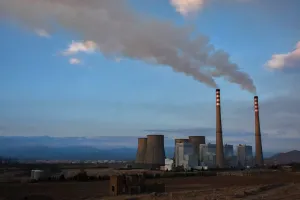
A thermal power plant following the increase in air pollution in Tehran, Iran, November 22, 2025.
100%
A thermal power plant following the increase in air pollution in Tehran, Iran, November 22, 2025.

Daycare centers and preschools in districts classified as unhealthy for all groups would shut, and female employees with young children could work remotely, he added.

Calls to phase out ageing vehicles, invest in cleaner energy and bolster a central environmental authority have so far gone unanswered. Critics say that without systemic change, major cities, including Tehran, will keep paying the price in hazardous air and lost lives.

As winter inversion deepens, the combination of stagnant air and growing mazut consumption is heightening concerns that Iran’s most polluted weeks may still lie ahead.

Iran sells first imported premium gasoline cargo on energy exchange

Nov 23, 2025, 12:39 GMT+0

Iran sold its first cargo of imported premium “super” gasoline on the Tehran Energy Exchange on Sunday with the base price set at 658,000 rials a liter ($0.58), state media reported. 

The shipment totaled 300,000 liters and will be delivered to a distributor on November 29, with supplies expected to reach filling stations within 7 to 10 days, according to the exchange’s chief executive. 

IRNA said the 658,000-rial base is not the final retail price, because transport and station fees will be added, meaning premium fuel for higher-end cars could cost at least 33–35 million rials ($29–$31) to fill a 50-liter tank, and potentially closer to 37.5 million rials ($33) if sold around 750,000 rials a liter ($0.66). 

The exchange’s upcoming trading board showed no new premium gasoline offer for Tuesday, suggesting the next batch may be delayed to next week. 

  • Iran says price of imported gasoline far outstrips subsidized rate

    Iran says price of imported gasoline far outstrips subsidized rate

  • Haunted by 2019 protests, Tehran avoids fuel price hike

    Haunted by 2019 protests, Tehran avoids fuel price hike

The sale comes amid renewed debate over Iran’s fuel subsidies six years after nationwide protests erupted over a gasoline price hike in November 2019. 

Officials have framed imported premium gasoline as a market-priced, third-tier option rather than a direct change to subsidized quotas, but President Masoud Pezeshkian has said there is “no doubt” prices must rise, and government spokeswoman Fatemeh Mohajerani has put the state’s cost of gasoline at about 700,000 rials a liter ($0.62).

Iranian matchmaking site enables child marriage, daily says

Nov 23, 2025, 12:12 GMT+0

An investigation by the reformist daily Shargh found that a licensed Iranian matchmaking platform lets parents sign up children as young as 13 for marriage, with no age filters or meaningful safeguards in place.

“Children aged 13 and 14 can be registered directly or by parents as marriage candidates,” Shargh wrote on Saturday.

The website Adam and Hava (Adam and Eve), which brands itself as a formal marriage intermediary, allows users to open profiles either for themselves or for a child or relative.

Shargh reporters were able to create a full profile for a girl born in 2012 without any age restriction or identity barrier, indicating that minors can be listed seamlessly as marriage candidates.

Profiles reviewed in the investigation show under-18 users concentrated in deprived regions where early marriage is common. Girls appear most frequently between 13 and 16, while boys cluster between 16 and 18.

The site’s 80-question registration form emphasizes religious observance, gender-role expectations, political attitudes and views on hijab, make-up and social interaction, but includes no questions about consent, emotional readiness or psychological maturity for minors.

  • Temporary marriage in Iran: religiously sanctioned, socially taboo

    Temporary marriage in Iran: religiously sanctioned, socially taboo

  • New Research Shows Rise In Child Marriages In Iran

    New Research Shows Rise In Child Marriages In Iran

Operator cites legal obligations

Executive manager Mohammad-Hossein Asghari defended the platform, saying the law obliges it to accept users who fall within statutory marriage ages. “Article 1041 of the Civil Code sets the marriage age at 13 for women and 15 for men,” Asghari said.

“From a legal standpoint we are obliged to accept membership and cannot block someone who falls within the age range set by law.”

About 300,000 people, he said, have attempted to register, with 70,000 profiles currently active following identity checks and psychological screening. Minors under 15, he added, must have a parent complete the form, and staff speak directly with the child before approval.

100%

Experts warn of deepening risks

Child-rights advocates told Shargh that formalizing under-18 marriage through a widely promoted digital platform deepens an already harmful pattern.

Children who marry between 10 and 16 lack the emotional and social development required for partnership and parenting, facing elevated risks of violence and long-term trauma, Psychologist Mansoureh Shahnazari told the outlet.

Iran’s Statistical Center recorded around 25,900 marriages of girls under 15 in 2022, down from roughly 32,000 in 2021 – figures that researchers say illustrate inconsistencies in government reporting.

Legal specialist Sahar Khajehvand described the platform’s model as “marketing child marriage” and said it contradicts constitutional commitments to stable family formation based on maturity rather than poverty or coercion.

Supreme Leader Ali Khamenei has repeatedly promoted policies encouraging higher birth rates and earlier marriages, with a target population of 150 million by 2050.

In line with these priorities, parliament passed the Rejuvenation of the Population and Protection of the Family law in 2021, imposing penalties for actions deemed to oppose childbearing or delay marriage, effectively placing demographic goals above safeguards for children.

With tens of thousands of child marriages recorded annually and a platform openly enrolling minors under an official banner, campaigners say only a clear ban on under-18 marriage will prevent online tools from further normalizing the practice.

Iran’s Central Bank ordered to slash four zeros from national currency

Nov 22, 2025, 22:23 GMT+0

Iran began implementing a long-delayed plan to drop four zeros from its battered currency after President Masoud Pezeshkian instructed the Central Bank on Saturday to begin two years of preparations.

Under the order, the Central Bank of Iran must prepare the shift within two years before managing a three-year phase in which old and new banknotes circulate together.

Once that cycle ends, all transactions will be settled in the new unit and existing notes will be withdrawn, according to Iranian state media.

Parliament earlier approved a law defining the “new rial” as equal to 10,000 current rials, with “gheran” designated as the subunit.

Economists remain divided over the effect of the redenomination. The policy is expected to require printing new notes, destroying old ones and modifying banking and accounting systems.

Critics argue that without wider reforms the move is mainly cosmetic, citing Argentina, Zimbabwe, Romania and the former Yugoslavia, where redenominations did little to restrain prices.

“This policy is largely cosmetic,” economist Ahmad Alavi told Iran International in August. “Without tackling the roots of inflation – from liquidity growth to systemic inefficiencies – removing zeros will not restore the rial’s value.”

100%

Debate over deleting zeros began in the late 1990s and circulated through multiple administrations. Parliament first passed the plan in 2020, but the Guardian Council sent it back for revisions. The current version – retaining the name “rial” and introducing “gheran” – won final approval in October and has now entered execution with Pezeshkian’s signature.

Long path to implementation

Officials say the overhaul aims to simplify calculations, improve the legibility of Iran’s currency and prepare the ground for broader fiscal measures.

The abundance of zeros in the national currency had caused accounting and operational difficulties, Shamseddin Hosseini, head of parliament’s Economic Committee, said last month, adding that similar redenominations had been undertaken by countries such as Turkey in 2003 and 2005.

The reform comes amid persistent inflation of about 40%, a more than 90% loss in the rial’s value since US sanctions were reimposed in 2018, and widespread economic hardship.

With the formal order issued, the central bank begins one of the Islamic Republic’s most extensive monetary reforms, whose outcome still hinges on the government’s broader effort to control inflation.