• العربية
  • فارسی
Brand
  • Iran Insight
  • Politics
  • Economy
  • Analysis
  • Special Report
  • Opinion
  • Podcast
  • Iran Insight
  • Politics
  • Economy
  • Analysis
  • Special Report
  • Opinion
  • Podcast
  • Theme
  • Language
    • العربية
    • فارسی
  • Iran Insight
  • Politics
  • Economy
  • Analysis
  • Special Report
  • Opinion
  • Podcast
All rights reserved for Volant Media UK Limited
volant media logo

Death of political prisoner exposes Islamic Republic’s abuse, US says

Nov 22, 2025, 08:49 GMT+0Updated: 23:52 GMT+0
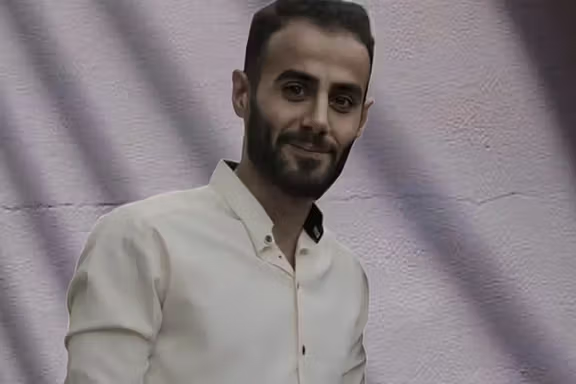
Political prisoner Farzad Khoshboresh

The US State Department called the death of political prisoner Farzad Khoshboresh an example of Islamic Republic abuses, saying that the establishment is suppressing dissent with violence instead of addressing public needs.

“Officials in Iran said Farzad Khoshboresh’s health deteriorated in detention and that he died after being transferred to a hospital,” the department wrote Saturday on its Persian-language page on X.

“But the bruises and signs of torture on his body tell a different story, one that Iranians know all too well: the story of someone who dared to speak out and paid a heavy price,” it added.

Judiciary outlet confirms death

Mizan, the news agency of Iran’s judiciary, confirmed Khoshboresh’s death on Wednesday and said he had been taken to a hospital with signs of illness, released on bail the same day, and died two days later from illness.

His death, the State Department said, fits into what it called a “violent pattern” by the Islamic Republic to silence dissent and spread fear. “Even in the face of such repression, the brave people of Iran continue to demand justice, dignity, and freedom,” the department wrote.

The Hengaw rights group reported Tuesday that witnesses saw bruising on Khoshboresh’s body. Mizan did not mention any injuries.

Local sources said Khoshboresh was detained for a second time by the intelligence ministry on November 12. They said he suddenly suffered acute pain and vomiting in custody after consuming cake and water at the Behshahr detention center, lost consciousness, and was taken to hospital.

He was kept shackled to a bed and died 24 hours after receiving antibiotics, following a rejected request for transfer to another medical facility, according to the sources. Medical equipment, they added, was removed without informing his family and that his body was taken to a morgue.

A prison in Iran (Undated)
100%
A prison in Iran

Khoshborash was buried Thursday under heavy security in a village near Neka in northern Mazandaran province.

A recurring pattern

His death follows a long list of political detainees who have died in Iranian custody over the years.

Many detainees held on non-political charges have also died after beatings in police detention centers.

Iran’s constitution prohibits torture under Article 38, although the country has not joined the UN Convention Against Torture.

Most Viewed

100 days after carnage: Iran economy reels from war, inflation, unemployment
1
INSIGHT

100 days after carnage: Iran economy reels from war, inflation, unemployment

2
INSIGHT

Ghalibaf defends Iran-US talks amid hardline backlash

3
EXCLUSIVE

Iranian assaulted in London amid concern over threats to regime critics

4

IRGC fires at Indian vessel in Hormuz

5
INSIGHT

A nation in limbo: 100 days after the massacre, has the world moved on?

Banner
Banner

Spotlight

  • War-hit homeowners feel abandoned as Iran’s reconstruction aid fades

    War-hit homeowners feel abandoned as Iran’s reconstruction aid fades

  • 100 days on: the anatomy of Iran’s January crackdown
    INSIGHT

    100 days on: the anatomy of Iran’s January crackdown

  • Ghalibaf defends Iran-US talks amid hardline backlash
    INSIGHT

    Ghalibaf defends Iran-US talks amid hardline backlash

  • 100 days on: why Iran’s January protests spread across social classes
    ANALYSIS

    100 days on: why Iran’s January protests spread across social classes

  • From instability to influence: Pakistan’s pivotal role in US-Iran diplomacy
    ANALYSIS

    From instability to influence: Pakistan’s pivotal role in US-Iran diplomacy

  • A nation in limbo: 100 days after the massacre, has the world moved on?
    INSIGHT

    A nation in limbo: 100 days after the massacre, has the world moved on?

•
•
•

More Stories

Iran suspects human cause in northern forest fire, probes land development ties

Nov 22, 2025, 08:00 GMT+0

Iranian officials said on Saturday that the massive wildfire burning for a week in the Hyrcanian forest in northern Mazandaran Province was most likely caused by human activity, as authorities investigate suspected attempts to clear forest land for real estate projects.

Reza Aflatouni, head of Iran’s Forests Organization, said initial findings “strongly suggest a human cause.” “Expert teams are in the area, and evidence points to deliberate or negligent action,” he told state media. “We are also examining possible connections between the fire and efforts to rezone forest and farmland for private construction.”

Mazandaran Governor Mehdi Younesi-Rostami also said security assessments confirm that the fire in the Elit area was caused by human activity.

The investigation follows mounting controversy in Mazandaran Province, where environmental experts have accused local officials and developers of converting protected farmland and forest edges into villa plots.

The blaze, centered in the Elit region near the town of Chalous, has spread through steep, densely wooded terrain and is being driven by high winds and dry conditions. Firefighting officials said eight helicopters from the Defense Ministry, police and Red Crescent are operating in the area, along with two Ilyushin aircraft from the Revolutionary Guards, each capable of carrying 40,000 liters of water per flight.

Turkey to send aircraft as Iran weighs Russian help

Two Turkish firefighting planes, a helicopter and eight personnel are expected to arrive on Saturday to support local crews, and officials said Iran may request additional assistance from Russia if needed. “If necessary, we will request cooperation from the Russian government to help contain the Elit forest fires,” Environment chief Shina Ansari said.

Authorities said the difficult terrain has slowed efforts to create firebreaks and reach isolated hot spots. Ansari warned that “the risk of fire spread remains high” and that teams have been working around the clock to prevent the blaze from reaching nearby villages.

The Hyrcanian forest, a UNESCO World Heritage site along Iran’s Caspian coast, is one of the world’s oldest temperate rainforests and home to thousands of plant and animal species, including endangered Persian leopards and brown bears.

Kaveh Madani, director of the UN University Institute for Water, Environment and Health, called the Elit blaze “heartbreaking,” saying Iranians are “losing a natural heritage older than Persian civilization.”

Officials said the full extent of the damage and the cause of the fire will be announced after investigations conclude.

Prominent academic body urges Iran to halt crackdown on scholars

Nov 21, 2025, 21:41 GMT+0

The Association of Iranian Studies Committee on Academic Freedom on Friday urged top Tehran’s officials to drop charges against five independent scholars, calling it a politically motivated move.

“We express our deep concern over the Iranian government’s ongoing violations of academic freedom, particularly in light of the recent politically motivated arrests and detentions of independent scholars,” the group wrote.

The open letter was addressed to Iranian Supreme Leader Ali Khamenei, President Masoud Pezeshkian and Chief Justice Gholam-Hossein Mohseni Ejei.

The AIS was referring to a recent crackdown on leftist academics Parviz Sedaghat, sociologist Mahsa Asadollahnejad, writer Shirin Karimi, economist Mohammad Maljoo, and scholar Heyman Rahimi.

“All face national security charges over their intellectual work. Sedaghat, Asadollahnejad, and Karimi were released on bail November 12, but charges persist; Maljoo and Rahimi face ongoing interrogations,” the group said.

"We are profoundly concerned by this latest violation of basic rights of citizenship and scholarly independence," the letter said. "We... consider it a clear violation of their fundamental right to academic freedom."

The group called on Iran to drop all charges, allow academic freedom and respect the UN human rights charter.

'Crackdown campaign'

AIS, founded in 1967, represents global experts on Iran and advocates for free scholarly exchange.

The arrests have drawn wider condemnation. The Committee to Protect Journalists (CPJ) called for the immediate release of Sedaghat and other detained scholars, while PEN America denounced Iran’s “escalating campaign against freedom of expression.”

Human rights groups have described the arrests and summonses as part of a broader campaign of arrests meant to stifle public debate following Iran’s 12-day June war with Israel.

In an article published three weeks after the June war, Sedeghat had written that despite the ceasefire with Israel, “we continue to live within the same rhetoric, the same confrontational tone.”

He warned that Iran’s economy “has been caught in structural blockage” and that without political reform, the country is headed "toward systemic collapse.”

Turkey sends aircraft to help battle Iran wildfires

Nov 21, 2025, 21:20 GMT+0

Two Turkish firefighting planes, one helicopter and eight personnel will arrive in Iran on Saturday to help quell fires in the Hyrcanian forest in the country's north, Iranian environment chief Shina Ansari said on Friday.

“There are warnings that the fire spread risk is high and we need to act accordingly,” official media cited Ansari as saying.

The blaze in the Elit area ongoing since last week, fueled by wind and dry conditions. Iranian helicopters and ground teams deployed round-the-clock, but rugged terrain has hampered efforts.

Iran seeks international aid as the massive wildfire rages in UNESCO-listed Hyrcanian forest near the town of Chalous.

“Heartbreaking scenes from Elit, Iran, where wildfire is damaging parts of the ancient Hyrcanian forests — a UNESCO World Heritage treasure and one of Earth’s last temperate rainforests,” Kaveh Madani, director of the UN University Institute for Water, Environment and Health posted on X.

“Iranians are losing a natural heritage older than Persian civilization,” he added.

Authorities said protection units remained on high alert along the forest front in western Mazandaran, where several smaller fires have been reported in recent days.

Iran's Vice President Mohammad Reza Aref ordered on Friday urgent provision of firefighting equipment and resources for the ongoing Elit forest wildfire.

The Hyrcanian Forests stretch along the southern Caspian Sea coast in Iran and Azerbaijan. This ancient temperate broadleaf and mixed forest ecoregion dates back 25-50 million years, surviving past ice ages as a refugium.

They host over 3,200 vascular plant species, 150 endemic and 180 bird species, plus mammals like the Persian leopard, brown bear, lynx and Caspian red deer.

Wildfires have been burning for over two weeks as officials warned that heat, wind and dry vegetation were fueling the blaze.

Iran parliament speaker says Vance sought talks amid June war

Nov 21, 2025, 19:27 GMT+0

Iranian parliament speaker Mohammad Bagher Ghalibaf said on Friday that by the sixth day of a 12-day conflict with Israel, US vice president JD Vance was seeking talks to end the war.

“Despite the damage we got on the first day, the situation reached a point where by the sixth day, the US Vice President was seeking negotiations to stop the war,” Ghalibaf told a Tehran even for the Basij, Iran's domestic militia.

“The enemy entered with military action, and we admonished and punished it with military power,” he added. “The enemy acted with full calculations to stop the revolution and disintegrate Iran.”

Vance's office did not immediately respond to an Iran International request for comment.

“Iran targeted the US command headquarters in the region with 14 missiles in less than 24 hours. Anti-missile systems failed to intercept them, and this response halted further attacks,” Ghalibaf added.

Washington engaged in talks with Tehran over its disputed nuclear program earlier this year after giving its Mideast arch-enemy a 60-day ultimatum.

After it expired on June 13, Israel launched a surprise military campaign killing senior nuclear scientists along with hundreds of military personnel and civilians. Iranian counterattacks killed 32 Israeli civilians and an off-duty soldier.

Joining the conflict on the tenth day, the United States attacked three Iranian nuclear sites. The next day Iran responded with missile attacks on a US airbase in Qatar before US President Donald Trump enforced a ceasefire on the twelfth day.

The impasse over Iran's disputed program festers despite Trump's assertion that the US attacks had "obliterated" it.

Iran said on Wednesday that no talks were underway with the United States, rejecting President Donald Trump’s assertion a day earlier that the two sides were in dialogue.

Trump had said the previous day that the United States was talking with Iran and that he believed Tehran wanted a deal “very badly.”

Israel’s attacks on Iran changed everything — or did they?

Nov 21, 2025, 19:14 GMT+0
•
Negar Mojtahedi

Iran’s nuclear strategy has entered an ambiguous new phase, said veteran non-proliferation expert Mark Fitzpatrick, and Israel’s attacks in June could have left intact Tehran's ability to pivot toward a bomb if it so chose.

"It’s all about ambiguity. Nuclear hedging is all about the other side not knowing exactly what we have or exactly what our intentions are," Fitzpatrick, an associate fellow with The International Institute for Strategic Studies (IISS), told Eye for Iran.

Fitzpatrick, the author of “The Iranian Nuclear Crisis" and former US Deputy Assistant Secretary for Non-Proliferation, spoke after Iran this week rejected a new International Atomic Energy Agency resolution demanding access to its bombed nuclear sites.

US strikes capped off a surprise military campaign against Iran in June and targeted the Natanz, Esfahan and Fordow nuclear sites. Iranian authorities have barred international inspection of the stricken facilities in the months since.

A leaked report from the UN nuclear watchdog says it has lost continuity of knowledge on Iran’s 60 percent enriched uranium stockpile, which had grown to roughly 400 kilograms before the attacks.

Rafael Grossi, head of the agency warned this week that monitoring gaps have become a serious proliferation risk. Iran’s ambassador to the IAEA, Reza Najafi, responded by saying the resolution voided an earlier deal with the nuclear body.

What has actually changed?

Fitzpatrick says none of these developments signal a shift in Iran’s doctrine and that ambiguity may be a deliberate part of Iran's strategy.

“I don’t see any evidence that they’ve given up the desire to have a nuclear option for the future.” He argued Iran remains committed to so-called nuclear hedging, a strategy designed to maintain the capability to produce a weapon quickly while avoiding the political cost of crossing the threshold.

What has changed is Iran’s capacity, as Iran's foreign minister said this week that no enrichment had occurred since the attacks. “We’re not enriching for now because we can’t,” Abbas Araghchi said this week.

Araghchi told The Economist in an interview published on Thursday that Tehran is open to talks with the United States but not on Washington’s terms. “Zero enrichment is impossible ... zero (nuclear) weapons is possible.”

Fitzpatrick believes Iran is now stuck between possible inclination to revive its nuclear capability and desire to avoid renewed attack.

If Tehran tries to recover the buried canisters of 60 percent material or construction accelerates at the sensitive sites, he says Israel will likely strike again. The current drift, Fitzpatrick added, may be a sign of Iran making a bid for time, or "temporizing."

Despite the damage, Fitzpatrick believes the strikes may have strengthened the internal argument for a bomb.

“It probably steels a determination to have an option.”

Regional dynamics add further risk

In Saudi Arabia’s Crown Prince Mohammed bin Salman was in Washington this week he inked a Civil Nuclear Cooperation Agreement with Washington, which “builds the legal foundation for a decades-long, multi-billion-dollar nuclear energy partnership."

It positions the United States as Saudi Arabia’s “civil nuclear cooperation partner of choice," according to a release by the White House.

White House officials said the partnership would not entail Saudi enrichment, though it adds another nuclear element to the tense Persian Gulf region.

“If Saudi Arabia has an enrichment capability, then not just Iran, but other states in the region will say well we should have it too.”

You can watch the full episode of Eye for Iran on YouTube or listen on any podcast platform of your choosing.