• العربية
  • فارسی
Brand
  • Iran Insight
  • Politics
  • Economy
  • Analysis
  • Special Report
  • Opinion
  • Podcast
  • Iran Insight
  • Politics
  • Economy
  • Analysis
  • Special Report
  • Opinion
  • Podcast
  • Theme
  • Language
    • العربية
    • فارسی
  • Iran Insight
  • Politics
  • Economy
  • Analysis
  • Special Report
  • Opinion
  • Podcast
All rights reserved for Volant Media UK Limited
volant media logo

Khamenei advisor accuses UK of orchestrating Manama conference against Tehran

Nov 9, 2025, 10:16 GMT+0Updated: 23:58 GMT+0
Photo from UK Foreign Secretary Yvette Cooper’s X account, taken at the Manama Dialogue Conference in Manama on November 1, 2025.

A senior advisor to Iran's Supreme Leader accused Britain of directing this year’s Manama Dialogue conference in Bahrain, saying the event was used as a platform for attacks on Tehran by governments that themselves back armed groups in Sudan and Yemen.

Ali-Akbar Velayati, international affairs adviser to Ali Khamenei, said Britain played a leading role in shaping the tone of the discussions.

“England was behind the scenes of the Manama events,” he told Tasnim news agency, saying London is “in the final breaths of power.”

The Manama Dialogue -- an annual regional security forum launched in 2004 and organized by the London-based International Institute for Strategic Studies -- drew senior officials from across the Middle East, Europe, and the West.

He accused the UK of fueling conflicts elsewhere, including the war in Ukraine, to weaken rivals.

“It was England that pushed Ukraine into this deep pit and provoked NATO to intervene,” he said, arguing that Britain’s influence has declined sharply as the United States under Donald Trump sidelined its former ally.

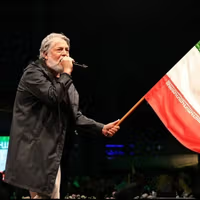
Ali-Akbar Velayati, international affairs adviser to Supreme Leader Ali Khamenei
100%
Ali-Akbar Velayati, international affairs adviser to Supreme Leader Ali Khamenei

Western officials target Iran

Velayati did not name the officials he accused of making anti-Iran remarks, but at the Manama Dialogue conference, senior Western ministers singled out Tehran’s behavior as a regional threat.

“We know that Iran has been obviously a long-term threat to the stability and security across this region, but also more widely,” UK Foreign Secretary Yvette Cooper said at the forum. “In the UK, we have had Iran-backed threats on our streets too.”

German Foreign Minister Johann Wadephul said Berlin, Paris, and London had “to trigger, unfortunately, the snap-back mechanism,” adding that “the behavior of Iran here in the region, and of course also the missile program” would remain central to future talks.

Tehran rejects accusations

Velayati dismissed such remarks as baseless, saying some of the same states criticizing Iran have a record of “supporting killers and terrorists” in Sudan and Yemen. “Those who, with British weapons, assist in the massacres in Sudan cannot speak about Iran’s peaceful role in the region,” he said.

He described Iran as a historic force for stability and solidarity among its neighbors, adding that “small states of the region have always been supported by Iran” and that Tehran has never sought domination over others.

Most Viewed

Ghalibaf defends Iran-US talks amid hardline backlash
1
INSIGHT

Ghalibaf defends Iran-US talks amid hardline backlash

2
INSIGHT

Iran diplomacy wobbles as factions compete to avoid looking soft on US

3
VOICES FROM IRAN

Bread shortages, soaring prices strain households in Iran, residents say

4
ANALYSIS

The politics of pink: how Iran uses cuteness to rebrand violence

5

War-hit homeowners feel abandoned as Iran’s reconstruction aid fades

Banner
Banner

Spotlight

  • Lights out, then gunfire: Witnesses recount Mashhad protest crackdown
    VOICES FROM IRAN

    Lights out, then gunfire: Witnesses recount Mashhad protest crackdown

  • Family told missing teen was alive, then received his body 60 days later
    EXCLUSIVE

    Family told missing teen was alive, then received his body 60 days later

  • Is Iran entering its Gorbachev moment?
    INSIGHT

    Is Iran entering its Gorbachev moment?

  • Iran crackdown reaches cemeteries as graves of slain protesters defaced
    EXCLUSIVE

    Iran crackdown reaches cemeteries as graves of slain protesters defaced

  • Iran diplomacy wobbles as factions compete to avoid looking soft on US
    INSIGHT

    Iran diplomacy wobbles as factions compete to avoid looking soft on US

  • The politics of pink: how Iran uses cuteness to rebrand violence
    ANALYSIS

    The politics of pink: how Iran uses cuteness to rebrand violence

  • Bread shortages, soaring prices strain households in Iran, residents say
    VOICES FROM IRAN

    Bread shortages, soaring prices strain households in Iran, residents say

•
•
•

More Stories

Activist urges unity among opposition groups of Iran, Russia, China

Nov 8, 2025, 17:40 GMT+0

Defeating the authoritarian rule requires learning from democratic societies, dissident activist Masih Alinejad said on Saturday, calling for unity among the opposition groups of Iran, Russia and China against the three allied countries' dictatorships.

The dissident activist made the remarks in Berlin on the sidelines of the annual forum of the World Liberty Congress, a movement she co-founded in 2022 along with Russian activist Garry Kasparov and Venezuelan opposition leader Leopoldo López.

“We intend to increase pressure on dictators by uniting opposition movements from different countries," she said.

Alinejad compared Iran’s compulsory hijab laws and political repression to the Berlin Wall, telling Iran International that Iranians are destroying this wall through their defiance.

The World Liberty Congress is holding its second annual gathering on the sidelines of the Freedom Week marking the 36th anniversary of the fall of the Berlin Wall.

100%

The gathering has brought together 180 participants from 60 countries including opposition figures, lawmakers, and rights activists from Iran, Russia, Venezuela, and China.

The event aims to coordinate global strategies to defend democracy and counter the spread of autocracy.

Practicing democracy in exile

Alinejad said the three founders of the World Liberty Congress had decided not to stand in this year’s internal elections to demonstrate democratic accountability.

“Mr. Leopoldo López, Garry Kasparov and I oppose Khamenei, Maduro and Putin, and to prove we are not like the dictators, we told the Berlin parliament that in the World Liberty Congress elections we will step aside so others can present themselves as the congress’s president, vice president and secretary this year.”

“This is an exercise to show democratic countries that we can hold elections and free ourselves from dictators,” added Alinejad.

The activist previously defined the World Liberty Congress as an alternative to the United Nations, which she said "has become a place to unite dictators."

Iran plotted to kill Israeli envoy to Mexico - Axios

Nov 7, 2025, 15:09 GMT+0

Iran's Islamic Revolutionary Guard Corps sought to kill the Israeli ambassador to Mexico but the plot was thwarted over the summer by Mexican security forces according to US and Israeli officials cited by Axios on Friday.

The plot to assassinate ambassador Einat Kranz-Neiger began at the end of 2024, Axios cited a source with knowledge of the matter as saying, and was led by a member of the IRGC Quds Force's secretive Unit 11000.

The operative, according to the source, spent several years overseeing agents from Iran's embassy in Venezuela.

"The plot was contained and does not pose a current threat," the outlet quoted a US official as saying.

"This is just the latest in a long history of assassination attempts by Iran around the world targeting diplomats, journalists, dissidents, and anyone who disagrees with them — something that should deeply concern every country where there is an Iranian presence," the US official added, according to Axios.

Israel and Iran have been arch-enemies since the 1979 Islamic Revolution made enmity to the Jewish State a key element of state ideology.

Their confrontation had mostly been contained to indirect fighting between Israel and Iran-backed Islamist armed groups in the Middle East including Hezbollah in Lebanon and Hamas in the occupied Palestinian territories.

The October 7, 2023 attacks on Israel led by Hamas helped propel the conflict into a direct showdown which culminated in a 12-day war in June.

Israel launched an air strike on Iran's embassy in Damascus in April 2024 killing several senior IRGC personnel and was widely believed to have carried out the assassination of Hamas senior official Ismail Haniyeh in Tehran in July last year.

A US federal court last week handed out lengthy sentences to two men convicted of seeking to kill US-based Iranian dissident Masih Alinejad in a plot prosecutors said was orchestrated by the IRGC.

Israel, Axios added, thanked Mexico for foiling the plot.

"The Israeli intelligence and security community will continue to work tirelessly, in full cooperation with security and intelligence agencies around the world, to thwart terror threats from Iran and its proxies against Israeli and Jewish targets worldwide," Axios quoted Israeli Foreign Ministry spokesperson Oren Marmorstein as saying.

US warns Iraq over cabinet posts for Iran-backed armed groups, source says

Nov 7, 2025, 11:36 GMT+0

Washington has warned Baghdad that it will not recognize Iraq’s next government if any ministries are handed to armed factions linked to the Islamic Republic, a source in Iraq’s Kurdistan region told Iran International on Friday.

The message was delivered to Iraqi officials as political negotiations over the formation of a new cabinet intensified ahead of the November 11 parliamentary elections, the source said.

“If any ministry is given to militias affiliated with Iran, the United States will refuse to recognize the government.”

Disputes over presidency and premiership

Responding to comments by some Sunni leaders about the presidency, the source said Shiite and Kurdish blocs had already agreed that the post would go to the Kurds, with Tehran also approving the arrangement. However, he said the possibility of appointing a Sunni figure as prime minister “would raise concern in Tehran.”

All Shiite factions, according to the source, oppose another term for Mohammed Shia al-Sudani as prime minister, though Mark Safaya, US President Donald Trump’s representative for Iraq, “has a personal relationship with Sudani and may influence the process.”

Unlike in previous election cycles, the source added, the Islamic Republic “no longer holds the same sway” in deciding Iraq’s leadership. “This time, the United States and European countries are far more determined to shape the outcome.”

Election dynamics and foreign pressure

Reuters reported on November 4 that Sudani has entered the campaign with growing public support, seeking to portray himself as capable of maintaining balanced ties with both Washington and Tehran. The 55-year-old prime minister has focused his campaign on improving public services and hopes to secure the largest bloc in parliament.

As the country moves toward the vote, Sudani’s government faces mounting US pressure to curb Iran-backed militias.

Sudani has said previously that disarming these militias would be impossible as long as the US-led coalition remains in Iraq.

Iran supports Iraqi groups through financing, training, and arms, primarily focusing on Shia militias that are often integrated into the official Popular Mobilization Forces (PMF). This support helps groups like the Badr Organization and Kata'ib Hezbollah exert military and political influence, though some factions like Harakat Hezbollah Al-Nujaba have focused more on military operations. The support allows Iran to pursue its regional objectives, gain influence, and destabilize Iraqi politics while coordinating attacks against US forces.

IAEA chief says Iran still capable of building nuclear weapons

Nov 7, 2025, 08:29 GMT+0

Iran still possesses enough highly enriched uranium and the technical capability to build nuclear weapons, despite the Israeli and US strikes that damaged its enrichment sites, Rafael Mariano Grossi, the head of the UN’s International Atomic Energy Agency, said on Thursday.

Although the June attacks on Natanz, Isfahan, and Fordo “severely damaged” Iran’s nuclear program, the country retains the knowledge and material “to manufacture a few nuclear weapons,” Grossi told FRANCE 24.

“To reconstruct that industrial technological base, Iran would need time,” Grossi said, adding that the strikes marked a sharp shift “from diplomacy to the use of force” and urging a return to negotiations. “Diplomacy is the only path toward a durable solution,” he said.

Politicized report and call for renewed talks

Grossi dismissed remarks that an IAEA safeguards report provided justification for the strikes, saying it had been politicized and contained nothing new. He also rejected suggestions that artificial intelligence influenced the agency’s conclusions, emphasizing that “our findings are made by human inspectors, not machines.”

The IAEA’s Board of Governors found Iran in non-compliance with its nuclear obligations on June 12 after the agency said Tehran had failed to explain the presence of undeclared nuclear material at multiple sites. Inspectors last verified more than 400 kilograms of highly enriched uranium in Iran shortly before the June conflict began.

In late September, 70 members of Iranian parliament in a letter to the heads of the branches of government and the Supreme National Security Council requested that, by changing Supreme Leader Ali Khamenei’s previous fatwa and in order to create deterrence, the Islamic Republic undertake the manufacture and possession of a nuclear bomb.

In recent months, and especially after the 12-day war with Israel, several officials of the Islamic Republic have criticized Grossi’s reports. Some called him a “Mossad agent,” and even Kayhan -- a newspaper overseen by Khamenei’s representative -- demanded his execution on charges of spying for Israel.

Western charity scrutiny tests line between faith, foreign influence

Nov 6, 2025, 21:40 GMT+0
•
Shahram Kholdi

A British inquiry into a pro-Iran charity reflects a mounting Western struggle to balance freedom of religion with efforts to confront Iranian political influence as Tehran's ties with Western Europe and North America plumb new lows.

The UK Charity Commission’s launched a statutory inquiry last week into the Islamic Human Rights Commission Trust's transfer of large six-figure annual sums into publications and events of a private company listed at the same address.

Cooperation of this kind is not inherently improper, but it demands transparency and demonstrable separation of purpose.

This controversy is not unique.

Across Europe and North America, governments have investigated institutions they suspect of channeling Iranian influence or ideological extremism while presenting themselves as advocates against Islamophobia and imperialism.

Lawful activism or faith-based advocacy can be conflated with subversion, leading to limits on freedoms a liberal democracy seeks to protect.

But Islamophobia can also be invoked as a rhetorical shield against legitimate oversight, discouraging scrutiny through accusations of prejudice.

Getting the balance right is crucial—and countries have tried to do so in different ways.

Germany: constitutional patriotism

Germany, grounded in its doctrine of wehrhafte Demokratie, acted decisively on July 24, 2024, by banning the Islamic Centre Hamburg (IZH) for functioning as a proxy of the Iranian state and ideological partner of Hezbollah.

Fifty-three premises were searched, assets seized, and the director expelled. Berlin’s message was plain: freedom of worship does not extend to institutions operating as arms of foreign governments.

Sweden: Law over rhetoric

On February 3, 2025, Sweden withdrew state funding from the Imam Ali Islamic Centre in Stockholm after confirming its use for Iranian espionage. 

The move, conducted within the bounds of legal proportionality, underscored that liberty of religion is strengthened—not weakened—by the rule of law.

Denmark: oversight before crisis

When reports surfaced of Iranian-linked transfers to Copenhagen’s Imam Ali Mosque, Denmark’s parliament opened Question S 770 (February 28, 2025), seeking government assurances of transparency.

This pre-emptive scrutiny exemplified democratic vigilance through inquiry rather than decree.

France: faith vs politics

France, long the sentinel of laïcité, dissolved Centre Zahra France on March 20, 2019, for glorifying armed movements and inciting hatred—a decision later upheld by the Lille Administrative Court.

Paris reaffirmed that belief may be free, but the politicization of faith is not protected under law.

The Netherlands: intelligence and prevention

In March 2025, Dutch and Belgian security agencies jointly reported Iranian intimidation and influence operations via religious networks. Their method—monitoring and early warning rather than dissolution—illustrates how intelligence can achieve restraint without spectacle.

Canada: strategic resilience

Canada has pursued a hybrid approach of fiscal regulation and national-security vigilance. The RCMP confirmed expanded investigations in its June 4, 2025, statement, while the Montréal Police Service increased protection for both Muslim and Jewish institutions amid geopolitical tension.

The 2019 revocation of charitable status for the Islamic Shia Assembly of Canada remains an instructive precedent that financial oversight can neutralise ideological capture without impugning religious liberty.

Patterns and implications

Across these jurisdictions, three convergent lessons emerge.

First, democratic states must recognise that the rhetoric of anti-discrimination can be co-opted to shelter extremism.

Second, the line between anti-Zionism and antisemitism remains a defining fault line. Regulators face a daunting challenge in distinguishing between political expression and the propagation of hatred.

Third, effective counter-strategy depends upon clarity of evidence and transparency of law. Germany and France favour enforcement; Sweden and Denmark rely on procedural oversight; Canada employs intelligence and fiscal scrutiny.

Their diverse methods share one aim: to protect the neutrality of civic space from ideological manipulation.

The British Context

The United Kingdom now faces its own test.

An official warning leveled in March and now the inquiry into the Islamic Human Rights Commission Trust are not isolated events but part of this wider democratic reckoning.

The Charity Commission seeks to determine whether funds raised under the banner of human rights were used for non-charitable political ends.

The Trust’s published accounts record £324,228 in 2022 and £416,246 in 2023 transferred to its corporate counterpart for “projects undertaken on behalf of the Charity.”

The question is not one of theology but of governance: whether charitable privilege can coexist with political partisanship, and whether appeals to anti-imperial justice can obscure the advance of intolerant ideology.

Britain’s tradition favors law over proclamation and balance over reaction. In that spirit, the task of the Charity Commission is to reaffirm the principle that transparency and accountability are the guardians of liberty.

Different approaches

Decisive action need not be punitive; proportionate inquiry and public explanation are the hallmarks of democratic strength.

If Germany has wielded the sword, France the decree, Sweden the warrant, and Canada the audit, then Britain may hold the scale—steady, balanced, incorruptible. For charity, like liberty, perishes less from attack than from misuse.

It is possible, indeed necessary, to tread with such care that the sceptred isle may once again say, in the calm majesty of her conscience, that she has defended both her charities and her soul.