• العربية
  • فارسی
Brand
  • Iran Insight
  • Politics
  • Economy
  • Analysis
  • Special Report
  • Opinion
  • Podcast
  • Iran Insight
  • Politics
  • Economy
  • Analysis
  • Special Report
  • Opinion
  • Podcast
  • Theme
  • Language
    • العربية
    • فارسی
  • Iran Insight
  • Politics
  • Economy
  • Analysis
  • Special Report
  • Opinion
  • Podcast
All rights reserved for Volant Media UK Limited
volant media logo

US court sentences two men to 25 years for plot to kill Iranian dissident

Oct 29, 2025, 17:44 GMT+0Updated: 00:05 GMT+0
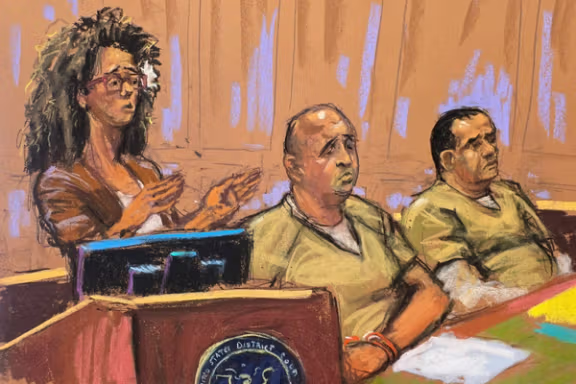
Prominent New York-based dissident and journalist Masih Alinejad makes a witness statement next to Polad Omarov and Radar Amirov, who were convicted of involvement in an unsuccessful Iran-backed plot to kill her, as they attend their sentencing at federal court in New York, October 29, 2025 in this courtroom sketch.

A federal judge in Manhattan on Wednesday sentenced two mobsters convicted of plotting to assassinate Iranian American journalist Masih Alinejad at her New York home to 25 years in prison.

The case is one of the most high-profile yet dealing with Iran's so-called transnational repression, or bid to deploy violence to silence its critics abroad.

Prosecutors had argued that Rafat Amirov, 46, of Iran and Polad Omarov, 41, of Georgia were senior figures in a Russian crime group enlisted by members of Iran's Revolutionary Guards to kill Alinejad.

The men were convicted in March after a two-week trial that included testimony from Alinejad and a hired gunman turned witness for the prosecution.

Alinejad, an author and Voice of America contributor, said she would attend the sentencing to deliver an impact statement.

Pleading guilty

The FBI disrupted the assassination attempt after surveillance footage revealed suspicious activity near Alinejad’s residence. She was away at the time, a factor that may have saved her life.

Khalid Mehdiyev, a member of the Thieves in Law gang who was allegedly due to carry out the killing, said he received orders from the two to kill the journalist who uses her platform to expose the Islamic Republic’s repression.

He pleaded guilty to attempted murder and gun charges.

Alinejad, who has long criticized Iran’s compulsory hijab laws and its treatment of women, said she will speak at the sentencing not just for herself, but "for every woman who refuses to be afraid.”

Prominent New York-based dissident and journalist Masih Alinejad holds a sunflower during the sentencing of Polad Omarov and Radar Amirov, who were convicted of involvement in an unsuccessful Iran-backed plot to kill her, at federal court in New York, October 29, 2025 in this courtroom sketch.
100%
Prominent New York-based dissident and journalist Masih Alinejad holds a sunflower during the sentencing of Polad Omarov and Radar Amirov, who were convicted of involvement in an unsuccessful Iran-backed plot to kill her, at federal court in New York, October 29, 2025 in this courtroom sketch.

The FBI’s Counterintelligence Division and its Iran Threat Task Force led the investigation with support from the NYPD and Czech authorities.

The Justice Department said Alinejad has previously been the target of IRGC-backed plots to kidnap or kill her for her activism, which includes highlighting Iran’s human rights record and advocating against compulsory hijab laws.

Most Viewed

Ghalibaf defends Iran-US talks amid hardline backlash
1
INSIGHT

Ghalibaf defends Iran-US talks amid hardline backlash

2
INSIGHT

100 days after carnage: Iran economy reels from war, inflation, unemployment

3
INSIGHT

A nation in limbo: 100 days after the massacre, has the world moved on?

4
ANALYSIS

From instability to influence: Pakistan’s pivotal role in US-Iran diplomacy

5
ANALYSIS

100 days on: why Iran’s January protests spread across social classes

Banner
Banner

Spotlight

  • War-hit homeowners feel abandoned as Iran’s reconstruction aid fades

    War-hit homeowners feel abandoned as Iran’s reconstruction aid fades

  • 100 days on: the anatomy of Iran’s January crackdown
    INSIGHT

    100 days on: the anatomy of Iran’s January crackdown

  • Ghalibaf defends Iran-US talks amid hardline backlash
    INSIGHT

    Ghalibaf defends Iran-US talks amid hardline backlash

  • 100 days on: why Iran’s January protests spread across social classes
    ANALYSIS

    100 days on: why Iran’s January protests spread across social classes

  • From instability to influence: Pakistan’s pivotal role in US-Iran diplomacy
    ANALYSIS

    From instability to influence: Pakistan’s pivotal role in US-Iran diplomacy

  • A nation in limbo: 100 days after the massacre, has the world moved on?
    INSIGHT

    A nation in limbo: 100 days after the massacre, has the world moved on?

•
•
•

More Stories

Imprisoned dissident mocks Khamenei's advice to Trump on 'No Kings' rallies

Oct 29, 2025, 16:30 GMT+0

Veteran political activist and prisoner Abolfazl Ghadyani published a letter from Tehran’s Evin Prison criticizing Iran’s Supreme Leader Ali Khamenei's advice to Trump on how to deal with recent domestic protests.

The veteran theocrat had referenced the “No Kings” protests across the United States on Oct. 18 in a recent speech, calling on US President Donald Trump to listen to demonstrators and refrain from interfering in other countries.

“If you’re that capable, calm them down, send them back to their residences, and don’t interfere in the affairs of other countries,” Khamenei had said.

Ghadyani, 80, who is serving a prison sentence for “propaganda against the regime,” including a 2019 sentence for insulting Khamenei, said the 86-year-old ruler was in no place to lecture Trump.

“Sooner or later, the Iranian people will rise and dismantle the oppressive, authoritarian and anti-national system of Ali Khamenei,” Ghadyani wrote.

“The most peaceful path forward is for him to relinquish his grip on power, seek forgiveness from the Iranian people, and allow a referendum to establish a government of the people’s choosing.”

Insulting Khamenei, considered by Iran's theocratic establishment to be a holy figure, is a crime and Ghadyani has few peers among prominent critics in leveling direct attacks on him.

Abolfazl Ghadyani
100%
Abolfazl Ghadyani

A former revolutionary turned outspoken dissident, he has faced multiple convictions for his political writings and public statements.

Ghadyani said Khamenei reveals his own hypocrisy and authoritarianism by urging the US president, in his interpretation, to suppress dissent as he does in Iran.

“This criminal autocrat unwittingly exposes his own nature by urging the US president to suppress dissent as he and his anti-people allies do in Iran,” he wrote.

Ghadyani challenged Khamenei’s concept of national security, arguing that it focuses solely on preserving power rather than protecting the Iranian people.

“For tyrants like him, national security and the safety of the people are meaningless. True security lies in the absence of authoritarian rule,” he wrote.

‘Let the public vote’

Authorities in Iran, where Khamenei is that ultimate decision maker, have suppressed with deadly force recurring rounds of anti-government protests in recent decades but have long bashed the rights records of Israel and the United States.

A long-time critic of Khamenei, Ghadyani dared the Iranian leader to test his popularity through a public vote.

“Khamenei dares not admit that over 95 percent of Iranians oppose him and the Islamic Republic. If he denies this, let him, just once, submit himself to a public vote and show the world how deeply the Iranian people reject him,” Ghadyani said.

His latest imprisonment follows a series of letters and speeches in which he has openly called for Khamenei’s resignation and the dismantling of Iran’s ruling system.

Iran continues to grapple with the aftermath of a punishing 12-day war in June against Israel and the United States and the the reimposition last month of UN sanctions triggered by Britain, France and the United Kingdom.

Iran steps up imports of missile fuel precursor from China - CNN

Oct 29, 2025, 16:21 GMT+0

Iran-bound Chinese shipments of sodium perchlorate, a key ingredient in ballistic missile fuel, have ramped up in recent weeks according to European intelligence sources cited by CNN on Wednesday.

Iran's arsenal was badly depleted by Israeli attacks and retaliatory salvos during a 12-day war in June, but Iran may be seeking to replenish its stocks despite European-triggered UN sanctions which resumed last month and aim to bar arms transfers.

But sodium perchlorate appears to fall beyond the ban, even as Russian and Iran opposed the renewed curbs and argue against any fresh hostilities in the region.

Ten to twelve shipments of the material began arriving from China in Iran on September 29, the European intelligence sources cited by CNN said, and contain around 2,000 tons of the material which can be turned into solid propellant for mid-range conventional missiles.

Iran has rejected reported US demands that it curb the range of its missiles to achieve any peace deal, calling the requests a non-starter which curbs its defense.

Several of the vessels are already subject to US sanctions for earlier transfers, the sources added, but there was no indication of Chinese state involvement.

Beijing reaction

Reached for comment by CNN, China's foreign ministry said it was not familiar with the situation but that Beijing has “consistently implemented export controls on dual-use items in accordance with its international obligations and domestic laws and regulations.”

It further called for the lingering standoff between Iran and the West over Tehran's disputed nuclear program to be resolved through dialogue, calling the latest sanctions “unconstructive” and a “serious setback”.

Unofficial accounts pointed to sodium perchlorate and other compounds imported from China for Iran’s missile program as the cause of an April 26 blast at the Bandar Abbas port which killed 57 people. Authorities have denied any military link.

Iran rolls out 'green tick' site to woo back émigrés but risks abound

Oct 29, 2025, 16:01 GMT+0
•
Negar Mojtahedi

Iran’ says a new website aims to quickly reassure Iranians abroad they can return home risk-free as it tries to coax back expats to revive a grim economy, but analysts say safety remains elusive.

Under a new law Iranians will be able to enter their details on a Foreign Ministry’s portal called Porseman to check whether they are “problem-free” to travel to Iran, top envoy Abbas Araghchi said according to state media.

Those cleared receive a green tick indicating they have no outstanding legal or security issues. Araghchi went further, saying that if a person with a green tick is arrested, “those who arrested them will be prosecuted.”

He described the plan as part of an effort to “decriminalize the mindset” of Iranians abroad and encourage smoother travel home.

The statement immediately drew ridicule online.

Iranian journalist Hossein Bastani wrote on X that the idea was absurd, asking where the Foreign Ministry could “take action” against more powerful armed organs of state power like the Intelligence Ministry or the Islamic Revolutionary Guard Corps (IRGC).

Competing state bodies staffed variously by clerics, security men, spies and conservative bureaucrats vie hotly for influence in the Islamic theocracy.

US diplomats have frequently criticized the foreign ministry as beholden to Supreme Leader Ali Khamenei and the IRGC.

Authorities are not the authorities

Analysts interviewed by Iran International said the Porseman portal may be subject to the vagaries of Iran's divided system.

Patrick Clawson, director at the Washington Institute for Near East Policy, said the initiative ignores the fundamental problem: that “the authorities are not the authorities.”

Different agencies in Iran, he said, often act without coordination or oversight, meaning a traveler could be cleared by one branch of government and still detained by another.

That lack of hierarchy, Clawson added, has long frustrated both diplomats and negotiators dealing with Tehran.

“You could have eight agencies saying you’re fine,” he said, “and the ninth one arrests you.” Clawson dismissed Araghchi’s claim of prosecuting the Revolutionary Guard as political theater, calling it another example of how little power the foreign minister actually holds in Iran’s decision-making structure.

'No green tick will protect you'

Alex Vatanka, head of the Iran Program at the Middle East Institute, said the Islamic Republic has spent years trying to convince Iranians abroad to visit and invest, but trust is almost nonexistent. The foreign ministry can make assurances, he said, but “if another branch of the system decides you’re a target, no green tick will protect you.”

That fear is not unfounded. Lebanese academic Nizar Zakka and Australian researcher Kylie Moore-Gilbert, who both described their ordeals in interviews with Iran International's podcast Eye for Iran— were invited to Iran by senior officials for conferences and academic exchanges, only to be later arrested and imprisoned on spurious charges.

Their cases remain emblematic of how one arm of the state can extend invitations while another turns those same visitors into hostages.

Vatanka believes the initiative stems from desperation to attract tourism and foreign currency as Iran’s economy falters.

“They look at Turkey, the UAE, even Saudi Arabia making billions from tourism, while Iran—with all its history and culture—gets almost nothing,” he said.

“But Iran treats people as currency. Hostage-taking has been part of its political toolbox since 1979, and that’s not something a website can fix.”

Former US diplomat Alan Eyre said the timing of the Porseman rollout also reflects President Masoud Pezeshkian’s attempt to project normalcy after a bruising year marked by snapback sanctions, a 12-day war, and deepening isolation.

“They’re trying to show Iran is open for tourism and investment,” Eyre told Iran International, “but the executive branch is weak and can’t control the security forces that actually run things.”

Eyre said the effort fits a familiar pattern: after international crises, the clerical establishment launches cosmetic outreach to soften its image abroad. But, he added, “beneath that surface message of safety, you still have a system that arrests its own citizens and uses them as bargaining chips.”

The US State Department has long advised US citizens not to travel to Iran, citing risks of arbitrary arrest, detention, and hostage-taking, and the current Level 4 “Do Not Travel” advisory remains in place.

For now, Porseman offers reassurance only on paper. In practice, the same system that issues a green tick cannot resolve the uncertainty that defines travel to Iran — a country where returning home still carries unpredictable risk.
Legal case filed over ‘assassination’ comment from ex-president Rafsanjani's daughter

Oct 29, 2025, 13:08 GMT+0

A legal case has been filed against Faezeh Hashemi, daughter of former president Akbar Hashemi Rafsanjani, after she said in an interview that her father was assassinated for criticizing Iran’s leadership, ISNA reported on Wednesday.

The judiciary said the case was launched hours after the interview appeared online and that Hashemi has been summoned to court to explain her remarks.

In the interview, Hashemi alleged that her father, one of the founders of the Islamic Republic and a central figure in its early leadership, was deliberately killed because he had become a “thorn in the eye” of Iran’s rulers. She said he was removed for siding with the people and speaking out against the country’s direction.

Rafsanjani, who served as president from 1989 to 1997, died in January 2017 while swimming at a government facility in Tehran. Authorities said at the time that he had suffered a heart attack, but members of his family have repeatedly voiced doubts about that explanation. They have cited missing CCTV footage, the disappearance of his diaries, and the lack of a post-mortem examination as reasons for their concern.

Rafsanjani was a powerful figure in Iran’s post-revolution politics and a key backer of Supreme Leader Ali Khamenei’s rise to power in 1989. But the two men later fell out, particularly after the disputed 2009 election, when Rafsanjani supported opposition candidates and called for political openness. His children have said that pressures on him increased in his final years.

Iran blocks access to Pasargadae complex on ‘Cyrus Day’

Oct 29, 2025, 10:12 GMT+0

Iranian authorities blocked roads and entrances to the Pasargadae archaeological complex, including the Tomb of Cyrus the Great, as some Iranians marked the unofficial “Cyrus Day” on Wednesday.

Witnesses said police, Basij militia and Revolutionary Guards manned checkpoints and turned people back from access routes in Fars province.

Iran has long declined to recognize Cyrus Day in its official calendar, and has in past years restricted access to Pasargadae and, at times, Persepolis to discourage large gatherings around the Achaemenid-era sites.

Security curbs around the October 28-31 anniversary -- linked by some accounts to Cyrus’s entry into Babylon in 539 BCE -- have become routine since large crowds rallied at the tomb in 2016.

The latest closures came amid renewed public debate inside Iran over how to commemorate pre-Islamic heritage.

Ghader Ashna, secretary of the Public Culture Council at the culture ministry, told the ISNA news agency that over the past year no formal request had reached his body to add “Cyrus Day” to the national calendar, but said any proposal would be reviewed by a dedicated working group and the Supreme Council of the Cultural Revolution.

Separately, ISNA quoted cultural scholar Bahman Namvar-Motlagh as saying that honoring Cyrus did not contradict Iran’s Islamic identity and could help bolster social cohesion if handled without “excess or confrontation.”

He framed interest in Cyrus among younger Iranians as part of a broader search for common symbols of national unity in a tense regional environment.

  • Exiled prince calls for ‘Cyrus Accords’ in post-Islamic Republic Iran

    Exiled prince calls for ‘Cyrus Accords’ in post-Islamic Republic Iran

  • Iran’s ancient sites face rising land subsidence risk, experts warn

    Iran’s ancient sites face rising land subsidence risk, experts warn

  • Trump is no Cyrus: Iran envoy swats down Gaza peace plaudits

    Trump is no Cyrus: Iran envoy swats down Gaza peace plaudits

  • Authorities block Iranians from ancient sites ahead of Cyrus the Great day

    Authorities block Iranians from ancient sites ahead of Cyrus the Great day

Rights activist and Nobel Peace laureate Narges Mohammadi marked the day with a message on Instagram describing Cyrus as a “cultural symbol” associated with tolerance and justice, and contrasted that legacy with Iran’s record on political freedoms and capital punishment.

Exiled opposition figure Reza Pahlavi, the son of Iran’s last shah, told supporters at a Toronto event earlier this month that a future post-Islamic Republic order should elevate the 2020 Abraham Accords into what he called “Cyrus Accords,” recasting Iran as a promoter of regional peace rather than conflict.

Cyrus the Great, who founded the Achaemenid Empire in the 6th century BCE, is widely cited in Iran’s schools and popular culture as a touchstone of nationhood. The Pasargadae site and Persepolis -- both UNESCO-listed -- draw steady domestic and foreign tourism, though access has at times been restricted on sensitive dates.

In 2024, heritage outlets connected to the state reported fencing and concrete barriers on the road to Pasargadae ahead of the October commemorations.

Iranian scientists and officials have separately warned that land subsidence from groundwater over-extraction is emerging as a long-term threat to several heritage sites, including areas around Persepolis and the Tomb of Cyrus.

Geologists cited this month reported cracks and surface fissures in Fars and other provinces, saying cumulative deformation could damage historic fabric over years if water withdrawals are not curbed.

Cyrus Day is not an official holiday, but diaspora communities and some Iranians at home mark it annually with cultural events and online campaigns.

The Islamic Republic’s leadership has historically promoted an Islamic “ummah” identity and has sometimes viewed mass gatherings at pre-Islamic monuments as politically sensitive, especially amid periodic anti-government protests.

Iranian state bodies did not immediately issue a statement on Wednesday’s access limits in Fars.