• العربية
  • فارسی
Brand
  • Iran Insight
  • Politics
  • Economy
  • Analysis
  • Special Report
  • Opinion
  • Podcast
  • Iran Insight
  • Politics
  • Economy
  • Analysis
  • Special Report
  • Opinion
  • Podcast
  • Theme
  • Language
    • العربية
    • فارسی
  • Iran Insight
  • Politics
  • Economy
  • Analysis
  • Special Report
  • Opinion
  • Podcast
All rights reserved for Volant Media UK Limited
volant media logo

Iranian police open fire on family in car, killing child

Oct 21, 2025, 13:21 GMT+1Updated: 00:09 GMT+0
Zolfaghar Sharafi
Zolfaghar Sharafi

A six-year-old boy was killed in southwest Iran after police fired on a family car and abandoned the wounded at the scene, local sources told Iran International, suggesting that officers’ failure to take him to hospital and leaving his family by the roadside led to his death.

Rights groups had previously reported that the child, identified as Zolfaghar Sharafi, was killed by direct police fire. New information suggests that officers left the scene without assisting the wounded boy or his family.

The sources said police allegedly opened fire after stopping the vehicle for lacking a license plate, injuring Zolfaghar and his younger sister, Tahani.

They said the officers then departed, leaving the injured family by the roadside. The boy died at the scene from heavy bleeding after failing to receive medical treatment in time.

Tahani, who sustained gunshot wounds to her arms and pelvis, was later taken to Ahvaz Golestan Hospital, where the cause of injury was recorded as a “conflict with the state,” according to sources.

Her family was told to pay 150 million tomans (around $1,400) for surgery, which was delayed for three days due to financial hardship before being performed at another hospital.

The sources, citing statements by government officials, said that the officers involved in the shooting have been arrested, but no information has yet been released about their identities or current status.

Rights organizations have documented repeated incidents of security forces firing at civilian vehicles in recent years, often resulting in the deaths of passengers, including children.

The killing of Zolfaghar Sharafi adds to a growing list of minors allegedly shot by security personnel in various provinces, incidents that have rarely led to public accountability.

Most Viewed

Ghalibaf defends Iran-US talks amid hardline backlash
1
INSIGHT

Ghalibaf defends Iran-US talks amid hardline backlash

2
INSIGHT

A nation in limbo: 100 days after the massacre, has the world moved on?

3
ANALYSIS

From instability to influence: Pakistan’s pivotal role in US-Iran diplomacy

4
ANALYSIS

100 days on: why Iran’s January protests spread across social classes

5

War-hit homeowners feel abandoned as Iran’s reconstruction aid fades

Banner
Banner

Spotlight

  • War-hit homeowners feel abandoned as Iran’s reconstruction aid fades

    War-hit homeowners feel abandoned as Iran’s reconstruction aid fades

  • 100 days on: the anatomy of Iran’s January crackdown
    INSIGHT

    100 days on: the anatomy of Iran’s January crackdown

  • Ghalibaf defends Iran-US talks amid hardline backlash
    INSIGHT

    Ghalibaf defends Iran-US talks amid hardline backlash

  • 100 days on: why Iran’s January protests spread across social classes
    ANALYSIS

    100 days on: why Iran’s January protests spread across social classes

  • From instability to influence: Pakistan’s pivotal role in US-Iran diplomacy
    ANALYSIS

    From instability to influence: Pakistan’s pivotal role in US-Iran diplomacy

  • A nation in limbo: 100 days after the massacre, has the world moved on?
    INSIGHT

    A nation in limbo: 100 days after the massacre, has the world moved on?

  • Number Of Minors Killed In Iran Protests On The Rise

    Number Of Minors Killed In Iran Protests On The Rise

  • Dreams cut short: the slain children Tehran never mentions

    Dreams cut short: the slain children Tehran never mentions

•
•
•

More Stories

Iran will turn region into 'hell' if attacked, Guards commander warns

Oct 21, 2025, 12:23 GMT+1

Iran would unleash a devastating response to any assault on its territory, the commander of Iran's Islamic Revolutionary Guard Corps (IRGC), Major General Mohammad Pakpour, said on Tuesday.

“If any aggression is committed against Iran, our response will be stronger than the 12-day war and we will turn the region into hell for the enemy,” Pakpour said, quoted by state broadcaster IRIB.

He added that Iran’s missile systems had performed with “power and precision” during the June war with Israel.

Pakpour made the remarks during a meeting in Tehran with Iraq’s National Security Adviser Qasim al-Araji.

According to Iranian state media, Al-Araji emphasized Iraq’s commitment to security cooperation with Iran and saying his country would not allow its territory to be used for hostile acts against Tehran.

Iraq’s National Security Adviser Qasim al-Araji (L) and Revolutionary Guard commander Mohammad Pakpour (R) (undated)
100%
Iraq’s National Security Adviser Qasim al-Araji (L) and Revolutionary Guard commander Mohammad Pakpour (R)

Iran’s top military officials have repeatedly warned they are monitoring regional adversaries and will respond forcefully if provoked.

Armed Forces Chief of Staff Abdolrahim Mousavi said on Monday that Tehran was not seeking war but would deliver a completely different response if attacked.

An Iranian lawmaker also warned on Tuesday that Iran would destroy enemy bases in the region if attacked.

“If the enemy is not attacking now, it is because it cannot,” Esmaeil Siavoshi said on Tuesday, according to state media. “It knows that if it attacks, we will destroy all its bases in the Persian Gulf.”

Pakpour said cooperation between Iran and Iraq was essential to prevent foreign interference and to ensure border security, adding that both countries had agreed to strengthen coordination through a joint field committee.

Iran government says hijab cannot be restored by force

Oct 21, 2025, 10:53 GMT+1

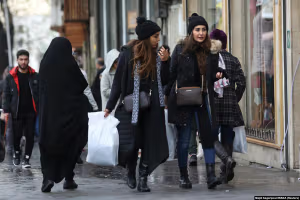
Iran’s government spokesperson said on Tuesday that the administration does not believe coercion can restore compliance with Iran’s hijab laws, amid renewed debate over enforcement and the deployment of tens of thousands of volunteers in Tehran.

Speaking at her weekly press briefing, Fatemeh Mohajerani said, “Hijab cannot be restored to society by force... The president has repeatedly said that we certainly cannot bring hijab back to people through coercion.”

She added that the government respects all existing laws but emphasized that social norms should be upheld through cultural engagement rather than force.

Mohajerani added that the government seeks to prevent the hijab debate from deepening social divisions.

“We must ensure,” she said, “that defending social values does not come at the cost of dividing our people.”

“We are a Muslim society,” she pointed out. “We must take care not to create divisions. While we believe inappropriate public behavior should be addressed, it is something that requires the cooperation of all citizens.”

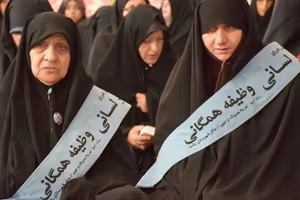
Her remarks came after Tehran’s Promotion of Virtue and Prevention of Vice headquarters said this month that 80,000 trained volunteers would be deployed across the capital as part of a new “hijab and chastity situation room.”

The initiative, announced by conservative officials, will rely on local monitoring and cooperation with cyber police and prosecutors.

No extra budget for hijab enforcement

Mohajerani also denied that any dedicated funding had been assigned for the recently announced mobilization, saying that “no special budget has been allocated for such programs.”

She added that Iran’s Supreme National Security Council (SNSC) -- headed by the president -- remained the ultimate authority on matters related to social order and security.

The new hijab enforcement drive has drawn concern among reformist politicians and clerics who warn that policing public behavior risks further division.

Cleric Abdolkarim Behjatpour, a senior member of Iran’s Institute for Islamic Culture and Thought, told ILNA news agency this week that if the campaign “turns into arrests and imprisonment, it will harm the system.”

He said moral guidance “must be delivered politely, with compassion and dignity, not through enforcement that creates social rifts.”

Another senior cleric and member of the Society of Seminary Teachers in Qom, Mohsen Faghihi, said on Tuesday that “inviting people to observe hijab should not involve confrontation, morality patrols, or imprisonment,” warning that such measures only create tension and division.

However, Abbas Ka'bi, a senior cleric and member of Iran’s Assembly of Experts, warned earlier this week against what he described as neglect over hijab enforcement, calling it a religious and legal duty of all state institutions.

He described hijab as an asset "protecting Iran’s Islamic identity from Western moral decline," and urged coordinated, well-planned action by cultural, security, and judicial bodies to prevent what he called the spread of immorality.

  • Iran says hijab laws remain in force amid debate over enforcement

    Iran says hijab laws remain in force amid debate over enforcement

  • Iran to mobilize 80,000 volunteers for hijab campaign, official says

    Iran to mobilize 80,000 volunteers for hijab campaign, official says

  • Iran business closures mark renewed crackdown on gender mixing, veil

    Iran business closures mark renewed crackdown on gender mixing, veil

  • Hardliners fault Iran government for lax hijab enforcement

    Hardliners fault Iran government for lax hijab enforcement

Since the 2022 death of Mahsa Amini in the custody of Iran’s morality police, enforcing compulsory hijab has become increasingly difficult, and the state’s ability to impose the rules has sharply eroded, particularly in major cities.

Since then, many women have continued to appear unveiled in public despite warnings, fines, and the return of hijab patrol vans, turning defiance into a daily act of resistance.

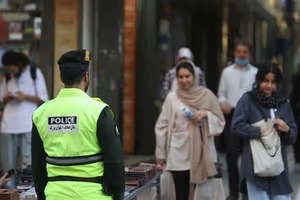
In recent months, however, authorities have revived enforcement drives through mobile patrol vans, increased fines, and business closures targeting cafés and shops accused of noncompliance.

Judiciary spokesman Ali-Asghar Jahangir said earlier this month that hijab laws remain in force, though enforcement methods have shifted toward targeting businesses rather than individuals.

Tehran metro breakdown sparks anti-Khamenei chants

Oct 21, 2025, 10:11 GMT+1

Passengers on Tehran’s subway shouted anti-government slogans on Tuesday after a major service disruption left commuters stranded between stations, according to videos sent to Iran International.

Footage from the Tehran–Karaj line showed frustrated passengers exiting carriages through emergency doors and walking along the tracks after a train broke down on Line 5, which links the capital with its western suburbs.

Some could be heard chanting “Death to Khamenei,” “Death to the dictator,” and “Reza Shah, bless your soul,” a reference to the founder of Pahlavi dynasty and Shah of Iran from 1925 to 1941.

Local news site DidbanIran reported that train services on Line 4, running east–west through central Tehran, were also disrupted earlier in the morning after a train stopped between two stations due to a technical failure. The stoppage caused long delays as following trains were held up along the line.

Tehran Metro’s public relations office said in a statement that technical teams resolved the issue completely, and service has returned to normal.

City Council Chairman Mehdi Chamran described the incident as unavoidable, saying “such disruptions can always happen” and that parts of the metro network are in urgent need of overhaul.

Similar outbursts of protests have occurred before. in August, passengers at Aliabad and Khazaneh stations shouted slogans against the Islamic Republic following long delays.

Iran says detainee in France part of prisoner exchange talks with Paris

Oct 21, 2025, 09:58 GMT+1

Iranian national Mahdieh Esfandiari has been put forward in a prisoner exchange arrangement with France, Deputy Foreign Minister Vahid Jalalzadeh said on Tuesday.

“The foreign minister announced that Ms. Esfandiari was placed in the exchange framework, and we have prepared a political and consular package that both countries must carry out,” Jalalzadeh said.

“We hope this will happen soon and that we will see Ms. Esfandiari back in our beloved country.”

Jalalzadeh said Iran had pursued legal and consular measures in Esfandiari’s case, including appointing a lawyer and holding ten consular meetings since her detention.

He accused France of holding her over “support for the Palestinian people,” saying her case was politically motivated.

Esfandiari, a student in Lyon, was arrested earlier this year over social media posts that prosecutors said violated counterterrorism laws.

Foreign Ministry spokesman Esmaeil Baghaei also said on Monday that Iran was seriously pursuing the issue of detainees with France and that “both sides have the necessary will to resolve it,” according to state media.

Similar remarks were made in September, when Foreign Minister Abbas Araghchi told state television that talks on a prisoner swap with France were “in their final stages.”

The comments came amid continuing diplomatic friction between Tehran and Paris over detained nationals in both countries.

  • European Parliament calls to end Iran's 'hostage diplomacy'

    European Parliament calls to end Iran's 'hostage diplomacy'

  • Iran gives long prison terms to two French nationals in espionage case

    Iran gives long prison terms to two French nationals in espionage case

France last week condemned lengthy prison sentences handed to citizens Cécile Kohler and Jacques Paris, who were convicted in Iran of espionage. French officials called the charges baseless and their detention arbitrary.

Foreign Minister Jean-Noël Barrot said there were “strong prospects” for bringing the two home following a meeting last month between President Emmanuel Macron and Iranian President Masoud Pezeshkian in New York.

Iranian officials have suggested that Esfandiari’s case could be part of a broader dialogue with France on consular matters, but no timetable has been announced.

Iran’s Guards media calls US protests ‘prelude to civil war’

Oct 21, 2025, 09:10 GMT+1

An outlet affiliated with Iran’s Islamic Revolutionary Guard Corps (IRGC) described the mass No Kings demonstrations across the United States as a “prelude to civil war,” portraying the rallies as evidence of deepening political and social divisions.

The commentary followed mass No Kings rallies on Saturday, when millions of Americans poured into the streets across hundreds of cities and suburbs to protest President Donald Trump’s policies.

Tasnim news agency, which is linked to the IRGC, characterized the protests as “a sign of severe polarization and institutional decay” in the United States.

The article said that the scale and spread of the demonstrations showed a society “on the verge of collapse,” suggesting that “civil conflict in America no longer seems unthinkable.”

On Monday, Iran’s Supreme Leader Ali Khamenei also referenced the protests during a speech in Tehran.

“I have heard that people across all US states are chanting against him,” Khamenei said, referring to Trump. 

“If you are truly powerful, then go and calm them down, silence them, and send them back to their homes,” he said, in a swipe at what he described as Washington’s interference in other countries.

Such framing by Iranian state-linked media is consistent with Tehran’s broader narrative that seeks to highlight social unrest and political dysfunction in Western nations as a counterpoint to criticism of Iran’s domestic situation.