• العربية
  • فارسی
Brand
  • Iran Insight
  • Politics
  • Economy
  • Analysis
  • Special Report
  • Opinion
  • Podcast
  • Iran Insight
  • Politics
  • Economy
  • Analysis
  • Special Report
  • Opinion
  • Podcast
  • Theme
  • Language
    • العربية
    • فارسی
  • Iran Insight
  • Politics
  • Economy
  • Analysis
  • Special Report
  • Opinion
  • Podcast
All rights reserved for Volant Media UK Limited
volant media logo

Iran resumes wheat imports from Caspian nations after three-year halt - Tasnim

Oct 6, 2025, 12:02 GMT+1
A combine harvests wheat in a field in the Rostov Region, Russia July 10, 2024.

Iran has resumed wheat imports from Caspian Sea countries for the first time in three years, with the arrival of an initial shipment at Amirabad port in northern Mazandaran province, the semi-official Tasnim news agency reported on Monday.

“The first shipment of imported wheat, part of a 30,000-ton import permit and weighing nearly 5,000 tons, has reached Amirabad port and will soon be transferred to provincial silos,” said the head of Mazandaran’s Grain and Commercial Services, as quoted by Tasnim.

The move follows sustained efforts by provincial authorities to diversify wheat supplies and improve food quality amid recurring drought and local production challenges. Officials said mixing imported grain with domestic wheat is expected to enhance flour quality across the province.

Caspian nations including Russia, Kazakhstan, Turkmenistan and Azerbaijan are among the region’s key grain producers.

Mazandaran officials also discussed tighter oversight of the flour and bread supply chain, including mandatory GPS and camera systems for flour transport vehicles to prevent diversion and ensure transparency, Tasnim said.

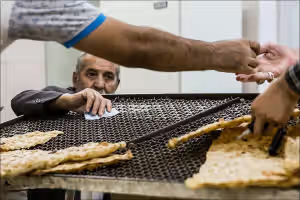
Provincial economic deputy governor Mohammad Ebrahim Toulaei added that Iran aims to strengthen local mills and improve the quality of subsidized bread, while providing loans to bakers for upgrading dual-fuel and backup power equipment.

Most Viewed

US blockade enters murky phase as tankers spoof signals and buyers hesitate
1
ANALYSIS

US blockade enters murky phase as tankers spoof signals and buyers hesitate

2

US tightens financial squeeze on Iran, warns banks over oil money flows

3
INSIGHT

Ideology may be fading in Iran, but not in Kashmir's ‘Mini Iran'

4
INSIGHT

Hardliners push Hormuz ‘red line’ as US blockade tests Iran’s leverage

5
VOICES FROM IRAN

Hope and anger in Iran as fragile ceasefire persists

Banner
Banner

Spotlight

  • Hardliners push Hormuz ‘red line’ as US blockade tests Iran’s leverage
    INSIGHT

    Hardliners push Hormuz ‘red line’ as US blockade tests Iran’s leverage

  • Ideology may be fading in Iran, but not in Kashmir's ‘Mini Iran'
    INSIGHT

    Ideology may be fading in Iran, but not in Kashmir's ‘Mini Iran'

  • War damage amounts to $3,000 per Iranian, with blockade set to add to losses
    INSIGHT

    War damage amounts to $3,000 per Iranian, with blockade set to add to losses

  • Why the $100 billion Hormuz toll revenue is a myth
    ANALYSIS

    Why the $100 billion Hormuz toll revenue is a myth

  • US blockade targets Iran oil boom amid regional disruption
    ANALYSIS

    US blockade targets Iran oil boom amid regional disruption

  • Iran's digital economy battered by prolonged blackout
    INSIGHT

    Iran's digital economy battered by prolonged blackout

  •  Iran sees steep bread price hikes as inflation bites

    Iran sees steep bread price hikes as inflation bites

  • Rampant inflation may ignite bread riots in Iran, economist warns

    Rampant inflation may ignite bread riots in Iran, economist warns

•
•
•

More Stories

Iran acquits French-German national Monterlos of espionage charges

Oct 6, 2025, 11:52 GMT+1

Iran acquitted dual German-French national Lennart Monterlos of espionage charges linked to the recent 12-day conflict, the head of Hormozgan Province’s judiciary said on Monday.

Lennart Christian Jean-Pierre Le Monterles, described by officials as a German citizen holding French nationality, had been arrested in southern Iran on suspicion of espionage during the conflict.

He was tried by the Revolutionary Court in Bandar Abbas, Hormozgan province’s chief justice Mojtaba Ghasemi said.

The official added that although prosecutors had filed an indictment, the court concluded there was insufficient evidence to prove guilt. Under Iranian law, the prosecutor retains the right to appeal the decision.

According to Le Monde, the 19-year-old is about to leave Iran and will be repatriated to France in the coming hours.

  • Verdict nears for British couple detained in Iran as diplomacy sours

    Verdict nears for British couple detained in Iran as diplomacy sours

  • British couple detained in Iran to face court on espionage charges

    British couple detained in Iran to face court on espionage charges

The verdict comes amid reports about Iran’s treatment of foreign detainees. Just last month, a British couple, Craig and Lindsay Foreman, appeared in court in Tehran on similar espionage charges after being held since January.

Their family has described “inhumane conditions” and accused authorities of extracting confessions through intimidation — claims Iran denies.

Western governments and rights groups say Tehran routinely detains foreign nationals to gain political leverage in disputes with Europe and the United States, an accusation Iran rejects, saying such cases involve genuine security concerns.

Iran-France prisoner talks advance

Iran and France signaled progress on Monday in negotiations to exchange two French citizens held in Iran for an Iranian national detained in France.

Iran has detained French nationals Cécile Kohler and Jacques Paris since 2022, while 18-year-old French-German cyclist Lennart Monterlos has been in custody since June.

France has repeatedly condemned their detention as arbitrary and accused Iran of subjecting them to harsh conditions in Tehran’s Evin prison -- allegations Tehran denies.

Iranian Foreign Minister Abbas Araghchi suggested last month that the two could be exchanged for Mahdieh Esfandiari, an Iranian woman arrested in Lyon in February on charges of promoting terrorism through social media.

“The decision regarding the release of these two individuals and Mrs. Esfandiari is currently being reviewed by the competent authorities,” Foreign Ministry spokesperson Esmaeil Baghaei said on Monday, adding that the exchange could happen soon once procedures are completed.

Also on Monday, French Foreign Minister Jean-Noël Barrot said on France Inter radio that Paris had solid prospects of securing their release in the coming weeks, adding that France “remains fully mobilized and demands their immediate and unconditional release.”

In September, France withdrew its case against Iran at the International Court of Justice over consular access violations, a move widely interpreted as a gesture to facilitate a potential deal.

Iran has accused Kohler and Paris of spying for Israel’s Mossad intelligence agency, charges both have denied.

  • Italian journalist returns home after being freed from Iran

    Italian journalist returns home after being freed from Iran

The last prisoner swap between Iran and a European country came when Italy freed an Iranian national wanted by the United States for allegedly supplying Tehran with drone technology in exchange for an Italian journalist arrested in Iran.

Iran has in recent months repeatedly said that all espionage cases are handled through “legal and transparent” procedures, while maintaining that several Western intelligence networks have sought to infiltrate the country during periods of heightened regional tension.

Northern Iran’s wetlands face collapse as migratory birds disappear

Oct 6, 2025, 10:32 GMT+1

Northern Iran’s once-thriving wetlands are facing severe ecological collapse, with environmental officials warning of an imminent disaster after the absence of hundreds of thousands of migratory birds this autumn, Tasnim reported on Monday.

The wetlands of Golestan Province -- part of the ancient Hyrcanian ecosystem -- have largely dried up amid three consecutive years of drought, poor water management, and upstream dam construction, according to environmental experts and local officials.

“This year the sky over Golestan is empty,” Tasnim quoted provincial experts as saying. “Wetlands that once hosted half a million birds have fallen silent, turning into potential dust storm hotspots.”

Meteorological data show rainfall in the province has dropped 38% below long-term averages, while temperatures have risen by 1.2°C.

The resulting “hydrological collapse,” compounded by unregulated water extraction and agricultural mismanagement, has left major wetlands -- including Gomishan, Alma Gol, Ajigol, and Alagol-- on the brink of disappearance.

“The drying of these wetlands threatens not only biodiversity but also human livelihoods,” said Mohammadreza Molla-Abbasi, a university professor. “Their ecological value is 200 times greater than farmland, yet poor governance has pushed them to the edge.”

Environmental activists say the loss of migratory species such as flamingos, pelicans and ducks reflects a deeper breakdown of natural systems. The exposed lakebeds are already producing saline dust, worsening air quality and damaging crops in surrounding communities.

“The wetlands are dying,” said AbdolhakimEdrisi, head of a Golestan environmental NGO. “Without urgent national action to restore water rights, revise farming practices and coordinate interprovincial water management, this crisis will soon turn into a humanitarian one.”

Experts warn that if the situation continues, parts of northern Iran could transform into new sources of dust storms, deepening the environmental and economic strain on one of the country’s most fertile regions.

China uses secret network to pay Iran for oil - WSJ

Oct 6, 2025, 09:52 GMT+1

China is secretly funneling billions of dollars to Iran through a covert payment system that bypasses US sanctions by swapping oil for infrastructure projects, The Wall Street Journal reported, saying the hidden conduit enabled Tehran to receive up to $8.4 billion last year.

Citing Western officials, the report said the mechanism -- linking state-owned firms, a government insurer, and an unregistered financial intermediary -- has provided a critical lifeline to Iran’s sanctions-hit economy, with state insurer Sinosure and a little-known financial vehicle called “Chuxin” channeling the money to Chinese contractors working in Iran.

Under the system, an Iranian-linked seller books crude sales to a Chinese buyer tied to state trader Zhuhai Zhenrong; the buyer then deposits funds with Chuxin, which pays Chinese firms working on insured projects inside Iran, according to the report.

The crude typically reaches China via ship-to-ship transfers that obscure origin, the officials said.

Beijing’s Foreign Ministry told the WSJ it was “unaware of the arrangement” and “opposes illegal unilateral sanctions.”

Sinosure and Zhuhai Zhenrong did not comment, the paper said, adding neither Sinosure nor Chuxin is under US sanctions.

“Iranian entities rely on shadow banking networks to evade sanctions and move millions,” said John K. Hurley, the US Treasury undersecretary for terrorism and financial intelligence, in a separate statement last month.

Brad Parks of AidData said Sinosure-backed deals typically require that “every creditor and every construction contractor has to come under this umbrella,” likening the Iran setup to documented structures in Iraq.

The conduit has helped sustain Iran’s sanctions-hit economy with US officials estimatingroughly 90% of Iran’s oil exports go to China.

Washington has warned Beijing over such purchases and has tightened measures on the “shadow fleet” moving Iranian crude, the Journal reported.

Iran warily backs Hamas response to Trump’s Gaza peace plan

Oct 5, 2025, 22:38 GMT+1

Iran’s foreign ministry on Sunday expressed cautious support for Hamas’s response to Donald Trump’s Gaza ceasefire plan, but warned against what it called the proposal's dangerous dimensions and Israel’s alleged failure to honor past commitments.

Iran welcomes any decision “that would result in stopping the genocide of Palestinians, the withdrawal of the occupying Zionist army from Gaza, respect for the Palestinian people’s right to self-determination, the entry of humanitarian aid, and the reconstruction of Gaza,” the Foreign Ministry said in a statement.

However, it warned about the risks surrounding the ceasefire plan and the “dangerous aspects of this plan.”

It also cautioned against what it called Israel’s “obstruction (of peace efforts) and bad faith in fulfilling its promises—especially in light of the regime’s expansionist and racist schemes.”

Despite the risks, it said, “Tehran maintains that any decision on this matter rests with the Palestinian people and resistance.”

Trump said on Saturday that Israel had agreed to an initial withdrawal line in Gaza and that a ceasefire would take effect once Hamas confirms acceptance.

Hamas said it accepts several parts of Trump’s ceasefire plan including the release of Israeli hostages it is holding since October 7 2023, but added that some elements still require further negotiations.

On Sunday, Al-Arabiya quoted a Hamas source as saying that the Palestinian group had agreed to hand over its weapons to a Palestinian-Egyptian authority under international supervision.

However, a Hamas source denied the report later in the day, telling Qatar’s Al-Araby TV the claims were misleading, incorrect, and baseless.

Israeli Prime Minister Benjamin Netanyahu's office said on Sunday that an Israeli delegation led by Strategic Affairs Minister Ron Dermer will fly to Egypt on Monday to take part in talks on Trump's Gaza plan, also attended by White House special envoy Steve Witkoff and Trump’s son-in-law Jared Kushner.

The war in Gaza began after an attack on Israel on October 7, 2023 by Hamas militants, in which 1,200 people, mostly civilians, were killed and about 251 were taken hostage, according to Israeli figures.

Since then, more than 67,000 people, also mostly civilians, have been killed in Gaza, according to Hamas-run health authorities.

Iran hands death sentences to three prisoners of conscience

Oct 5, 2025, 21:00 GMT+1

A court in Tehran has sentenced three prisoners of conscience from Iran’s ethnic minorities, including a woman, to death on charges of waging war against God, Norway-based rights group Hengaw said on Sunday.

The defendants were identified as Nasimeh Eslamzahi, a woman from Iran’s Baluch minority; her husband, Arsalan Sheikhi, from a Kurdish minority community in the northwest; and a third man identified only as Hassan.

Eslamzahi is being held in Gharchak prison near Tehran, while Sheikhi and Hassan are detained in Evin Prison in northern Tehran, Hengaw said.

The case was overseen by Judge Abolghasem Salavati, who is known for issuing harsh sentences in political cases and was sanctioned by the United States in 2019 for his role in what Washington described as “unfair trials” and multiple death sentences.

Hengaw said the defendants were accused of involvement in a 2023 bus bombing that killed an infant but denied the charges during their trial.

Eslamzahi was pregnant at the time of her arrest and gave birth to her daughter in prison. Hengaw said she and the baby were held for 40 days in solitary confinement in a cell with poor ventilation and inadequate lighting before being transferred to another ward.

The report comes a day after Iran executed seven political prisoners from ethnic minorities, including six Arabs and one Kurd, in what rights groups called a “grave violation” of international human rights and due process standards following torture and unfair trials.

According to Amnesty International, Iranian authorities have executed more than 1,000 people so far this year, the highest annual figure recorded by the group in at least 15 years.