• العربية
  • فارسی
Brand
  • Iran Insight
  • Politics
  • Economy
  • Analysis
  • Special Report
  • Opinion
  • Podcast
  • Iran Insight
  • Politics
  • Economy
  • Analysis
  • Special Report
  • Opinion
  • Podcast
  • Theme
  • Language
    • العربية
    • فارسی
  • Iran Insight
  • Politics
  • Economy
  • Analysis
  • Special Report
  • Opinion
  • Podcast
All rights reserved for Volant Media UK Limited
volant media logo

UN nuclear chief says military action cannot destroy Iran nuclear program

Oct 5, 2025, 17:05 GMT+1Updated: 00:30 GMT

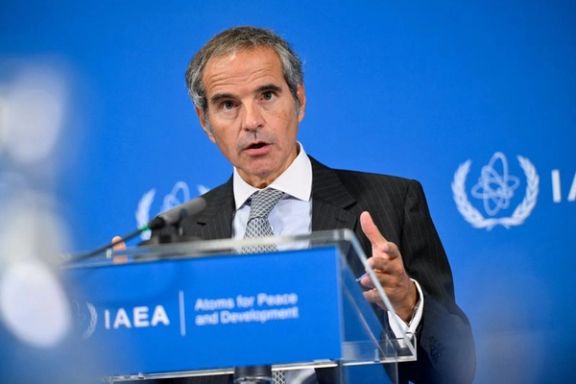
Military strikes on Iran’s nuclear sites would have only short-term effects and fail to destroy its capabilities, the UN atomic watchdog chief said, urging diplomacy as the sole path to a lasting solution to concerns over Tehran’s disputed nuclear program.

"One thing is clear to me, to Iran, and to those who attacked Iran: a lasting, permanent solution to this situation and to the doubts surrounding Iran’s nuclear program can only be diplomatic," Rafael Grossi said on a podcast hosted by Colombia’s Innovation for Development Foundation on Friday.

"Although attacks or military action may have short-term effects, the technical and technological capabilities exist — what was destroyed can be rebuilt," he added.

"I always remind all the parties involved that beyond missiles and bombs, the only lasting solution will have to be some form of new agreement to restore lost trust.”

Talks between Tehran and Western powers over the country's nuclear program remain stalled.

A sixth round of indirect US-Iran talks was suspended in June after Israel and the United States struck Iranian nuclear facilities, prompting waves of Iranian missile retaliation against Israel.

A preliminary US Defense Intelligence Agency assessment found the strikes may have delayed Iran’s nuclear program by only a few months, according to a report by Reuters.

However, US President Donald Trump has consistently said Iran’s nuclear facilities targeted in the attacks were “totally obliterated.”

In a confidential report leaked to reporters last month, the International Atomic Energy Agency (IAEA) said Iran's stock of near-weapons grade uranium had increased almost eight percent before Israel attacked its nuclear facilities on June 13.

The report shows Iran had 440.9 kilograms (972 pounds) of uranium enriched up to 60%, marking a 7.9% increase since the UN nuclear watchdog’s previous report in May.

Iran insists its nuclear program is for civilian use and denies pursuing the development or acquisition of nuclear weapons.

Germany's Foreign Minister Johann Wadephul on Friday said Berlin wants a negotiated solution to limit Iran’s nuclear program after the reimposition of United Nations sanctions.

The UN sanctions on Iran were reinstated on September 28 after the UK, France, and Germany (the E3) triggered the snapback mechanism under the 2015 nuclear deal known as the Joint Comprehensive Plan of Action (JCPoA).

The E3 said the decision followed “Iran rejecting two offers put on the table by the JCPoA coordinator in 2022 and further expanding its nuclear activities in clear breach of its JCPoA commitments.”

Iran has blamed the failure of the talks on what it calls Western powers’ “excessive demands.”

Most Viewed

Worst outcome is Islamic Republic’s survival, ex-CIA official says
1
PODCAST

Worst outcome is Islamic Republic’s survival, ex-CIA official says

2
ANALYSIS

Iran brings unusually broad team to US talks to blunt future blame

3
INSIGHT

Tehran sends tough message but keeps diplomacy door open

4

Zoroastrian religious figure arrested in Iran

Banner
Banner

Spotlight

  • What the US naval blockade would mean for Iran’s economy
    INSIGHT

    What the US naval blockade would mean for Iran’s economy

  • Tehran sends tough message but keeps diplomacy door open
    INSIGHT

    Tehran sends tough message but keeps diplomacy door open

  • Worst outcome is Islamic Republic’s survival, ex-CIA official says
    PODCAST

    Worst outcome is Islamic Republic’s survival, ex-CIA official says

  • Why the Iran-US truce is more likely to buy time than peace
    ANALYSIS

    Why the Iran-US truce is more likely to buy time than peace

  • Engaged but uncommitted: China watches Iran and US fight and talk
    ANALYSIS

    Engaged but uncommitted: China watches Iran and US fight and talk

  • A truce for the world, a reckoning for Iran’s economy
    ANALYSIS

    A truce for the world, a reckoning for Iran’s economy

•
•
•

More Stories

Ex-Iran diplomat says nuclear dispute will persist for decades

Oct 5, 2025, 11:32 GMT+1

Former Iranian diplomat Hamid Baeidinejad said Iran’s nuclear issue will remain a defining challenge for decades, arguing that uranium enrichment is a permanent feature of the country’s national and diplomatic landscape.

Speaking at a conference on “Nuclear Law in Peace, War and Post-War,” Baeidinejad said Iran’s nuclear file “has been with us for fifty years and will stay with us for another fifty.”

He described enrichment as “a very important national achievement” that cannot be separated from Iran’s future international relations.

He said reaching any new agreement on the issue would require long and exhausting negotiations, adding that “there is no easy or quick solution to such a complex international matter.”

Baeidinejad also said five rounds of indirect talks between Tehran and Washington over the summer failed to yield progress and that mutual distrust deepened after an Israeli strike in June.

According to him, “Iran’s only path forward is continued diplomacy, even if the process is difficult and slow.”

He called for international consensus to ban attacks on nuclear facilities, saying, “No one in Iran doubts that attacking nuclear installations must be absolutely prohibited and punishable under international law,” but acknowledged that building such a norm would take “years of study, debate and persuasion.”

Baeidinejad added that the 2015 deal’s snapback mechanism had been designed after lengthy talks to balance Iran’s demand for lifting UN sanctions with the powers’ insistence on retaining a safeguard. “More than a thousand hours of negotiations were devoted to this single issue,” he said.

He urged Iranian academics and research institutions to engage more deeply in nuclear law and safeguards, arguing that “we must become an active player in shaping global norms, not just a subject of them.”

Iran blames Western 'excessive demands’ for failed talks

Oct 5, 2025, 09:30 GMT+1

Western countries rejected renewed negotiations with Tehran because of what Iran’s Foreign Minister Abbas Araghchi described as excessive demands on Sunday.

The remarks came during a meeting with foreign ambassadors in Tehran, where he said the session was held to brief diplomats on developments in New York and the reactivation of UN sanctions.

“Iran had sought a fair and balanced solution, but Western states responded negatively out of greed,” Araghchi said.

Iranian Foreign Minister Abbas Araghchi during a meeting with foreign envoys in Tehran on October 5, 2025
100%
Iranian Foreign Minister Abbas Araghchi during a meeting with foreign envoys in Tehran on October 5, 2025

“Years of pressure had proven that there is no solution to Iran’s nuclear issue other than diplomacy...The snapback of sanctions, like military attacks, cannot work.”

All UN sanctions suspended under the 2015 deal with Iran snapped back into force on September 27, one month after European powers triggered the snapback mechanism.

The three European countries had weakened their own diplomatic role by resorting to pressure, he said

  • Iran signals ‘strategic patience’ after rejecting latest US proposal - IRNA

    Iran signals ‘strategic patience’ after rejecting latest US proposal - IRNA

  • Iran sanctions snapback heralds suffering, possible war

    Iran sanctions snapback heralds suffering, possible war

The Cairo agreement with the IAEA was no longer viable after the snapback, and Iran would redefine its framework for engagement under new conditions, according to the Iranian foreign minister.

Iran had demonstrated goodwill in its dealings with both Western powers and the IAEA, Araghchi said, adding that Tehran had “taken every step it could to reach a negotiated solution.”

“We showed goodwill through our cooperation with the Agency and our fair proposals. The West has no excuse to say Iran avoided talks, nor any justification for triggering the snapback mechanism… Iran’s position is now fully vindicated.”

The United Nations sanctions include restrictions on Iran’s nuclear and military activities, asset freezes on designated entities, and a duty to “exercise vigilance” when doing business with Iran.

France, Germany and the United Kingdom said in a joint statement the reimposition of sanctions was unavoidable after Iran’s breaches of the 2015 nuclear deal, citing enriched uranium stockpiles 48 times above agreed limits.

However, the foreign minister said Iran had proved it seeks only to secure its legitimate rights while remaining open to any fair diplomatic path.

“The last time there was an attack, more than 120 countries condemned it because Iran acted wisely,” Araghchi said. “Once again, Iran has shown it is a smart player that will not surrender its rights.”

Tehran pins hopes on Russia and China to blunt sanctions impact

Oct 4, 2025, 16:25 GMT+1
•
Maryam Sinaiee

With Russia’s UN Security Council presidency and China’s economic leverage, Tehran is betting Moscow and Beijing can shield it from the impact of UN sanctions through legal maneuvers, committee vetoes, and strategic investments.

Both countries have condemned the Council’s decision, leading some in Iran to hope the rhetorical rejection will be followed by action.

“China and Russia currently intend either not to implement the resolutions under Resolution 2231 or to apply them selectively,” political analyst Mehdi Kharatian said in a post on X.

Former diplomat Kourosh Ahmadi put forward ways in which the duo could help Iran.

“China and Russia can play an effective role in reducing the impact of reinstated UN resolutions in three areas,” he wrote in the reformist daily Shargh, “preventing the implementation of the six reactivated resolutions, obstructing the work of the Sanctions Committee … and blocking any new measures.”

Obstruct sanctions

Ahmadi asserted that decisions in the Committee require consensus, enabling Beijing and Moscow to delay appointments, hinder panel functions, and limit enforcement—as they did on occasion in relation to North Korea.

Another former diplomat, Nosratollah Tajik, struck a more hopeful tone.

“China and Russia… can use existing legal mechanisms within the United Nations to obstruct the implementation of sanctions,” he told moderate outlet Jamaran.

In a joint letter to the UNSC president on September 28, China and Russia, together with Iran, argued that the snapback move by the E3 (Britain, France, and Germany) was “inherently flawed both legally and procedurally,” branding it “null and void.”

Russia’s UN Ambassador Vasily Nebenzia declared on October 1: “We’ll be living in two parallel realities, because for some snapback happened, for us it didn’t.”

Invest in Iran

Alongside legal avenues, some experts asserted, Russia and China could also try to neutralize the sanctions with hard cash.

Conservative politician Mansour Haghighatpour said Tehran and China could be looking at a new chapter in their economic cooperation if China takes “concrete steps to invest in and finance Iran’s infrastructure projects using the digital yuan.”

Such a move would prove that Beijing “will not allow imposed obstacles to block the implementation of ambitious initiatives such as the Belt and Road Initiative,” Haghighatpour argued in a piece for the moderate daily Etemad.

The optimism has been invariably met with doubt and even ridicule from ordinary Iranians on social media.

“Russia and China did not invest in Iran when we only had the US sanctions—so now they don’t recognize UN sanctions?” one user commented on X.

Another posted: “China buys only a small amount of oil from Iran … and it forces Iran to barter with Chinese goods! Humiliation higher than this?!”

‘They didn’t even abstain’

Bloomberg reported this week that Qingdao Port, a major Chinese oil terminal, plans measures targeting vessels transporting sanctioned Iranian oil, highlighting the limits of Beijing’s support.

Iran has signed strategic partnership treaties with Russia, a 20-year pact that took effect on October 2, and with China, a 25-year deal agreed in 2021 but still only partly implemented.

Some in Tehran are betting on these agreements.

“We are witnessing the emergence of a trilateral strategic partnership among Iran, Russia, and China, which could have significant implications for the balance of power,” academic Jalal Dehghani told the state-run Iran newspaper.

Another anonymous user on X reminded him of ominous precedents: “Russia and China voted in favor of all the sanctions resolutions between 2006 and 2011 … They didn’t even abstain!”
Australia, New Zealand to implement revived UN sanctions on Iran

Oct 4, 2025, 09:25 GMT+1

Australia and New Zealand said they will implement revived United Nations sanctions on Iran, officials told Iran International, backing a decision by France, Germany and Britain to trigger the snapback mechanism over Tehran’s nuclear program.

“Australia supports the decision of France, Germany and the UK (the E3) to trigger the ‘snapback’ mechanism under UN Security Council Resolution 2231,” a Department of Foreign Affairs and Trade spokesperson told Iran International.

The spokesperson said Iran must be held accountable for its “longstanding non-performance” of nuclear commitments under the 2015 Joint Comprehensive Plan of Action (JCPOA). Australia called on Iran to return to talks and reach a diplomatic solution “which provides assurances that it can never develop a nuclear weapon.”

Canberra said it is obliged under international law to implement Security Council sanctions and will do so through amendments to domestic regulations, which may take time.

New Zealand’s foreign ministry said it was “deeply concerned” about Iran’s non-compliance and that work was underway on regulatory changes.

“As a UN Member State, New Zealand is bound to implement sanctions imposed by the UNSC,” the ministry said in a statement. “We advise New Zealanders to apply heightened due diligence in reviewing any ongoing transactions during this interim period.”

The United Nations sanctions, reimposed on Sept. 28, include restrictions on Iran’s nuclear and military activities, asset freezes on designated entities, and a duty to “exercise vigilance” when doing business with Iran.

Western powers say Iran left no choice

France, Germany and the United Kingdom said in a joint statement the reimposition of sanctions was unavoidable after Iran’s “persistent breaches” of the 2015 nuclear deal, citing enriched uranium stockpiles 48 times above agreed limits.

German Foreign Minister Johann Wadephul said the sanctions were a “serious mistake” by Tehran’s rulers that harmed ordinary Iranians, but added diplomacy was still possible. “Iran must never come into possession of a nuclear weapon,” he told Funke media group, urging a “negotiated solution to resolve this issue permanently.”

The European Union also reinstated sweeping restrictions this week on Iran’s oil, banking, transport and trade sectors. Tehran has rejected the sanctions as illegal and said all restrictions under Resolution 2231 must expire on October 18.

Canadian court blocks entry of former Iranian oil executive – Global News

Oct 3, 2025, 22:00 GMT+1

Canada’s Federal Court has upheld a government decision to block a former Iranian oil executive from entering the country, dismissing his appeal as baseless, Global News reported on Friday.

The ruling concerns Mohammadreza Mazloumi Aboukheili, 64, a former director of operations at the National Iranian Oil Products Distribution Company, a state-owned firm reporting to Iran’s Ministry of Petroleum.

He had applied for a visa to visit his son in Ontario, but Canadian authorities determined he was inadmissible due to his senior role in "a regime engaged in terrorism and systematic human-rights abuses," according to the court ruling.

Mazloumi had previously visited Canada before Ottawa introduced a 2022 policy targeting high-ranking Iranian officials, the court decision cited by Global News said.

Immigration officials argued his position placed him only two ranks below Iran’s oil minister, undermining his assertion that he was a “middle manager.”

Mazloumi challenged the assessment, but the judge rejected his arguments, saying the government’s decision was reasonable and supported by evidence. The court found “no error” in how the visa officer handled the case, noting the executive knowingly served in a government accused of terrorism and repression.

The case reflects Ottawa’s broader effort to prevent senior Iranian officials from entering Canada.

Almost three years after the policy was introduced, authorities have stopped nearly 200 suspected Islamic Republic figures at the border.

However, deporting those already inside Canada has proven more difficult. Only one suspected official has been removed to Iran, while several others remain in the country due to legal challenges.

Oil revenues play a central role in funding the Iranian state, which Ottawa has accused of supporting groups such as Hezbollah, Hamas and Yemen’s Houthis, and supplying drones to Russia for its war in Ukraine.

Canadian authorities have also accused Tehran of targeting critics abroad, including activists and journalists living in Canada.

Mazloumi did not respond to a request for comment, Global News reported.