• العربية
  • فارسی
Brand
  • Iran Insight
  • Politics
  • Economy
  • Analysis
  • Special Report
  • Opinion
  • Podcast
  • Iran Insight
  • Politics
  • Economy
  • Analysis
  • Special Report
  • Opinion
  • Podcast
  • Theme
  • Language
    • العربية
    • فارسی
  • Iran Insight
  • Politics
  • Economy
  • Analysis
  • Special Report
  • Opinion
  • Podcast
All rights reserved for Volant Media UK Limited
volant media logo
VOICES FROM IRAN

Disgruntled students protest at Iranian universities, videos show

Oct 1, 2025, 18:41 GMT+1Updated: 00:32 GMT+0
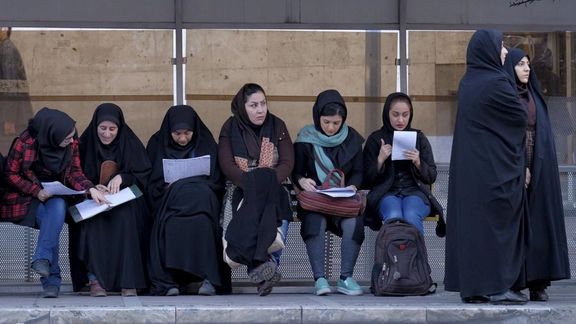
Iranian students study as they wait for a bus in central Tehran January 16, 2016

Protests against university authorities and gripped several campuses across Iran, according to videos sent to Iran International, pointing to widespread anxiety among students which stopped short of overtly political grievances.

In one video, filmed at night, students are seen protesting disciplinary measures and calling for an end to harsh punishments.

At Khajeh Nasir Toosi University of Technology they chanted, “University is not a barracks; expulsion is no longer the answer.” The dispute related to student dissatisfaction with food and accommodation.

University administrators in Iran frequently deploy expulsion to silence pushback and punish students who protest their conditions.

Tabriz University of Medical Sciences also witnessed series of protests alleging administrators' alleged mismanagement and provision of substandard accommodation.

A video obtained by Iran International showed students chanting slogans including “incompetent official, resign!” and “university officials, shame shame!”

Bus crash tragedy

A separate incident in the town of Sorkheh north of Tehran has left the community reeling. A bus carrying female paramedical students crashed on Tuesday, killing two and leaving five others in critical condition.

In a recorded meeting with the dean, one student described the scene as horrific and said some victims were impossible to identify because their faces were badly damaged.

“Seeing two of your friends’ faces crushed, unrecognizable — we identified them by their clothes and nail polish. Someone you were talking and laughing with, and now they’re being brought back as a corpse, it’s very hard,” she said.

Multiple videos show students pressing the dean and university administrators for accountability.

Provincial authorities pledged a full investigation into the crash.

Iranian university students have continued staging demonstrations despite heavy pressure from authorities, demanding accountability and an end to harsh disciplinary measures such as expulsions and suspensions.

Slogans on walls

Other citizen-submitted videos showed dissidents painting slogans on city walls and on large billboards around Tehran in several separate locations.

Large-scale political protests have been rare since authorities quashed with deadly force the so-called Woman, Life, Freedom protests sparked by the death of a young woman in morality police custody in 2022.

One man is filmed writing messages in favor of Iran's monarchy, which was ousted by the Islamic Revolution in 1979, while others call on citizens to resist authorities: “Break the silence, compatriot, while there’s still time.”

Another slogan directly addresses the country’s Supreme Leader: “Khamenei should know he will be overthrown soon.”

UN sanctions reactivated by European powers took effect over the weekend and are set to deepen Iran's economic pain.

Iran denies seeking nuclear weapons the West accuses it of pursuing and has warned the measures could deepen civil unrest.

Most Viewed

Ghalibaf defends Iran-US talks amid hardline backlash
1
INSIGHT

Ghalibaf defends Iran-US talks amid hardline backlash

2
INSIGHT

A nation in limbo: 100 days after the massacre, has the world moved on?

3
ANALYSIS

From instability to influence: Pakistan’s pivotal role in US-Iran diplomacy

4
ANALYSIS

100 days on: why Iran’s January protests spread across social classes

5

War-hit homeowners feel abandoned as Iran’s reconstruction aid fades

Banner
Banner

Spotlight

  • War-hit homeowners feel abandoned as Iran’s reconstruction aid fades

    War-hit homeowners feel abandoned as Iran’s reconstruction aid fades

  • 100 days on: the anatomy of Iran’s January crackdown
    INSIGHT

    100 days on: the anatomy of Iran’s January crackdown

  • Ghalibaf defends Iran-US talks amid hardline backlash
    INSIGHT

    Ghalibaf defends Iran-US talks amid hardline backlash

  • 100 days on: why Iran’s January protests spread across social classes
    ANALYSIS

    100 days on: why Iran’s January protests spread across social classes

  • From instability to influence: Pakistan’s pivotal role in US-Iran diplomacy
    ANALYSIS

    From instability to influence: Pakistan’s pivotal role in US-Iran diplomacy

  • A nation in limbo: 100 days after the massacre, has the world moved on?
    INSIGHT

    A nation in limbo: 100 days after the massacre, has the world moved on?

•
•
•

More Stories

Disinformation during June war favored Tehran, Israeli think tank says

Oct 1, 2025, 17:13 GMT+1

The majority of disinformation circulated across global digital platforms during the Israel-Iran war in June served Iran's narrative, a new report by the Israel Internet Association (IIA) found.

The study, titled "Ballistic Fakes: Disinformation and Fact-Checking Efforts during the Israel-Iran War", analyzed the work of fact-checking organizations in 23 countries.

Among the most active were Misbar in Jordan, AFP in France, Newschecker in India and Teyit in Turkey — each contributing a significant volume of war-related fact-checks.

In assessing the motivations behind the spread of false information, the IIA asked which party might gain from the dissemination of misinformation and coded each answer.

It found that in 72% of cases, the content was likely to serve Iranian strategic narratives, while 24% appeared to support the Israeli side. The remaining 4% could not be clearly classified, the research said.

Video content accounted for 85% of all disinformation reviewed. Of this, 82% was found to be outdated, 68% misattributed geographically, and 77% presented with false contextual framing. 17% of video content was generated using artificial intelligence, and 12% was entirely fabricated.

“A large proportion of the fact-checks (71%) concerned false connections and decontextualized content,” the report said. “In these instances, genuine material was accompanied by misleading captions or narrative framing, producing an effect contrary to the original meaning.”

One example cited was a demonstration in San Diego during the war. While the event was accurately located and timed, it was misrepresented online as a protest related to the Israel–Iran conflict. It was images from a domestic protest known as "No Kings" against US President Donald Trump's domestic policies.

Other examples included an image of a hotel fire in China from 2009 portrayed as the aftermath of an Iranian missile strike in Israel as well as footage of an Israeli strike in Lebanon circulated as evidence of Iranian attacks.

Generative AI

In total, the report found that a fifth of fact-checked items were created using generative AI, primarily fabricated images and videos. These included depictions of destroyed Israeli infrastructure, the downing of Israeli aircraft, an Israeli soldier allegedly surrendering and fabricated scenes of domestic anti-war protests.

Fabricated claims, entirely invented events, actions or quotes, made up 15% of the sample. These included false reports of Israeli aircraft crashes in Iran, captured Israeli pilots, and nuclear attacks by both sides.

An additional 2% of items involved impersonation. These included a forged resignation letter from Iran’s president and a deepfake video purporting to show Russian President Vladimir Putin declaring support for Iran.

The most common theme in disinformation content concerned physical damage to infrastructure, featuring in 44% of the items reviewed.

False reports included alleged Iranian missile strikes on Tel Aviv’s Azrieli Towers and Israeli attacks on Tehran’s airport.

Many items focused on explosions, often accompanied by misattributed images or video clips. One widely circulated example included a fabricated report of an attack on the Fordow nuclear site, while another falsely described an explosion in Haifa Bay.

New US sanctions target Iran’s military procurement network

Oct 1, 2025, 17:03 GMT+1

The US Treasury on Wednesday imposed sanctions on 38 individuals and companies from Iran and China it accused of advancing Iran’s military procurement including surface-to-air missiles and US-manufactured helicopter parts.

The sanctions, the Treasury said in a statement, focus on networks that facilitate the transfer of sensitive goods and technology to Iran’s Ministry of Defense and Armed Forces Logistics (MODAFL).

“Under President Trump’s leadership, we will deny the regime weapons it would use to further its malign objectives,” Treasury Secretary Scott Bessent said in a statement.

The Treasury also reminded UN member states that UN sanctions on Iran were reimposed as of September 28 and must be enforced.

These measures include restrictions on Iran’s nuclear, missile and arms programs, embargoes, export controls, travel bans, asset freezes and prohibitions on entities like banks involved in Iran’s weapons activities.

Sanctioned Iranian entities include Abzar-e Daghigh-e Taha Company, Beh Joule Pars Commercial Engineering Company and Business United Unipessoal Lda, which is tied to Pasargad Helicopter Company.

Several Chinese-based firms such as Westcom Technology Co Limited, UIY Inc, Rocket PCB Solution Ltd, and Rayming Technology were also designated.

The list further names Iranian individuals such as Mehdi Shirazi Shayesteh and Mehdi Nili Ahmadabadi, along with Chinese nationals Liu Baojuan and Sun Zhaola.

The new designations come as part of Washington’s broader effort to enforce the return of UN sanctions reactivated by European powers in response to what they say is Tehran's defiance of negotiations and nuclear inspections.

Iran denies seeking a nuclear bomb and has rejected sanctions and curbs on its conventional weapons as illegal violations of its sovereignty.

US officials argue that tightening sanctions is essential to block Tehran from acquiring advanced technologies that could bolster both its firepower and potential nuclear capabilities.

Iran agrees to conditionally join UN convention against terror financing

Oct 1, 2025, 16:56 GMT+1

Iran’s Expediency Council has agreed to conditionally join a United Nations convention aimed at preventing and criminalizing the financing of terrorism, the body’s spokesperson said on Wednesday.

“After holding four public sessions and joint commission meetings, the Expediency Council agreed in today’s session for Iran to join the CFT convention on a conditional basis,” Mohsen Dehnavi wrote on X.

The International Convention for the Suppression of the Financing of Terrorism (CFT), adopted by the United Nations in 1999, is designed to prevent and criminalize the financing of terrorist activities worldwide.

Iran's Expediency Council, overseen by Supreme Leader Ali Khamenei, mediates disputes between parliament and the Guardian Council, a hard-line body that vets laws and candidates.

The move comes just days after UN sanctions on Iran were reinstated on September 28.

In April, over 150 hardline lawmakers urged the Council to reject the convention.

In a letter to Expediency Council chairman Sadegh Amoli Larijani, they argued that any approval—conditional or not—should wait until the risk of the reimposition of UN triggered by the snapback mechanism is entirely eliminated.

In May, the Council conditionally approved the country’s accession to the Palermo Convention, one of the two key legislative items tied to the Financial Action Task Force (FATF) standards aimed at addressing money laundering and terrorism financing.

An annual US State Department report last December, called Iran the world's leading state sponsor of terrorism for the 39th year running, accusing Tehran of using its allied armed groups to destabilize the Middle East.

Tehran faces worsening water shortage, official says

Oct 1, 2025, 14:18 GMT+1

Tehran is facing an escalating water crisis as dammed reservoirs drop to critical lows, a senior sanitation official said, with rainfall and dam inflows reduced by nearly half leaving most of the capital’s reservoirs nearly depleted.

“Rainfall has dropped 40% and dam inflows 42%, leaving most of the capital’s five dams near dead storage. Only Taleghan Dam remains relatively stable,” Abbasali Mosarzadeh, CEO of Tehran’s Sewage Company cited on Tuesday as saying by official media.

“Tehran’s reserves in October fell to 258 million cubic meters, 227 million less than last year," he added. These figures were cited by Iran’s Water Resources Management Company.

The crisis extends far beyond the capital. Nationally, water reserves have fallen to alarming lows, with Iranian energy officials acknowledging that 19 of the country’s major dams are operating at below 20 percent capacity.

Independent reporting by Iran International based on satellite data showed Tehran’s Amir Kabir reservoir at roughly 6 percent of usable volume in July, with the Lar and Latyan reservoirs also at historic lows.

Groundwater depletion is worsening the picture. Research cited by Iranian geoscience institutes shows parts of Tehran sinking by more than 10 centimeters a year due to subsidence.

Agriculture, which consumes about 80 percent of the country’s water according to government and international environmental assessments, remains highly inefficient, further straining supplies.

Experts warn that without sweeping reforms in consumption and water management, Iran risks deeper shortages, environmental collapse, and growing public unrest.

Iran watchdog clears tougher espionage law targeting Israel, US cooperation

Oct 1, 2025, 13:27 GMT+1

Iran’s Guardian Council on Wednesday approved a bill imposing harsher penalties for espionage and collaboration with Israel, the United States and other “hostile states,” clearing the way for the law to be enacted once signed by President Masoud Pezeshkian.

The legislation, formally titled the “Intensification of Punishment for Espionage and Cooperation with the Zionist Regime and Hostile States Against National Security and Interests,” was passed by parliament in late June following the 12-day war between Iran and Israel.

The Guardian Council, a powerful 12-member body of clerics and jurists that vets legislation and elections in Iran, initially sent the bill back in July citing ambiguities, but said after revisions it no longer conflicted with Islamic law or the constitution.

  • New Iran espionage law halted for review, slowing post-war crackdown

    New Iran espionage law halted for review, slowing post-war crackdown

  • Iran's parliament approves death penalty for cooperation with Israel, US

    Iran's parliament approves death penalty for cooperation with Israel, US

The measure classifies espionage or intelligence cooperation with Israel and the US as “corruption on earth,” a charge under Iran’s penal code that can carry the death penalty.

It also criminalizes providing information, media content or assistance to groups deemed hostile, with prison sentences ranging from two to 15 years depending on the offense.

  • Iran executes man accused of spying for Israel

    Iran executes man accused of spying for Israel

  • Iran hangs nuclear scientist over alleged espionage for Israel’s Mossad

    Iran hangs nuclear scientist over alleged espionage for Israel’s Mossad

Supporters say the law is needed to counter infiltration and disinformation. “Any cooperation in media or propaganda activity, including sending videos or images to hostile channels that weaken public morale or create division, undermines national security and will face severe judicial response,” said Ebrahim Azizi, a former Revolutionary Guards commander and head of parliament’s national security committee.

  • Iran arrests over 700 accused of spying for Israel amid espionage crackdown

    Iran arrests over 700 accused of spying for Israel amid espionage crackdown

  • Iran to execute over 100 inmates over Israel spying charges - Sunday Times

    Iran to execute over 100 inmates over Israel spying charges - Sunday Times

The bill follows the June conflict in which Israeli airstrikes targeted Iranian nuclear and missile sites, prompting Tehran to retaliate with hundreds of missile and drone launches.

Iranian authorities later announced the arrest of hundreds of people accused of spying for Israel and the US.

Rights advocates have expressed concern that the law’s broad definitions, including provisions applying retroactively, could restrict free expression and be used against journalists and activists.