• العربية
  • فارسی
Brand
  • Iran Insight
  • Politics
  • Economy
  • Analysis
  • Special Report
  • Opinion
  • Podcast
  • Iran Insight
  • Politics
  • Economy
  • Analysis
  • Special Report
  • Opinion
  • Podcast
  • Theme
  • Language
    • العربية
    • فارسی
  • Iran Insight
  • Politics
  • Economy
  • Analysis
  • Special Report
  • Opinion
  • Podcast
All rights reserved for Volant Media UK Limited
volant media logo

Iran says US sought uranium handover for 90-day relief in 'humiliating' offer

Sep 27, 2025, 21:23 GMT+1Updated: 00:34 GMT+0
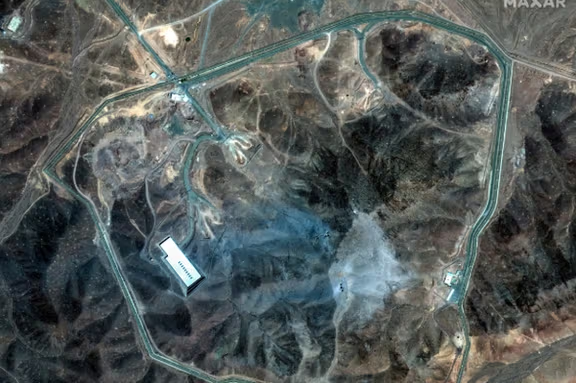
A satellite view shows an overview of Fordow underground complex, after the US struck the underground nuclear facility, near Qom, Iran June 22, 2025.

Western countries demanded Iran surrender its stocks of highly enriched uranium in exchange for only a few months of relief from UN sanctions, Iranian authorities said on Saturday, calling the offer humiliating.

“They demanded that we hand over all our enriched uranium and in exchange they give us a temporary relief of 90 days, which is absolutely unacceptable,” Iranian President Masoud Pezeshkian said on Saturday.

“If we are to choose between the unreasonable demands of the Americans and the snapback, our choice is the snapback,” Pezeshkian added, hours before the return of UN sanctions against Tehran.

Foreign Minister Abbas Araghchi also said Saturday that "the three European countries and the United States expected Iran to give up all its nuclear material or hand it over to them, in exchange for delaying the activation of the snapback mechanism by three or six months."

"This is the height of a brazen approach toward us, and we will not submit to such humiliation," Araghchi told Iran's state TV. "Iran will not accept the humiliating pressure over snapback."

The fate of Iran’s highly enriched uranium (HEU) stockpile of 400 kg (882 pounds) remains under investigation, while Tehran claims it is trapped under rubble after US attacks on three nuclear sites in June.

After triggering the so-called snapback mechanism on August 28, the Europeans asked Iran to address concerns over the highly enriched uranium stockpile, cooperate with the UN nuclear watchdog, and engage in talks with the United States.

Iran accuses US of swaying Europeans

While talks with European leaders had produced some convergence, Washington’s stance remained irreconcilable, Pezeshkian said upon arrival in Tehran after a visit to New York.

"On the snapback mechanism, we apparently reached an agreement with Europe, but when they spoke with the United States, they came up with various excuses."

Barbara Slavin, a longtime Iran analyst, wrote in a post on X that Pezeshkian told a private meeting France had floated a similar idea, proposing Iran hand over its enriched uranium in return for just one month’s extension.

The so-called snapback mechanism stems from UN Security Council Resolution 2231, which endorsed the 2015 Joint Comprehensive Plan of Action (JCPOA). It allows any participant to reimpose sanctions if Iran is judged in “significant non-performance.”

The United States, Britain, France and Germany argue that Iran’s growing uranium stockpile and failure to resolve International Atomic Energy Agency (IAEA) concerns meet that threshold.

A May 2025 IAEA safeguards report concluded Iran had concealed activities, sanitized sites, and retained undeclared nuclear materials, leading to its referral to the Security Council. The vote has now restored suspended measures.

On September 23, Iran's Supreme Leader reiterated that Tehran does not need and seek to develop nuclear weapons, so it enriches uranium to up to 60% purity, unlike nuclear-armed countries that enrich it up to 90% purity.

Most Viewed

100 days after carnage: Iran economy reels from war, inflation, unemployment
1
INSIGHT

100 days after carnage: Iran economy reels from war, inflation, unemployment

2
INSIGHT

Ghalibaf defends Iran-US talks amid hardline backlash

3
INSIGHT

A nation in limbo: 100 days after the massacre, has the world moved on?

4
ANALYSIS

From instability to influence: Pakistan’s pivotal role in US-Iran diplomacy

5
ANALYSIS

100 days on: why Iran’s January protests spread across social classes

Banner
Banner

Spotlight

  • War-hit homeowners feel abandoned as Iran’s reconstruction aid fades

    War-hit homeowners feel abandoned as Iran’s reconstruction aid fades

  • 100 days on: the anatomy of Iran’s January crackdown
    INSIGHT

    100 days on: the anatomy of Iran’s January crackdown

  • Ghalibaf defends Iran-US talks amid hardline backlash
    INSIGHT

    Ghalibaf defends Iran-US talks amid hardline backlash

  • 100 days on: why Iran’s January protests spread across social classes
    ANALYSIS

    100 days on: why Iran’s January protests spread across social classes

  • From instability to influence: Pakistan’s pivotal role in US-Iran diplomacy
    ANALYSIS

    From instability to influence: Pakistan’s pivotal role in US-Iran diplomacy

  • A nation in limbo: 100 days after the massacre, has the world moved on?
    INSIGHT

    A nation in limbo: 100 days after the massacre, has the world moved on?

•
•
•

More Stories

Trump’s path will 'set fire' to the region, Pezeshkian tells NBC

Sep 27, 2025, 07:40 GMT+1

The Islamic Republic does not seek conflict but would respond forcefully to aggression, said Iranian President Masoud Pezeshkian in an interview with NBC on Friday.

“We’re not afraid of war. We do not seek war,” he told NBC’s Tom Llamas. “President Trump has said that his administration has come to create peace, but the path that they have embarked upon will set fire to the entire region.”

Iran would never initiate a conflict but would give “the strongest answer” to any attack, Pezeshkian said.

Tehran continues to build its defense capabilities to deter adversaries, he added.

On nuclear issues, he rejected suggestions that Iran is developing weapons, pointing to the Supreme Leader’s fatwa against weapons of mass destruction.

He said inspectors from the International Atomic Energy Agency were welcome to visit sites in Iran, dismissing reliance on satellite images as insufficient.

Iran has resumed construction at an underground mountain site following US and Israeli strikes on its nuclear facilities, with satellite imagery and analysts indicating the work may reflect efforts to rebuild its damaged nuclear program.

The president also commented on domestic unrest, saying Iranians “have a right to choose” in response to questions about the enforcement of hijab laws. He acknowledged mishandling of Mahsa Amini’s case but accused outside observers of exaggerating Iran’s record while ignoring civilian deaths in Lebanon, Gaza, Yemen, and Syria.

Supreme Leader Ali Khamenei has ruled out direct talks with the US on missiles and uranium enrichment.

The president also referred to an injury he sustained during Israeli strikes in June’s 12-day war, saying doctors drained fluid from his knee and that the wound was minor.

Iran challenge persists despite Trump's triumph call, analyst says

Sep 27, 2025, 04:59 GMT+1
•
Negar Mojtahedi

US President Donald Trump used his UN General Assembly address to take a “victory lap” on Iran, but an analyst warns Tehran’s nuclear and ballistic ambitions remain unresolved.

Behnam Ben Taleblu, the Iran Program Director at the Foundation for Defense of Democracies, told Eye for Iran podcast that Trump’s remarks may reflect premature confidence.

“On Iran, Trump was short and sweet, with a casualness in referencing Israel’s targeting of Iran’s senior military leadership months ago,” Taleblu said.

“My fear is the Islamic Republic might encourage this sense of victory, while rebuilding its missile program, terrorism threats, and oppression at home,” he added.

The US president has repeatedly asserted that Iran’s nuclear weapons capability was “obliterated” in June strikes.

Iran remains defiant, however, rejecting US demands to curb its missile program and uranium enrichment.

Ali Larijani, Iran’s top security official, said Thursday that a likely return of UN sanctions on September 27 will not hurt Iran more than existing US measures.

Taleblu said Washington may drift toward containment rather than sustained pressure after snapback, but dismissed claims that China—the biggest buyer of Iranian oil in recent years—would benefit from international sanctions on Tehran.

Despite backing from Beijing and Moscow, he argued, the theocracy faces multiple dangers: looming UN sanctions, leadership missteps, Israel’s potential strikes and growing unrest amid economic decline.

'Remind Iranians who the oppressor is'

Asked about the UNGA debates on Iran, Taleblu singled out what he called the silence on the Islamic Republic’s human rights abuses, citing over 1,000 executions this year and intensified crackdowns since the 12-Day war.

“There hasn’t even been much on the UN fact-finding mission, which was established after the Woman, Life, Freedom protests to shed light on abuses,” he said.

Taleblu urged Western leaders to highlight Iran’s repression, noting that Supreme Leader Ali Khamenei himself has admitted Israel targets the Islamic Republic, not ordinary Iranians.

“My advice to them is: never miss an opportunity to remind the Iranian people who their real oppressor is,” he said. “Never miss an opportunity to show them their government is the one painting them into a corner—not the West.”

Blame over bargain: why no one expected talks to halt Iran sanctions

Sep 26, 2025, 23:00 GMT+1
•
Ata Mohamed Tabriz

On the eve of the return of UN sanctions against Iran, all sides insist the doors of diplomacy remain open, but the table beyond those doors looks less like one for negotiation than for autopsy—an exercise in assigning blame for a failure long deemed inevitable.

The 2015 nuclear deal set out a mechanism allowing UN sanctions to be reimposed within 30 days if Iran was accused of breaching its commitments.

That window closes at 8:00 p.m. Washington time on September 27. Yet even at this late hour, officials speak of talks more than they conduct them.

The US and Europe have made demands Tehran cannot meet in the wake of the 12-Day War: cooperation with the IAEA, clarifying the fate of 60%-enriched uranium, curbing the missile program, and striking a deal with Washington.

Tehran, meanwhile, signals readiness for “fair” talks but chiefly to show it did not slam the door.

Packages of blame

Western capitals have pursued “diplomacy backed by threats” since talks resurfaced in early 2025, and the war did not alter that approach.

Their demands serve less to reach agreement than to build the narrative: “We gave Iran a chance; it refused.”

Washington’s posture has been no more conciliatory. US envoy Steve Witkoff spoke of willingness to engage as late as Wednesday, but both Iranian Vice President Mohammad Reza Aref and Reuters reported Tehran’s messages have gone unanswered.

Tehran’s signals point the same way.

Officials from the Supreme Leader to Ali Larijani stress that negotiations must be “fair” and free of threats—framing the Islamic Republic’s line as: “We tried, they refused.”

This is less about diplomacy than about managing domestic opinion, with rival factions poised to pin the blame on one another once snapback hits.

Moscow and Beijing’s pause

In the stalemate, Russia and China floated a six-month delay at the Security Council—but few ever expected it to pass.

The point was never to resolve the crisis but to buy time, cast the West as obstructionist, and tether Tehran more tightly once sanctions return.

It may also be viewed as geopolitical gamesmanship: draining US and European bandwidth in the region.

Had Moscow and Beijing sought a solution, they could have mediated far earlier.

Where the failure bomb lands

The sanctions are now all but certain to proceed.

The war has left Tehran unable to concede, the West will not soften its conditions, and Russia and China are content with delay.

What remains is not crisis-solving but narrative-shaping: deciding where the bomb of failure lands.

For the US and Europe, the message is: “Iran squandered its chance.” For Tehran: “We negotiated, they refused.” For Russia and China: “We offered diplomacy, the West rejected it.”

As a senior European diplomat told Al-Monitor this week: “The negotiations have failed, and snapback will occur.”

It was a verdict on talks but also the opening line of the autopsy of a lost decade since the deal in 2015.
UN rejects Russian-Chinese push to delay Iran sanctions snapback

Sep 26, 2025, 22:20 GMT+1

In a 4–9 vote with two abstentions, the UN Security Council on Friday rejected a Russian-Chinese proposal to delay the snapback of UN sanctions on Iran, which are set to be reinstated Saturday night, 30 days after being triggered by the Europeans.

The resolution aimed to extend sanctions relief under Security Council Resolution 2231 for six months to allow further diplomacy.

Russia, China, Algeria, and Pakistan voted in favor, while the United States, Britain, France, and five other members opposed it. Guyana and South Korea abstained.

Dorothy Shea, Acting US Representative to the UN advised Russia and China to ask Iran for full cooperation instead of postponing the sanctions.

“They must press leaders in Tehran to take meaningful immediate steps to fulfill its commitments and obligations, including by fully cooperating with the IAEA,” Shea said.

British ambassador to the UN Barbara Woodward told the Security Council the doors to diplomacy are not yet closed.

"The United Kingdom remains committed to pursuing a diplomatic solution that ensures Iran never acquires a nuclear weapon, while maintaining Iran's right to a civil nuclear program in line with the nuclear Non-Proliferation Treaty."

Russia's representative at the meeting said Moscow "had hoped that the US, that European colleagues in the US, would think twice and that they would opt for the path of diplomacy and dialog instead of their clumsy blackmail, which merely results in escalation of the situation in the region."

However, the envoy said, "what did we see instead, in the 29 days that have elapsed since then, was the very same typical scenario for Europeans of pressure."

Iran had already warned if the UN sanctions reinstated, it will halt cooperation with the International Atomic Energy Agency, (IAEA).

Iran's foreign minister Abbas Araghchi told the UN Security Council that "Iran put forward several constructive proposals in New York to avert an unnecessary and avoidable crisis, all were ignored."

"I have to remind the distinguished representative of France that two nights ago, I agreed with your foreign minister a framework agreement, but he was not able to get the agreement of the United States," Araghchi said.

Following the Security Council meeting, Araghchi told Iran International that the reimposition of UN sanctions could jeopardize Tehran's cooperation with the UN nuclear watchdog.

The snapback mechanism was triggered on August 28 by France, Germany, and the UK (E3), citing Iran's "significant non-performance,” including enriched uranium stockpiles exceeding JCPOA limits and restricted IAEA access to facilities like Natanz and Fordow.

Larijani warns Trump of consequences if Iran is attacked again

Sep 26, 2025, 20:55 GMT+1

Iran’s nuclear program can never be destroyed and the United States will face consequences if it launches new attacks, Secretary of the Supreme National Security Council Ali Larijani said.

With UN sanctions on Iran set to be reinstated on September 28, Tehran will halt cooperation with the International Atomic Energy Agency (IAEA), Larijani warned.

“We have pursued every option and mechanism available to resolve this conflict peacefully,” he said in an interview with PBS’s Frontline, recorded on September 22 and partially aired Friday.

Larijani warned US President Donald Trump against new attacks, saying Iran will never surrender.

Asked about damage to bombed nuclear sites, Larijani declined to provide details: “We haven't abandoned any of those locations. They could continue operating as they are or be shut down in the future.”

‘Know-how can’t be taken away’

Israel launched a surprise attack on Iran in June, targeting nuclear and military sites as well as key officials. Iran retaliated with drones and ballistic missiles.

On June 22, the United States joined the campaign, striking nuclear sites at Natanz, Fordow, and Esfahan. A US-brokered ceasefire between Iran and Israel was established on June 24.

Iran’s national security chief dismissed assertions that the country’s nuclear capabilities had been destroyed.

“Iran's nuclear program cannot be destroyed. Once a technology is discovered, it can't be taken away. It's like inventing a machine that gets stolen—you can still rebuild it,” Larijani said.

‘Unreasonable terms’

Any talks about curbing Tehran’s missile program are a non-starter, Larijani said.

“The Americans insist we negotiate specifically about Iran's missiles. They’ve demanded no enrichment at all, or missile ranges below 300 kilometers (185 miles), now 500 kilometers (310 miles) — essentially stripping us of key defensive and offensive capabilities.”

US president Donald Trump told the UN General Assembly on Tuesday that he had offered full cooperation in exchange for Iran suspending its nuclear program, but said his letter to Supreme Leader Ali Khamenei was met with threats.

Larijani said the Islamic Republic is open to dialogue but will reject what he called “unreasonable” terms.